
Best Passive Income Investments USA – Complete Guide
Welcome to Maintain Market; we post finance, investment, insurance, and loan blogs. In this blog, we will talk about the best passive income investments USA.
📌 What Is Passive Income?
Passive income is money earned with minimal daily effort after the initial setup. Unlike a job, where income stops if you stop working, passive investments continue generating cash flow.
Passive income in the USA usually comes from:
- Investments
- Assets
- Businesses that run without your active involvement
The goal is financial freedom, cash flow stability, and wealth building.
🧠 Why Passive Income Is Important in 2026
With rising living costs, inflation, and economic uncertainty, relying on one income source is risky. Passive income helps by:
✔ Creating multiple income streams
✔ Reducing financial stress
✔ Supporting early retirement
✔ Funding lifestyle goals
🏆 BEST PASSIVE INCOME INVESTMENTS USA
We’ll rank them based on:
- Risk level
- Investment required
- Returns
- Effort
1️⃣ Dividend Stocks
How it works:
You buy shares of companies that distribute profits to shareholders regularly.
Potential returns:
- Dividend yield: 2%–6%
- Capital appreciation possible
Best for:
Long-term investors
Examples:
- Coca-Cola
- Johnson & Johnson
- Procter & Gamble
2️⃣ Dividend ETFs
Instead of one stock, ETFs hold many dividend-paying stocks.
✔ Diversification
✔ Lower risk
✔ Easy to manage
Popular ETFs:
- VYM
- SCHD
- HDV
3️⃣ Real Estate Investment Trusts (REITs)
REITs invest in properties and pay out rental income.
✔ No property management
✔ Regular payouts
✔ Stock-like liquidity
Types:
- Residential REITs
- Commercial REITs
- Data center REITs
4️⃣ Rental Real Estate
Buying property and renting it out.
✔ High cash flow potential
❌ Requires management
Can be outsourced to property managers.
5️⃣ High-Yield Savings Accounts
Low risk, FDIC insured.
Returns: 3%–5%
Great for emergency funds.
6️⃣ Certificates of Deposit (CDs)
Fixed-term deposits.
Safe but less flexible.
7️⃣ Bonds & Bond Funds
Government and corporate bonds.
Stable income, lower risk.
8️⃣ Peer-to-Peer Lending
Lend money to borrowers online.
Higher risk, higher returns.
9️⃣ Index Funds
Track markets like S&P 500.
Long-term growth with dividends.
🔟 Online Businesses
Examples:
- Blogging
- YouTube
- Digital products
High effort initially, passive later.
📊 Comparison Table
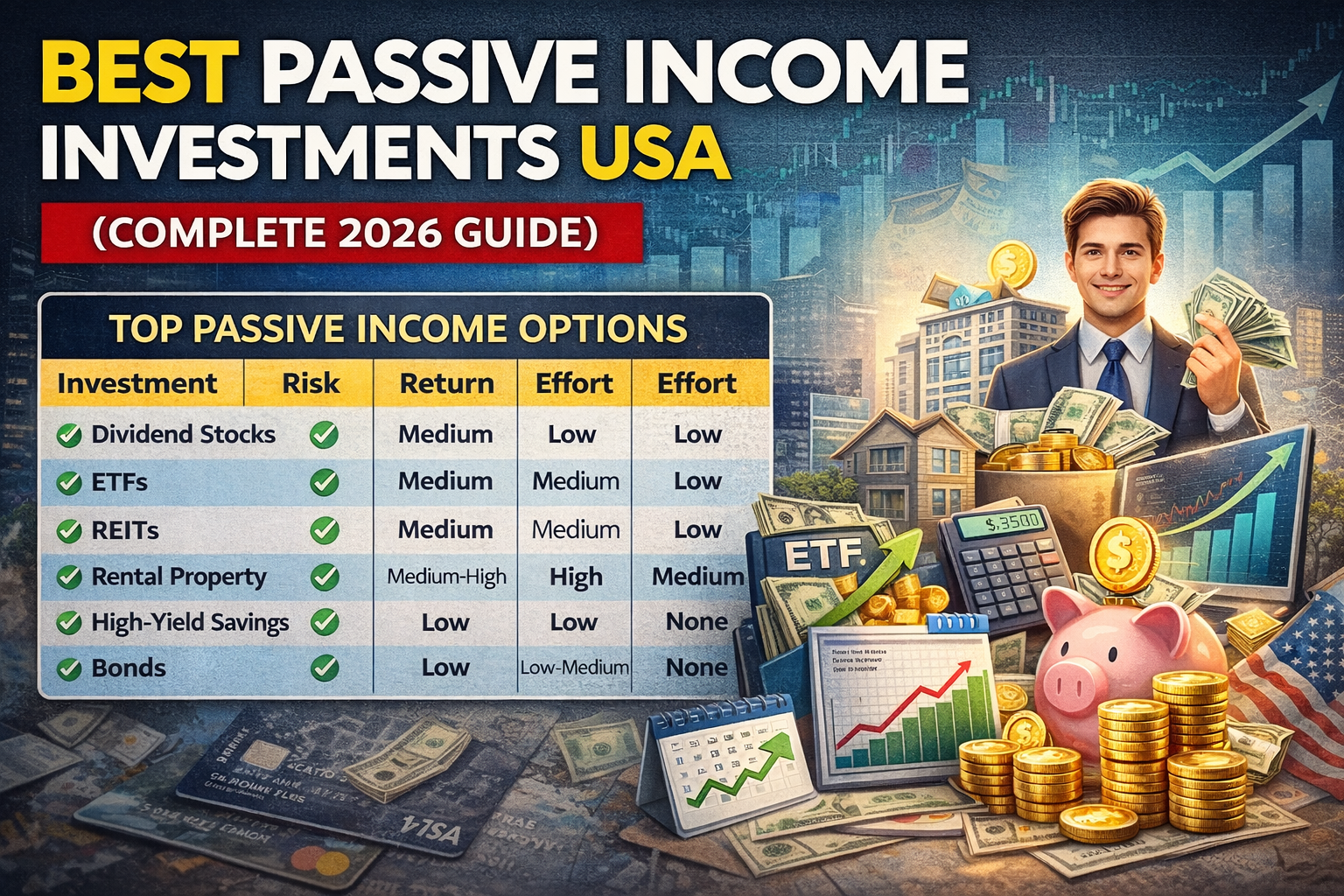
| Investment | Risk | Return | Effort |
|---|---|---|---|
| Dividend Stocks | Medium | Medium | Low |
| ETFs | Low-Medium | Medium | Very Low |
| REITs | Medium | Medium | Low |
| Rental Property | Medium-High | High | Medium |
| Savings | Low | Low | None |
| Bonds | Low | Low-Medium | None |
🧮 How Much Do You Need to Start?
Example:
$10,000 in 5% yield = $500/year
Scaling capital increases passive income.
⚠️ Risks to Consider
- Market volatility
- Interest rate changes
- Property vacancies
- Default in lending
Diversification reduces risk.
🧠 Strategy for Beginners
Start with:
- Index fund
- Dividend ETF
- High-yield savings
Then expand.
💡 Passive Income vs Active Income
| Passive | Active |
|---|---|
| Asset-based | Time-based |
| Scalable | Limited |
How Inflation Affects Passive Income Investments
Inflation reduces the purchasing power of money. If your investment returns are lower than inflation, you’re actually losing value.
Inflation-Resistant Passive Investments
✔ Dividend growth stocks
✔ REITs (rents rise with inflation)
✔ Index funds
✔ Rental property
Low-yield savings or fixed CDs may struggle to beat inflation long term.
🧠 The “Income vs Growth” Strategy
Passive investors often choose between:
| Strategy | Focus | Best For |
|---|---|---|
| Income Investing | Regular cash flow | Retirees |
| Growth Investing | Capital appreciation | Younger investors |
Smart investors combine both:
- Dividend ETFs (income)
- Index funds (growth)
📊 How Much Passive Income Do You Need?
Example goal: $2,000 per month passive income
If average return = 5%
Required capital ≈ $480,000
This shows why reinvesting earnings is critical.
🔄 Reinvesting Dividends (The Compounding Engine)
Instead of withdrawing dividends:
✔ Reinvest automatically
✔ Buy more shares
✔ Increase future payouts
This is how wealth snowballs.
🏦 Tax Considerations for Passive Income (USA)
Different passive incomes are taxed differently:
| Investment | Tax Type |
|---|---|
| Dividends | Ordinary/Qualified tax |
| Rental income | Income tax |
| REIT payouts | Ordinary income |
| Savings interest | Income tax |
Tax-efficient accounts like IRAs help reduce burden.
📈 Risk Diversification Strategy
Don’t rely on one passive source.
Balanced portfolio example:
- 40% Index Funds
- 20% Dividend ETFs
- 20% REITs
- 10% Bonds
- 10% Cash/Savings
🧮 Passive Income at Different Life Stages
20s–30s
Focus on growth: Index funds, ETFs
40s–50s
Balance growth + income: REITs + dividends
60+
Income-focused: Bonds, dividends, rentals
🔐 How to Start With Small Capital
Even $500–$1,000 can start:
✔ Fractional shares
✔ ETFs
✔ High-yield savings
Consistency beats large one-time investments.
🚨 Common Passive Income Mistakes
❌ Chasing high yields blindly
❌ No diversification
❌ Ignoring taxes
❌ Not reinvesting
❌ Panic selling
📉 Market Crash Strategy
Passive investors should:
✔ Continue investing
✔ Reinvest dividends
✔ Avoid emotional selling
Crashes often create best buying opportunities.
🧠 Psychological Side of Passive Income
Passive investing reduces financial stress but requires patience. Markets fluctuate, but discipline wins.
📊 Rule of 72 (Powerful Insight)
Divide 72 by your return rate.
At 8% return → money doubles in 9 years.
🏁 Long-Term Wealth Formula
Wealth = Capital × Time × Return × Discipline
Passive income is a marathon, not a sprint.
The “Cash Flow vs Appreciation” Passive Income Debate
Many investors misunderstand passive income because they focus only on monthly cash flow. But passive wealth comes from two sources:
| Type | Meaning | Example |
|---|---|---|
| Cash Flow | Regular income | Dividends, rent |
| Appreciation | Asset value growth | Stocks, property |
Smart investors combine both. For example:
- REITs → cash flow
- Index funds → appreciation
Together they build sustainable wealth.
📉 How Interest Rates Impact Passive Income Investments
Interest rate changes influence returns:
When Rates Rise
- Bond yields improve
- Savings accounts pay more
- REITs may drop short term
When Rates Fall
- Stocks often rise
- REIT values increase
- Bond yields drop
Understanding this helps you shift allocation smartly.
🏦 Using Retirement Accounts for Passive Income
Passive investing becomes more powerful inside:
✔ Roth IRA
✔ Traditional IRA
✔ 401(k)
Benefits:
- Tax-deferred or tax-free growth
- Automatic investing
- Long-term compounding
📊 The “4% Rule” for Passive Income
Common retirement rule:
You can withdraw 4% of your portfolio annually without running out of money.
Example:
$500,000 × 4% = $20,000/year passive income.
🔄 Building Multiple Income Streams
Never rely on one source.
Example portfolio:
- Dividends
- REIT income
- Savings interest
- Online side business
Multiple streams = financial safety.
🧮 Passive Income From $10K, $50K, and $100K
| Investment | $10K | $50K | $100K |
|---|---|---|---|
| 5% yield | $500/yr | $2,500/yr | $5,000/yr |
| 8% yield | $800/yr | $4,000/yr | $8,000/yr |
Shows importance of scaling capital.
📉 Passive Income vs Inflation Trap
If return < inflation → wealth shrinks.
Aim for:
- Dividend growth stocks
- Real estate
- Equity funds
These historically beat inflation.
💡 Automating Passive Investments
Use automation to stay disciplined:
✔ Auto-invest plans
✔ Dividend reinvestment (DRIP)
✔ Automatic savings transfers
Removes emotional decisions.
🚨 High-Yield Passive Income Scams to Avoid
Beware of:
❌ Guaranteed returns
❌ “Too good to be true” schemes
❌ Crypto yield traps
❌ Unregulated platforms
Safe passive income is usually steady, not explosive.
📊 How Long It Takes to See Results
Passive income is slow early.
| Year | Growth Pattern |
|---|---|
| 1–2 | Slow |
| 3–5 | Noticeable |
| 6–10 | Strong |
| 10+ | Compounding explosion |
Patience is key.
🧠 Behavioral Advantage of Passive Investors
Successful passive investors:
- Ignore daily noise
- Focus on long-term
- Reinvest profits
- Stay diversified
Most people fail due to emotions, not strategy.
🔐 Emergency Fund Before Passive Investing
Always keep 3–6 months of expenses before investing aggressively. This prevents forced selling during emergencies.
📈 The Snowball Effect of Reinvestment
Example:
$20,000 at 8% return reinvested grows to $43,000 in 10 years without adding more money.
🏁 Ultimate Passive Income Blueprint
Step 1 → Emergency fund
Step 2 → Index funds
Step 3 → Dividend ETFs
Step 4 → REITs
Step 5 → Scale capital
Step 6 → Reinvest
This system builds financial independence.
❓ Frequently Asked Questions (FAQs)
Q1. Is passive income truly passive?
Mostly, but monitoring is needed.
Q2. What’s the safest option?
High-yield savings & bonds.
Q3. Best for beginners?
ETFs + savings.
🏁 Final Thoughts
Passive income is about building assets that work for you. The key is diversification, patience, and reinvestment.
Also read: Personal Loan or Bad Credit
Also read: Debt Consolidation Loan With Poor Credit







One Comment