
A Credit Card EMI Calculator helps you estimate the monthly EMI if you convert your credit card purchases into installments.
Many banks allow customers to convert large purchases into easy monthly installments (EMIs) instead of paying the entire credit card bill at once.
Use our Credit Card EMI Calculator below to calculate your monthly EMI instantly.
💳 Credit Card EMI Calculator
Users will enter:
• Total Purchase Amount (₹)
• Interest Rate (% per year)
• EMI Tenure (Months)
The calculator will automatically display:
• Monthly EMI
• Total Interest Payable
• Total Amount Payable
Example Credit Card EMI Calculation
Here are some examples to understand EMI calculation.
| Purchase Amount | Interest Rate | Tenure | Monthly EMI |
|---|---|---|---|
| ₹20,000 | 14% | 6 months | ₹3,452 |
| ₹50,000 | 15% | 12 months | ₹4,512 |
| ₹1,00,000 | 16% | 24 months | ₹4,907 |
The EMI depends on the purchase amount, interest rate, and repayment tenure.
What is Credit Card EMI?
Credit card EMI allows cardholders to convert large purchases into fixed monthly installments.
Instead of paying the full bill immediately, the amount is divided into manageable payments over a chosen tenure.
Each EMI includes:
• Principal amount
• Interest charged by the bank
This feature helps cardholders manage large expenses more easily.
Credit Card EMI Formula
The EMI calculation follows the standard loan formula:
EMI = P × R × (1+R)^N / ((1+R)^N – 1)
Where:
P = Purchase amount
R = Monthly interest rate
N = Number of months
Using the calculator eliminates the need for manual calculations.
Typical Credit Card EMI Interest Rates in India
Interest rates vary depending on the bank and credit card type.
Typical EMI interest rates:
| Bank | EMI Interest Rate |
|---|---|
| SBI Card | 13% – 18% |
| HDFC Bank | 14% – 20% |
| ICICI Bank | 15% – 22% |
| Axis Bank | 14% – 21% |
Interest rates may also depend on credit score and transaction type.
Advantages of Credit Card EMI Calculator
Credit card EMI offers several benefits.
Easier Payment Management
Large purchases can be divided into smaller monthly payments.
Instant Conversion
Many banks allow EMI conversion directly through mobile banking apps.
No Need for Separate Loan
Cardholders can avoid applying for a personal loan.
Flexible Tenure Options
Most banks offer tenures between 3 months to 24 months.
When Should You Use Credit Card EMI?
Credit card EMI is useful in situations such as:
- Buying electronics or gadgets
- Booking travel tickets
- Medical emergencies
- Paying education expenses
- Home appliances purchase
However, EMI should be used carefully to avoid excessive debt.
Factors That Affect Credit Card EMI
Several factors determine the EMI amount.
Purchase Amount
Higher purchase amount increases EMI.
Interest Rate
Higher interest rate increases total repayment cost.
EMI Tenure
Longer tenure reduces EMI but increases total interest.
Example: EMI vs Full Payment
Let’s compare paying the full credit card bill vs converting to EMI.
| Purchase Amount | Payment Method | Total Paid |
|---|---|---|
| ₹50,000 | Full Payment | ₹50,000 |
| ₹50,000 | 12 Month EMI | ₹54,144 |
This shows EMI convenience comes with extra interest cost.
Hidden Charges in Credit Card EMI
Some banks may charge additional fees.
Common charges include:
| Fee Type | Charges |
|---|---|
| Processing Fee | ₹199 – ₹999 |
| GST | 18% on interest |
| Late Payment Fee | ₹500 – ₹1,000 |
Always check these charges before converting transactions into EMI.
Tips to Use Credit Card EMI Wisely
Here are some smart tips for managing credit card EMI.
Avoid Multiple EMIs
Too many EMIs can increase financial burden.
Pay EMIs on Time
Late payments can damage your credit score.
Choose Shorter Tenure
Shorter tenure reduces interest cost.
Compare Interest Rates
Different banks offer different EMI plans.
Credit Card EMI vs Personal Loan
Many people compare EMI conversion with personal loans.
| Feature | Credit Card EMI | Personal Loan |
|---|---|---|
| Approval | Instant | 1–3 days |
| Interest Rate | Higher | Lower |
| Loan Amount | Limited | Higher |
| Tenure | Short | Longer |
For small purchases, credit card EMI may be convenient.
Common Mistakes to Avoid
Avoid these mistakes when using credit card EMI.
Ignoring Interest Cost
EMI convenience comes with additional interest.
Converting Small Purchases
Small transactions should usually be paid directly.
Missing EMI Payments
Late payments can lead to penalties.
Related Financial Calculators
You can also explore other calculators on MaintainMarket.
• Personal Loan EMI Calculator
• Home Loan EMI Calculator
• SIP Calculator
• Car Loan EMI Calculator
• Loan Eligibility Calculator
These tools help users plan finances better.
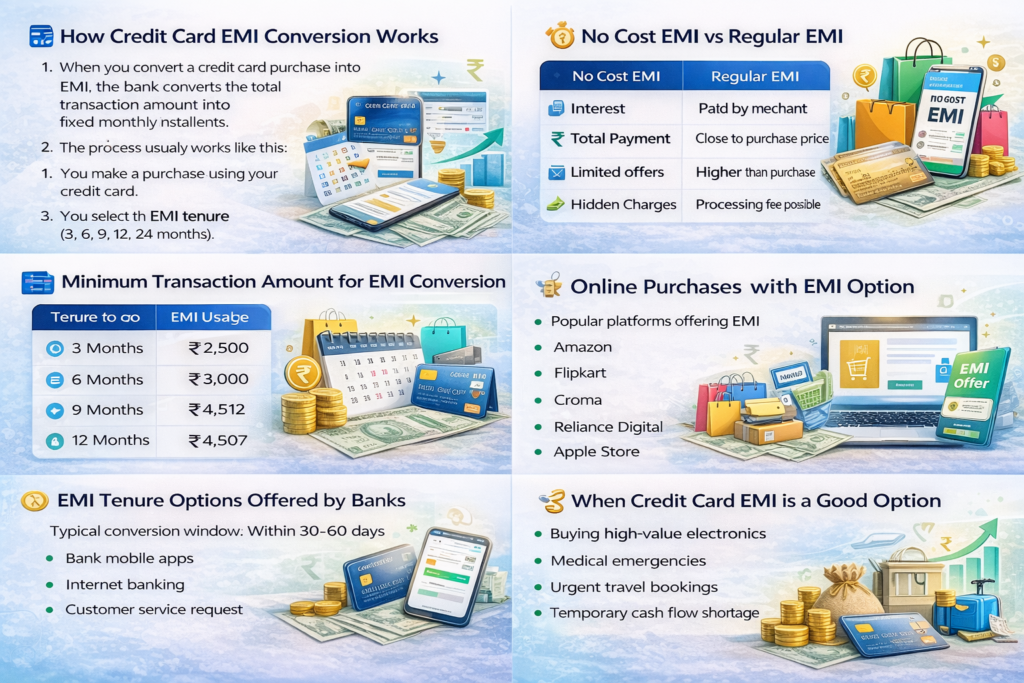
How Credit Card EMI Conversion Works
When you convert a credit card purchase into EMI, the bank converts the total transaction amount into fixed monthly installments.
The process usually works like this:
- You make a purchase using your credit card.
- The bank allows EMI conversion for eligible transactions.
- You select the EMI tenure (3, 6, 9, 12, or 24 months).
- The total amount is divided into fixed EMIs.
- The EMI amount is added to your monthly credit card bill.
Many banks allow EMI conversion through:
- Mobile banking apps
- Net banking
- Customer support
- Merchant EMI options at checkout
No Cost EMI vs Regular EMI
Many online shopping platforms offer No Cost EMI options.
However, there is an important difference between No Cost EMI and Regular EMI.
| Feature | No Cost EMI | Regular EMI |
|---|---|---|
| Interest | Paid by merchant | Paid by customer |
| Total Payment | Close to purchase price | Higher than purchase price |
| Availability | Limited offers | Available on most cards |
| Hidden Charges | Processing fee possible | Interest + fees |
Even in No Cost EMI, banks may charge small processing fees or GST.
Minimum Transaction Amount for EMI Conversion
Most banks allow EMI conversion only for transactions above a certain amount.
Typical limits:
| Bank | Minimum Transaction for EMI |
|---|---|
| HDFC Bank | ₹2,500 |
| SBI Card | ₹3,000 |
| ICICI Bank | ₹3,000 |
| Axis Bank | ₹2,500 |
Transactions below this amount usually cannot be converted into EMI.
How Credit Card EMI Affects Your Credit Limit
When you convert a purchase into EMI, the total amount is temporarily blocked from your credit limit.
Example:
Credit Card Limit = ₹1,00,000
Purchase Converted to EMI = ₹40,000
Remaining available limit:
₹60,000
As you pay each EMI, the credit limit gradually gets restored.
Impact of Credit Card EMI on Credit Score
Credit card EMIs can impact your credit score depending on your repayment behavior.
Positive impact:
- Timely EMI payments improve credit history
- Shows responsible credit usage
Negative impact:
- Missing EMI payments lowers credit score
- High credit utilization may reduce score
Maintaining on-time EMI payments is essential for a healthy credit profile.
EMI Tenure Options Offered by Banks
Credit card EMI tenure options vary across banks.
Common tenure options include:
| EMI Tenure | Suitable For |
|---|---|
| 3 Months | Small purchases |
| 6 Months | Medium purchases |
| 9 Months | Gadgets & electronics |
| 12 Months | Large purchases |
| 18–24 Months | High-value products |
Shorter tenure results in lower total interest cost.
Online Purchases with EMI Option
Many e-commerce platforms offer instant EMI options during checkout.
Popular platforms offering EMI include:
- Amazon
- Flipkart
- Croma
- Reliance Digital
- Apple Store
At checkout, users can select:
- Bank card
- EMI tenure
- Monthly installment
This makes high-value purchases more affordable.
EMI Conversion After Purchase
If you did not choose EMI during purchase, you can still convert transactions into EMI later.
Most banks allow post-purchase EMI conversion within a certain time period.
Typical conversion window:
Within 30–60 days of transaction
This option is usually available through:
- Bank mobile apps
- Internet banking
- Customer service request
When Credit Card EMI is a Good Option
Credit card EMI can be useful in certain situations.
Examples include:
- Buying high-value electronics
- Medical emergencies
- Urgent travel bookings
- Temporary cash flow shortage
It helps spread the cost over time instead of paying the full amount at once.
When You Should Avoid Credit Card EMI
Despite convenience, EMI may not always be the best option.
Avoid EMI when:
- The purchase amount is small
- You can pay the bill in full
- Interest rates are very high
- Multiple EMIs already exist
Too many EMIs can create long-term financial stress.
Smart Strategy for Credit Card Users
A smart strategy followed by many financial planners is:
Use EMI only for essential large purchases.
For example:
| Purchase Type | EMI Suitable |
|---|---|
| Smartphone | Yes |
| Laptop | Yes |
| Travel tickets | Sometimes |
| Dining expenses | No |
| Shopping | No |
Using EMI selectively helps maintain financial discipline.
Credit Card EMI vs Buy Now Pay Later (BNPL)
Many people confuse EMI with BNPL services.
| Feature | Credit Card EMI | BNPL |
|---|---|---|
| Requires Credit Card | Yes | Not always |
| Interest | Usually charged | Sometimes zero |
| Tenure | Up to 24 months | Shorter |
| Approval | Instant for cardholders | App-based approval |
Both options allow installment payments, but their structures differ.
Expert Tip for Credit Card Users
Before converting a transaction into EMI, always check:
- Total interest payable
- Processing fees
- GST charges
- Total repayment amount
Using a Credit Card EMI Calculator helps estimate the exact monthly payment and total cost before selecting EMI.