
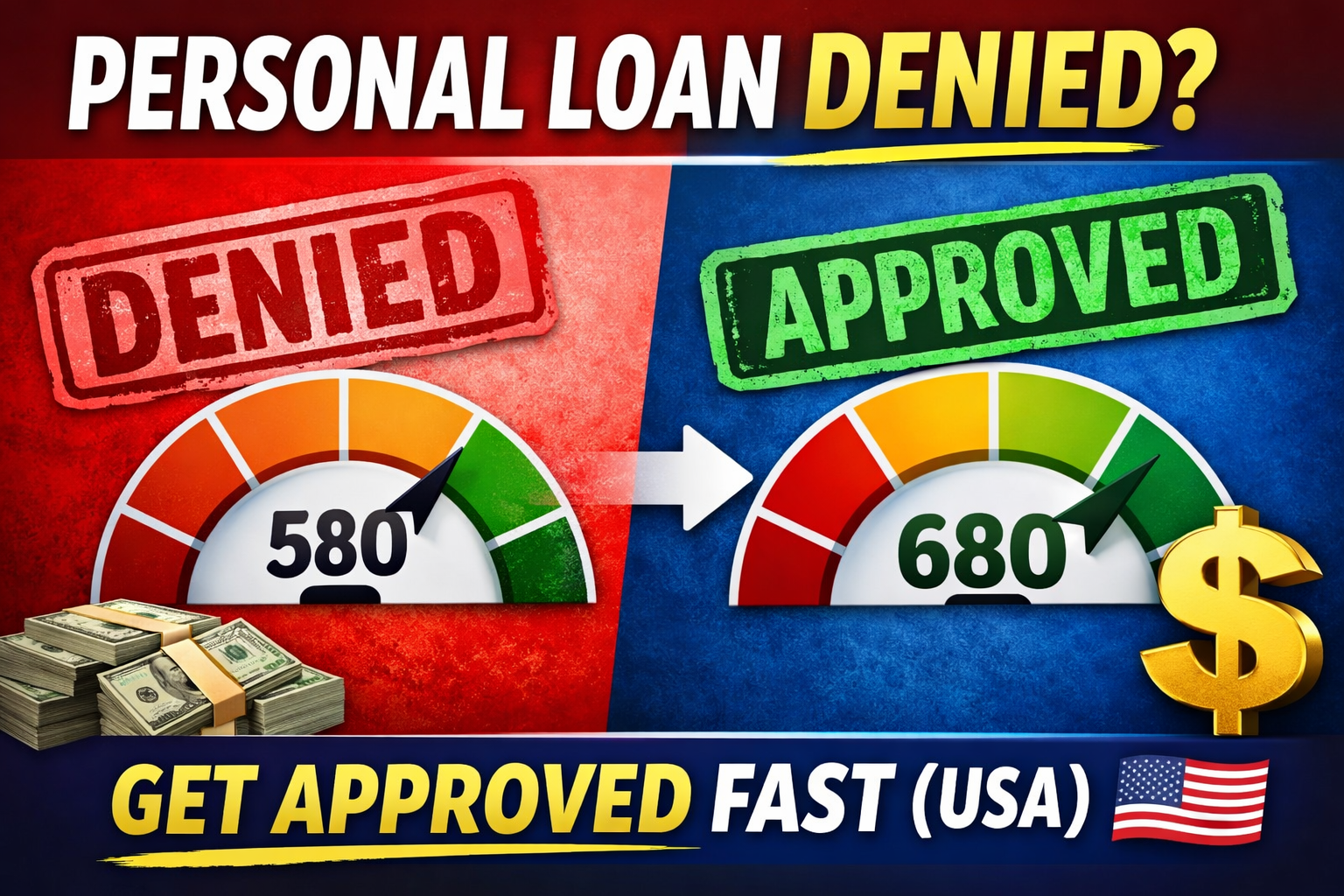
Personal Loan Denied in USA? What To Do after rejection: If your personal loan was denied in the USA, wait 14–21 days before applying again, reduce credit card balances below 50% utilization, review your credit report for errors, and apply for a smaller amount with a suitable lender. Most rejections happen due to risk behavior rather than low credit score.
Lenders don’t just decide based on your credit score — they decide based on risk prediction.
That means they analyze your behavior, patterns, stability, and borrowing habits to estimate whether you may miss payments in the future.
So a denial usually means:
The lender believes your current financial signals suggest higher repayment risk — not that you are a bad borrower.
The encouraging part is this:
Risk signals can often be improved in just a few weeks, and many borrowers get approved shortly after rejection once they adjust their profile correctly.
This detailed guide will explain:
- Why personal loans get denied in the USA
- What to do immediately after rejection
- How to fix approval problems in 30 days
- When to apply again
- Alternative options
- Long-term strategies to avoid denial forever
Quick Action Plan (If You Were Just Rejected)
Do these first before reading anything else:
- Stop applying for loans for at least 14 days
- Reduce credit card balances below 50% of limits
- Check your credit report for mistakes
- Apply to the right lender type next time
- Request a smaller loan amount
These five steps alone dramatically increase approval probability.
How U.S. Lenders Actually Decide Approvals
Most people think loan approval works like an exam score — pass or fail based on one number.
Instead, lenders use scoring systems created by Fair Isaac Corporation and data reported by bureaus like TransUnion.
They evaluate:
- Payment history
- Credit usage patterns
- Borrowing frequency
- Income stability
- Debt load
- Recent financial behavior
Two borrowers with the same score can receive opposite decisions because their risk patterns differ.
Top Reasons Personal Loans Get Denied
1. Credit Score Below Requirement
| Credit Score | Typical Outcome |
|---|---|
| 720+ | Strong approval odds |
| 660–719 | Good approval odds |
| 600–659 | Possible but difficult |
| Below 600 | Often denied |
But even 700+ borrowers sometimes get rejected — meaning something else triggered risk concerns.
2. High Credit Utilization
If most of your credit cards are nearly maxed out, lenders worry you depend on borrowing to cover expenses.
Example:
- Limit: $5,000
- Balance: $4,600
- Utilization: 92%
Ideal utilization is below 30%.
Above 70% dramatically reduces approval chances.
3. Too Many Recent Applications
Each application creates a hard inquiry.
Multiple inquiries in a short period suggest urgent need for money — a red flag.
4. High Debt-to-Income Ratio (DTI)
DTI Formula:
Monthly Debt ÷ Monthly Income × 100
| DTI | Lender View |
|---|---|
| <36% | Safe |
| 37–49% | Caution |
| 50%+ | High risk |
Many denials happen even with good credit because income cannot support additional payments.
5. Unstable Employment or Income
Lenders prefer predictable income.
Risk factors:
- New job under 3 months
- Freelance volatility
- Commission-only pay
6. Requesting Too Much Money
Even qualified borrowers get denied when requesting maximum loan size.
Smaller loan = lower risk = higher approval.
What To Do Immediately After a Loan Denial
The biggest mistake borrowers make is applying again the same day.
This reduces approval probability even further.
Instead follow this structured approach.
Step 1 — Pause Applications (14–21 Days)
Allow your credit profile to stabilize.
Hard inquiries lose impact over time.
Step 2 — Check Credit Report
Get free report from AnnualCreditReport.com
Look for:
- Wrong late payments
- Incorrect balances
- Duplicate accounts
- Closed accounts listed as open
Fixing one error can change approval outcome.
Step 3 — Read the Denial Notice
The adverse action letter explains exactly why the lender declined.
Treat it as instructions, not rejection.
The 30-Day Approval Recovery Plan
Week 1 — Lower Credit Utilization
Pay down highest usage cards first.
Target:
- Under 50% minimum
- Under 30% ideal
Week 2 — Correct Report Errors
Dispute inaccurate information.
Score improvements often appear within days of update.
Week 3 — Stabilize Financial Behavior
Avoid:
- New credit accounts
- Large purchases
- Additional applications
Consistency reduces perceived risk.
Week 4 — Apply Strategically
Match lender to your profile:
| Borrower Profile | Best Choice |
|---|---|
| Low credit | Online lenders |
| Moderate credit | Fintech lenders |
| Good credit | Banks |
| Limited history | Credit unions |
Why Waiting Improves Approval Odds
After rejection, lenders see:
- Recent borrowing attempt
- Possible financial stress
- High urgency
After 2–3 weeks:
- Inquiries age
- Balances update
- Behavior looks stable
You become a different borrower to the algorithm.
Choosing the Correct Loan Amount
Use safe formula:
Monthly Income × 2
Example:
Income: $3,200 → Request about $6,400
Higher requests increase rejection risk significantly.
Best Time of Week to Apply
Higher approval success often occurs:
- Tuesday to Thursday
- Morning hours
Manual underwriting staff are active and verification faster.
Alternatives If You Still Get Denied

Credit Builder Loan
Builds payment history.
Secured Loan
Backed by deposit.
Co-Signer Loan
Shares repayment responsibility.
Smaller Loan Request
Often works immediately after denial.
When NOT to Apply Again
Wait longer if:
- You changed jobs recently
- You missed a payment last month
- Your cards are maxed out
- You applied multiple times this week
Applying too early creates a rejection cycle.
Long-Term Strategy to Avoid Future Denials
- Keep credit usage below 30%
- Maintain emergency savings
- Avoid frequent applications
- Check credit report quarterly
- Increase limits instead of opening new accounts
Understanding the Personal Loan Underwriting Process (How Lenders Think)
Most borrowers imagine a computer instantly approves or rejects their application.
In reality, loan decisions usually involve two stages:
- Automated risk scoring
- Conditional underwriting review
Automated systems filter applications first. If your profile sits near the approval boundary, a human underwriter may review your financial behavior manually.
This is why small changes — like lowering a credit card balance — can flip a rejection into approval without major score improvement.
Automated Approval Factors
Algorithms analyze patterns such as:
- Balance trends over last 90 days
- Frequency of borrowing
- Ratio of revolving debt vs installment debt
- Average account age
- Payment consistency
The scoring logic originally developed by Fair Isaac Corporation helps predict repayment risk rather than measuring financial success.
Manual Underwriting Factors
If your application isn’t instantly rejected, lenders evaluate:
- Employer stability
- Banking behavior
- Cash-flow patterns
- Expense obligations
- Reason for loan
Applicants with moderate credit often get approved during this stage if their finances appear stable.
Bank Statements Matter More Than You Think
Many borrowers focus only on credit score but forget lenders frequently analyze bank transactions.
Red flags include:
- Frequent overdrafts
- Gambling payments
- Large unexplained transfers
- Rapid balance drops after payday
Positive signals:
- Consistent savings
- Stable ending balance
- Regular payroll deposits
- Low monthly volatility
You can improve approval odds simply by stabilizing your account activity for 2–3 weeks before applying.
How Credit Card Behavior Influences Decisions
Credit cards affect approval more than any other factor besides income.
Lenders study usage pattern, not just balance.
| Behavior | Lender Interpretation |
|---|---|
| Maxed every month | Living on credit |
| Small steady usage | Controlled spending |
| Gradually decreasing | Improving stability |
| Large sudden payments | Possible temporary manipulation |
Gradual improvement works better than last-minute payoff.
Soft Pull vs Hard Pull Applications
Before applying, many lenders offer pre-qualification checks.
Soft inquiry:
- No score impact
- Only estimation
Hard inquiry:
- Recorded on report
- Affects lending decision
Always start with pre-qualification whenever possible.
How Long Negative Marks Affect Loan Approval
| Item | Impact Duration |
|---|---|
| Late payment | 12–24 months major impact |
| Collection account | 2–5 years strong impact |
| Hard inquiry | 3–12 months minor impact |
| High utilization | Immediate impact |
| Missed payment last month | Severe short-term impact |
Notice something important:
Recent behavior matters more than old history.
Rebuilding Approval Chances After Multiple Rejections
If you’ve already been denied several times, you must first reset your profile.
Recovery Strategy
Week 1–2
- No applications
- Pay down balances
- Stabilize bank account
Week 3–4
- Dispute errors
- Maintain low spending
- Avoid credit usage spikes
Week 5
- Apply once to matched lender
This sequence significantly improves outcomes.
Why Smaller Loan Requests Get Approved Faster
Lenders assign internal risk limits per borrower.
You may qualify for a loan, but not necessarily the amount requested.
Example:
| Requested | Decision |
|---|---|
| $10,000 | Denied |
| $6,000 | Approved |
| $4,000 | Instant approval |
Lower exposure = lower lender risk.
Employment History and Approval
Stable employment is one of the strongest approval factors.
Preferred profiles:
- Same employer 1+ year
- Same industry 2+ years
- Consistent income deposits
Higher risk profiles:
- Job changes within 60 days
- Seasonal work
- Commission-only income
Waiting even one additional month at a new job can change approval outcome.
Geographic and Industry Risk Factors
Some lenders evaluate risk by employment sector.
Higher perceived risk industries may include:
- Commission sales
- Gig economy driving
- Short-term contract work
- Hospitality seasonal roles
Lower perceived risk:
- Healthcare
- Government
- Education
- Large corporate employment
This doesn’t mean denial is certain — only that lenders may request stronger credit signals.
Debt Consolidation vs New Debt (Important Difference)
If applying to consolidate debt, approval probability often increases because:
- Payment structure improves
- Risk of default decreases
- Monthly obligations simplify
But applying for discretionary spending raises risk perception.
Always clearly state loan purpose when possible.
Psychological Behavior Lenders Monitor
Modern lending models analyze patterns such as:
- Repeated borrowing cycles
- Rapid balance increases
- Emergency borrowing frequency
- Payment timing consistency
A borrower showing improving discipline often outranks a higher-score borrower showing instability.
The Approval Preparation Checklist
Before your next application confirm:
- No new inquiries in last 14 days
- Credit utilization below 50%
- Stable bank balance
- No missed payments this month
- Requested amount reasonable
Meeting these conditions dramatically increases approval chances.
Loan Approval Recovery Timeline
- Week 1: Reduce balances
- Week 2: Fix errors
- Week 3: Stabilize profile
- Week 4: Apply again
Frequently Asked Questions
Q1. Does denial hurt credit score?
Only the inquiry affects score slightly.
Q2. Can I apply again tomorrow?
No — wait at least 14 days.
Q3. What score is required?
Around 600+ but depends on full profile.
Q4. Can 550 score get approved?
Sometimes with smaller loan and correct lender.
Q5. Fastest approval improvement?
Lower utilization and wait.
Real Case Study: Approved After 3 Personal Loan Denials (Texas Borrower)
To understand how approval actually changes, here is a real-world style scenario based on common borrower patterns.
Borrower Profile
| Detail | Information |
|---|---|
| Name | Daniel (changed) |
| Age | 30 |
| State | Texas |
| Monthly Income | $3,100 |
| Credit Score | 598 |
| Credit Cards | 2 cards, 88% utilization |
| Recent Applications | 4 in 10 days |
| Loan Amount Requested | $9,000 |
| Result | Denied 3 times |
Why He Was Rejected
After reviewing his credit report from AnnualCreditReport.com, the main problems were:
- Credit utilization too high
- Too many hard inquiries
- Requested loan amount too large
- Applied immediately after denial
The credit score itself was not the main issue — the behavior pattern was.
What He Changed (21-Day Fix)
Step 1 — Reduced Card Usage
Paid $900 toward balances
Utilization dropped from 88% → 46%
Step 2 — Stopped Applications
Waited 17 days without applying anywhere
Step 3 — Requested Smaller Loan
Reduced request from $9,000 → $5,000
Step 4 — Applied to Matching Lender
Chose a moderate-credit lender instead of a prime bank
Final Result for Personal Loan Denied In USA? What to do after rejection
| Attempt | Outcome |
|---|---|
| Application 1 | Denied |
| Application 2 | Denied |
| Application 3 | Denied |
| Application 4 (after fixes) | Approved |
Approved Amount: $5,000
APR: 26%
Time After Last Rejection: 21 days
Key Lesson From the Case Study
The borrower’s credit score increased only slightly (598 → 612).
But approval probability changed dramatically because the risk signals improved.
This demonstrates an important principle:
Loan approvals depend more on recent financial behavior than the credit score alone.
Final Conclusion
A personal loan denial is not permanent — it’s a risk assessment result.
Borrowers who try again immediately usually fail again.
Borrowers who adjust financial signals often succeed quickly.
When you:
- reduce credit balances
- wait strategically
- correct report errors
- apply to the right lender
Approval probability can change dramatically within weeks.
In the U.S. lending system, behavior matters more than numbers.
Reviewed by Vishal Shaw — Finance Research & Consumer Behaviour Analysis