
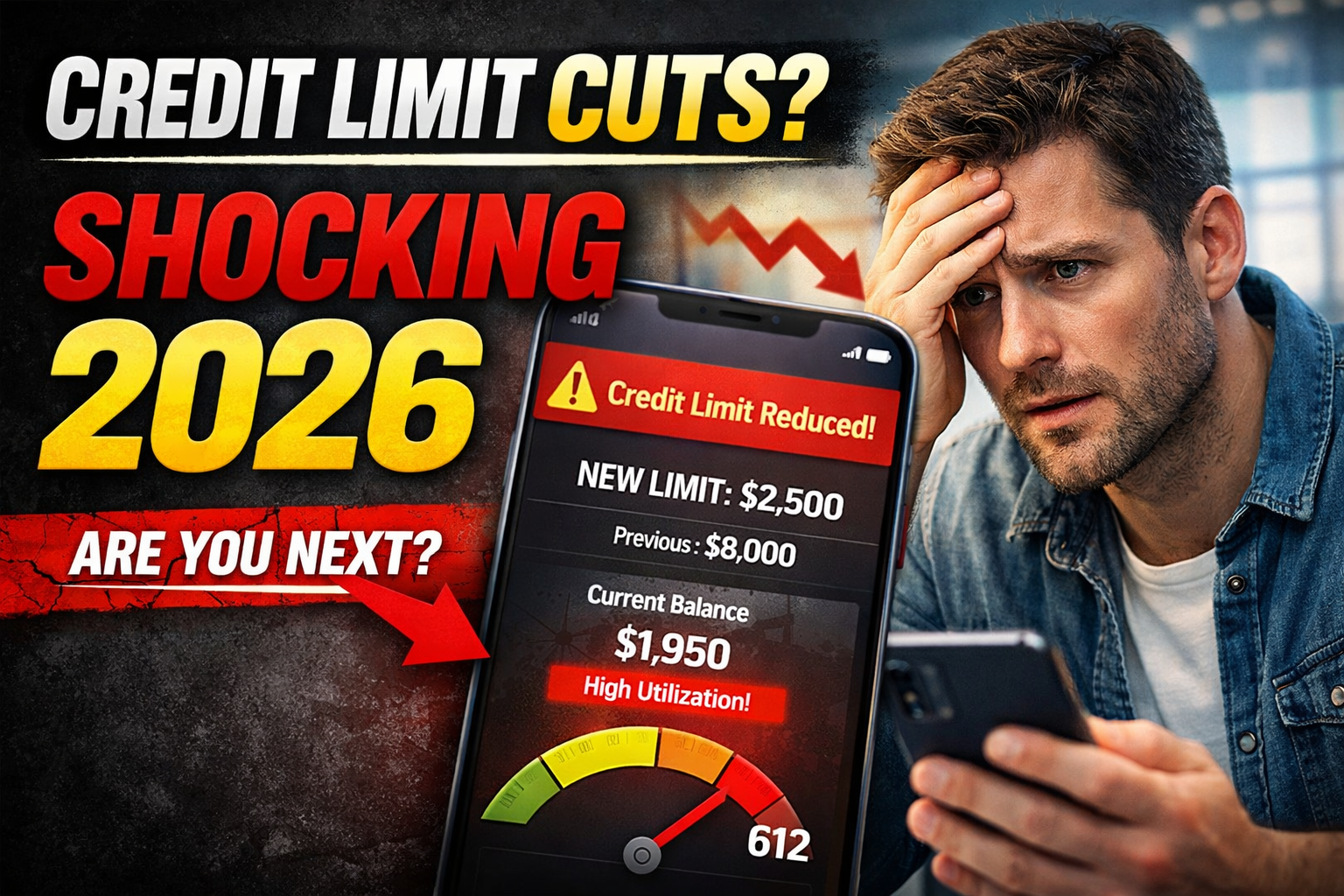
New credit limit cuts in 2026 are affecting US users without warning. Learn why banks are reducing limits, who is impacted, and what to do now.
Introduction
Your credit card limit suddenly drops—and now your score falls.
You’re doing everything right, but banks are still tightening your access to credit.
In the US, even users with decent FICO scores are facing unexpected limit cuts in 2026.
This is not random. It’s a system-level shift.
Quick Update Box
What Changed:
Banks are reducing credit limits proactively due to rising default risks and economic uncertainty.
Who Is Affected:
Mid-range credit users (FICO 580–720), high utilization users, and those with rising debt.
What To Do Immediately:
- Lower credit utilization below 30%
- Avoid new hard inquiries
- Check credit report for risk signals
- Request limit reconsideration early
1. What’s Happening Right Now
In 2026, US banks have started quietly reducing credit limits—even for users who haven’t missed payments.
This trend is being seen across major issuers like:
- Capital One
- Chase Bank
- Bank of America
Instead of waiting for defaults, banks are now acting early.
Key patterns:
- Sudden credit limit cuts (10%–50%)
- No prior notification
- No missed payments required
- More frequent in unsecured credit cards
This is called “risk-based limit adjustment”—and it’s becoming aggressive in 2026.
2. Why This Is Happening (US System + Psychology)
This is not about you. It’s about the system.
1. Rising Delinquencies in the US
Credit card debt crossed record levels in recent quarters. More people are missing payments.
Banks are reacting early.
2. Federal Reserve Pressure
Higher interest rates mean:
- Cost of lending increases
- Risk tolerance decreases
Banks reduce exposure to avoid future losses.
3. Behavioral Risk Signals
Banks track:
- Spending spikes
- High utilization
- Multiple card usage
- BNPL usage
Even if you pay on time, your behavior can trigger risk alerts.
4. Profit Protection Strategy
Banks prefer:
- Lower exposure
- Higher interest earners
- Low-risk borrowers
If you don’t fit perfectly, your limit becomes a liability for them.
3. Who Is Affected Most
This is where it gets serious.
High-Risk Groups in 2026:
1. Mid Credit Score Users (580–720)
Not bad enough to reject—but risky enough to limit.
2. High Utilization Users (Above 30%)
Even if payments are on time, high usage signals dependency.
3. Multiple Credit Card Holders
Too many accounts = higher risk exposure.
4. Recent Loan Applicants
Hard inquiries reduce trust signals.
5. Buy Now Pay Later (BNPL) Users
Seen as hidden debt behavior.
4. Real Impact on Users
This is where most people get hit unexpectedly.
1. Credit Score Drops
When your limit drops:
- Utilization increases instantly
- Score can drop 20–50 points
2. Loan Rejections
Lower limits = higher perceived risk
→ Lower approval chances
3. Higher Interest Burden
Less available credit = more dependency on high APR usage
4. Financial Stress Cycle
Limit cut → utilization spike → score drop → rejection → stress
5. What You Should Do Now
Immediate Actions
1. Reduce Utilization Below 30%
Target:
- Ideal: 10–20%
- Maximum: 30%
2. Avoid New Credit Applications
Each hard inquiry = risk signal
3. Request Limit Reinstatement
Call bank before situation worsens
Provide:
- Stable income proof
- Payment history
4. Monitor Credit Report Weekly
Use tools to detect:
- Soft changes
- Account behavior flags
5. Spread Usage Across Cards
Don’t overload one card.
6. Comparison Table (Before vs After 2026 Changes)
| Factor | Before 2026 | After 2026 |
|---|---|---|
| Credit Limit Policy | Reactive | Proactive cuts |
| Risk Monitoring | Payment-based | Behavior-based |
| Limit Reduction | Rare | Frequent |
| User Notification | Sometimes | Often none |
| Approval Focus | Score-driven | Risk + behavior |
7. Real-Life Example (US Case)
Case: John (Texas, 32 years old)
- FICO Score: 705
- Credit Limit: $10,000
- Usage: $4,500
Suddenly:
- Limit reduced to $6,000
Impact:
- Utilization jumps from 45% → 75%
- Score drops by 38 points
- Personal loan gets rejected
John didn’t miss any payments.
The system flagged:
- High usage
- Recent BNPL activity
8. Mistakes to Avoid
1. Ignoring Early Signs
Small limit cuts lead to bigger issues.
2. Applying for Multiple Cards Quickly
Triggers risk alerts.
3. Keeping High Balances Consistently
Even if paid later.
4. Closing Old Cards
Reduces total credit limit.
5. Panic Spending After Limit Cut
Makes situation worse.

9. Expert Insights (Hidden Truth)
Banks don’t reward “good users” anymore—they reward predictable users.
Key hidden logic:
- If you use too much → risky
- If you use too little → unprofitable
- If you behave unpredictably → flagged
The sweet spot:
- Moderate usage
- Consistent payments
- Low dependency
Also:
Banks are now using AI-based risk modeling, not just FICO scores.
This means:
Your behavior matters more than your score.
10. Future Prediction (What Happens Next)
Expect these changes in 2026–2027:
- More silent limit reductions
- Dynamic credit limits (monthly adjustments)
- AI-driven approvals
- Stricter unsecured lending
Credit will become:
More controlled
Less flexible
Highly behavior-driven

11. Hidden Triggers That Cause Limit Cuts (Most People Ignore)
Even if you think you’re “safe,” these silent triggers can reduce your credit limit:
1. Sudden Spending Spike
If your monthly usage jumps:
- From $1,000 → $4,000
Banks assume financial stress.
2. Minimum Payment Pattern
Paying only minimum dues repeatedly signals:
- Cash flow issues
- Higher default probability
3. Salary Not Updated
If your income hasn’t been updated:
- Bank assumes stagnant earning
- Risk profile increases
4. External Data Signals
Banks now track:
- Rent payment delays
- Utility bill behavior
- Economic region risk
5. Inactive Cards
Low usage cards may get reduced or closed:
- Banks prefer active profit-generating users
12. Psychological Game Banks Are Playing in 2026
This is not just finance. It’s behavioral control.
Banks are pushing users into 3 buckets:
| User Type | Bank View | Action Taken |
|---|---|---|
| High spender | Risky | Limit cut |
| Low spender | Unprofitable | Limit reduce/close |
| Balanced user | Ideal | Stable limit |
Reality:
Banks want users who:
- Spend consistently
- Pay interest (but not default)
- Stay predictable
If you don’t fit this pattern → your limit is adjusted.
13. How to “Hack” the System (Smart User Strategy)
This is what actually works in 2026:
1. Use 10–20% Utilization Consistently
Not zero. Not high.
2. Pay Before Statement Date
Most people pay after bill generation.
Smart users:
- Pay before statement closes
- Show lower usage
3. Keep Old Accounts Active
Use once every 30–60 days.
4. Increase Income Visibility
Update income regularly in apps of:
- Capital One
- Chase Bank
5. Avoid Credit-Hungry Behavior
No:
- Multiple applications
- Frequent balance transfers
14. Credit Cards Most Likely to Reduce Limits (2026 Trend)
Based on recent user patterns:
High Risk of Limit Cuts:
- Entry-level cards
- Subprime credit cards
- Store cards
Medium Risk:
- Cashback cards
- Travel cards with moderate limits
Low Risk:
- Premium cards
- High-income profile cards
Banks like:
- American Express
tend to monitor behavior strictly but reward stable users.
15. Early Warning Signs Before Your Limit Gets Cut
Watch these signals:
- Credit limit increase requests getting denied
- Emails about “account review”
- Sudden drop in pre-approved offers
- Reduced spending power alerts
- Credit monitoring app warnings
If you see 2–3 signs → act immediately.
16. Advanced Strategy: Protect Your Credit Score During Limit Cuts
Step-by-Step Protection Plan:
Step 1: Pre-pay balances before statement
Step 2: Split usage across 2–3 cards
Step 3: Keep utilization under 20%
Step 4: Avoid closing any card
Step 5: Maintain 100% payment history
Bonus Tip:
If your limit drops:
- Immediately reduce balance
- Don’t wait for next cycle
17. What Banks Will NEVER Tell You
Here’s the truth:
- Your credit limit is NOT permanent
- Your credit score is NOT the only factor
- Your behavior is constantly monitored
- Your risk profile updates monthly
Banks don’t warn you because:
- It prevents panic
- It protects their system
- It maintains control
Where to Take Action (USA Only)
If your limit hasn’t been reduced yet, act now.
Check eligibility and diversify your credit:
- https://www.discover.com/credit-cards
- https://www.capitalone.com/credit-cards
- https://creditcards.chase.com
- https://www.bankofamerica.com/credit-cards
Apply strategically before your profile weakens.
Why MaintainMarket is Different
Most blogs explain basics. We focus on outcomes.
- Data-backed insights from real user behavior
- Strategies that improve approval chances
- Practical actions—not theory
- Focus on saving money and boosting credit profile
We don’t just inform. We help you act.
Final Action Plan
What To Do Today:
- Check all credit card limits
- Calculate utilization ratio
- Pay down balances if above 30%
What To Avoid:
- New credit applications
- High spending spikes
- Ignoring small limit cuts
What To Check Weekly:
- Credit report changes
- Score fluctuations
- Account activity signals
FAQ Section
Q1. Why did my credit limit decrease without warning in 2026?
Banks are proactively reducing risk due to rising defaults and economic uncertainty.
Q2. Does a credit limit decrease hurt my credit score?
Yes. It increases utilization, which can drop your score significantly.
Q3. Can I request my limit back?
Yes. You can contact your bank and request reconsideration with income proof.
Q4. Are all banks reducing limits in 2026?
Most major US banks are following similar risk-based strategies.
Q5. What utilization is safe now?
Below 30%, ideally between 10–20%.
Q6. Will this trend continue in 2027?
Yes. Expect stricter credit control and AI-based monitoring.
People searched for: 7 Reasons Why Your Credit Card Limit Reduced? Here’s What Banks Are Not Telling You
Also read this: Low Salary? Get the Best Credit Cards for ₹30000 Salary (Fast Approval Guide)
500 Credit Score? Get a Credit Card Approval in the USA (Hidden Tricks Banks Don’t Tell You)