
Transfer stuck or pending? Learn why bank transfers get delayed in the USA and how to speed them up safely. In this article, let’s talk about Bank Transfer Pending and how you can fix it.
You sent money.
The amount is deducted.
But the receiver hasn’t got it.
And your bank shows one word: “Pending.”
This is where frustration starts.
You start refreshing your banking app.
You call customer care.
You panic thinking: “Did I lose my money?”
Here’s the truth most banks won’t clearly tell you:
A “pending transfer” is not random. It happens for very specific reasons—and most of them are fixable.
In this guide, I’ll break down exactly:
- Why is your transfer stuck
- What’s happening behind the scenes
- And how you can speed it up (legally and safely)





2. Quick Answer Box
Why is your bank transfer pending in the USA?
Your transfer is pending because of:
- ACH processing delays (1–3 business days)
- Bank fraud/security checks
- Incorrect recipient details
- Transfer limits or unusual activity
- Weekends/holidays
How to fix it fast:
- Verify transfer details immediately
- Contact your bank within 24 hours
- Ask for status (processing vs hold vs flagged)
- Upgrade to wire transfer if urgent
- Avoid repeating the transaction
3. Why This Problem Happens (Real Reasons)
Let’s be real—banks don’t delay your money for no reason.
1. ACH System Is Slow by Design
Most US transfers use ACH (Automated Clearing House).
It’s not instant.
- Batch processed
- Runs only on business days
- Takes 1–3 days (sometimes more)
2. Fraud Detection Systems
Banks track:
- New payees
- Large amounts
- Unusual patterns
If anything looks “different,” your transfer gets flagged.
3. First-Time Transfers
Sending money to someone for the first time?
Higher chances of delay.
4. Weekends & Federal Holidays
Transfers don’t move:
- Saturday
- Sunday
- Federal holidays
So a Friday transfer = Monday/Tuesday arrival.
5. Incorrect Details
Even small mistakes:
- Wrong account number
- Name mismatch
Can freeze the process.
4. Step-by-Step Solution (What Actually Works)
Step 1: Check Status Properly
Don’t assume “pending” means stuck.
Ask:
- Is it processing?
- Is it on hold?
- Is it flagged?
Huge difference.
Step 2: Call Bank (But Ask Smart Questions)
Don’t just say: “Where is my money?”
Ask:
- Is my transfer under review?
- Any compliance or fraud hold?
- Expected clearing time?
Step 3: Confirm Recipient Details
Double-check:
- Account number
- Routing number
- Name
Even a small mismatch delays things.
Step 4: Avoid Duplicate Transfers
Big mistake people make:
They panic and send money again.
Now:
- Two transfers pending
- More flags triggered
Step 5: Use Wire Transfer (If Urgent)
If timing matters:
Switch to wire transfer:
- Same-day or next-day
- More expensive
- Less delay
5. Insider Insights (How Banks Actually Think)
Banks don’t care about your urgency.
They care about:
- Fraud risk
- Compliance
- Liability
If your transfer looks risky, they will delay it—even if it’s genuine.
Key trigger factors:
- Sudden large transfer
- New recipient
- Different location
- Unusual timing
6. Real-Life Case Study (USA)
Case: John from Texas
- Sent $4,500 via ACH
- First-time transfer
- Friday evening
Result:
- Pending for 3 days
- Cleared on Tuesday
Why?
- Weekend delay
- New recipient flag
Fix:
- Called bank
- Confirmed legitimacy
7. Comparison Table
| Transfer Type | Time | Cost | Risk of Delay | Best For |
|---|---|---|---|---|
| ACH Transfer | 1–3 days | Low/Free | Medium | Regular payments |
| Wire Transfer | Same day | High | Low | Urgent transfers |
| Zelle | Instant | Free | Low (limits apply) | Small transfers |
| PayPal | Instant–1 day | Medium | Medium | Online payments |
8. Mistakes People Make
- Sending money twice
- Ignoring bank calls
- Not checking holidays
- Entering wrong details
- Assuming instant transfer
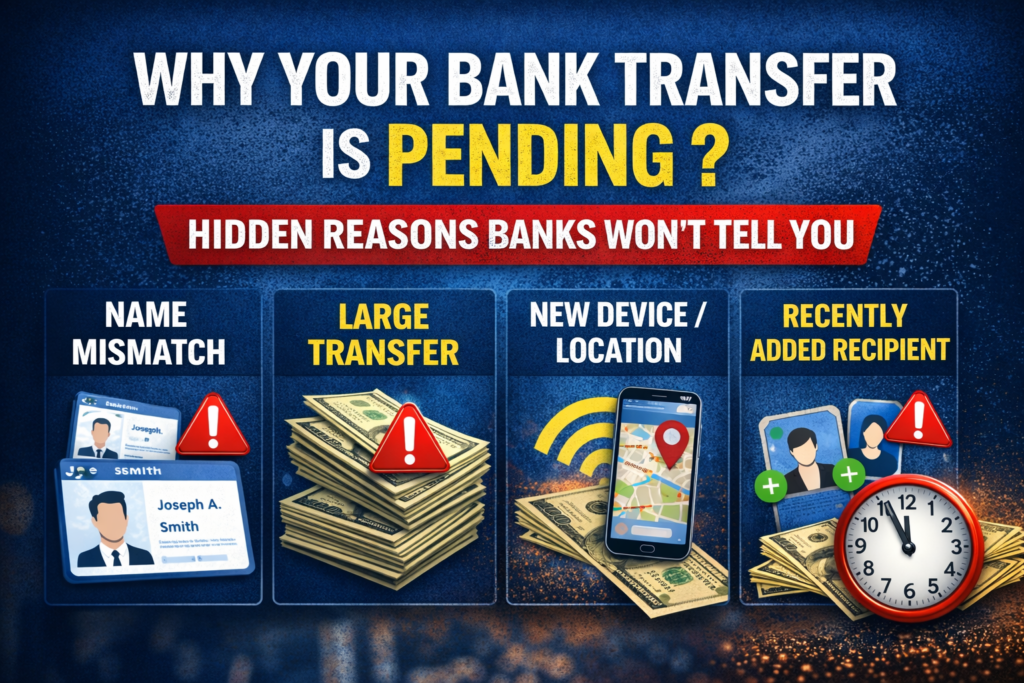
9. Hidden Reasons Your Bank Transfer Is Still Pending
Most people think delays are random. They’re not.
Here are real triggers banks don’t clearly explain:
9.1 Name Mismatch Between Sender & Receiver
Even a small mismatch (like initials vs full name) can pause verification.
9.2 Sudden Increase in Transfer Amount
If you usually send $200 and suddenly send $5,000, your transaction gets flagged.
9.3 New Device or Location Login
Logging in from a different city or device increases risk score instantly.
9.4 Recently Added Recipient
Sending money immediately after adding a new beneficiary is one of the biggest delay triggers.
9.5 Pending Balance or Unsettled Funds
If your account has:
- Recent deposits
- Unsettled checks
Your outgoing transfer may get delayed internally.
10. How to Speed Up a Pending Bank Transfer (Practical Hacks)
This is what actually works—not generic advice.
10.1 Split Large Transfers
Instead of sending $10,000 at once, split into smaller parts.
This reduces fraud flags.
10.2 Send During Business Hours
Best time:
- 9 AM – 11 AM (EST)
Worst time:
- Friday evening
- Weekends
10.3 Do a Test Transfer First
Send $10–$50 before the full amount.
This builds trust in the system.
10.4 Use Same-Bank Transfers
Transfers within the same bank are processed faster.
10.5 Maintain Consistency
Banks trust patterns.
Avoid sudden changes in behavior.
11. Transfer Delays by Major US Banks (Reality Check)
Here’s how some major banks typically behave:
- JPMorgan Chase → Fast processing but strict on new recipients
- Bank of America → Strong fraud filters, delays for large transfers
- Wells Fargo → Slower ACH clearing, strict compliance checks
- Citibank → Faster wires, slower first-time transfers
12. When You Should Actually Be Concerned
Not every delay is normal.
Watch for these warning signs:
- More than 5 business days delay
- No clear response from bank
- Transfer marked “completed” but not received
- Receiving bank denies the transfer
If you see these → take action immediately.
13. Escalation Strategy (What to Do If It’s Truly Stuck)
If basic support isn’t helping, do this:
13.1 Ask for “Transfer Investigation”
Use this exact term when talking to support.
13.2 Request the Trace ID
Every transfer has a tracking number.
Use it to track across banks.
13.3 File an Official Complaint
You can escalate to:
- Consumer Financial Protection Bureau
- Federal Reserve
Banks respond faster when regulators are involved.
14. Tax & Compliance Triggers (High CPC Insight)
If your transfer involves:
- Large amounts ($10,000+)
- Frequent high-value transfers
- International transactions
It may trigger compliance checks.
The Internal Revenue Service may indirectly get reporting signals.
This doesn’t mean trouble—but it can delay processing.
15. Best Alternatives to Avoid Transfer Delays
If delays are frequent, consider switching methods:
Instant Options:
- Zelle (bank-integrated)
- Wire transfers
Faster Platforms:
- Wise
- PayPal
These reduce dependency on slow ACH systems.
16. Advanced Comparison Table
| Method | Speed | Cost | Best Use Case | Delay Risk |
|---|---|---|---|---|
| ACH | 1–3 days | Free | Regular payments | Medium |
| Wire Transfer | Same day | $15–$50 | Urgent transfers | Low |
| Zelle | Instant | Free | Personal use | Low |
| PayPal | Instant–1 day | Medium fees | Online payments | Medium |
| Wise | Hours–1 day | Low fees | International | Low |
17. Biggest Mistake People Make
They panic too early.
What they do:
- Call repeatedly
- Send duplicate transfers
- Assume money is lost
What you should do:
- Wait → Verify → Act
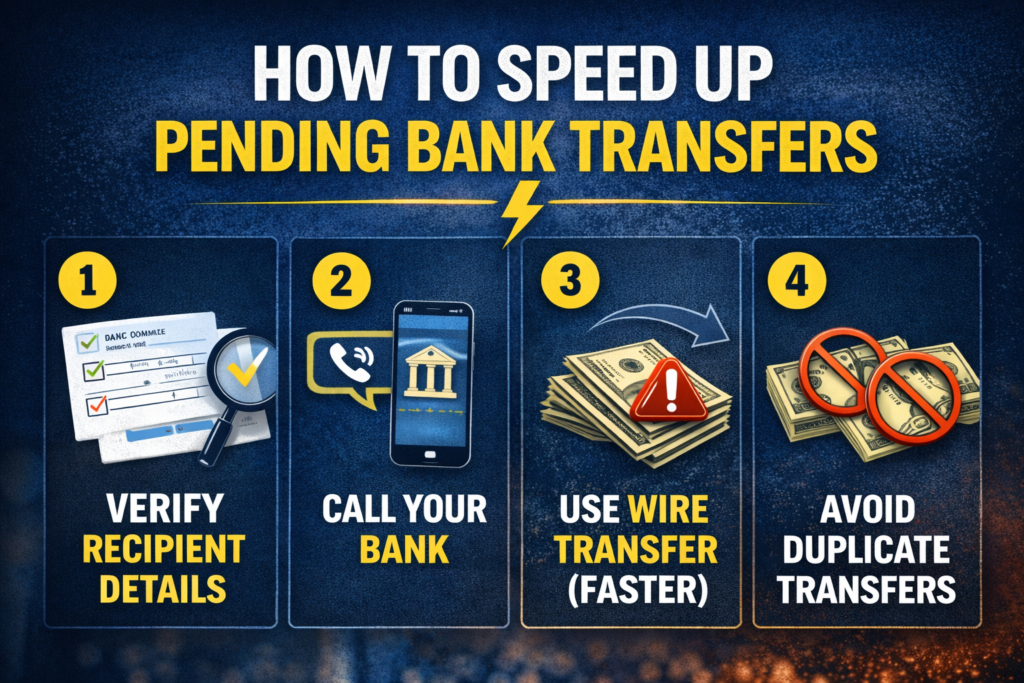
MaintainMarket Expert Advice
If your transfer is stuck:
- Wait at least 24–48 hours before panic
- Always verify details before sending
- Use Zelle/Wire for urgent needs
- Keep transaction proof
Why MaintainMarket is Different
Most blogs just explain “what is ACH.”
We go deeper:
- Real problems
- Real fixes
- Real behavior of banks
This is built for people who are actually stuck, not just curious.
Action Plan
If your transfer is pending:
Do this now:
- Check status in bank app
- Call support within 24 hours
- Confirm transfer details
- Wait 1–3 business days
- Switch to wire next time if urgent
Conclusion
A pending transfer feels scary.
But in most cases, your money is safe—just delayed.
The key is understanding:
- Why it’s happening
- And acting quickly (but smartly)
Don’t panic.
Fix it step-by-step.
FAQs
Q1. How long can a bank transfer stay pending in the USA?
Usually 1–3 business days, but can go up to 5 days.
Q2. Can I cancel a pending transfer?
Sometimes yes, if it hasn’t been processed.
Q3. Is my money lost if transfer is pending?
No, it’s either processing or on hold.
Q4. Why is Zelle pending?
Security checks or new recipient.
Q5. Do weekends delay transfers?
Yes, most banks don’t process transfers on weekends.
Q6. What is fastest transfer method?
Wire transfer.
Q7. Why bank didn’t inform delay?
Most delays are system-based, not manual.
Q8. Can banks stop a transfer?
Yes, if fraud is suspected.
People searched for: 11 Hidden Reasons Why Credit Card Approved but Not Delivered USA – What’s Really Happening? (2026 Reasons & Fix)
Also read: 10 Real Reasons Why Pre-Approved Personal Loan Rejected? Approval Fix (2026 Guide)
7 Hidden Reasons Car Insurance Claim Denied in USA? You’re Losing Money (2026 Guide)
1 thought on “Bank Transfer Pending? 5 Reasons Here’s Exactly Why It’s Pending (And How to Fix It Fast)”