
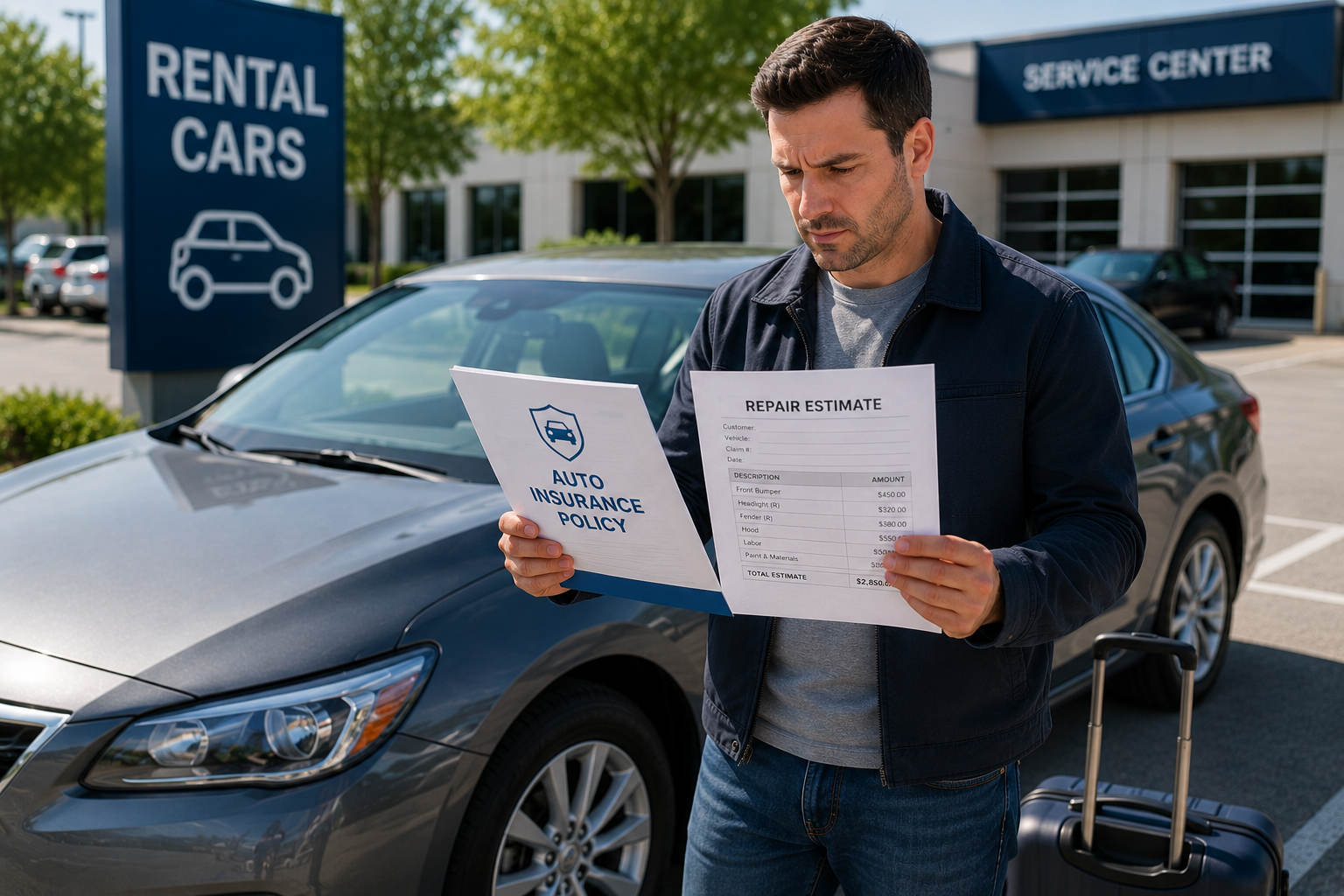
If you’re considering rental car reimbursement coverage, it’s important to understand that this coverage is different from the insurance you buy when renting a car for a vacation. Rental reimbursement is an optional part of your own auto insurance policy that can help pay for temporary transportation when your insured vehicle is being repaired after a covered loss. (Allstate)
A covered loss might include an accident covered by collision insurance or certain weather, theft or other events covered by comprehensive insurance. Your policy will usually have a daily limit and a total limit, so it may not pay for every rental expense. (Progressive)
Quick Answer: What Is Rental Car Reimbursement Coverage?
Rental car reimbursement coverage is an optional auto insurance coverage that can help pay for a rental car or other eligible transportation while your insured vehicle is being repaired after a covered loss.
It generally does not pay for a rental car simply because you want one for a vacation, your vehicle needs routine maintenance or your car has an uncovered mechanical breakdown.
Coverage usually comes with:
- A daily reimbursement limit
- A maximum amount per claim
- A limit on the number of eligible days
- Specific conditions for when the coverage applies
For example, a policy might provide $40 per day up to $1,200 per claim. If your rental costs more than $40 per day, you may have to pay the difference yourself. (Progressive)
How Does Rental Car Reimbursement Coverage Work?
The process is relatively straightforward.
Step 1: Your car suffers a covered loss
For example, you are involved in an accident and your car needs repairs.
Step 2: Your primary auto coverage responds
Your collision or comprehensive coverage may pay for the covered damage to your vehicle, subject to your policy terms and deductible.
Step 3: Your car goes to the repair shop
If you cannot reasonably use your vehicle while it is being repaired, rental reimbursement coverage may help pay for temporary transportation.
Step 4: You rent a vehicle
Depending on your insurer, you may be able to use a participating rental company with direct billing, or you may pay upfront and submit receipts for reimbursement.
Step 5: Coverage ends
Rental reimbursement generally ends when your vehicle is repaired or when you reach the applicable coverage limit, whichever comes first. If the vehicle is declared a total loss, rental coverage may end according to the insurer’s policy rules rather than continuing indefinitely. (GEICO)
| Coverage/Option | What It Pays For | Usually Included? |
|---|---|---|
| Rental Car Reimbursement | Rental car or alternative transportation after a covered claim | ❌ Optional |
| Comprehensive Coverage | Non-collision damage such as hail, theft, or fire | ❌ Optional |
| Collision Coverage | Damage to your car from a collision | ❌ Optional |
| Liability Coverage | Injuries or property damage you cause to others | ✅ Required in most states |
| Rental Car Insurance | Protection for the rental vehicle itself while you rent it | ❌ Separate coverage |
What Does Rental Reimbursement Coverage Cover?
Rental reimbursement coverage can help pay for eligible transportation expenses while your insured vehicle is unavailable because of a covered loss.
Depending on your policy, this may include:
- Rental car charges
- Certain alternative transportation expenses
- Public transportation
- Rideshare expenses in some policies
- Other eligible temporary transportation
For example, State Farm describes rental reimbursement as coverage that can help pay for a rental vehicle or commercial transportation when an insured vehicle is being repaired following a covered loss. (State Farm)
The exact benefits vary between insurers and states.
What Does Rental Reimbursement Insurance Not Cover?
This is just as important as knowing what it does cover.
Rental reimbursement generally does not cover:
- Vacation rental cars
- Routine maintenance
- Oil changes
- Tire replacement
- Mechanical breakdowns that aren’t covered
- Fuel for the rental car
- Security deposits
- Optional rental-car insurance purchased from the rental company
- Costs above your policy limits
- Every type of transportation expense
Allstate, GEICO and State Farm all explain that expenses such as fuel, deposits and certain additional rental costs may not be included in rental reimbursement coverage. (Allstate · GEICO · State Farm)
Is Rental Car Reimbursement Coverage the Same as Rental Car Insurance?
No. These are two different types of coverage.
This is one of the most common points of confusion.
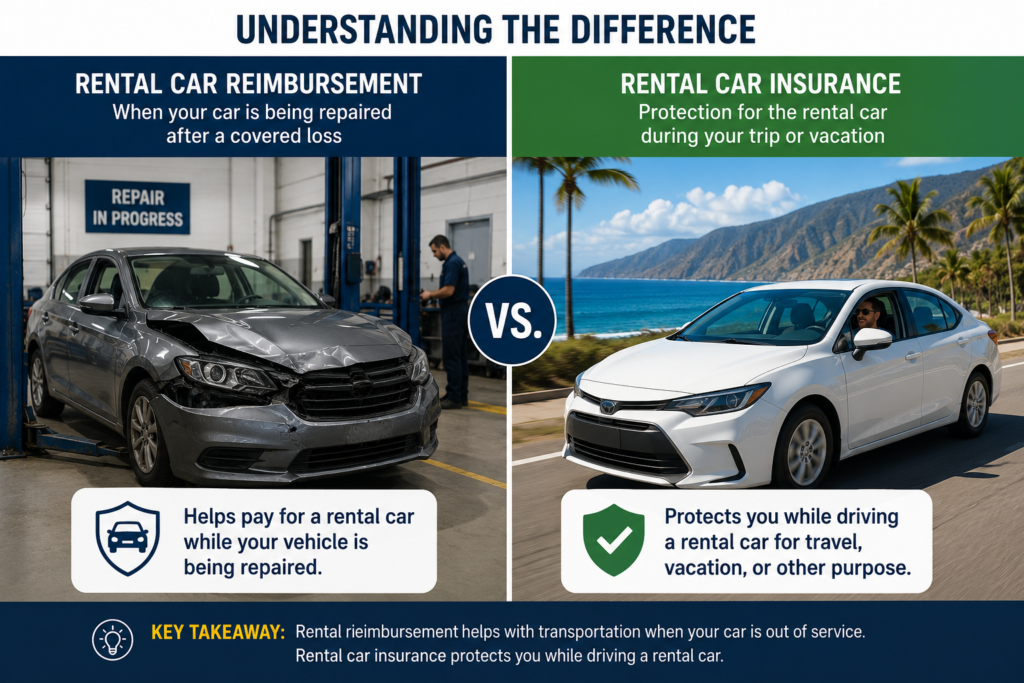
Rental car reimbursement coverage
Protects your transportation needs when your own insured car is unavailable because of a covered loss.
Rental car insurance
Protects you while you’re driving a rental vehicle, depending on the coverage you purchase or already have through another policy.
For example, suppose your car is damaged in an accident and is in the repair shop.
Your rental reimbursement coverage may help pay for the rental vehicle.
But you may also need appropriate liability and physical-damage protection for the rental vehicle itself.
State Farm specifically distinguishes rental reimbursement from rental car insurance purchased when renting a vehicle for travel or another non-claim-related purpose. (State Farm)
Does Full Coverage Car Insurance Include Rental Reimbursement?
Not automatically.
“Full coverage” isn’t a standardized insurance policy name. It is commonly used to describe a combination of liability, collision and comprehensive coverage.
Rental reimbursement is generally an additional optional coverage.
GEICO specifically notes that full coverage doesn’t automatically include rental reimbursement. (GEICO)
So you could have:
- Liability
- Collision
- Comprehensive
and still not have rental reimbursement.
What should you do?
Check your declarations page or contact your insurer and ask:
“Do I have rental reimbursement coverage on my policy, and what are my daily and per-claim limits?”
Also read: How To Lower Car Insurance
Do You Need Comprehensive and Collision to Get Rental Reimbursement?
Often, yes.
Rental reimbursement generally applies when your vehicle has a covered loss under comprehensive or collision coverage.
Progressive states that its rental reimbursement coverage typically requires comprehensive and collision coverage. (Progressive)
This makes sense because rental reimbursement is designed to provide temporary transportation after your vehicle experiences a covered physical loss.
Example
You have:
- Collision coverage
- Comprehensive coverage
- Rental reimbursement coverage
You are involved in a covered accident.
Your collision coverage addresses the covered damage to your vehicle.
Your rental reimbursement coverage may help with eligible rental transportation while the car is being repaired.
Does Rental Reimbursement Cover a Rental Car After an Accident?
Yes, if the accident results in a covered loss and you have rental reimbursement coverage.
For example:
You are involved in an accident on Monday.
Your vehicle is damaged and needs to remain at the repair shop for 10 days.
If the accident is covered and your policy includes rental reimbursement, the coverage may help pay for a rental vehicle during the eligible repair period.
Your insurer’s daily and total limits still apply.
Does Rental Reimbursement Cover Hail Damage?
It can, if you have the appropriate comprehensive coverage and rental reimbursement coverage.
For example:
A hailstorm damages your vehicle.
Your comprehensive insurance covers the eligible vehicle damage.
Your rental reimbursement coverage may then help pay for temporary transportation while your car is being repaired.
Allstate gives hail damage as an example where comprehensive coverage can cover the vehicle damage and rental reimbursement may help with transportation during repairs. (Allstate)
This is a good example of why rental reimbursement should be viewed as supporting coverage, rather than coverage that independently repairs your vehicle.
Does Rental Reimbursement Cover Theft?
It may.
If your vehicle is stolen and the theft is covered under your comprehensive insurance, rental reimbursement may provide temporary transportation subject to the policy’s limits and conditions.
However, if the vehicle is never recovered and is declared a total loss, the amount of time available for rental transportation may be limited.
GEICO notes that rental reimbursement for a total-loss vehicle is generally limited, so drivers should begin considering replacement transportation after learning the vehicle is a total loss. (GEICO)
Does Rental Reimbursement Cover Mechanical Breakdowns?
Generally, no.
Rental reimbursement typically applies because of a covered insurance loss—not because your vehicle simply stopped working.
Usually not covered:
- Engine failure
- Transmission failure
- Dead battery
- Normal wear and tear
- Routine maintenance
- Air-conditioning repairs
- Tire problems
Progressive specifically states that mechanical breakdowns that aren’t covered by the auto policy generally don’t qualify for rental reimbursement. (Progressive)
If you want protection against mechanical breakdowns, you would need to look at a different type of product or coverage.
Does Rental Reimbursement Cover a Rental Car If My Car Breaks Down?
Usually not.
This is a common misconception.
Imagine your engine suddenly fails while you’re driving home.
Your car needs to stay at a repair shop for five days.
If there was no covered insurance event, your rental reimbursement coverage generally won’t pay for the rental.
That’s because rental reimbursement isn’t the same thing as mechanical breakdown insurance.
How Much Does Rental Car Reimbursement Coverage Cost?
There is no single price for rental reimbursement coverage.
The cost can depend on:
- Insurance company
- State
- Vehicle
- Selected daily limit
- Per-claim limit
- Other policy characteristics
Because rental reimbursement is usually optional, you’ll generally pay an additional premium for it.
Instead of asking:
“Is rental reimbursement cheap?”
ask:
“How much does it cost me per year, and how much could it pay if I actually need it?”
That gives you a much better way to evaluate its value.
What Are Rental Reimbursement Coverage Limits?
Most policies use limits such as:
Daily limit + total claim limit
For example:
$40/day + $1,200 maximum
This means the insurer may pay up to $40 per eligible day, with a maximum reimbursement of $1,200 for that covered loss.
If your rental costs:
$55/day
you could be responsible for the additional:
$15/day
subject to your policy.
If you need the rental for longer than the covered period, you may also have to pay for the additional days yourself.
Progressive and GEICO both explain that rental reimbursement policies can have daily and total claim limits. (Progressive · GEICO)
Example: How Rental Reimbursement Limits Work
Imagine your policy provides:
$50 per day
$1,500 maximum per claim
Your car needs 20 days of repairs.
Rental cost
$50 × 20 days = $1,000
Your policy limit is $1,500.
So the eligible rental cost could fit within your policy limit, assuming all other requirements are met.
Now imagine the rental costs $75 per day.
$75 × 20 = $1,500
You have reached the total limit.
If repairs take five additional days, those extra costs may be your responsibility.
This is why checking your limits before an accident happens is useful.
Does Rental Reimbursement Have a Deductible?
Usually, rental reimbursement itself does not have a separate deductible.
However, there’s an important distinction.
You may still have to pay a deductible under your collision or comprehensive coverage for the underlying vehicle damage.
Progressive and Allstate both explain this distinction. (Progressive · Allstate)
Example
Your car is damaged in an accident.
Collision deductible: $500
Rental reimbursement: $50/day
You may have to pay the $500 collision deductible for the vehicle repair claim, while the rental reimbursement portion doesn’t have its own deductible.
The exact application depends on your policy.
Who Pays for Your Rental Car After an Accident?
There are two common possibilities.
Your Own Insurance
If you have rental reimbursement coverage, your insurer can provide benefits according to your policy.
This can be useful even when fault is disputed.
The At-Fault Driver’s Insurance
If another driver caused the accident, their liability insurance may ultimately be responsible for reasonable rental expenses under applicable state law and claim circumstances.
The NAIC explains that when a claim is made against the other driver’s insurer, that company should pay rental costs for a reasonable repair period in applicable situations. (NAIC)
The advantage of your own rental reimbursement coverage is that you may be able to access it through your own policy rather than waiting for the other insurer to finish its liability investigation.
Can You Choose Any Rental Car?
Not always without additional cost.
Your insurer may have preferred rental companies or guidelines regarding the type of replacement vehicle.
GEICO, for example, states that customers generally have a right to choose a rental provider, but reimbursement remains subject to policy limits. It also notes that a comparable-size vehicle may be available in many states. (GEICO)
If you choose a vehicle that costs more than your daily limit, you may have to pay the difference.
Example
Your coverage:
$40/day
Rental you choose:
$65/day
Potential difference:
$25/day
That difference could come out of your pocket.
Does Insurance Pay the Rental Company Directly?
Sometimes.
Some insurers have direct-billing arrangements with participating rental companies.
In that situation, the insurer may pay the rental company directly up to the applicable coverage limits.
If you use a rental company outside the insurer’s network, you may have to pay upfront and submit receipts for reimbursement.
GEICO, Allstate and State Farm all describe direct-billing or network-rental arrangements in their rental reimbursement information. (GEICO · Allstate · State Farm)
Does Rental Reimbursement Cover Gas?
Usually, no.
Rental reimbursement generally covers eligible rental transportation expenses, not fuel.
So if your rental costs:
$45/day
and you spend another:
$12/day on gasoline
the fuel expense generally isn’t part of your rental reimbursement benefit.
GEICO, Allstate and State Farm identify fuel/gas as an expense that generally isn’t covered by rental reimbursement. (GEICO · Allstate · State Farm)
Does Rental Reimbursement Cover Rideshare or Public Transportation?
Some policies may.
Rental reimbursement is increasingly described as temporary transportation coverage rather than simply “rental car coverage.”
Depending on the insurer and policy, eligible alternatives may include:
- Bus
- Taxi
- Rideshare
- Other commercial transportation
State Farm, for example, describes commercial transportation expenses as part of its available rental reimbursement/travel-expense coverage. (State Farm)
Don’t assume your policy automatically reimburses every transportation option.
Check the exact wording.
What Happens If Your Car Is a Total Loss?
This is where rental reimbursement can work differently.
If your vehicle is repairable, coverage may continue while eligible repairs are underway.
If your vehicle is declared a total loss, there may no longer be a repair period.
The insurer may limit rental coverage to a specified period after the total-loss determination or settlement process.
GEICO specifically explains that rental authorization for a total-loss vehicle is limited and advises beginning to look for a replacement vehicle once you know the vehicle is totaled. (GEICO)
Important
Don’t assume:
“My insurance will pay for a rental until I buy another car.”
That may not be how your policy works.
Is Rental Reimbursement Coverage Worth It?
For many drivers, it can be worth considering, especially if you rely heavily on your vehicle.
Think about what would happen if your car suddenly became unavailable for two or three weeks.
Could you:
- Work from home?
- Use public transportation?
- Borrow another car?
- Use rideshare services?
- Afford a rental car yourself?
If the answer is no, rental reimbursement could provide useful financial protection.
Who Should Consider Rental Reimbursement Coverage?
It may be particularly useful for drivers who:
Commute to Work
If you need your car every day, being without it can quickly become expensive.
Have No Backup Vehicle
If your household has only one car, rental reimbursement can provide a useful backup.
Live in an Area With Limited Public Transportation
A rental vehicle may be more practical than relying on buses or rideshares.
Have Long Repair Times
Complex repairs can take days or weeks.
Have Limited Emergency Savings
Even a relatively short rental period can create a significant unexpected expense.
Who May Not Need Rental Reimbursement?
You may decide not to purchase it if:
- You have access to another vehicle
- You work from home
- You have reliable public transportation
- You can comfortably pay for a rental yourself
- You rarely drive
- The coverage doesn’t provide enough value for your situation
This is ultimately a personal risk-versus-cost decision.
Also read: Gap Insurance For Leased Cars
How to Decide How Much Rental Coverage You Need
Don’t simply choose the lowest or highest limit.
Think about:
Your local rental rates
Research what a basic rental car costs in your area.
Your likely repair time
A minor repair could take a few days. A major accident may take much longer.
Your budget
Could you cover the difference if the rental exceeds your daily limit?
Your transportation alternatives
Do you have another car or easy access to public transportation?
Your vehicle
More complicated or specialized vehicles may take longer to repair.
What Should You Look for in Rental Reimbursement Coverage?
Before adding this coverage, check:
Daily limit
How much will the insurer pay per day?
Per-claim limit
What’s the maximum total amount?
Number of days
Is there a specific maximum duration?
Eligible transportation
Does it cover only rental cars or other transportation?
Rental company requirements
Can you use any rental company?
Direct billing
Does the insurer pay the rental company directly?
Total-loss rules
When does coverage stop if the vehicle is totaled?
Covered losses
Does the coverage apply to both comprehensive and collision claims?
These details can be more important than the name of the coverage itself.
How to Add Rental Car Reimbursement Coverage
If you don’t already have it, contact your insurer or review your online policy account.
Ask:
“Do you offer rental reimbursement coverage?”
Then ask:
“What daily and per-claim limits are available?”
And:
“Does it apply to both comprehensive and collision claims?”
Finally:
“Is there a waiting period before the coverage becomes effective?”
That last question matters because you generally can’t add rental reimbursement after an accident and use it for that existing loss.
Progressive explicitly states that coverage changes made after an accident apply only to future losses. (Progressive)
Also read: Does Car Insurance Cover Hail Damage
Common Mistakes to Avoid
Mistake 1: Assuming Full Coverage Includes Rental Reimbursement
It doesn’t necessarily.
Mistake 2: Not Checking the Daily Limit
A $30/day limit may not cover the rental vehicle you actually need.
Mistake 3: Ignoring the Total Claim Limit
Your daily limit isn’t the only number that matters.
Mistake 4: Assuming Mechanical Breakdowns Are Covered
They’re generally not.
Mistake 5: Waiting Until After an Accident to Add It
Coverage generally can’t be added retroactively.
Mistake 6: Assuming Gas Is Covered
Fuel is generally your responsibility.
Mistake 7: Assuming You Can Rent Any Expensive Vehicle
Your policy limit still applies.
Mistake 8: Forgetting About Total-Loss Rules
Rental benefits can end sooner than expected when a vehicle is declared a total loss.
Rental Reimbursement vs. Roadside Assistance
These are also different.
Rental Reimbursement
Helps pay for temporary transportation after a covered loss.
Roadside Assistance
Helps with services such as:
- Towing
- Jump starts
- Flat tires
- Lockouts
- Fuel delivery
Roadside assistance generally doesn’t mean your insurer will automatically provide a rental vehicle.
Progressive lists roadside assistance and rental reimbursement as separate coverage options. (Progressive)
Rental Reimbursement vs. Gap Insurance
These cover completely different financial risks.
Rental Reimbursement
Helps with temporary transportation while your vehicle is unavailable after a covered loss.
Gap Insurance
May help cover a qualifying difference between what your insurer pays for a totaled vehicle and what you still owe on a loan or lease.
So:
Rental reimbursement = transportation
Gap insurance = potential financial gap after total loss
If you’re financing or leasing your car, you may want to understand both—but they don’t replace each other.
Frequently Asked Questions About Rental Car Reimbursement Coverage
Q1. What is rental car reimbursement coverage?
Rental car reimbursement coverage is an optional auto insurance benefit that can Rental car reimbursement coverage is an optional auto insurance benefit that helps pay for temporary transportation when your insured vehicle is being repaired after a covered loss.
Depending on the policy, it may help pay for a rental car or certain alternative transportation expenses.
Q2. Is rental reimbursement included in full coverage?
Not necessarily. “Full coverage” is an informal term generally used for liability, comprehensive and collision coverage, while rental reimbursement is usually an additional optional benefit.
You should check your policy declarations page to confirm whether rental reimbursement is included.
Q3. How does rental car reimbursement coverage work?
If your vehicle is damaged in a covered accident or another covered event, your insurer may authorize a rental vehicle while your car is being repaired.
The insurer will generally apply your policy’s daily, total-dollar and duration limits to the rental expenses.
Q4. Does rental reimbursement cover an accident?
Yes, it can cover eligible rental expenses when an accident causes covered damage to your vehicle and you have rental reimbursement on your policy.
The amount the insurer pays will depend on your coverage limits and the circumstances of the claim.
Q5. Does rental reimbursement cover hail damage?
It can if the hail damage is covered under your comprehensive insurance and your policy also includes rental reimbursement coverage.
In that situation, comprehensive coverage may address the vehicle damage while rental reimbursement helps with temporary transportation during repairs.
Q6. Does rental reimbursement cover theft?
It may provide temporary transportation if your vehicle is stolen and the theft is covered under comprehensive insurance.
However, coverage limits and the amount of time available for a rental can vary, particularly if the vehicle is eventually declared a total loss.
Q7. Does rental reimbursement cover mechanical breakdowns?
Generally, no. Rental reimbursement is typically connected to a covered insurance loss rather than ordinary mechanical problems or vehicle breakdowns.
Engine failure, transmission problems, normal wear and tear and routine maintenance usually aren’t covered under this benefit.
Q8. Does rental reimbursement cover a rental car if my car breaks down?
Usually not if the breakdown happens without a covered insurance event. For example, a failed engine or transmission generally doesn’t trigger rental reimbursement.
You may need a separate mechanical breakdown product, warranty or other form of protection for those situations.
Q9. How much does rental car reimbursement coverage cost?
There isn’t one standard price because premiums vary by insurer, state, vehicle and selected coverage limits.
The best way to evaluate the cost is to compare the additional premium with how expensive a rental could be if you were without your car for several days or weeks.
Q10. What are rental reimbursement coverage limits?
Rental reimbursement commonly has a daily limit and a maximum amount available for a particular claim.
For example, a policy might provide $40 per day up to $1,200 per covered loss, meaning expenses above those limits may be your responsibility.
Q11. How long will insurance pay for a rental car?
The coverage period depends on your policy and the circumstances of the claim. Your insurer may set a maximum number of eligible days or a total dollar limit.
Rental benefits can also be handled differently when a vehicle is declared a total loss instead of being repaired.
Q12. Does rental reimbursement have a deductible?
Rental reimbursement itself often doesn’t have a separate deductible. However, your underlying comprehensive or collision claim may still have a deductible for repairing your vehicle.
For example, you could have a $500 collision deductible while separately receiving eligible rental reimbursement benefits.
Q13. Does rental reimbursement pay for gas?
Generally, no. Rental reimbursement is primarily intended to help with eligible transportation costs rather than fuel used during the rental period.
You should expect to pay for gasoline yourself unless your specific policy provides otherwise.
Q14. Does rental reimbursement cover rideshare or public transportation?
Some insurers may allow eligible alternative transportation expenses instead of a traditional rental car. These can potentially include public transportation, taxis or rideshare services, depending on the policy.
Always check your specific coverage because these benefits aren’t automatically available under every policy.
Q15. Can I choose any rental car company?
Your options depend on your insurance company and policy. Some insurers have preferred rental partners, while others may allow you to use another provider subject to your reimbursement limits.
Choosing a more expensive vehicle can also leave you responsible for costs above your daily coverage limit.
Final Takeaway
Rental car reimbursement coverage can be a relatively simple way to protect yourself from the transportation costs that come with an unexpected covered vehicle loss.
The key is understanding what you’re actually buying.
It generally doesn’t repair your car.
It generally doesn’t cover routine maintenance.
It generally doesn’t pay for a vacation rental.
Instead, it can help pay for temporary transportation while your vehicle is being repaired after a covered loss, subject to your policy’s limits and conditions.
Before adding it, check:
- Daily reimbursement limit
- Total claim limit
- Eligible number of days
- Covered losses
- Rental-company requirements
- Direct-billing options
- Total-loss rules
- Alternative transportation benefits
For drivers who rely on their vehicle every day and don’t have a backup option, the coverage may provide valuable peace of mind.
For someone who works from home, has another vehicle or can easily use public transportation, paying for the additional coverage may be less important.
The right choice depends on how much you rely on your car and how much unexpected transportation you could comfortably afford yourself.
Why Maintain Market Is Different
At Maintain Market, we don’t believe insurance information should stop at a definition.
If someone searches “rental car reimbursement coverage,” simply telling them that it “pays for a rental car” doesn’t answer the questions that actually matter.
How much does it pay?
When does it start?
When does it end?
Does it cover mechanical breakdowns?
What happens if the car is totaled?
Do you still pay a deductible?
Can you use rideshare instead?
That’s why our insurance guides focus on the real financial decision behind the search.
We explain:
- Insurance terminology in plain English
- Real-world examples
- Coverage limits
- Deductibles
- Important exclusions
- Potential costs
- Situations where coverage may or may not be worthwhile
- Questions readers should ask their insurer
- Authoritative sources instead of unsupported claims
We also distinguish between similar-looking products—such as rental reimbursement, rental car insurance, roadside assistance and gap insurance—so readers don’t accidentally assume one type of protection covers something completely different.
Our goal isn’t to tell every driver what insurance they must buy.
Our goal is to help you understand what you’re paying for and make a more informed financial decision.
Maintain Market — Clear information. Smarter financial decisions.
Also read: Car Insurance For College Students