
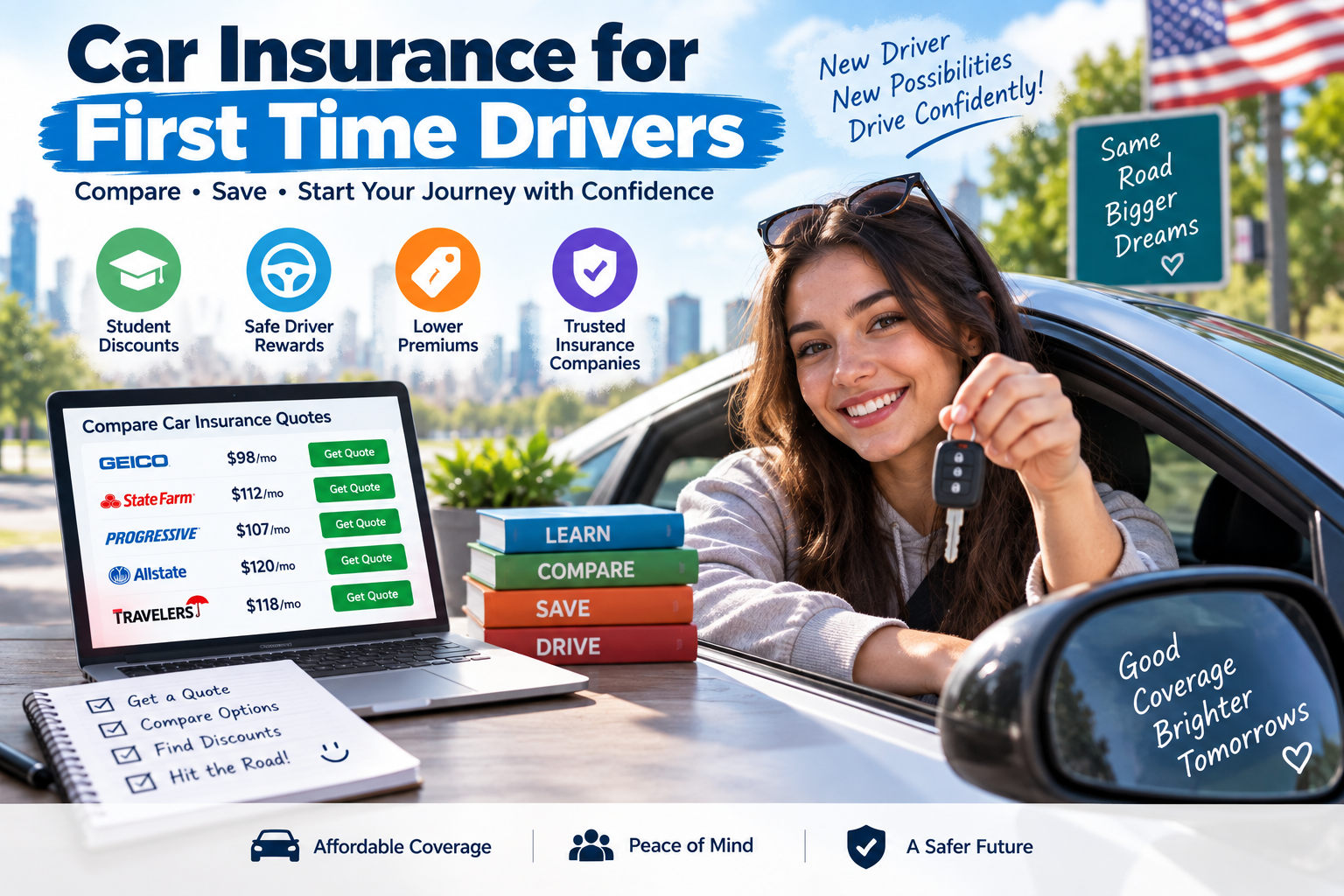
Finding car insurance for first time drivers can be confusing, especially if you’ve just received your license, bought your first car, or have never had an insurance policy in your own name. First-time drivers often pay more because insurers have limited driving and insurance history to evaluate.
The good news is that you don’t have to accept the first quote you receive. Comparing insurers, choosing an appropriate vehicle, asking about discounts, maintaining a clean driving record and understanding whether you should join a family policy can all help you find better coverage at a more manageable price.
Quick Answer: What Is the Best Car Insurance for First Time Drivers?
There isn’t one insurance company that is cheapest or best for every first-time driver.
Current 2026 comparisons frequently identify companies such as State Farm, GEICO, USAA, Erie, Travelers, Progressive and Auto-Owners as companies worth comparing for new or inexperienced drivers. However, rankings differ because insurers price drivers differently based on age, location, vehicle, driving history, coverage and other factors.
For example, The Zebra’s September 2026 analysis identifies State Farm as its top overall choice for new drivers, while ValuePenguin’s June 2026 analysis selected State Farm for cheap new-driver coverage. NerdWallet’s August 2026 analysis found different median rates among major insurers for 20-year-old drivers, illustrating why comparing multiple quotes matters.
The right approach is to use these companies as a starting shortlist, then compare actual quotes for your specific situation.
Best Car Insurance for First Time Drivers at a Glance
| Insurance Company | Best For | Why Consider It |
|---|---|---|
| State Farm | Overall new-driver option | Strong young-driver programs and broad availability |
| GEICO | Online shoppers | Competitive pricing and multiple discounts |
| USAA | Military families | Often competitive for eligible members |
| Erie | Teen drivers where available | Strong rates and coverage options |
| Travelers | Young adults | Competitive pricing and discounts |
| Progressive | Telematics and digital tools | Usage-based insurance and online experience |
| Auto-Owners | Regional comparison | Competitive new-driver rates in its service area |
Availability, rates, coverage and discounts vary by state and individual driver.
1. State Farm — Strong Overall Choice for First-Time Drivers
State Farm is one of the first insurers worth quoting when you’re buying car insurance for the first time.
The company has programs specifically relevant to younger and inexperienced drivers, including Steer Clear, which is designed for eligible drivers under 25. State Farm also offers its Drive Safe & Save usage-based program, which can reward eligible drivers based on driving behavior.
The Zebra’s September 2026 analysis ranked State Farm as its top overall insurer for new drivers and found competitive average pricing for both new teen and adult drivers.
Best for:
- Newly licensed drivers
- Drivers under 25
- Students
- Drivers interested in telematics
- Families looking for a widely available insurer
Potential drawback
The cheapest insurer for you could still be another company. Always compare an actual quote rather than relying on a national ranking.
2. GEICO — Good Option for Online Quotes and Discounts
GEICO is another strong company to include when comparing first-time driver insurance.
Current 2026 comparisons frequently show GEICO as competitive for inexperienced drivers, and the company offers discounts that may be particularly useful to students and new drivers.
Depending on eligibility and state, discounts can include good-student and driver-training opportunities.
Best for:
- Drivers who prefer online insurance
- Young adults
- Students
- First-time policy shoppers
- Drivers looking for multiple discount opportunities
Potential drawback
GEICO’s rates and available discounts vary by state, so don’t assume its advertised pricing will be your lowest quote.
3. USAA — Excellent for Eligible Military Families
If you qualify for USAA through military service or an eligible family relationship, it should generally be included in your comparison.
USAA is frequently competitive in new-driver and young-driver rate comparisons, but eligibility is restricted.
NerdWallet’s August 2026 analysis, for example, showed USAA with a lower median rate than several other major insurers for its analyzed 20-year-old driver profile.
Best for:
- Active-duty military members
- Veterans
- Eligible family members
- Young drivers in military households
Potential drawback
USAA isn’t available to everyone.
4. Erie — Strong Choice for Teen Drivers Where Available
Erie can be particularly attractive for first-time teen drivers.
Forbes Advisor’s 2026 analysis ranked Erie as its best overall car insurance company for teens and young drivers and found it had particularly competitive rates for novice drivers ages 16 to 19.
Erie also offers features such as accident forgiveness and Rate Lock in eligible circumstances.
Best for:
- Teen drivers
- Families adding a first-time driver
- Drivers in Erie-served states
- Families looking for competitive coverage
Potential drawback
Erie isn’t available nationwide, so availability depends on your state.
5. Travelers — Worth Comparing for Young Adults
Travelers is another insurer that deserves a quote from first-time drivers, especially young adults.
Current 2026 comparisons have found Travelers competitive for young-driver profiles. The company also offers several discounts and coverage options that may benefit newer drivers.
Best for:
- Young adults
- First-time policyholders
- Drivers comparing multiple national insurers
- Students who qualify for discounts
Potential drawback
Your individual quote could be higher than competing companies depending on your state and profile.
6. Progressive — Good for Telematics and Digital Insurance
Progressive is worth considering if you’re interested in usage-based insurance.
Its Snapshot program evaluates driving behavior and can potentially help eligible drivers save based on how they drive.
For a first-time driver who is confident about maintaining safe driving habits, a telematics program may be worth investigating.
Best for:
- Tech-focused drivers
- Safe drivers
- Young adults
- Drivers interested in usage-based insurance
- People who prefer managing policies online
Potential drawback
Telematics isn’t automatically the cheapest option for every driver. Read the program terms and understand how driving behavior may affect your rate.
7. Auto-Owners — A Strong Regional Option
Don’t overlook regional insurers when shopping for first-time driver coverage.
Auto-Owners has been highlighted in current 2026 comparisons for competitive rates among newer drivers in the states where it operates.
A regional insurer can sometimes offer a better combination of pricing and service than the largest national companies.
Best for:
- Drivers in Auto-Owners service areas
- First-time policy shoppers
- Drivers comparing regional insurers
- Families looking beyond the biggest national brands
Potential drawback
Auto-Owners isn’t available in every state.
Why Is Car Insurance More Expensive for First-Time Drivers?
Insurance companies evaluate risk using many factors.
The NAIC says factors that can affect auto insurance premiums include:
- Driving record
- Age
- Location
- Vehicle
- Vehicle use
- Annual mileage
- Prior insurance coverage
- Other characteristics permitted by state law
A first-time driver may have little or no insurance history and limited driving experience, giving the insurer less information about future risk.
That doesn’t mean you are a bad driver.
It simply means you’re an unproven driver from the insurer’s perspective.
First-Time Driver vs. Young Driver: What’s the Difference?
These terms are often used interchangeably, but they’re not exactly the same.
Young driver
Usually refers to a driver in their teens, early 20s or another relatively young age group.
First-time driver
Refers to someone who is driving for the first time or has little/no previous driving or insurance history.
For example:
A 17-year-old who just received a license: young + first-time driver.
A 35-year-old who just obtained a U.S. driver’s license: potentially a first-time driver but not a young driver.
This distinction matters because insurers may rate these two profiles very differently.
Should a First-Time Driver Stay on a Parent’s Policy?
If you’re a teenager or young adult living with your parents, adding you to a household policy can often be less expensive than purchasing a completely separate policy.
The NAIC specifically notes that it is generally cheaper to add a teenager to a family auto policy than to purchase a separate policy.
However, the exact result depends on the household, vehicles, insurer and state.
Staying on a family policy may make sense when:
- You live with your parents
- You drive a family vehicle
- You’re still financially dependent
- Your insurer allows you to remain on the policy
- The total household premium is reasonable
An individual policy may make more sense when:
- You live independently
- You own your own vehicle
- You have a separate permanent address
- You’re financially independent
- The insurer requires a separate policy
Always ask the insurer about the rules for your particular household.
How Much Does Car Insurance Cost for First-Time Drivers?
There isn’t one reliable nationwide price for every first-time driver.
Current 2026 research shows substantial differences between insurers and driver profiles.
For example, NerdWallet’s August 2026 analysis reported median annual rates ranging from about $3,440 for USAA to $4,523 for State Farm for its analyzed 20-year-old driver profiles. The Zebra’s September 2026 analysis found substantially different rates when comparing new teen and new adult drivers.
These figures should not be treated as your expected premium.
Your actual rate can depend on:
- Age
- State
- ZIP code
- Vehicle
- Driving record
- Annual mileage
- Coverage limits
- Deductible
- Insurance history
- Credit-based insurance information where permitted
- Discounts
The only way to know your actual price is to get a quote.
7 Smart Ways to Save on Car Insurance as a First-Time Driver
1. Compare Multiple Insurance Companies
This is probably the most important step.
Different insurers can charge dramatically different premiums for the same driver.
Get several quotes and compare the same:
- Liability limits
- Comprehensive coverage
- Collision coverage
- Deductibles
- Optional coverage
Otherwise, you may accidentally compare completely different policies.
2. Ask About Good-Student Discounts
If you’re a student with strong academic performance, ask insurers about good-student discounts.
The NAIC lists good-student discounts among the discounts that insurers may offer to qualifying drivers under 25.
Requirements vary by company and state.
3. Take an Approved Driver Education Course
Some insurers offer discounts to drivers who complete qualifying driver education or defensive-driving courses.
Before paying for a course specifically to save on insurance, ask the insurer whether it qualifies and how much the discount could be.
4. Consider Telematics
Usage-based insurance programs can monitor driving behavior through a mobile app, device or connected vehicle.
Depending on the program, factors may include:
- Braking
- Acceleration
- Mileage
- Driving patterns
- Time of day
If you drive safely, a telematics program may offer an opportunity to reduce your premium.
5. Choose an Affordable Vehicle
Your first car can have a major impact on your insurance cost.
Before buying a vehicle, request an insurance quote for that exact:
- Make
- Model
- Year
- Trim
- Vehicle identification information when available
A modest used sedan may cost considerably less to insure than a high-performance sports car.
6. Consider Your Deductible Carefully
A higher deductible can sometimes reduce your premium.
For example:
| Deductible | Potential Effect |
|---|---|
| $500 | Higher premium, lower out-of-pocket claim cost |
| $1,000 | Potentially lower premium, higher out-of-pocket claim cost |
Don’t choose a $1,000 deductible if you couldn’t realistically afford to pay it after an accident.
7. Ask About Bundling
If you or your household has renters insurance, homeowners insurance or multiple vehicles, ask whether combining policies could qualify for a discount.
The NAIC lists auto/home package and multiple-vehicle discounts among potential ways consumers may reduce insurance costs.
What Car Insurance Coverage Does a First-Time Driver Need?
The minimum required coverage depends on the state.
But minimum legal coverage isn’t necessarily the same as adequate financial protection.
Liability Coverage
Liability insurance helps pay for covered injuries or property damage you cause to other people, up to your policy limits.
Collision Coverage
Collision coverage generally helps pay for damage to your own vehicle resulting from a covered collision, subject to your deductible.
Comprehensive Coverage
Comprehensive coverage generally protects against certain non-collision events such as:
- Theft
- Fire
- Hail
- Falling objects
- Animal-related damage
Coverage depends on the policy and deductible.
Uninsured/Underinsured Motorist Coverage
This can help protect you if another driver causes an accident and doesn’t have enough insurance, depending on state requirements and policy terms.
Medical Payments or Personal Injury Protection
Depending on the state, these coverages may help pay certain medical expenses after an accident.
Minimum Coverage vs. Full Coverage for a First-Time Driver
Choosing the minimum legal coverage can produce a lower premium, but it can also leave you with greater financial exposure.
Minimum coverage may make sense when:
- You’re driving an older, low-value vehicle
- You have limited financial resources
- Your state minimums are appropriate for your situation
- You understand the risks
More extensive coverage may make sense when:
- Your vehicle is newer
- Your vehicle is expensive to replace
- You’re financing the vehicle
- A lender requires comprehensive and collision
- You want greater protection after an accident
If you’re financing your first vehicle, check the lender’s insurance requirements before choosing coverage.
What Discounts Should First-Time Drivers Ask About?
Don’t simply ask an insurer, “Do you have discounts?”
Ask specifically about:
- Good-student discount
- Driver education discount
- Defensive-driving discount
- Telematics or usage-based insurance
- Multi-car discount
- Bundling discount
- Safety equipment discount
- Anti-theft discount
- Student-away-at-school discount
- Safe-driver programs
Not every discount is available in every state.
Can First-Time Drivers Get Car Insurance With No Insurance History?
Yes.
Having no prior insurance history doesn’t mean you cannot buy car insurance.
However, a lack of insurance history can affect pricing because the insurer has less information about your previous coverage.
This situation is common among:
- Newly licensed drivers
- Young adults
- People who previously lived without a vehicle
- Recent immigrants
- People who have never owned a car
The best response is to compare multiple insurers rather than assuming you’ll receive the same rate everywhere.
If you also have little or no credit history, you may want to compare insurers that are competitive with drivers in that situation.
Does Credit Score Affect First-Time Driver Insurance?
It can, depending on the state and insurer.
Some insurers use credit-based insurance information as one factor in determining premiums where state law permits it.
However, a credit-based insurance score is not the same thing as the traditional credit score used by lenders.
If you’re a first-time driver with limited credit history, ask insurers how your state and profile are evaluated.
Also read: Best Car Insurance Companies for Low Credit Score
How to Buy Car Insurance for the First Time
Buying your first policy doesn’t have to be complicated.
Step 1: Gather your information
You’ll generally need information such as:
- Driver’s license
- Address
- Vehicle information
- Driving history
- Estimated annual mileage
- Other household drivers
Step 2: Decide what coverage you need
Check your state’s minimum requirements and consider whether you need comprehensive, collision and additional liability protection.
Step 3: Get several quotes
Compare multiple insurers using the same coverage limits.
Step 4: Check discounts
Ask about student, driver-training, telematics, bundling and other discounts.
Step 5: Compare the total policy
Don’t compare monthly prices alone.
Check:
Annual premium + coverage limits + deductible + exclusions + available discounts.
Step 6: Avoid a coverage gap
If you’re replacing an existing policy, make sure the new coverage begins before the old policy ends.
Example: A 19-Year-Old Buying Their First Car
Imagine a 19-year-old driver who:
- Has a clean driving record
- Recently received a license
- Buys a used Toyota
- Lives with parents
- Is a full-time college student
- Has never had their own insurance policy
A smart shopping strategy would be:
- Ask whether they can remain on the family policy.
- Compare the family-policy price with an individual policy.
- Ask about good-student discounts.
- Ask about driver-training discounts.
- Compare State Farm, GEICO, Progressive, Travelers and other available insurers.
- Check telematics programs.
- Compare the cost of comprehensive and collision.
- Choose a deductible the driver can afford.
The cheapest insurer may be different for another 19-year-old in another state.
Example: A 35-Year-Old First-Time Driver
Now consider someone who is 35 and has just received a driver’s license after previously relying on public transportation.
This person is not a young driver, but they are still a first-time driver.
Their shopping strategy should focus on:
- Lack of previous insurance history
- Vehicle type
- Annual mileage
- State requirements
- Coverage limits
- Multiple insurer quotes
- Available discounts
- Whether credit-based insurance information is used in their state
This is why “first-time driver” and “young driver” should not always be treated as identical insurance categories.
Common Mistakes First-Time Drivers Should Avoid
Mistake 1: Buying the first policy offered
The first quote isn’t necessarily the cheapest or best.
Mistake 2: Comparing different coverage levels
A $100 quote isn’t better than a $150 quote if the first policy provides significantly less protection.
Mistake 3: Buying an expensive car without checking insurance
Get an insurance quote before buying the vehicle.
Mistake 4: Ignoring discounts
Students and newly licensed drivers may qualify for programs that reduce premiums.
Mistake 5: Choosing a deductible you can’t afford
Lower premiums aren’t useful if you can’t pay the deductible after a claim.
Mistake 6: Giving inaccurate information
Always provide accurate information about your address, vehicle, mileage and drivers.
Mistake 7: Forgetting about household drivers
Insurance companies generally need accurate information about licensed household members who drive insured vehicles.
The NAIC warns that failing to disclose household drivers can create serious problems, including potential claim or policy issues.
Best Car Insurance for First-Time Drivers by Situation
| First-Time Driver Situation | Companies Worth Comparing |
|---|---|
| Overall new driver | State Farm, GEICO, Travelers |
| Teen driver | Erie, State Farm, GEICO |
| Military family | USAA |
| Young adult | GEICO, Progressive, Travelers, State Farm |
| Driver interested in telematics | Progressive, State Farm |
| Driver looking for regional options | Erie, Auto-Owners |
| Student driver | State Farm, GEICO, Travelers |
| First-time driver with limited insurance history | Compare several national and regional insurers |
These are starting points, not guaranteed rankings. Your actual quote should determine the final choice.
Frequently Asked Questions
Q1. What is the best car insurance for first-time drivers?
There isn’t one insurer that is best for everyone. State Farm, GEICO, USAA, Erie, Travelers, Progressive and Auto-Owners are all worth comparing depending on your age, state, eligibility and driving situation.
Q2. Is car insurance more expensive for first-time drivers?
It can be. Insurers may consider limited driving experience and lack of prior insurance history when determining premiums. Younger first-time drivers can face especially high rates.
Q3. What is the cheapest car insurance for first-time drivers?
The cheapest company depends on your profile and location. Current 2026 studies disagree on the cheapest insurer, which is why comparing multiple quotes is more reliable than choosing a company based on a national average.
Q4. Is it cheaper to stay on my parents’ car insurance?
For many young drivers living with their parents, adding the driver to the household policy can be cheaper than purchasing an independent policy. The exact savings depend on the insurer, vehicles and household.
Q5. Can an adult get first-time driver insurance?
Yes. A first-time driver can be an adult who has recently obtained a license or has never previously carried auto insurance. Insurers will evaluate the person’s individual circumstances.
Q6. Can I get car insurance without previous insurance?
Yes. Previous insurance isn’t required in every situation. However, having no prior insurance history can affect the price you receive from some insurers.
Q7. Do first-time drivers need full coverage?
Not always. State minimum liability coverage may be enough to legally drive, but drivers may want broader protection. If the vehicle is financed, the lender may require comprehensive and collision coverage.
Q8. Do good grades lower car insurance?
They can. Some insurers offer good-student discounts for eligible students, although requirements and savings vary by company and state.
Q9. Does driver’s education reduce insurance costs?
It may. Some insurers offer discounts for qualifying driver education or defensive-driving courses. Check with the insurer before enrolling.
Q10. Can telematics lower insurance for a first-time driver?
Potentially. Usage-based programs can evaluate driving behavior, and safe driving may result in savings depending on the program. However, savings aren’t guaranteed.
Q11. Does the car I buy affect my insurance price?
Yes. Vehicle value, repair costs, safety features, theft risk and performance can all affect premiums. Get an insurance quote before buying your first car.
Q12. What information do I need to get my first car insurance quote?
You may need your driver’s license information, address, vehicle details, estimated mileage, driving history and information about other drivers in your household.
Q13. How many insurance companies should I compare?
There isn’t a fixed number, but getting quotes from several insurers is a smart approach. Make sure each quote uses the same coverage limits and deductibles.
Q14. Does having no credit history affect first-time driver insurance?
It can in states where insurers are permitted to use credit-based insurance information. The effect varies by state and insurer, and a credit-based insurance score is different from a standard lending credit score.
Q15. When does car insurance get cheaper for first-time drivers?
Rates may become more favorable as drivers gain experience and maintain a clean driving record. The timing varies by driver, insurer and state.
Why Maintain Market Is Different
At Maintain Market, we don’t believe that finding the cheapest insurance quote automatically means finding the best policy.
First-time drivers have different situations. A teenager living with parents, a 25-year-old buying a first car, and a 40-year-old getting a license for the first time shouldn’t necessarily shop for insurance in exactly the same way.
That’s why this guide focuses on the factors that actually affect the decision:
- Driver experience
- Age
- Vehicle
- Coverage
- Discounts
- Family vs. individual policy
- Telematics
- Insurance history
- State-specific rules
The goal isn’t simply to find the lowest monthly number.
It’s to find reliable coverage at a price that fits your situation.
Final Takeaway
Finding car insurance for first time drivers doesn’t have to be overwhelming.
Start by comparing several insurers rather than accepting the first quote. State Farm, GEICO, USAA, Erie, Travelers, Progressive and Auto-Owners can all be worth checking depending on your circumstances.
Then:
- Compare multiple quotes.
- Check whether joining a family policy makes sense.
- Ask about good-student and driver-training discounts.
- Consider telematics if appropriate.
- Get an insurance quote before buying your vehicle.
- Compare coverage limits, not just monthly prices.
- Choose a deductible you can actually afford.
- Maintain a clean driving record.
Your first insurance policy is also the beginning of your insurance history. Making smart choices now can help you build a stronger record for the years ahead.
References
- NAIC — Consumer Auto Insurance
- NAIC — Protect Yourself: Insuring a Teen Driver
- NAIC — Tips for Saving on Auto Insurance
- NerdWallet — Car Insurance for New Drivers
- The Zebra — Best Insurance for New Drivers
- Forbes Advisor — Best Car Insurance for Teens and Young Drivers
- ValuePenguin — Best Cheap Car Insurance for New Drivers
- WalletHub — Best Cheap Car Insurance for New Drivers
Editorial Review
Written by the Maintain Market Editorial Team
Reviewed for accuracy by the Maintain Market Editorial Team
This article provides general educational information and should not be considered insurance, legal or financial advice. Insurance requirements, pricing, eligibility, discounts and coverage vary by state, insurer and individual circumstances.