
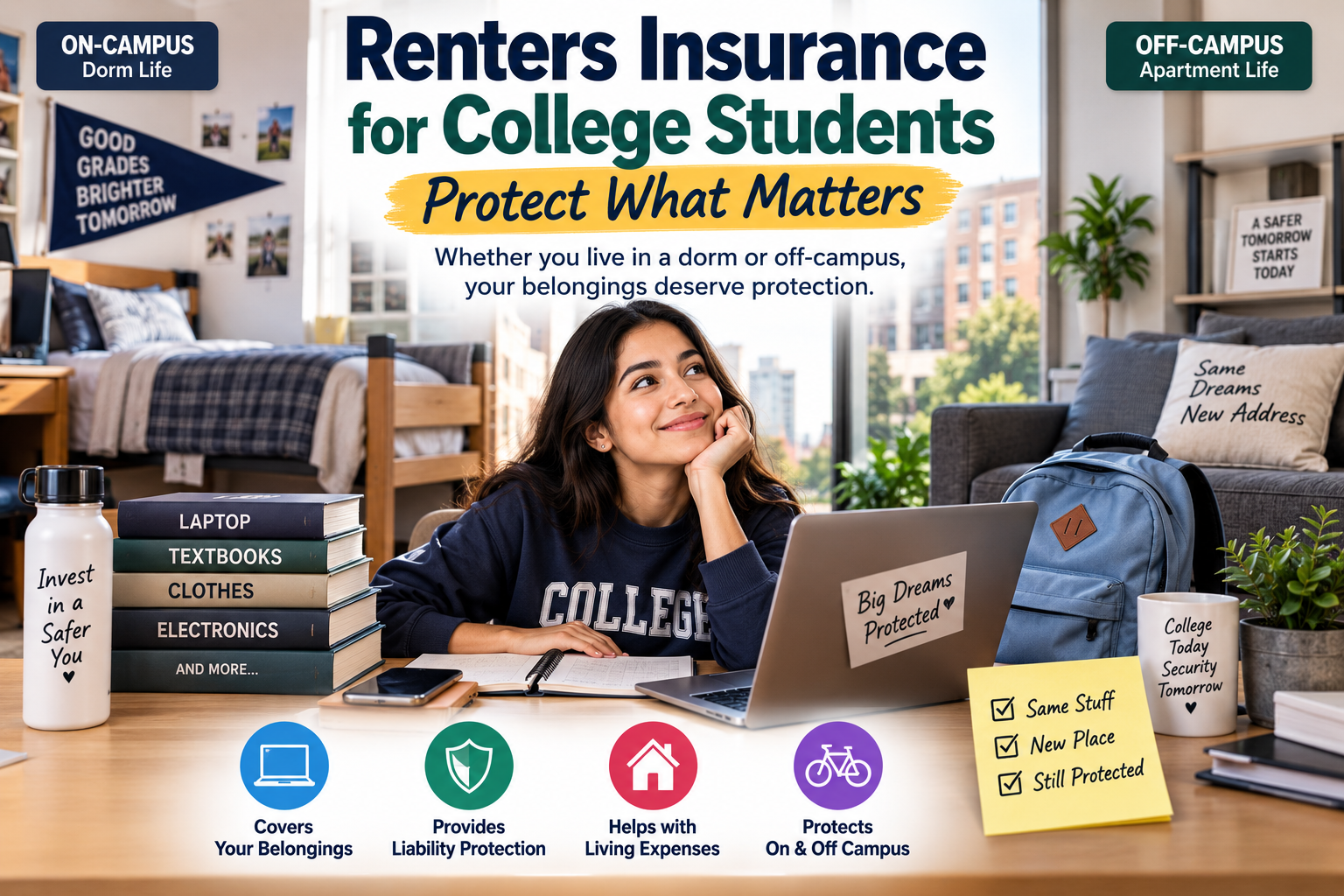
If you are heading to college and wondering whether you need renters insurance for college students, the answer depends largely on where you live and whether your parents’ insurance policy already provides coverage. Students living in off-campus apartments or houses will often benefit from their own renters insurance because a landlord’s insurance generally does not cover the student’s personal belongings.
A college student may bring thousands of dollars of electronics, clothing, furniture, textbooks and other belongings to school. Renters insurance can help protect those possessions and can also provide liability coverage if someone is injured or you accidentally damage someone else’s property.
Quick Answer: Do College Students Need Renters Insurance?
It depends on your housing situation and existing insurance coverage.
If you live in a college dorm, your belongings may already have limited coverage under a parent’s homeowners or renters insurance policy, depending on the policy’s terms, your age, student status and where you live.
If you live in an off-campus apartment or house, you should seriously consider your own renters insurance policy. Your landlord’s insurance generally covers the building, not your personal belongings.
The National Association of Insurance Commissioners (NAIC) specifically recommends that college students consider renters insurance, particularly those living off campus.
What Is Renters Insurance for College Students?
Renters insurance is a type of insurance designed to protect a renter’s personal belongings and provide certain liability protections.
For a college student, a renters policy may provide coverage for:
- Laptop and computer equipment
- Clothing
- Textbooks
- Furniture
- Television
- Bicycle
- Headphones
- Personal electronics
- Other belongings
Depending on the policy, renters insurance can also provide personal liability coverage and additional living expenses after certain covered losses.
Most renters insurance policies typically include personal property, liability and additional living expense coverage.
Does a College Student Need Renters Insurance?
There is no universal answer.
The most important questions are:
- Do you live in a dorm or off-campus housing?
- Are you still covered under your parents’ insurance?
- How much are your belongings worth?
- Does your landlord require renters insurance?
- Could you afford to replace your belongings after a major loss?
If you have a $2,000 laptop, $1,000 phone, expensive clothing, furniture and other belongings, replacing everything after a fire or theft could become expensive very quickly.
Renters insurance can provide financial protection against covered losses.
Do College Students Living in Dorms Need Renters Insurance?
Not always.
Students living in college dorms may have some coverage through a parent’s homeowners or renters insurance policy.
However, you should not assume everything is automatically covered.
The NAIC says students living on campus and under age 26 may have coverage under their parents’ policy, but the coverage can be subject to specific limits and exclusions.
Before college starts, ask your parents’ insurance company:
- Is my dorm room covered?
- Are my belongings covered?
- What is the coverage limit?
- Does the coverage apply away from home?
- What deductible applies?
- Are laptops and electronics subject to special limits?
- Does my student status affect coverage?
Does Parents’ Homeowners Insurance Cover College Students?
It may.
A dependent college student can sometimes receive coverage under a parent’s homeowners or renters insurance policy, especially when living in a dorm or temporarily away at school.
However, the exact coverage depends on the policy.
The NAIC notes that students may have limited coverage under their parents’ policies, and parents should confirm the coverage limits and exclusions with their insurance company.
This is particularly important for expensive electronics.
A parent might have coverage for a student away at school, but the policy may have a lower limit for property located away from the primary residence.
Does Renters Insurance Cover College Students Living Off Campus?
Yes, a renters insurance policy can be designed for students renting an apartment, house or other eligible residential unit.
Off-campus students often have a stronger reason to consider their own renters insurance because the landlord’s insurance generally protects the building rather than the student’s belongings.
For example, if a fire damages an off-campus apartment, the landlord’s insurance may address covered damage to the building, while the student’s renters insurance may help with covered damage to the student’s personal property.
The NAIC specifically identifies off-campus college students as people who should consider renters insurance.
What Does Renters Insurance Cover for College Students?
Renters insurance can provide several types of protection.
1. Personal Property
This is one of the most important coverages for college students.
It can help pay to repair or replace covered belongings that are damaged, destroyed or stolen, subject to the policy terms and limits.
Examples include:
- Laptop
- Phone
- Clothing
- Furniture
- Bicycle
- Television
- Gaming equipment
- Textbooks
2. Personal Liability
Liability coverage can help if you are legally responsible for someone else’s bodily injury or property damage.
For example, suppose a visitor is injured in your apartment and you are found responsible.
Your renters insurance may provide liability protection according to your policy.
Liability coverage can also potentially apply if you accidentally cause certain property damage to another person.
3. Additional Living Expenses
Some renters policies provide coverage for additional living expenses if your rented home becomes uninhabitable because of a covered loss.
For example, if a covered fire makes your apartment temporarily unlivable, the policy may help with certain additional expenses while repairs are completed.
The exact coverage and limits depend on your policy.
What Does Renters Insurance NOT Cover?
Renters insurance does not cover everything.
Common exclusions or limitations can include:
- Flood damage
- Earthquake damage
- Normal wear and tear
- Intentional damage
- Certain high-value belongings without additional coverage
- Damage caused by excluded events
Policies vary, so don’t assume a particular loss is covered simply because you have renters insurance.
The NAIC notes that flood and earthquake are typically excluded from standard homeowners and renters policies, although additional coverage may be available.
Does Renters Insurance Cover a College Student’s Laptop?
A laptop may be covered as personal property when damaged, destroyed or stolen because of a covered event.
However, there can be limits for certain electronics or property located away from the primary residence, depending on the policy.
If your laptop is worth several thousand dollars, check the policy’s limits and whether additional coverage is appropriate.
Keep your purchase receipt, serial number and photographs of the laptop as part of your home inventory.
Does Renters Insurance Cover Theft at College?
It may cover theft when the loss falls within a covered event and the policy terms apply.
For example, a covered renters policy may protect eligible personal belongings stolen from your apartment.
Some policies can also provide coverage for belongings away from the rented home, although limits and exclusions may apply.
The NAIC notes that some renters policies cover belongings outside the home, including certain theft losses from places such as a car or hotel room.
Always check your policy before assuming an item stolen outside your residence is fully covered.
Does Renters Insurance Cover a College Student’s Bike?
A bicycle can generally be treated as personal property under a renters policy, subject to the policy’s coverage, limits and exclusions.
If your bicycle is expensive, check whether the policy has special limits for bicycles or sporting equipment.
Take photographs and keep your purchase documentation.
If the bicycle is stolen, having proof of ownership can make the claims process easier.
How Much Does Renters Insurance Cost for College Students?
The cost depends on factors such as:
- Location
- Coverage amount
- Deductible
- Property value
- Liability limits
- Insurance company
- Claims history
- Available discounts
The NAIC’s current consumer guidance says renters insurance premiums average roughly $15 to $30 per month, depending on factors such as location, rental size and possessions. Actual prices can vary significantly by student and policy.
That means a basic policy could potentially cost less than many students spend on subscriptions, dining out or other monthly expenses.
Still, compare actual quotes rather than assuming your price will fall within a particular range.
Is Renters Insurance Worth It for College Students?
For many students, it can be.
Consider what you would have to pay if you suddenly lost:
- Laptop
- Phone
- Clothing
- Furniture
- Textbooks
- Electronics
- Bicycle
- Other personal belongings
If replacing everything would create a major financial problem, renters insurance can provide valuable protection.
It can also provide liability coverage, which is something students may overlook when thinking only about their belongings.
Renters Insurance vs. Parents’ Homeowners Insurance
| Situation | Parents’ Policy May Help? | Own Renters Insurance? |
|---|---|---|
| Living in college dorm | Possibly | May not be necessary |
| Living off campus | Coverage may be limited | Often worth considering |
| Renting an apartment | Depends on policy | Often appropriate |
| Expensive electronics | Check limits carefully | May provide more appropriate coverage |
| Roommates | Depends on policy | Individual coverage may be preferable |
| Landlord requires insurance | Parents’ policy may not satisfy requirement | Check landlord’s requirements |
Important: Never assume that a parent’s policy automatically provides enough coverage.
Ask the insurer before moving into your college housing.
Do College Apartments Require Renters Insurance?
Sometimes.
A college or university may not require renters insurance for every student, but a private landlord or property management company may make it a condition of the lease.
Before signing a lease, check whether it requires:
- Renters insurance
- A specific liability limit
- Proof of insurance
- The landlord to be listed as an interested party
If insurance is required, make sure your policy satisfies the lease requirements.
Do Roommates Need Separate Renters Insurance?
Often, separate policies are the safer approach.
Roommate arrangements can create complications because one student’s policy may not automatically cover another student’s belongings.
For example, if four students share an apartment, one student’s renters policy should not automatically be assumed to cover all four students’ personal property.
The NAIC recommends considering individual coverage for adult tenants rather than assuming everyone in a shared property is covered by one policy.
Before sharing a policy, ask the insurer exactly who qualifies as an insured person.
How Much Renters Insurance Does a College Student Need?
Start by calculating the replacement value of your belongings.
Create a list of:
- Electronics
- Clothing
- Furniture
- Books
- Appliances
- Sports equipment
- Jewelry
- Musical instruments
- Bicycles
- Other valuable possessions
Then estimate how much it would cost to replace everything.
Example
Suppose your belongings include:
| Item | Estimated Replacement Cost |
|---|---|
| Laptop | $1,500 |
| Phone | $800 |
| Clothing | $1,500 |
| Furniture | $1,000 |
| TV & electronics | $1,000 |
| Books | $500 |
| Bicycle | $700 |
| Other belongings | $1,000 |
| Total | $8,000 |
You would want to discuss an appropriate personal-property limit with the insurer rather than automatically choosing the lowest available amount.
Actual Cash Value vs. Replacement Cost for College Students
This is an important decision when buying renters insurance.
Actual Cash Value
Actual cash value generally considers depreciation.
For example, if your five-year-old laptop originally cost $2,000, its value at the time of the loss may be considerably lower.
Replacement Cost
Replacement cost coverage generally aims to reimburse the cost to replace covered property with a similar new item, subject to the policy’s terms and limits.
The NAIC explains that replacement cost coverage can provide a higher reimbursement than actual cash value because depreciation is not deducted in the same way.
For students with expensive electronics, understanding this difference can be especially important.
What Is the Best Renters Insurance for College Students?
There is no single renters insurance company that is best for every student.
When comparing policies, look at:
1. Personal property limit
Make sure it is enough to replace your belongings.
2. Deductible
A lower deductible can mean higher premiums, while a higher deductible can reduce the premium but increase your out-of-pocket cost after a covered loss.
3. Replacement cost vs. actual cash value
Understand how damaged or stolen belongings will be valued.
4. Liability coverage
Check the liability limit and what situations are covered.
5. Additional living expenses
Find out whether temporary living expenses are covered after a qualifying loss.
6. Special limits
Check limits for electronics, jewelry, bicycles and other valuable items.
7. Off-premises coverage
This can be particularly important for students who frequently travel between campus, home and other locations.
How College Students Can Save Money on Renters Insurance
You don’t necessarily need to buy the most expensive policy.
Try these strategies:
Compare multiple quotes
Insurance prices can differ between companies for similar coverage.
Choose a deductible you can afford
Don’t choose a very high deductible simply to reduce the monthly premium.
Ask about discounts
Some insurers offer discounts for security systems, fire protection features, bundling and other qualifying factors.
Avoid underinsuring your belongings
Saving a few dollars on premiums isn’t useful if your coverage limit is too low after a major loss.
How to Buy Renters Insurance for College Students
The process is relatively simple.
Step 1: Determine where you will live
Dorm, apartment, rented house or another housing arrangement.
Step 2: Check your parents’ insurance
Find out whether you already have coverage.
Step 3: Calculate your belongings
Estimate the replacement cost of your possessions.
Step 4: Check your lease
See whether your landlord requires renters insurance.
Step 5: Compare quotes
Compare coverage, deductibles, limits and exclusions—not just the monthly price.
Step 6: Choose your coverage
Make sure the policy provides adequate personal-property and liability limits.
Step 7: Create a home inventory
Take photographs and keep receipts and serial numbers.
The NAIC recommends documenting possessions because an inventory can help establish what you owned if you need to file a claim.
College Student Renters Insurance Checklist
Before leaving for college, check:
☐ Where will I live?
☐ Am I covered under my parents’ policy?
☐ What is the coverage limit?
☐ Are my electronics covered?
☐ Are my belongings covered off campus?
☐ Does my landlord require renters insurance?
☐ What deductible will I have?
☐ Is coverage actual cash value or replacement cost?
☐ Do I need additional coverage for expensive belongings?
☐ Do my roommates need separate policies?
☐ Have I created a home inventory?
Real-Life Examples
Example 1: Student living in a dorm
A student lives in a university dorm and owns a $1,500 laptop.
The student’s parents have homeowners insurance.
What to do: Ask the parents’ insurer whether the student’s belongings are covered while living on campus and what limits apply.
Example 2: Student renting an off-campus apartment
A student rents an apartment with $10,000 worth of personal belongings.
The landlord’s insurance protects the building but not the student’s belongings.
What to do: Consider a renters policy with an appropriate personal-property limit and liability coverage.
Example 3: Laptop stolen from an apartment
A student’s laptop is stolen from an off-campus apartment.
What happens: If theft is a covered loss under the renters policy, the student may be able to file a claim subject to the deductible, policy limits and valuation method.
Example 4: Student’s apartment becomes unlivable
A covered event makes the student’s apartment temporarily uninhabitable.
What happens: The renters policy may provide additional living expense coverage, subject to the policy’s terms and limits.
Common Mistakes College Students Make
1. Assuming the landlord’s insurance covers their belongings
It generally doesn’t.
2. Assuming parents’ insurance automatically covers everything
Coverage can have limits and exclusions.
3. Choosing coverage based only on price
The cheapest policy may not provide enough protection.
4. Ignoring the deductible
A low monthly premium can come with a high deductible.
5. Forgetting expensive electronics
Students often underestimate the replacement cost of laptops, phones and other devices.
6. Not documenting belongings
Receipts, photographs and serial numbers can help support a claim.
7. Assuming roommates are automatically covered
Do not assume another person’s policy covers your belongings.
Renters Insurance for College Students FAQs
Q1. Do college students need renters insurance?
Not every college student needs a separate renters policy. Students living in dorms may have some coverage through their parents’ policy, while students living off campus should generally consider their own coverage.
Q2. How much is renters insurance for college students?
The NAIC says renters insurance averages about $15 to $30 per month, although actual prices vary based on location, coverage limits, possessions and other factors. Students should compare quotes for their specific situation.
Q3. Does my parents’ homeowners insurance cover me at college?
It may, particularly if you are a dependent student living in a dorm. However, coverage limits and exclusions can apply, so your parents should confirm the details directly with their insurance company.
Q4. Do college students living off campus need renters insurance?
Off-campus students should strongly consider renters insurance because a landlord’s insurance generally covers the building rather than the student’s personal belongings. A renters policy can also provide personal liability coverage.
Q5. Does renters insurance cover a college student’s laptop?
A laptop may be covered as personal property when damaged, destroyed or stolen because of a covered event. Check your policy for coverage limits, deductibles and any special restrictions on electronics.
Q6. Does renters insurance cover theft at college?
It may cover theft when the loss falls within the policy’s covered events and conditions. Some policies can also cover belongings away from the rented home, but limits and exclusions may apply.
Q7. Does renters insurance cover college dorms?
A student living in a dorm may already have limited coverage under a parent’s homeowners or renters policy. Because coverage varies, students should confirm the limits and exclusions before deciding whether separate insurance is necessary.
Q8. Does my landlord require renters insurance?
Some landlords and property management companies require renters insurance as part of the lease. Check your rental agreement for any required coverage amount or liability limit before moving in.
Q9. Do roommates need separate renters insurance?
Roommates should not assume that one student’s policy automatically covers everyone else’s belongings. Separate policies can provide each student with clearer individual protection.
Q10. What does renters insurance cover for college students?
Renters insurance can cover personal belongings against certain covered losses and can provide liability protection. Some policies also provide additional living expense coverage if the rental becomes uninhabitable after a covered loss.
Q11. Is renters insurance worth it for college students?
It can be worthwhile if replacing your belongings would be financially difficult. The coverage can also provide liability protection, making it useful beyond simply protecting a laptop or other possessions.
Q12. What is the best renters insurance for college students?
There is no single best company for every student. Compare personal-property limits, liability coverage, deductible, replacement-cost options, exclusions and price before choosing a policy.
Final Verdict: Is Renters Insurance Worth It for College Students?
Renters insurance for college students can be a relatively inexpensive way to protect personal belongings and provide liability coverage.
If you live in a dorm, first check whether your parents’ homeowners or renters policy already covers you and what limits apply.
If you live in an off-campus apartment or house, having your own renters insurance is often worth considering because your landlord’s insurance generally does not protect your personal belongings.
Before buying a policy, calculate the value of your belongings, compare quotes, check your deductible and understand whether you have actual cash value or replacement cost coverage.
Most importantly, don’t assume you are covered simply because your parents have homeowners insurance. Ask the insurer and get the coverage details in writing.
Why Maintain Market Is Different
At Maintain Market, we explain insurance in practical terms so students and families can understand what coverage they actually need.
This guide focuses on the questions college students commonly face:
- Dorm vs. off-campus coverage
- Parents’ insurance
- Laptop and electronics protection
- Theft coverage
- Roommates
- Liability
- Additional living expenses
- Deductibles
- Actual cash value vs. replacement cost
- Renters insurance costs
- How to compare policies
Insurance coverage varies by insurer, policy and state, so students should review their specific policy and speak with an insurance professional when they need coverage-specific advice.
References
- National Association of Insurance Commissioners (NAIC) — Do I Need Renters Insurance For College?
- National Association of Insurance Commissioners (NAIC) — Renters Insurance for College Students
- National Association of Insurance Commissioners (NAIC) — For Rent: Protecting Your Belongings With Renters Insurance
- National Association of Insurance Commissioners (NAIC) — Understanding Your Homeowners or Renter’s Policy
- Allstate — Do College Students Need Renters Insurance?
Editorial Review
Written by the Maintain Market Editorial Team
Reviewed for accuracy by the Maintain Market Editorial Team
This article provides general educational information and should not be considered insurance, legal or financial advice. Renters insurance coverage, limits, exclusions and pricing vary by insurer and state.
Recommended Reads
Car Insurance for College Students
Car Insurance for College Students: Costs, Discounts, Parents’ Policies & How to Save. Learn how college students can compare auto insurance coverage, discounts and potential ways to lower their premiums.
Car Insurance for International Students
Best Car Insurance for International Students in the USA: Coverage, Cost & How to Get It. Understand the key insurance considerations for international students driving in the United States.
How to Lower Car Insurance
How to Lower Car Insurance in 2026: 15 Ways to Save Money. Explore practical ways drivers may reduce their auto insurance costs without unnecessarily reducing important coverage.