
Your home is more than just the building you live in. It also contains furniture, clothing, electronics, appliances, kitchen equipment, and other belongings that can be expensive to replace after a disaster. That’s why homeowners insurance personal property coverage is an important part of protecting your financial security.
Also known as Coverage C, personal property coverage helps pay to repair or replace your belongings when they are damaged, destroyed, or stolen because of a covered event under your homeowners insurance policy.
For example, if a fire destroys your furniture or a covered theft results in stolen electronics, personal property coverage may help pay for the loss, subject to your deductible, coverage limits, and policy conditions.
However, not every item or type of damage is automatically covered. High-value belongings may have special limits, certain disasters may be excluded, and your claim payment may depend on whether your policy uses replacement cost or actual cash value.
In this guide, we’ll explain what personal property coverage includes, how much protection you may need, what it does not cover, and how to make a claim.
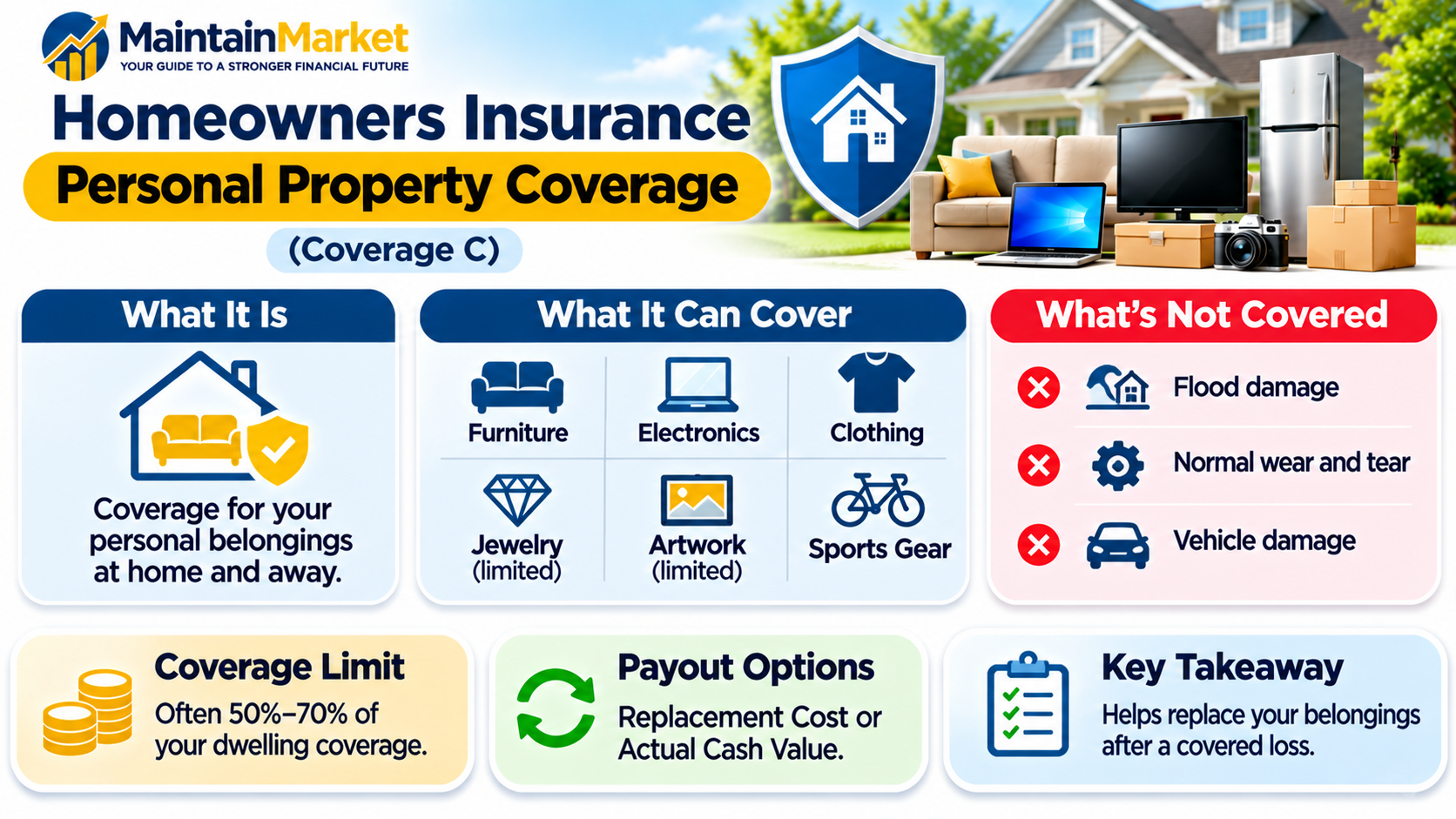
What Is Personal Property Coverage in Homeowners Insurance?
Personal property coverage is the part of a homeowners insurance policy that protects your personal belongings.
It is commonly identified as Coverage C in standard homeowners insurance policy structures.
It may cover belongings such as:
- Furniture and mattresses
- Clothing and shoes
- Televisions and computers
- Kitchen appliances and household equipment
- Books and personal collections
- Sports and recreational equipment
- Certain jewelry, artwork, and valuables
If these belongings are damaged, destroyed, or stolen because of a covered peril, your insurance company may reimburse you according to the policy.
Personal property coverage generally protects more than just items inside your house. Many policies also provide some protection for belongings temporarily kept outside your home, although off-premises limits may apply.
Important: Personal property coverage does not automatically protect against every possible cause of damage. Your policy determines which events are covered and which are excluded.
What Does Homeowners Insurance Personal Property Coverage Include?
The specific protection depends on your policy, but personal property coverage commonly applies to several categories of household belongings.
1. Furniture and Household Items
Your furniture can represent a significant portion of your household’s total value.
Personal property coverage may help protect:
- Sofas and couches
- Beds and mattresses
- Dining tables and chairs
- Wardrobes and cabinets
- Carpets and rugs
- Lamps and decorative items
For example, if a covered fire destroys your living room furniture, your policy may help pay for its repair or replacement.
The amount paid depends on your coverage limit and whether your claim is settled using replacement cost or actual cash value.
2. Electronics and Appliances
Electronics and household appliances can be expensive to replace.
Depending on the covered event and policy terms, personal property coverage may protect:
- Televisions
- Laptops and desktop computers
- Tablets
- Cameras
- Refrigerators
- Washing machines
- Microwave ovens
- Other household electronics
Some electronics may have special coverage conditions or exclusions. For example, damage caused by a mechanical breakdown is not necessarily covered simply because you have homeowners insurance.
3. Clothing and Personal Accessories
Personal property coverage may also protect everyday belongings, including:
- Shirts, trousers, and dresses
- Jackets and coats
- Shoes and bags
- Watches
- Personal accessories
- Household linens
If a covered event damages or destroys these items, your insurer may consider them as part of your personal property claim.
4. Jewelry and Valuable Belongings
Jewelry, watches, artwork, antiques, collectibles, and other expensive possessions may be covered under a homeowners policy.
However, they often have special dollar limits, particularly for theft.
For example, a policy may cover jewelry but limit the amount paid for stolen jewelry to a specified amount. That limit could be much lower than the actual value of an expensive engagement ring or collection.
If you own valuable belongings, consider asking your insurer about:
- Scheduled personal property coverage
- Personal articles endorsements
- Higher special limits
- Separate valuable-property insurance
These options may provide broader or higher protection for specific items.
5. Belongings Outside Your Home
Personal property coverage may extend to belongings temporarily kept away from your insured residence.
For example, certain policies may cover personal belongings:
- In a hotel room while travelling
- In a college dormitory
- In a temporary rental
- In a storage facility
- Inside your vehicle, subject to policy conditions
However, off-premises coverage may have a separate limit, and some categories of property may be treated differently.
Check your policy before assuming that every item is covered wherever you take it.
What Does Personal Property Insurance Not Cover?
Personal property coverage is not an all-purpose protection plan.
Some belongings, causes of damage, or situations may be excluded or covered only through additional insurance.
Here are common examples to understand.
| Item or situation | Typical coverage position |
|---|---|
| Flood damage to belongings | Generally requires separate flood coverage |
| Earthquake damage | May require separate coverage or an endorsement |
| Normal wear and tear | Generally not covered |
| Mechanical breakdown | Generally not covered unless an applicable endorsement provides protection |
| Vehicle damage | Usually handled by auto insurance, not homeowners personal property coverage |
| Expensive jewelry | May have special limits, particularly for theft |
| Business equipment | May have limited coverage or require additional insurance |
| Intentional damage by an insured | Generally excluded |
The exact exclusions depend on the policy form and endorsements.
For example, standard homeowners insurance generally does not cover flood damage to personal belongings. Homeowners in flood-prone areas may need separate flood insurance through the National Flood Insurance Program or a private insurer.
Similarly, earthquake damage may require a separate policy or endorsement.
Always read the exclusions section of your policy rather than assuming that a particular event is covered.
How Much Personal Property Coverage Do You Need?
The right amount of personal property coverage depends on the total value of your belongings and the amount you could afford to replace yourself after a major loss.
Many homeowners policies calculate the personal property limit as a percentage of dwelling coverage.
For example, some policies may offer personal property coverage equal to 50% or 70% of the dwelling coverage amount. These percentages are common examples, not universal requirements.
Example: Calculating Personal Property Coverage
Imagine your homeowners insurance policy has:
- Dwelling coverage: $400,000
- Personal property coverage: 50% of dwelling coverage
Your personal property limit would be:
$400,000 × 50% = $200,000
This means the policy may provide up to $200,000 in personal property coverage, subject to the policy’s conditions, sublimits, and deductible.
But does that mean $200,000 is enough?
Not necessarily.
If you own expensive furniture, electronics, jewelry, artwork, or other valuable belongings, your actual replacement costs could exceed the available coverage.
The best way to estimate your needs is to create a home inventory.
How to Calculate the Value of Your Personal Belongings
A home inventory is a detailed record of the belongings you own and their estimated value.
It can help you understand whether your current personal property coverage is sufficient.
Follow these steps.
Step 1: List Your Belongings Room by Room
Start with every room in your home.
For example:
Living room
- Sofa
- Television
- Coffee table
- Carpet
- Bookshelf
- Lighting and decorations
Bedroom
- Bed and mattress
- Wardrobe
- Clothing
- Shoes
- Personal accessories
Kitchen
- Refrigerator
- Microwave
- Cookware
- Dining equipment
- Small appliances
Home office
- Laptop
- Desktop computer
- Monitor
- Printer
- Office furniture
Step 2: Estimate Replacement Costs
Research how much it would cost to replace each item with a comparable new product.
Do not automatically use the price you originally paid. Current replacement prices may be different.
Step 3: Record Valuable Items Separately
Create a separate list for expensive belongings such as:
- Jewelry
- Watches
- Artwork
- Antiques
- Collectibles
- Musical instruments
- High-end cameras
Check whether these items fall under special policy limits.
Step 4: Take Photographs and Save Receipts
Photograph your belongings and keep receipts, invoices, appraisals, and product details where available.
Store digital copies somewhere secure outside your home, such as cloud storage.
Step 5: Compare Your Inventory With Your Policy Limit
Add the estimated replacement values of your belongings.
Then compare that total with the personal property coverage shown on your declarations page.
If the available limit is too low, ask your insurer about increasing your coverage.
Replacement Cost vs Actual Cash Value for Personal Property
One of the most important details to understand is how your insurer calculates the value of damaged or stolen belongings.
Your personal property coverage may use either:
- Replacement Cost Value (RCV)
- Actual Cash Value (ACV)
The difference can significantly affect the amount you receive after a claim.
What Is Replacement Cost Coverage for Personal Property?
Replacement cost coverage generally pays the amount needed to replace damaged or stolen belongings with comparable new items, without deducting depreciation.
For example, suppose a covered fire destroys your five-year-old sofa.
A comparable new sofa costs $2,000.
If your personal property coverage includes replacement cost and you meet the policy’s requirements, the insurer may calculate the claim using the $2,000 replacement cost.
The deductible and any applicable coverage limits still apply.
What Is Actual Cash Value Coverage for Personal Property?
Actual cash value accounts for depreciation.
Depreciation reflects factors such as the item’s age, condition, and wear and tear.
For example:
- Comparable new sofa cost: $2,000
- Estimated depreciation: $800
- Actual cash value: $1,200
Under an ACV settlement, the starting claim value may be $1,200 instead of $2,000, before applying the deductible and policy terms.
Replacement Cost vs Actual Cash Value: Comparison
| Feature | Replacement Cost | Actual Cash Value |
|---|---|---|
| Depreciation | Generally not deducted | Deducted |
| Claim value | Comparable new replacement cost | Depreciated value |
| Potential out-of-pocket cost | May be lower | May be higher |
| Premium | Often higher | May be lower |
| Policy conditions | Replacement requirements may apply | Settlement based on depreciated value |
Some policies initially pay ACV and release recoverable depreciation after you replace the item and provide the required documentation.
Important: Do not assume your home has replacement cost coverage for personal belongings just because the dwelling itself is insured at replacement cost. Check the personal property section and relevant endorsements.
For a more detailed explanation, read our guide: Homeowners Insurance Replacement Cost vs Actual Cash Value.
What Are Special Limits on Personal Property?
Special limits are lower maximum payment amounts that may apply to certain categories of belongings.
Even if your overall personal property coverage is $200,000, your policy may impose a much smaller limit for a particular type of property.
Common categories that may have special limits include:
- Jewelry and watches
- Cash and currency
- Silverware and precious metals
- Firearms
- Collectibles
- Business property
- Certain electronic equipment
For example, imagine you have a $10,000 diamond ring, but your policy has a $1,500 limit for theft of jewelry.
If the ring is stolen in a covered theft, the insurer may pay no more than the applicable special limit, subject to the policy and deductible.
This is why homeowners with valuable possessions should review their policy’s special limits carefully.
How Can You Increase Coverage for Valuable Items?
You may be able to purchase additional protection through:
1. Scheduled Personal Property Endorsement
This allows specific valuable items to be listed separately, often with higher limits based on their appraised or documented value.
2. Personal Articles Floater
This is separate coverage designed for valuable personal belongings. Depending on the policy, it may provide broader protection than standard homeowners coverage.
3. Higher Personal Property Limits
Some insurers may allow you to increase your overall personal property coverage.
Ask your insurance agent which option is appropriate for the items you own.
Does Homeowners Insurance Cover Personal Belongings Outside the Home?
In many cases, yes.
Some homeowners policies extend personal property protection beyond the insured residence.
For example, your belongings may have coverage while:
- Staying in a hotel
- Travelling within the United States
- Temporarily living elsewhere
- Staying in a college dormitory
- Being stored away from your home
However, coverage away from the insured residence may have a separate percentage limit or other restrictions.
Some policies also treat property in a storage unit differently from property inside your home.
Before travelling with expensive belongings or placing them in storage, check your policy’s off-premises coverage provisions.
How to File a Personal Property Insurance Claim
If your belongings are damaged, destroyed, or stolen because of a covered event, follow these steps.
Step 1: Contact Your Insurance Company
Report the incident as soon as reasonably possible.
Explain what happened, when it happened, and which belongings were affected.
If the loss involves theft, contact the appropriate law enforcement agency and obtain a report when required.
Step 2: Document the Damage or Loss
Take photographs or videos of damaged belongings before disposing of them, if it is safe to do so.
Create a list containing:
- Item description
- Brand and model
- Approximate purchase date
- Original purchase price, if known
- Estimated replacement cost
- Available receipts or proof of ownership
Step 3: Prevent Further Damage
Take reasonable steps to protect your property from additional damage.
For example, move undamaged belongings away from an affected area if it is safe.
Keep receipts for reasonable emergency expenses and ask your insurer whether they qualify for reimbursement.
Step 4: Review Your Deductible and Coverage Limits
Check your policy to understand:
- Your personal property limit
- Your deductible
- Special limits for valuable items
- Whether the claim uses ACV or replacement cost
- Any applicable exclusions
Step 5: Cooperate With the Insurance Adjuster
The insurer may ask for photographs, receipts, repair estimates, or other proof.
Provide accurate information and keep copies of the documents you submit.
Step 6: Review the Settlement Offer
Before accepting a settlement, check how the insurer calculated the value of your belongings.
If you believe an item was undervalued, provide supporting evidence such as receipts, comparable product prices, or appraisals.
Ask for an explanation if an item or expense is excluded from the settlement.
How to Protect Your Personal Belongings Before a Disaster
You cannot prevent every disaster, but you can make it easier to document and insure your belongings.
Here are practical steps:
- Create a room-by-room home inventory.
- Photograph expensive belongings.
- Keep receipts and purchase records.
- Store digital copies of important documents securely.
- Update your inventory after major purchases.
- Review special limits for jewelry and collectibles.
- Ask about replacement cost coverage for personal property.
- Review your policy at renewal.
- Consider additional protection for valuable items.
A well-maintained inventory can save time and reduce confusion when you need to file a claim.
Frequently Asked Questions About Homeowners Insurance Personal Property Coverage
1. What is personal property coverage in homeowners insurance?
Personal property coverage, also known as Coverage C, helps protect your belongings against covered events such as certain fires, theft, and other insured perils. It can include furniture, clothing, electronics, appliances, and other personal possessions.
2. What does Coverage C mean in homeowners insurance?
Coverage C is the section of many standard homeowners insurance policies that covers personal belongings. It generally applies to covered personal property losses, subject to the policy’s limits, deductible, exclusions, and special restrictions.
3. How much personal property coverage do I need?
The amount depends on the total value of your belongings and how much it would cost to replace them. Create a home inventory, estimate current replacement costs, and compare the total with your policy limit.
4. Does homeowners insurance cover stolen belongings?
It generally covers theft of personal belongings when theft is a covered peril under the policy. However, special limits may apply to jewelry, watches, cash, firearms, and other valuable property.
5. Does personal property coverage include items outside my home?
Many homeowners policies provide some off-premises personal property coverage. However, separate limits and restrictions may apply depending on where the property is kept and the type of loss.
6. Are laptops and mobile phones covered by homeowners insurance?
They may be covered when damaged, destroyed, or stolen because of a covered event. However, mechanical breakdown, accidental damage, or other specific losses may not be covered unless your policy or an endorsement provides protection.
7. Does homeowners insurance cover jewelry?
Jewelry may be covered under personal property coverage, but policies often have special limits for theft. If you own expensive jewelry, consider scheduled personal property coverage or a separate personal articles policy.
8. Is personal property covered at replacement cost or actual cash value?
It depends on your policy. Some policies provide ACV coverage by default, while replacement cost protection may be available through an endorsement or a different policy form. Check your policy documents.
9. Does homeowners insurance cover flood damage to personal belongings?
Standard homeowners insurance generally excludes flood damage. You may need a separate flood insurance policy that includes contents coverage. Check the contents coverage options and limits before purchasing.
10. Does personal property coverage include business equipment?
Business property may have limited coverage under a homeowners policy. If you operate a business from home or own expensive business equipment, ask your insurer about business property coverage or a suitable endorsement.
11. Does personal property coverage pay for normal wear and tear?
No. Homeowners insurance is designed to cover qualifying sudden and accidental losses, not the gradual deterioration of belongings through ordinary use.
12. What is the difference between personal property coverage and dwelling coverage?
Dwelling coverage protects the physical structure of your home, including covered attached components. Personal property coverage protects your belongings, such as furniture, clothing, electronics, and appliances.
Final Thoughts: Make Sure Your Belongings Have Enough Protection
Homeowners insurance personal property coverage is an important part of protecting the things you own.
It can help pay for covered losses involving furniture, electronics, clothing, appliances, and other belongings. But the amount you receive depends on your coverage limit, deductible, exclusions, special limits, and whether your policy uses replacement cost or actual cash value.
Do not assume that your overall dwelling coverage automatically provides enough protection for everything inside your home.
Create a home inventory, review the value of your belongings, and check whether expensive items need additional coverage.
A little preparation now can make a major difference when you need to replace your belongings after an unexpected loss.
Disclaimer: This article is for general educational purposes only and does not constitute insurance, financial, or legal advice. Personal property coverage, exclusions, special limits, and claim settlement methods vary by insurer, state, and policy. Review your policy documents and consult your insurance company or a licensed insurance professional for information about your coverage.
Authoritative Sources
- National Association of Insurance Commissioners (NAIC): Consumer Homeowners Insurance Guide
- NAIC: Homeowners Insurance Overview
- NAIC: Actual Cash Value vs. Replacement Cost Coverage
- Insurance Information Institute: What Is Covered by Standard Homeowners Insurance?
- California Department of Insurance: Residential Insurance Guide
- New York Department of Financial Services: Homeowners Insurance Basic Coverage
Recommended Reads:
| Existing article | Suggested anchor text |
|---|---|
| Homeowners Insurance Replacement Cost vs Actual Cash Value | replacement cost vs actual cash value |
| Homeowners Insurance Additional Living Expenses | additional living expenses coverage |
| Homeowners Insurance Liability Coverage | homeowners insurance liability coverage |