
When comparing homeowners insurance replacement cost vs actual cash value, the biggest difference is how much your insurance company may pay after a covered loss. Replacement cost coverage generally pays to repair or replace damaged property without deducting depreciation. Actual cash value (ACV) coverage deducts depreciation based on factors such as age, wear, and condition.
This difference can have a major impact on your finances after a fire, storm, theft, or another covered event. A policy with a lower premium might leave you paying more out of pocket when you need to replace damaged belongings or repair your home.
In this guide, we’ll explain how both coverage types work, compare their payouts with practical examples, and show you what to check before choosing a homeowners insurance policy.
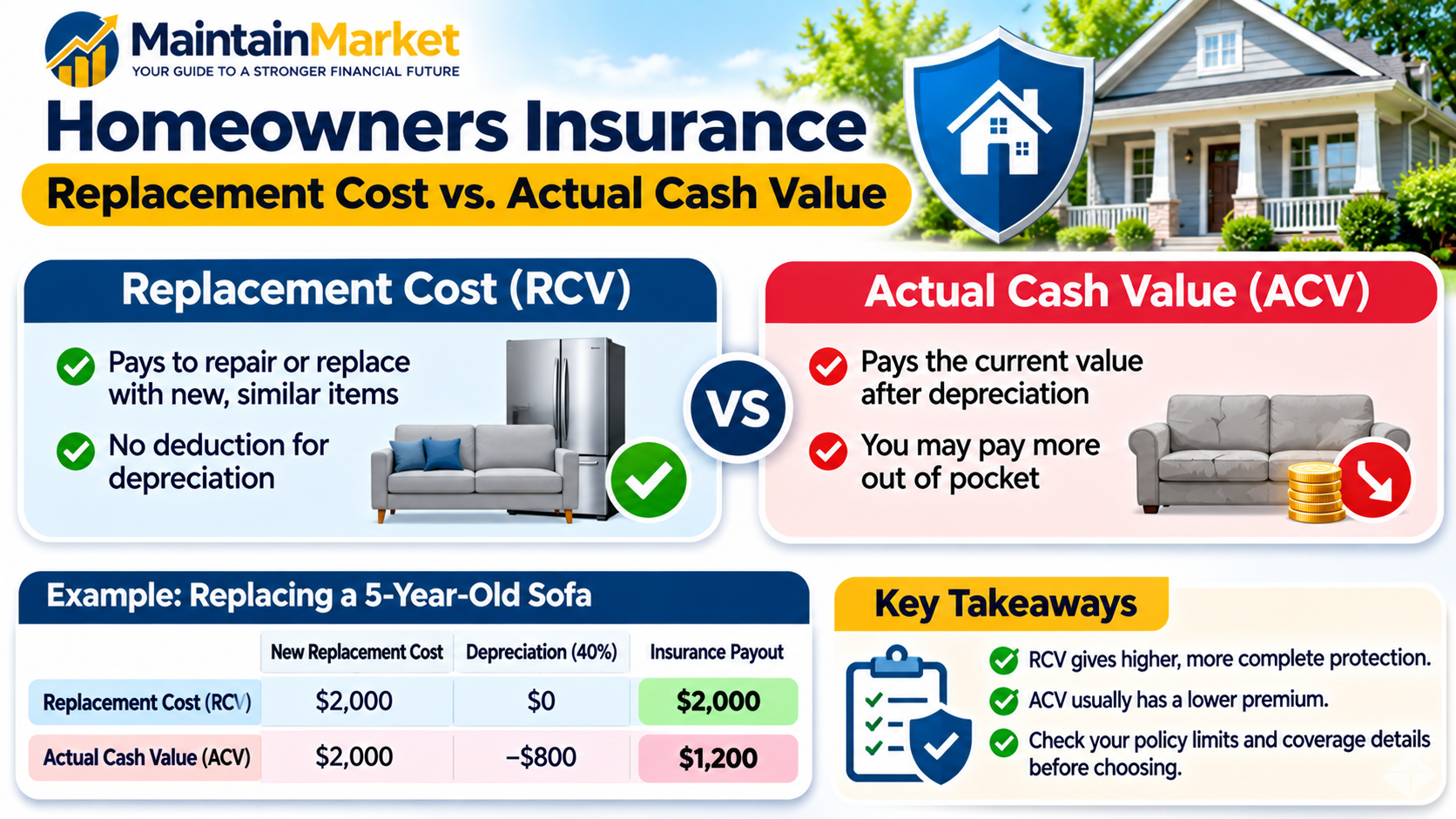
Replacement Cost vs Actual Cash Value: Quick Comparison
| Feature | Replacement Cost (RCV) | Actual Cash Value (ACV) |
|---|---|---|
| Depreciation | Generally not deducted | Deducted |
| Claim payment | Cost to repair or replace with comparable new property | Depreciated value of damaged property |
| Out-of-pocket costs | May be lower, depending on limits and terms | May be higher |
| Premium | Often higher | Often lower |
| Best suited for | Homeowners seeking stronger replacement protection | Homeowners prioritizing lower premiums who can handle more replacement costs |
The exact settlement depends on your policy language, coverage limits, deductible, exclusions, and applicable state rules.
What Is Replacement Cost Coverage?
Replacement cost coverage pays the amount needed to repair or replace damaged property using materials of similar kind and quality, without subtracting depreciation.
For example, imagine a covered fire damages your five-year-old refrigerator. A comparable new refrigerator costs $1,500. If your policy provides replacement cost coverage for that item, the insurer may calculate the claim using the cost of a comparable new refrigerator rather than its depreciated value.
However, replacement cost coverage does not automatically mean your insurance company will pay any amount necessary. The policy limit, deductible, sublimits, and specific replacement-cost conditions still apply.
How Replacement Cost Coverage Works
A typical replacement-cost claim may follow these steps:
- You report the covered damage to your insurance company.
- An insurance adjuster evaluates the damage and estimates the repair or replacement cost.
- The insurer may initially issue a payment based on actual cash value, withholding depreciation.
- You complete the required repairs or replacement.
- You submit invoices, receipts, or other required proof.
- If the policy conditions are satisfied, the insurer may release the recoverable depreciation.
Not every policy follows exactly the same payment process. Check your policy or ask your insurer how replacement-cost claims are settled.
What Is Actual Cash Value Coverage?
Actual cash value (ACV) coverage pays the value of damaged property after accounting for depreciation.
Depreciation is the reduction in an item’s value over time because of age, wear and tear, condition, and other relevant factors.
For example, suppose a five-year-old television originally cost $1,200. A comparable new television now costs $1,500, but the insurer determines that the damaged television’s depreciated value is $600.
Under an ACV settlement, the starting claim value may be $600 rather than the $1,500 needed to purchase a new television.
Your deductible and any applicable coverage limits would also affect the final payment.
How Actual Cash Value Coverage Works
The process is generally straightforward:
- You report a covered loss.
- The insurer assesses the damaged property.
- The insurer estimates its replacement or repair cost.
- Depreciation is deducted.
- Your deductible and applicable policy limits are considered.
- The insurer pays the covered amount under the policy.
Because depreciation is deducted, you may need to contribute more money to purchase a new item or complete repairs.
Replacement Cost vs Actual Cash Value: Example With Numbers
Let’s compare how the two coverage types could work after a covered incident.
Imagine a storm damages your roof. The estimated cost to replace the damaged portion with comparable materials is $15,000.
The insurer estimates depreciation at $4,000, and your deductible is $1,000.
These figures are illustrative, not an insurance quote or a standard depreciation schedule.
| Calculation | Replacement Cost | Actual Cash Value |
|---|---|---|
| Estimated replacement cost | $15,000 | $15,000 |
| Depreciation | $0 deducted from final RCV amount | $4,000 |
| Value before deductible | $15,000 | $11,000 |
| Deductible | $1,000 | $1,000 |
| Initial payment example | $10,000 | $10,000 |
| Potential additional recoverable depreciation | $4,000 | $0 |
| Total potential payment | $14,000 | $10,000 |
What does this mean?
With replacement cost coverage, the insurer may initially pay $10,000 and withhold $4,000 in recoverable depreciation. If you meet the policy’s repair and documentation requirements, you may receive the additional $4,000.
With ACV coverage, the insurer generally pays the depreciated amount, less the deductible. There is no recoverable depreciation simply because you later purchase a new roof.
In this example, the difference in total insurance payments is $4,000.
Actual claim settlements can differ. Some policies have special roof payment schedules, separate deductibles, depreciation rules, or other restrictions.
Replacement Cost vs Actual Cash Value for Personal Belongings
The difference does not apply only to your house. It can also affect your furniture, appliances, electronics, clothing, and other personal belongings.
Consider these examples:
| Damaged item | New replacement cost | Illustrative ACV |
|---|---|---|
| Television | $1,500 | $600 |
| Sofa | $2,000 | $800 |
| Laptop | $1,200 | $400 |
| Washing machine | $900 | $350 |
Under replacement cost coverage, the insurer generally uses the cost of a comparable replacement without deducting depreciation, subject to the policy.
Under ACV coverage, the insurer accounts for depreciation when calculating the property’s value.
Keep in mind that some items may have special limits or exclusions. Jewelry, collectibles, artwork, antiques, and certain electronics may require additional coverage or a scheduled personal property endorsement.
Does Replacement Cost Mean Your Insurance Will Pay the Full Cost to Rebuild Your Home?
Not necessarily.
This is one of the most important details homeowners should understand.
Replacement cost coverage does not automatically guarantee that your entire home can be rebuilt regardless of the cost.
Your dwelling coverage limit still matters. If rebuilding costs exceed your policy limit, you could be responsible for the difference unless you have additional protection.
For example:
- Estimated rebuilding cost: $450,000
- Dwelling coverage limit: $400,000
- Potential shortfall: $50,000
This simplified example assumes the full rebuilding cost is covered by the policy except for the limit. Actual claims may involve deductibles, exclusions, endorsements, and other conditions.
Some insurers offer extended replacement cost or guaranteed replacement cost coverage.
What Is Extended Replacement Cost Coverage?
Extended replacement cost coverage can provide additional protection above your dwelling coverage limit when the cost to rebuild exceeds the insured amount, subject to the endorsement’s percentage, conditions, and exclusions.
For example, a policy might offer an additional 25% above the dwelling limit. If the dwelling limit is $400,000, that could provide up to $100,000 in additional coverage, subject to the policy terms.
What Is Guaranteed Replacement Cost Coverage?
Guaranteed replacement cost coverage may pay the covered cost to rebuild the home even when it exceeds the dwelling coverage limit, subject to the specific policy conditions.
Availability and eligibility vary by insurer and state. Do not assume that a policy includes this protection simply because it advertises replacement cost coverage.
What Is the Difference Between Market Value and Replacement Cost?
Replacement cost and market value are not the same thing.
Market value is what your home could sell for in the real estate market. It can include the value of the land, location, neighborhood, and local housing demand.
Replacement cost is the estimated amount needed to rebuild the physical structure using comparable materials and construction methods.
For example:
- Home market value: $550,000
- Estimated rebuilding cost: $380,000
- Land value included in market value: $170,000
These are hypothetical figures.
Your homeowners insurance dwelling limit should generally be based on the estimated cost to rebuild your home, not simply its purchase price or current market value.
Construction labor, materials, architectural features, local building requirements, and debris removal can all affect rebuilding costs.
Which Is Better: Replacement Cost or Actual Cash Value?
For homeowners who want stronger financial protection after a covered loss, replacement cost coverage is often the more protective option.
However, the right choice depends on your budget, property, policy terms, and ability to pay for depreciation-related shortfalls.
When Replacement Cost Coverage May Make More Sense
Consider replacement cost coverage if:
- You want to reduce the financial impact of replacing damaged belongings.
- You would struggle to pay large repair or replacement costs yourself.
- You want coverage based on current prices for comparable materials and products.
- You own a home with substantial rebuilding costs.
- You prefer stronger protection even if the premium is higher.
When Actual Cash Value Coverage May Be Considered
ACV coverage may be worth comparing if:
- Keeping your insurance premium lower is a priority.
- You can afford to pay more out of pocket after a covered loss.
- You are insuring older property or belongings.
- You understand how depreciation affects claim payments.
- The policy offers terms that make sense for your financial situation.
Do not choose ACV coverage based on premium alone. Compare the potential claim payment and the amount you could personally afford to pay after a major loss.
Can a Homeowners Insurance Policy Have Both Replacement Cost and Actual Cash Value Coverage?
Yes. A homeowners insurance policy can use different claim settlement methods for different types of property.
For example, a policy might provide:
- Replacement cost coverage for the dwelling.
- Actual cash value coverage for personal belongings.
- Special settlement terms for certain roofs or exterior materials.
- Separate limits for jewelry, collectibles, or other valuable items.
This means having replacement cost coverage for your home does not necessarily mean every item inside it is covered on a replacement-cost basis.
Review the declarations page, policy forms, and endorsements to understand how each category is insured.
What Is Recoverable Depreciation in Homeowners Insurance?
Recoverable depreciation is the amount withheld from an initial claim payment when a policy provides replacement cost coverage but the insurer first calculates or pays the depreciated value.
If you complete the required repairs or replacement and provide the requested documentation, the insurer may release that withheld amount.
For example:
- Estimated replacement cost: $12,000
- Depreciation withheld: $3,000
- Deductible: $1,000
- Initial payment: $8,000
- Potential recoverable depreciation: $3,000
- Total potential payment: $11,000
The deductible is still your responsibility in this example.
Is Recoverable Depreciation Always Paid?
No. You generally need to satisfy the policy’s requirements.
Depending on the policy, these may include:
- Completing the repair or replacement.
- Using comparable materials or products.
- Submitting invoices and receipts.
- Completing the work within a specified time.
- Staying within the applicable coverage limit.
Ask your adjuster for the deadline and documentation requirements. Do not assume that withheld depreciation will be paid automatically.
How to Check Whether Your Homeowners Insurance Has Replacement Cost or ACV Coverage
You do not need to wait until you file a claim to find out how your property is insured.
Follow these steps:
1. Check your declarations page
Look for your dwelling coverage, personal property coverage, deductibles, and any references to replacement cost or actual cash value.
2. Review your policy forms
The declarations page may not explain every settlement condition. Read the relevant sections of your policy.
3. Check your endorsements
Look for additional provisions covering replacement cost, extended replacement cost, roof settlement schedules, and valuable personal property.
4. Ask your insurer directly
Ask whether your dwelling and personal belongings are covered at replacement cost or ACV.
5. Request a rebuilding-cost estimate
Ask your insurer or agent how your dwelling coverage limit was calculated and whether it reflects current local construction costs.
6. Review your coverage annually
Construction costs, home improvements, and the value of your belongings can change. Revisit your coverage when you renovate, add features, or purchase expensive items.
Questions to Ask Your Homeowners Insurance Agent
Before choosing or renewing a policy, ask:
- Is my dwelling covered at replacement cost or actual cash value?
- Are my personal belongings covered at replacement cost?
- Are roofs settled at replacement cost or under a depreciation schedule?
- Does my policy include extended or guaranteed replacement cost?
- How is depreciation calculated?
- Can I recover withheld depreciation, and what is the deadline?
- What deductible applies to wind, hail, or other covered events?
- Are there special limits for jewelry, electronics, or collectibles?
- Does my dwelling coverage reflect current rebuilding costs?
Getting clear answers can help prevent unpleasant surprises during a claim.
Frequently Asked Questions
1. Is replacement cost better than actual cash value?
Replacement cost is generally more protective because it does not deduct depreciation when calculating the covered replacement cost. ACV deducts depreciation, which can result in a lower payment. However, replacement cost often comes with a higher premium, and policy limits and conditions still apply.
2. Why is actual cash value cheaper than replacement cost?
ACV coverage generally exposes the insurer to a lower claim payment because depreciation is deducted. That can make the policy less expensive. Actual premiums depend on the insurer, property, location, deductible, coverage limits, and other underwriting factors.
3. Does replacement cost coverage pay for a brand-new item?
It may pay the cost of a comparable new item of like kind and quality, without deducting depreciation. It does not necessarily pay for an upgraded or more expensive product. Policy terms and replacement requirements apply.
4. Does actual cash value include depreciation?
Yes. Actual cash value generally accounts for depreciation based on factors such as age, condition, and wear and tear.
5. Can I switch from ACV to replacement cost coverage?
Possibly. Many insurers offer replacement cost options or endorsements, but eligibility, availability, and pricing vary. Contact your insurer to ask whether your home and belongings qualify.
6. Is replacement cost the same as market value?
No. Replacement cost estimates the amount needed to repair or rebuild a structure or replace an item with comparable property. Market value reflects what a property may sell for and can include land value and location.
7. What happens if rebuilding costs exceed my dwelling coverage limit?
You may have to pay the difference unless your policy includes additional protection, such as extended or guaranteed replacement cost coverage. Review your policy’s limits and endorsements before a loss occurs.
8. What is recoverable depreciation?
Recoverable depreciation is the amount withheld from an initial payment under certain replacement-cost claims. You may receive it after completing the required repairs or replacement and submitting acceptable documentation.
9. Are roofs always covered at replacement cost?
No. Some policies provide replacement cost for roofs, while others use actual cash value, age-based schedules, or special roof settlement provisions. Check your policy and endorsements for the exact terms.
10. Does replacement cost coverage apply to personal belongings?
It can, but not automatically. Some policies provide replacement cost for the dwelling and ACV for personal property unless you purchase an additional endorsement. Valuable items may also have special limits.
Final Thoughts: Understand Your Coverage Before Filing a Claim
The difference between homeowners insurance replacement cost vs actual cash value can determine how much money you receive after a covered loss.
Replacement cost coverage generally provides a higher level of protection because it does not deduct depreciation from the covered cost of repairing or replacing property. ACV coverage accounts for depreciation and may leave you with a larger out-of-pocket expense.
Before selecting a policy, check how your home, roof, and personal belongings are insured. Compare premiums, deductibles, coverage limits, and replacement-cost conditions rather than choosing a policy based on price alone.
A few minutes spent reviewing your homeowners insurance today could help you avoid a significant financial gap when you need to make a claim.
Disclaimer: This article is for general educational purposes only and does not constitute insurance, financial, or legal advice. Homeowners insurance coverage, claim settlement methods, exclusions, and requirements vary by insurer, state, and policy. Review your policy documents and consult your insurance company or licensed insurance professional about your coverage.
Authoritative Sources
- National Association of Insurance Commissioners (NAIC): Actual Cash Value vs. Replacement Cost
- NAIC: Consumer Homeowners Insurance Guide
- Consumer Financial Protection Bureau: How Home Insurance Companies Pay Out Claims
- North Carolina Department of Insurance: Actual Cash Value vs. Replacement Cost Value
- California Department of Insurance: Residential Property Claims Guide
- Texas Office of Public Insurance Counsel: ACV vs. RCV
Recommended Reads:
- 10 Important Facts: Does Homeowners Insurance Cover Mold?
- Does Homeowners Insurance Cover Plumbing?
- 10 Important Facts: Does Homeowners Insurance Cover Foundation Problems?
- 10 Important Facts: Does Homeowners Insurance Cover Sewer Backup?
- 10 Important Facts: Does Homeowners Insurance Cover Tree Damage?