
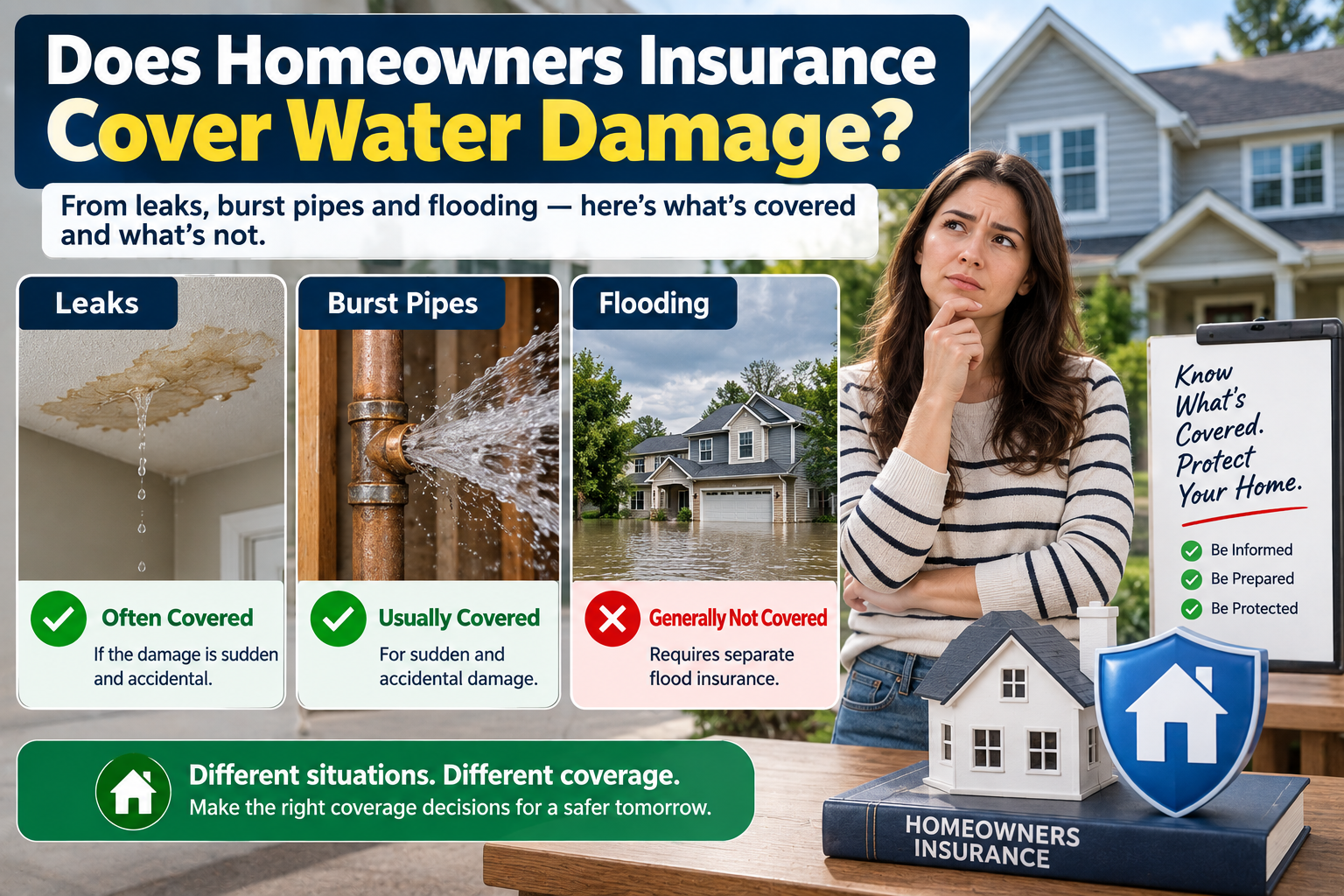
Does homeowners insurance cover water damage? In many cases, yes—but it depends on where the water came from and why the damage occurred. Homeowners insurance generally covers sudden and accidental water damage, such as a burst pipe or ruptured appliance, but standard policies usually exclude flood damage, gradual leaks caused by poor maintenance, and certain sewer or drain backups.
That distinction is extremely important. Two homeowners can have serious water damage but receive completely different insurance outcomes depending on the source of the water.
In this guide, we’ll explain when homeowners insurance typically covers water damage, when it doesn’t, what happens with burst pipes, roof leaks, flooding, sewer backups, mold, plumbing problems and more.
Quick Answer: Does Homeowners Insurance Cover Water Damage?
Yes, homeowners insurance can cover water damage when the loss results from a covered, sudden and accidental event.
For example, a standard homeowners policy may cover resulting damage when:
- A pipe suddenly bursts
- A water heater suddenly ruptures
- A washing machine hose suddenly breaks
- A dishwasher unexpectedly leaks
- A covered roof event allows water into the home
- A frozen pipe bursts despite reasonable preventive care
However, standard homeowners insurance generally does not cover:
- Flooding from outside water
- Gradual leaks
- Poor maintenance
- Long-term seepage
- Certain sewer backups
- Sump pump failures unless appropriate coverage applies
- Damage resulting from neglect
The exact answer depends on your policy, exclusions, endorsements, deductible and the circumstances of the loss.
What Types of Water Damage Does Homeowners Insurance Cover?
The key phrase to remember is:
Sudden and accidental water damage
A typical homeowners policy may cover resulting damage from an accidental discharge or overflow from plumbing, heating, air-conditioning systems, fire-protection sprinkler systems or household appliances.
Here are some common examples.
1. Burst Pipe
If a pipe suddenly bursts and water damages your walls, floors or belongings, homeowners insurance may cover the resulting damage.
However, your policy may not pay to replace the defective or worn-out pipe itself.
NAIC specifically notes that homeowners policies often cover resulting water damage from a burst pipe when reasonable steps were taken to maintain the plumbing and prevent freezing.
2. Water Heater Rupture
If your water heater suddenly breaks and releases a large amount of water, the resulting damage to covered property may be insured.
For example, water could damage:
- Flooring
- Drywall
- Cabinets
- Furniture
- Personal belongings
However, the failed appliance itself may not be covered if its failure resulted from wear and tear or another excluded cause.
3. Washing Machine Leak
Suppose a washing machine hose suddenly breaks while you’re away.
You return home and discover water across the laundry room floor.
If the loss is covered by your policy, homeowners insurance may help pay for the resulting covered property damage, subject to your deductible and policy terms.
4. Dishwasher Leak
A dishwasher can cause significant damage if a hose or internal component suddenly fails.
If the water release is sudden and accidental, the resulting damage may be covered.
However, normal deterioration or a long-term unresolved leak may lead to a different coverage decision.
5. Frozen Pipe That Bursts
Frozen pipes can create major water damage during winter.
Homeowners insurance may cover resulting damage if the pipe burst suddenly and you took reasonable precautions to prevent freezing.
For example, insurers may expect homeowners to maintain adequate heat or shut off and drain water systems when a home is vacant, depending on the policy.
What Water Damage Is Not Covered by Homeowners Insurance?
This is where many homeowners become confused.
Homeowners insurance isn’t designed to cover every type of water problem.
Common exclusions can include:
Flooding
Water entering your home from an overflowing river, storm surge, heavy runoff or other external flooding generally isn’t covered by a standard homeowners policy.
Separate flood insurance is generally required for flood damage.
Gradual Leaks
A slow leak that continues for months because it wasn’t repaired may not be covered.
Insurance generally isn’t intended to pay for damage caused by a homeowner’s failure to maintain the property.
Sewer Backup
Sewer or drain backup generally requires separate optional coverage or an endorsement.
Don’t assume your standard homeowners policy automatically covers it.
Sump Pump Overflow
Sump pump-related water damage may require an additional endorsement, depending on your policy.
Wear and Tear
If an old plumbing component deteriorates over time and eventually leaks, the resulting claim may be limited or excluded depending on the circumstances and policy language.
Water Damage Coverage: Covered vs. Not Covered
| Water Damage Situation | Usually Covered? |
|---|---|
| Sudden burst pipe | ✅ Often |
| Water heater suddenly ruptures | ✅ Often |
| Washing machine suddenly leaks | ✅ Often |
| Dishwasher suddenly leaks | ✅ Often |
| Frozen pipe bursts | ✅ Often, if reasonable precautions were taken |
| Gradual plumbing leak | ❌ Usually not |
| Poor maintenance | ❌ Usually not |
| Flood from outside water | ❌ Not under standard homeowners insurance |
| River overflow | ❌ Generally not |
| Storm surge | ❌ Generally not |
| Sewer backup | ⚠️ Usually requires additional coverage |
| Sump pump failure | ⚠️ May require additional coverage |
| Groundwater seepage | ❌ Generally not |
| Mold from an excluded water event | ❌ May not be covered |
These are general guidelines. Your actual policy wording and endorsements control the claim.
Does Homeowners Insurance Cover Water Damage From a Burst Pipe?
Generally, yes, homeowners insurance may cover the resulting damage from a sudden burst pipe.
For example, imagine a pipe behind your kitchen wall suddenly bursts.
Water damages:
- Drywall
- Cabinets
- Flooring
- Appliances
- Furniture
Your homeowners policy may help cover the resulting covered damage after your deductible.
However, the insurer may investigate why the pipe burst.
If the damage resulted from neglect or failure to take reasonable precautions, coverage could be affected.
Does Homeowners Insurance Cover a Plumbing Leak?
It depends on whether the leak was sudden or gradual.
Sudden leak
A pipe suddenly breaks and releases water.
Coverage may apply.
Gradual leak
A pipe has been slowly leaking behind a wall for months.
Coverage may be denied or limited.
Insurance generally doesn’t exist to pay for ongoing maintenance problems that a homeowner could reasonably have discovered and repaired.
Does Homeowners Insurance Cover Water Damage From a Roof Leak?
It depends on why the roof leaked.
If a covered event damages the roof and water subsequently enters your home, the resulting damage may be covered.
For example:
Severe covered storm → roof damage → rain enters home → interior damage
That can be different from:
Old roof → years of deterioration → gradual leak → interior damage
The second situation may be considered a maintenance issue rather than a sudden covered loss.
NAIC notes that water damage from a home’s plumbing or a roof leak is typically covered in appropriate circumstances, while flood damage from groundwater, rain runoff or snowmelt is not covered by a standard homeowners policy.
Does Homeowners Insurance Cover Flood Damage?
Generally, no.
Standard homeowners insurance usually excludes flood damage.
Flooding can occur when:
- Rivers overflow
- Heavy rain causes external flooding
- Storm surge enters the property
- Snowmelt causes widespread flooding
- Water rises from surrounding land
- A body of water overflows
Separate flood insurance may be available through the National Flood Insurance Program (NFIP) or private insurers.
This is one of the biggest misconceptions about homeowners insurance.
Water damage and flood damage are not automatically the same thing from an insurance perspective.
Does Homeowners Insurance Cover Sewer Backup?
Usually, not under a basic standard homeowners policy.
Sewer or drain backup coverage may be available as an optional endorsement.
For example, if sewage backs up through a drain and damages your basement, your standard homeowners policy may not cover the loss unless you purchased the appropriate additional coverage.
If your home has a basement or is in an area with sewer-backup risk, this is an endorsement worth discussing with your insurer.
Does Homeowners Insurance Cover Sump Pump Failure?
Not necessarily.
Damage caused by a sump pump failure or overflow may require specific additional coverage.
This is particularly important for homeowners with:
- Finished basements
- Below-ground living spaces
- Sump pumps
- Homes in areas prone to heavy rainfall
Check whether your policy includes water-backup or sump-pump coverage before assuming you’re protected.
Does Homeowners Insurance Cover Mold Caused by Water Damage?
Mold coverage depends heavily on what caused the water damage.
If mold develops following a covered water loss, some policies may provide limited coverage under certain circumstances.
But mold caused by long-term moisture, poor maintenance or an excluded water event may not be covered.
For example:
Covered burst pipe → sudden water damage → mold develops
may be treated differently from:
Months-long hidden leak → moisture buildup → mold
Your policy’s mold provisions and exclusions matter here.
Does Homeowners Insurance Cover Water Damage to Personal Belongings?
It can.
Homeowners policies generally include personal property coverage for covered losses.
For example, if a covered burst pipe damages:
- Television
- Clothing
- Furniture
- Electronics
- Books
- Appliances
your personal property coverage may help pay for covered losses, subject to policy limits, deductibles and valuation rules.
Remember that personal property coverage can have special limits for certain categories of items, so review your policy if you own expensive valuables.
Does Homeowners Insurance Pay for the Plumbing Repair?
Not necessarily.
This distinction is extremely important.
Your homeowners insurance may cover the resulting damage without paying to replace the failed plumbing component itself.
For example:
Broken pipe: potentially not covered
Water damage to walls and flooring caused by the pipe: potentially covered
The exact outcome depends on the cause of the failure and your policy language.
Does Homeowners Insurance Cover Water Damage From an Appliance?
It can if the appliance suddenly and accidentally releases water and the resulting damage is covered by the policy.
Examples include:
- Washing machine
- Dishwasher
- Water heater
- Refrigerator water line
However, the cost of repairing or replacing the appliance itself may not be covered if the problem resulted from wear and tear or mechanical failure.
Does Homeowners Insurance Cover Basement Water Damage?
It depends entirely on how the water entered the basement.
Burst pipe
Coverage may apply.
Sewer backup
Additional coverage may be required.
Sump pump failure
Additional coverage may be required.
Groundwater seepage
Generally not covered.
Flooding
Generally requires flood insurance.
This is why saying “my basement flooded” isn’t enough to determine coverage. The insurer needs to know where the water came from.
What Happens If You Have Water Damage in Your Home?
If you discover significant water damage, act quickly.
Step 1: Stop the source if it’s safe
Turn off the water supply if you can safely do so.
Step 2: Prevent additional damage
Move belongings away from the water and take reasonable steps to protect the property.
Step 3: Document everything
Take photos and videos before making major repairs, if it’s safe.
Document:
- Where the water came from
- Damaged rooms
- Damaged belongings
- Visible structural damage
- The suspected cause
Step 4: Contact your insurer
Report the loss promptly and ask what documentation is required.
Step 5: Keep receipts
Save receipts for reasonable emergency expenses and temporary repairs.
Step 6: Don’t make permanent repairs before inspection unless necessary
Your insurer may want to inspect the damage.
However, don’t leave your home exposed to additional damage simply to wait for an adjuster. Follow your insurer’s instructions and take reasonable emergency measures.
How Much Water Damage Will Homeowners Insurance Pay For?
There is no single amount.
The insurer considers factors such as:
- Cause of the water damage
- Whether the loss is covered
- Policy limits
- Deductible
- Type of property damaged
- Replacement cost or actual cash value provisions
- Applicable exclusions
- Additional endorsements
For example, if covered damage totals $20,000 and your deductible is $2,000, the claim calculation may start with the covered loss minus the applicable deductible.
But the final settlement can depend on much more than this simple calculation.
Water Damage Deductible Example
Imagine a burst pipe causes $15,000 in covered damage.
Your homeowners insurance deductible is:
$2,500
If the entire $15,000 is covered, a simplified calculation would be:
$15,000 − $2,500 = $12,500
The insurer could potentially pay $12,500, subject to the policy terms, limits and claim evaluation.
The deductible is your portion of the covered loss before the insurance payment begins.
Will a Water Damage Claim Increase Your Homeowners Insurance?
It can.
A water damage claim may affect future insurance costs or underwriting decisions, but the impact varies by insurer, state, claim history and circumstances.
This doesn’t mean you should avoid filing a legitimate claim.
Instead, consider:
- The severity of the damage
- Your deductible
- Whether the loss is clearly covered
- Your claim history
- The potential financial impact of paying out of pocket
For a very small loss only slightly above your deductible, some homeowners may choose to handle it themselves. For a major covered loss, filing a claim may be financially necessary.
How to Prevent Water Damage in Your Home
Prevention can be much cheaper than dealing with a major water-loss claim.
Check your plumbing regularly
Look for:
- Dripping faucets
- Wet cabinets
- Rust
- Corrosion
- Water stains
- Damp walls
- Unusual odors
Know where your main water shutoff is
If a pipe suddenly bursts, knowing how to shut off your home’s water can significantly reduce additional damage.
Protect pipes during freezing weather
Insulate vulnerable pipes and take appropriate precautions when temperatures drop.
NAIC recommends reasonable steps such as maintaining heat, insulating exposed pipes and properly winterizing homes to reduce the risk of frozen pipes.
Inspect your roof
Look for damaged shingles, flashing problems and other potential sources of water intrusion.
Maintain appliances
Inspect hoses and connections on washing machines, dishwashers and other water-using appliances.
Clean gutters
Blocked gutters can contribute to water intrusion and drainage problems.
Consider water-leak detection devices
Smart leak sensors can alert you when unexpected water is detected.
Homeowners Insurance vs Flood Insurance for Water Damage
This comparison is essential.
| Situation | Homeowners Insurance | Flood Insurance |
|---|---|---|
| Burst interior pipe | ✅ Often | Usually unnecessary |
| Water heater rupture | ✅ Often | Usually unnecessary |
| Washing machine suddenly leaks | ✅ Often | Usually unnecessary |
| River overflow | ❌ | ✅ |
| Storm surge | ❌ | ✅ |
| External floodwater | ❌ | ✅ |
| Groundwater from flooding | ❌ | ✅ |
| Sewer backup | ⚠️ May require endorsement | Generally not the same coverage |
| Gradual plumbing leak | ❌ Usually | ❌ Usually |
Standard homeowners insurance and flood insurance protect against different types of water-related losses.
Common Water Damage Insurance Mistakes
1. Assuming all water damage is covered
The source of the water matters enormously.
2. Confusing flood insurance with homeowners insurance
Standard homeowners insurance generally doesn’t cover flood damage.
3. Ignoring a small leak
A minor leak can become a major maintenance problem.
4. Assuming the broken appliance is covered
Your policy may cover resulting water damage without covering the failed appliance itself.
5. Forgetting about sewer backup coverage
Standard coverage may not automatically include sewer or drain backup.
6. Waiting too long to report major damage
Promptly notify your insurer and follow its claims instructions.
7. Failing to document the damage
Photos, videos, receipts and maintenance records can be useful when handling a claim.
A Simple Water Damage Coverage Test
When you discover water damage, ask these five questions:
Question 1:
Where did the water come from?
Pipe? Roof? River? Sewer? Ground?
Question 2:
Was the event sudden or gradual?
Sudden events are more likely to be covered than long-term maintenance problems.
Question 3:
Was the cause a covered peril?
Check your policy.
Question 4:
Do I have an endorsement for this type of water damage?
Sewer backup and sump-pump coverage may require additional protection.
Question 5:
What is my deductible?
A claim may not make financial sense for a very small loss.
Frequently Asked Questions
Q1. Does homeowners insurance cover water damage?
Yes, homeowners insurance can cover water damage when it results from a covered sudden and accidental event, such as a burst pipe or ruptured appliance. Flooding, gradual leaks and some types of water backup are generally treated differently.
Q2. Does homeowners insurance cover a burst pipe?
Usually, resulting damage from a sudden burst pipe may be covered if the loss is otherwise covered under the policy. Coverage can be affected if the homeowner failed to take reasonable steps to prevent freezing or maintain the plumbing.
Q3. Does homeowners insurance cover a slow leak?
Usually, gradual leaks caused by long-term deterioration or lack of maintenance are not covered. Your insurer may distinguish between the resulting damage and the underlying maintenance problem.
Q4. Does homeowners insurance cover flood damage?
Standard homeowners insurance generally does not cover flood damage from external water such as overflowing rivers, storm surge or widespread runoff. Separate flood insurance is generally needed for this type of risk.
Q5. Does homeowners insurance cover sewer backup?
A standard policy generally does not automatically cover sewer or drain backup. You may be able to add water-backup or sewer-backup coverage through an endorsement.
Q6. Does homeowners insurance cover water damage from a washing machine?
It may cover resulting damage if the washing machine suddenly and accidentally releases water. The cost of repairing or replacing the machine itself may not be covered if the problem resulted from wear and tear.
Q7. Does homeowners insurance cover water heater damage?
If a water heater suddenly ruptures and causes covered water damage, the resulting damage may be covered. However, the failed water heater itself may not be covered, particularly when the failure results from wear and tear.
Q8. Does homeowners insurance cover roof leaks?
It depends on the cause of the leak. Water entering through a roof damaged by a covered event may be covered, while leaks caused by deterioration or poor maintenance may be excluded.
Q9. Does homeowners insurance cover basement water damage?
It depends on how the water entered the basement. A burst pipe may be covered, while flooding, groundwater seepage, sewer backup or sump-pump failure may require separate or additional coverage.
Q10. Should I file a homeowners insurance claim for water damage?
For significant damage that appears potentially covered, contacting your insurer is usually sensible. For a small loss only slightly above your deductible, you may want to consider the financial tradeoff before filing.
Q11. How much water damage will homeowners insurance cover?
There is no universal amount because coverage depends on your policy limits, deductible, cause of loss, type of property damaged and applicable exclusions. Your insurer determines the covered amount after evaluating the claim.
Q12. Does homeowners insurance cover mold caused by water damage?
Mold coverage depends on the cause of the water damage and the policy’s mold provisions. Mold resulting from a covered sudden water loss may receive different treatment from mold caused by long-term moisture or an excluded event.
Final Verdict: Does Homeowners Insurance Cover Water Damage?
So, does homeowners insurance cover water damage?
Often, yes—but not all water damage.
The most important factor is the source and cause of the water.
A sudden burst pipe, ruptured water heater or unexpected appliance leak may result in covered water damage. On the other hand, flooding, gradual leaks, poor maintenance and many sewer-backup situations generally require different coverage or may be excluded.
The best thing you can do is review your homeowners policy before you have a water emergency.
Check:
- Water damage exclusions
- Deductible
- Flood coverage
- Sewer-backup coverage
- Sump-pump coverage
- Personal property limits
- Mold provisions
- Roof coverage
And remember: water damage is not automatically the same thing as flood damage in insurance terms.
Why Maintain Market Is Different
At Maintain Market, we explain homeowners and insurance topics in straightforward language so readers can understand what their policy actually means before they need to make a claim.
Instead of simply saying “yes” or “no,” we break water damage down by its source, cause, coverage type, deductible and exclusions.
That matters because the difference between a burst pipe, a slow leak, sewer backup and flooding can completely change the insurance outcome.
Before making a claim or changing your coverage, always check your actual policy and speak with your insurer or insurance professional about your specific situation.
Also read: Best Car Insurance Companies for Low Credit Score