
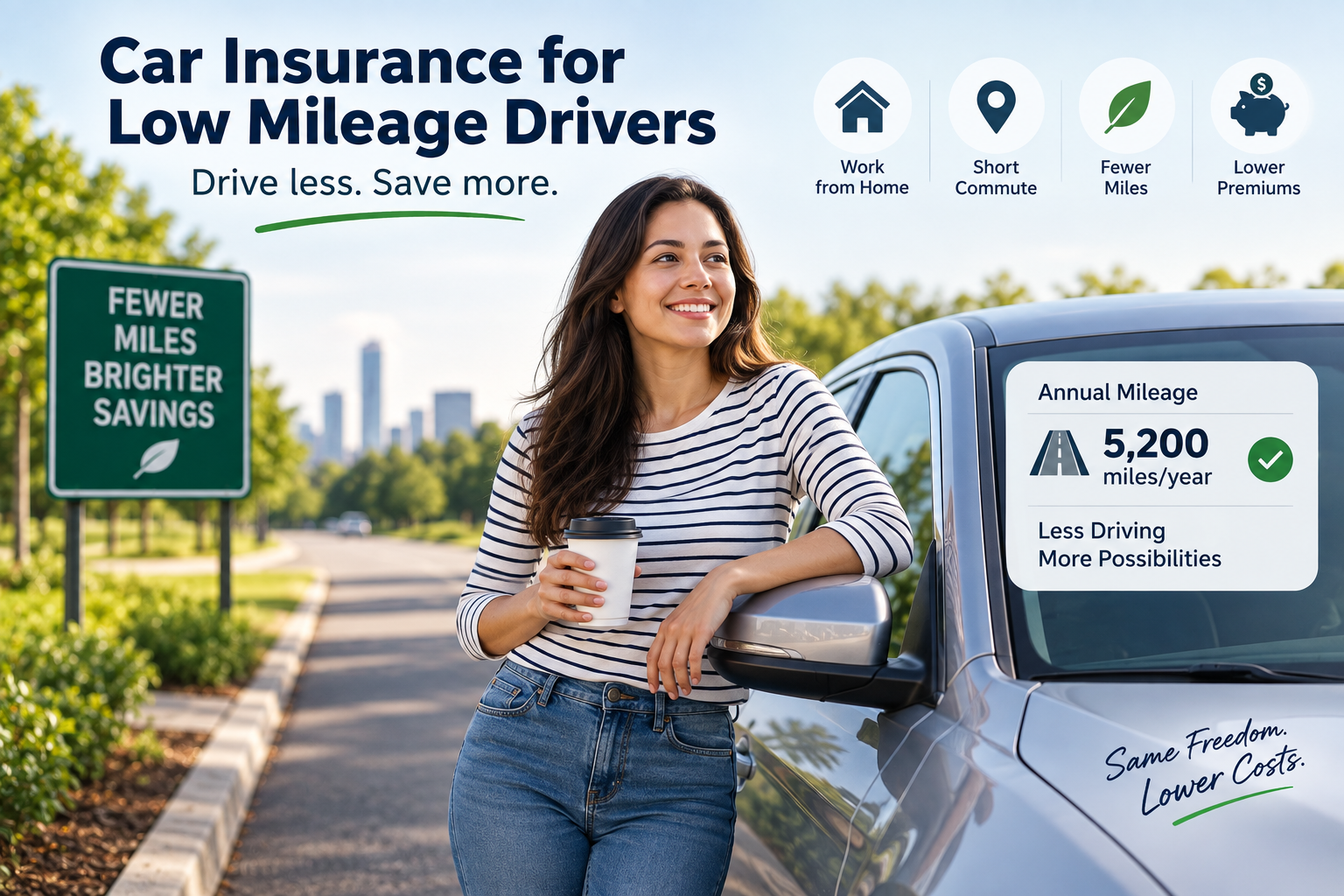
Car insurance for low mileage drivers can be cheaper than standard coverage because driving fewer miles generally means less time on the road and potentially lower accident exposure. However, there is no single mileage number that automatically qualifies every driver for a lower rate. Insurers use different mileage thresholds, rating methods and discount programs.
If you work from home, use public transportation, have a short commute, own a second car, or simply don’t drive very often, you may have several ways to reduce what you pay for car insurance.
Quick Answer: Is Car Insurance Cheaper for Low Mileage Drivers?
Yes, car insurance can be cheaper for low mileage drivers, but the amount you save depends on the insurer, your state, driving history, vehicle, coverage and actual mileage.
Insurance companies may offer a low-mileage discount, adjust your rate based on reported annual mileage, or offer usage-based insurance that considers how much and how you drive.
The National Association of Insurance Commissioners (NAIC) lists mileage and vehicle use among the factors insurers may consider when pricing auto insurance and notes that some insurers offer low-mileage discounts.
What Is a Low Mileage Driver?
A low mileage driver is someone who drives significantly less than other drivers in a similar situation.
There is no universal U.S. definition of “low mileage.” Each insurance company can use its own rating rules and may consider factors such as estimated annual mileage, commute distance and vehicle use.
You might be considered a low-mileage driver if you:
- Work from home
- Have a very short commute
- Take public transportation regularly
- Walk or bike frequently
- Use your car mainly on weekends
- Have a second vehicle
- Rarely use your car
- Are retired and drive less frequently
- Live close to work and essential services
- Use another form of transportation for most trips
The important point is that driving less does not automatically guarantee a discount. You need to ask your insurer how it treats your mileage.
How Does Mileage Affect Car Insurance Rates?
Mileage can affect insurance pricing because driving more generally means spending more time exposed to traffic and potential accidents.
NAIC identifies miles driven and vehicle use as rating factors that insurers may consider when calculating premiums.
For example, consider two drivers:
Driver A: Drives 4,000 miles per year
Driver B: Drives 18,000 miles per year
The second driver spends considerably more time on the road, which can mean greater exposure to accidents.
However, mileage is only one factor. Your insurer may also consider:
- Driving record
- Claims history
- Location
- Vehicle
- Age
- Driving experience
- Credit-based insurance score where permitted
- Previous insurance coverage
- Coverage limits
- Deductibles
- Vehicle use
So a low-mileage driver can still have a relatively high premium if other rating factors increase the insurer’s assessment of risk.
How Many Miles a Year Is Considered Low Mileage for Car Insurance?
There is no standard mileage threshold used by every insurance company.
One insurer might offer a low-mileage discount at one mileage level, while another may use a different threshold or pricing system.
Some insurers ask for your estimated annual mileage. Others may focus on commute distance, while usage-based insurance programs can collect actual driving information through telematics.
Progressive, for example, explains that insurers have their own criteria for determining what counts as low mileage and how mileage affects rates.
The important question isn’t:
“What mileage qualifies everywhere?”
Instead, ask:
“How does my insurance company price drivers who drive as little as I do?”
What Is Low Mileage Car Insurance?
Low-mileage car insurance generally refers to insurance options designed to account for drivers who use their vehicles less frequently or drive fewer miles.
Depending on the insurer, this can include:
- Traditional insurance with a low-mileage discount
- Usage-based insurance
- Pay-per-mile insurance
- A mileage-based rating adjustment
These options are not identical.
A low-mileage discount may simply reduce your premium because you report relatively low annual mileage.
Usage-based insurance may track both mileage and driving behavior.
Pay-per-mile insurance can tie part of the premium directly to the number of miles driven.
Low Mileage Discount vs. Pay-Per-Mile Insurance
These terms are sometimes used interchangeably, but they are different.
| Feature | Low-Mileage Discount | Pay-Per-Mile Insurance |
|---|---|---|
| Pricing | Traditional premium with discount | Often includes base + mileage component |
| Mileage tracked | May be reported/verified | Usually tracked more directly |
| Driving behavior | Usually not the main focus | Depends on program |
| Best for | Drivers who drive less | Drivers who drive very little |
| Availability | Varies by insurer/state | More limited |
| Potential savings | Depends on discount | Depends heavily on mileage and base rate |
Not every insurer offers pay-per-mile insurance.
Progressive notes that pay-per-mile insurance is relatively uncommon and that some low-mileage drivers may find usage-based insurance more advantageous.
What Is Usage-Based Insurance?
Usage-based insurance (UBI) uses technology to help insurers price coverage based partly on how and how much you drive.
Depending on the program, telematics may measure:
- Miles driven
- Time of day
- Speed
- Hard braking
- Rapid acceleration
- Hard cornering
- Location or GPS-related information
- Other driving behaviors
NAIC explains that UBI programs can use telematics devices, connected vehicles or smartphone applications to collect driving information.
For a low-mileage driver who also drives safely, UBI may provide an opportunity to reduce insurance costs.
However, you should understand exactly what information is collected and how the insurer uses it before enrolling.
Can Low Mileage Drivers Save Money With Usage-Based Insurance?
They can, but it depends on the specific program.
A low-mileage driver may benefit because some UBI programs consider both mileage and driving behavior.
For example, someone who drives only 5,000 miles per year and generally avoids hard braking and rapid acceleration could potentially receive favorable pricing under a program that rewards those behaviors.
But don’t assume UBI will always produce a lower premium.
Some programs can use driving behavior to adjust rates, and the rules differ by insurer and state.
NAIC recommends understanding what data is collected and how it can affect your premium before signing up.
Who Should Consider Car Insurance for Low Mileage Drivers?
Low-mileage insurance options may be worth investigating if you fall into one of these categories.
1. Work-From-Home Employees
If you previously drove to an office every day but now work remotely, your annual mileage may have dropped substantially.
Tell your insurer about the change instead of continuing to report an outdated commute.
2. Retirees
Retirees may drive fewer miles because they no longer commute to work every weekday.
If your driving habits have changed significantly, ask your insurer whether your policy can be re-rated.
3. Public Transportation Users
If you use buses, trains or other public transportation for most trips, you may drive your car much less than the average driver.
That lower mileage could potentially help reduce your insurance cost.
4. Drivers With a Second Car
Some households have one primary vehicle and another car that is rarely used.
The low-use vehicle may qualify for different pricing depending on the insurer.
5. Weekend Drivers
If you mainly use your vehicle for weekend trips, shopping and occasional errands, your annual mileage may be relatively low.
Ask your insurer whether a low-mileage discount or usage-based program is available.
How to Get Cheaper Car Insurance as a Low Mileage Driver
If you don’t drive much, don’t simply assume your insurer already knows.
Try these steps.
1. Tell Your Insurer Your Current Mileage
If your driving habits have changed, contact your insurer and ask whether your premium can be adjusted.
For example, moving from a daily commute to working from home could significantly reduce your annual mileage.
NAIC advises drivers who substantially reduce their annual mileage to contact their insurer about possible lower-mileage pricing.
2. Ask About a Low-Mileage Discount
Some insurance companies offer specific discounts for drivers who don’t drive many miles.
NAIC specifically lists low mileage among the discounts consumers should ask insurers about.
Don’t assume the discount is automatic.
Ask:
“Do you offer a low-mileage discount, and what mileage qualifies?”
3. Compare Usage-Based Insurance
If your insurer offers a telematics program, compare the potential savings with your current premium.
Look at:
- Mileage tracking
- Driving behavior tracking
- Privacy considerations
- Whether rates can increase
- Program availability in your state
- How long the monitoring lasts
4. Compare Multiple Insurance Companies
The cheapest insurer for a low-mileage driver isn’t necessarily the cheapest insurer for everyone.
Different companies can weigh mileage and other rating factors differently.
NAIC recommends comparing quotes using the same coverage limits and information so you’re making a meaningful comparison.
5. Review Your Vehicle Usage
Make sure your insurer has accurate information about how you use your car.
For example, if you stopped commuting to work but your policy still reflects a daily commute, ask whether your vehicle-use classification should change.
6. Review Your Coverage
Driving less doesn’t necessarily mean you should eliminate important coverage.
Instead, review:
- Liability limits
- Collision coverage
- Comprehensive coverage
- Uninsured/underinsured motorist coverage
- Deductibles
- Optional coverages
A low-mileage driver still needs appropriate protection when the vehicle is being driven.
7. Ask About Other Discounts
Mileage isn’t the only way to reduce your premium.
Depending on the insurer and state, you may qualify for:
- Multi-policy discount
- Multi-vehicle discount
- Good-driver discount
- Defensive-driving discount
- Good-student discount
- Anti-theft discount
- Safety-device discount
- Automatic-payment discount
NAIC notes that available discounts vary by insurer and state.
Is Pay-Per-Mile Car Insurance Better for Low Mileage Drivers?
Not necessarily.
Pay-per-mile insurance can be attractive to someone who drives very little, but you need to compare the total cost, not just the per-mile rate.
A policy may have:
- A monthly or base charge
- A per-mile charge
- Taxes or fees
- Different coverage options
For example, someone who drives only occasionally may benefit from mileage-based pricing, while another low-mileage driver may get a better deal through a traditional policy with a low-mileage discount.
The only reliable way to know is to compare quotes.
Does Working From Home Lower Car Insurance?
It can.
Working from home may reduce the number of miles you drive because you no longer commute to an office every day.
If your annual mileage has dropped, contact your insurer and ask whether your premium can be adjusted.
Progressive notes that changes such as working from home can affect estimated mileage and may be relevant when determining how a vehicle is used.
Does Driving Less Always Mean Cheaper Car Insurance?
No.
Mileage is only one factor used in auto insurance pricing.
For example, a driver who drives only 5,000 miles a year could still pay more than someone who drives 10,000 miles if the first driver has a poor driving record, lives in a higher-risk area or has other rating factors that increase the premium.
That’s why low mileage should be treated as one opportunity to save, not a guarantee of cheap insurance.
Should You Tell Your Insurance Company If You Drive Less?
Yes.
If your annual mileage has significantly changed, it’s a good idea to contact your insurer and ask whether your policy information should be updated.
For example:
Before: 15-mile daily commute
Now: Work from home and drive mainly on weekends
That is a meaningful change in vehicle use.
Be accurate rather than intentionally underestimating your mileage. NAIC warns consumers to report mileage honestly because discrepancies can create problems when a claim is investigated.
Can You Get Low Mileage Insurance for a Second Car?
Potentially, yes.
If you have a second vehicle that is driven only occasionally, tell your insurer how the vehicle is actually used and how many miles you expect to drive.
Some insurers may offer low-mileage pricing or other discounts, while others may price the vehicle differently.
Compare the cost of insuring both vehicles rather than assuming the second car automatically qualifies for a special rate.
What Happens If You Drive More Than You Reported?
It depends on the policy and insurer.
If your actual mileage consistently becomes higher than the mileage you reported, contact your insurance company and update your information.
Don’t intentionally report an unrealistically low mileage figure just to get a cheaper premium.
Accurate information helps ensure that your policy reflects how you actually use the vehicle.
Can Low Mileage Drivers Keep Full Coverage?
Yes.
Driving fewer miles does not mean you have to switch to liability-only insurance.
You can generally maintain comprehensive and collision coverage if your policy and insurer allow it.
This can be especially important if:
- Your vehicle is newer
- You have a car loan
- You lease your vehicle
- You couldn’t comfortably replace the vehicle after a major loss
Low mileage affects how much you drive, but it doesn’t eliminate the risk of theft, hail, fire, vandalism or an accident when you do drive.
Low Mileage Driver vs. Occasional Driver
These terms can sound similar but don’t always mean the same thing.
A low-mileage driver may drive regularly but cover relatively few miles.
For example:
6,000 miles per year with several short trips each week.
An occasional driver might use the car only a few times each month.
The insurance company may classify vehicle use differently depending on the circumstances.
Always tell your insurer how frequently and for what purposes you actually drive.
How to Estimate Your Annual Mileage
If you don’t know how many miles you drive each year, start with your odometer.
Simple method
- Record your current odometer reading.
- Check your previous year’s mileage if available.
- Compare the two readings.
- Add any major expected changes for the coming year.
- Give the insurer your best honest estimate.
You can also track your mileage for several months and annualize the result.
For example, if you drive approximately 400 miles per month:
400 × 12 = 4,800 miles per year
Remember that this is only an estimate. Unexpected trips, vacations and changes in routine can increase your actual mileage.
Does Mileage Affect All Car Insurance Coverage?
Mileage can influence the overall price of an auto policy, but it doesn’t mean every coverage is individually priced only according to miles driven.
Your insurer may consider mileage alongside many other factors when determining your overall premium.
NAIC lists vehicle use and miles driven among the factors insurers may consider, along with location, driving record, claims history, vehicle type and selected coverage.
Common Mistakes Low Mileage Drivers Should Avoid
Mistake 1: Assuming Low Mileage Automatically Means Cheap Insurance
There is no guaranteed discount.
Your other rating factors still matter.
Mistake 2: Reporting Too Few Miles
Don’t deliberately underestimate mileage to obtain a lower rate.
Provide accurate information to your insurer.
Mistake 3: Ignoring Usage-Based Insurance
If you drive very little and safely, a telematics program may be worth comparing.
Mistake 4: Dropping Important Coverage
Driving less doesn’t eliminate the possibility of theft, weather damage or an accident.
Mistake 5: Never Comparing Quotes
Your current insurer may not offer the best price for your particular driving profile.
Mistake 6: Forgetting to Update a Changed Commute
If you started working from home or changed jobs, your annual mileage may be substantially different.
How to Compare Car Insurance for Low Mileage Drivers
When comparing policies, don’t look only at the headline premium.
Check:
| Factor | What to Compare |
|---|---|
| Annual mileage | Is your actual mileage being reflected? |
| Low-mileage discount | Does the insurer offer one? |
| UBI | Is telematics available? |
| Pay-per-mile | Is mileage directly priced? |
| Liability | Are limits comparable? |
| Comprehensive | Same deductible and coverage? |
| Collision | Same deductible and coverage? |
| Discounts | Which ones do you qualify for? |
| Privacy | What driving data is collected? |
| Renewal pricing | Can rates change based on the program? |
The best comparison is between policies that provide similar coverage, not simply the lowest advertised price.
Example: How a Low Mileage Driver Could Save
Imagine Sarah used to commute to work five days a week.
She drove approximately 14,000 miles per year.
Now she works from home and drives mostly for:
- Grocery shopping
- Weekend trips
- Occasional appointments
- Visiting family
Her annual mileage falls to around 5,000 miles.
Instead of leaving her insurance information unchanged, Sarah contacts her insurer and asks about:
- A low-mileage discount
- A revised mileage estimate
- Usage-based insurance
- Other available discounts
- Quotes from competing insurers
Her final savings will depend on the insurer and her other rating factors, but the important point is that she is making sure her policy reflects her actual driving habits.
Best Car Insurance Options for Low Mileage Drivers
There isn’t one insurance company that is automatically best for every low-mileage driver.
Instead, look for insurers offering one or more of these options:
Traditional low-mileage discount
Good for drivers who want a conventional policy without extensive tracking.
Usage-based insurance
Potentially useful for drivers who are comfortable sharing driving data and want pricing based partly on actual driving behavior.
Pay-per-mile insurance
Potentially attractive for people who drive extremely infrequently, depending on the base and per-mile charges.
Standard policy with accurate mileage
Sometimes simply updating your mileage and comparing quotes can produce a better price without switching to a specialized program.
Frequently Asked Questions
Q1. Is car insurance cheaper for low mileage drivers?
It can be because driving fewer miles may reduce your exposure to accidents. However, insurers consider many other factors, so low mileage does not guarantee a lower premium.
Q2. What mileage qualifies as low mileage for car insurance?
There is no universal mileage threshold used by every insurer. Companies can use different mileage levels, rating methods and discount requirements when determining whether a driver qualifies.
Q3. How can I lower car insurance if I don’t drive much?
Ask your insurer about a low-mileage discount, update your annual mileage and compare usage-based or pay-per-mile options. You should also compare quotes from multiple insurers.
Q4. Does working from home lower car insurance?
Working from home can reduce your annual mileage if you no longer commute regularly. Tell your insurer about the change and ask whether your rate or vehicle-use classification can be adjusted.
Q5. Is pay-per-mile insurance good for low mileage drivers?
It can be, particularly for people who drive very little, but it isn’t automatically cheaper. Compare the policy’s base charge, mileage charge, coverage and total annual cost.
Q6. Does usage-based insurance help low mileage drivers?
It can, because some UBI programs consider both miles driven and driving behavior. However, program rules vary, so understand what data is collected and how it affects your premium.
Q7. Can I get a low-mileage discount if I work from home?
Possibly. Many insurers consider mileage when pricing auto insurance, and some offer specific low-mileage discounts. Ask your insurer what requirements apply in your state.
Q8. Should I report my lower mileage to my insurance company?
Yes. If your driving habits have changed significantly, tell your insurer and ask whether your policy should be updated. Always provide an honest estimate rather than intentionally underreporting mileage.
Q9. Does driving less affect comprehensive and collision insurance?
Driving less can influence the overall insurance premium, but comprehensive and collision coverage still protect against covered losses when they occur. Lower mileage doesn’t eliminate risks such as theft, hail or accidents.
Q10. Is low-mileage car insurance available in every state?
Insurance products and discounts vary by state and insurer. A program available in one state may not be offered in another, so check directly with the companies you’re considering.
Final Verdict: Car Insurance for Low Mileage Drivers
Car insurance for low mileage drivers can provide an opportunity to save money, but there is no universal mileage threshold or guaranteed discount.
If you drive less because you work from home, use public transportation, have a short commute, are retired or simply don’t use your vehicle very often, start by telling your insurer about your actual driving habits.
Then compare:
- Low-mileage discounts
- Usage-based insurance
- Pay-per-mile options
- Traditional insurance quotes
- Other available discounts
Most importantly, don’t reduce important coverage simply because you drive less. The goal is to find a policy that accurately reflects how you use your vehicle while still providing the protection you need.
Why Maintain Market Is Different
At Maintain Market, we make insurance topics easier to understand without relying on complicated industry terminology.
When comparing car insurance, we focus on the questions that actually matter:
- What does the coverage include?
- Who can benefit from it?
- How can you potentially reduce the premium?
- What information should you give an insurer?
- What are the alternatives?
- What should you compare before switching?
For low-mileage drivers, the cheapest policy isn’t necessarily the best policy. The better approach is to compare the total price, coverage, discounts and pricing method based on your actual driving habits.
Mileage is only one factor that can affect your premium, so drivers should also compare insurers based on their overall profile. You can also explore our guide to the best car insurance companies for low credit score.
Also read: Best Car Insurance Companies for Low Credit Score