
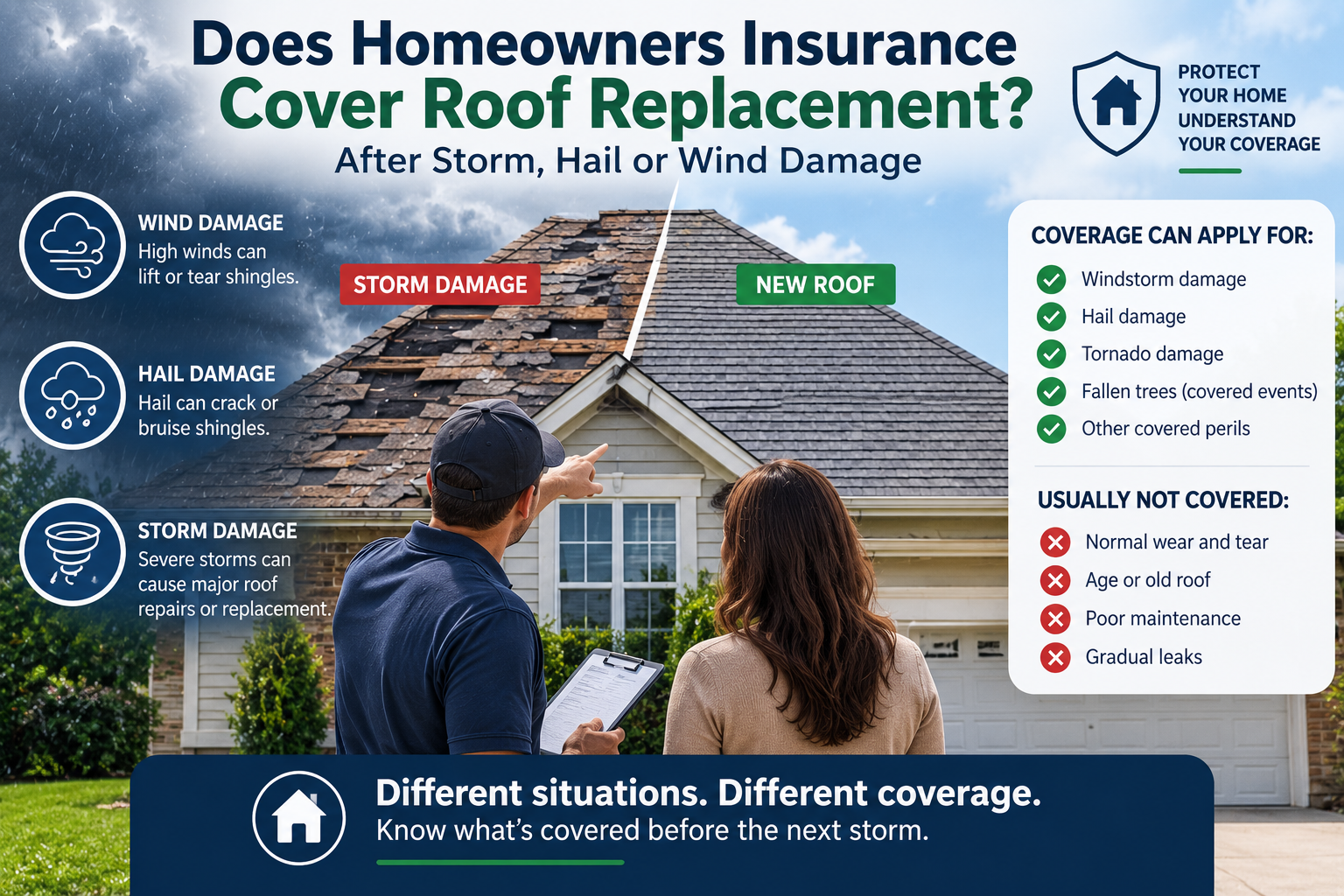
Does homeowners insurance cover roof replacement? It can, but homeowners insurance does not automatically pay to replace every damaged or aging roof. Coverage generally depends on what caused the damage, whether that cause is covered by your policy, the condition of your roof, your deductible, and whether your policy pays replacement cost or actual cash value.
For example, a roof damaged by a covered windstorm or hail event may qualify for insurance coverage, while an old roof that needs replacement because of normal wear and tear may not. The National Association of Insurance Commissioners (NAIC) also notes that homeowners policies can differ in how they cover roofs, including whether roof losses are settled at replacement cost or actual cash value.
This guide explains when homeowners insurance may pay for roof repairs or replacement, what it usually doesn’t cover, how roof deductibles work, and what to do if your roof is damaged.
Quick Answer: Does Homeowners Insurance Cover Roof Replacement?
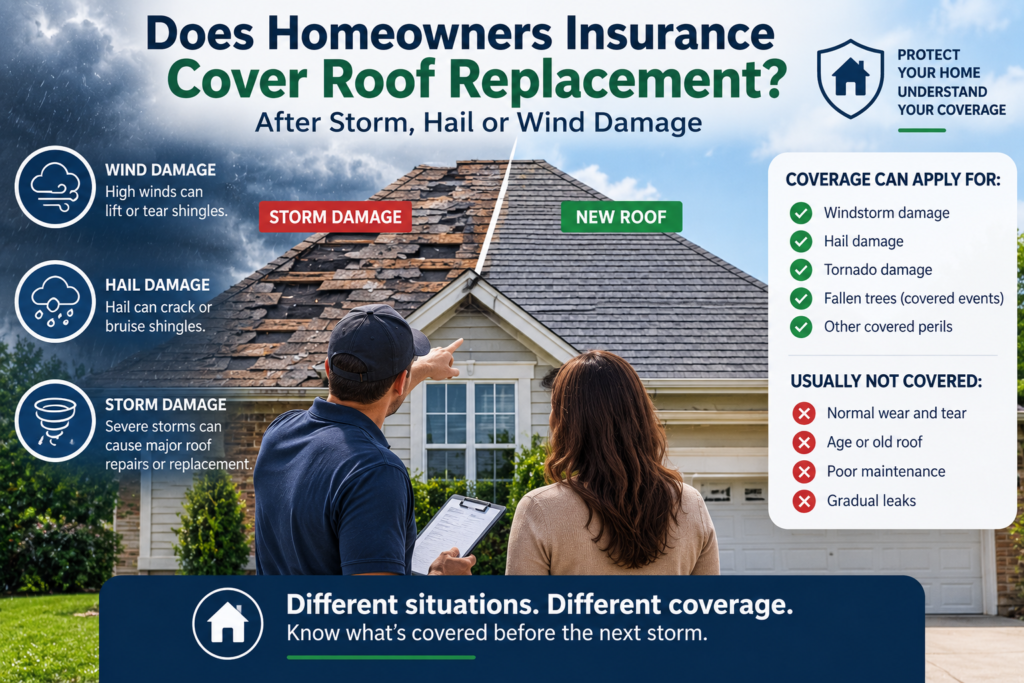
Yes, homeowners insurance can cover roof replacement when the roof is damaged by a covered event, such as certain windstorms, hail, fire or other covered perils.
However, insurance generally does not cover replacing a roof simply because it is old, worn out or reaching the end of its useful life.
Your insurer may consider:
- Cause of the damage
- Age and condition of the roof
- Policy exclusions
- Deductible
- Roof-specific deductible
- Replacement cost vs. actual cash value coverage
- Policy limits
- State-specific rules
The exact coverage is determined by your policy. NAIC explains that homeowners policies pay for damage caused by covered perils and that different policies can provide different levels of protection.
When Does Homeowners Insurance Pay for Roof Replacement?
The most important question is:
Why does the roof need to be replaced?
If the roof was damaged by a covered event, insurance may pay for some or all of the covered repair or replacement costs after your deductible.
Common examples can include:
- Hail damage
- Windstorm damage
- Tornado damage
- Fire
- Lightning
- Falling objects
- Certain tree damage
- Other covered perils listed in your policy
NAIC notes that homeowners policies commonly include coverage for perils such as windstorm, hail, fire and other specified causes of loss, although exclusions and coverage can vary.
When Does Homeowners Insurance Not Cover Roof Replacement?
A standard homeowners policy generally isn’t a maintenance contract.
You may not have coverage when the roof needs replacement because of:
- Normal wear and tear
- Age
- Poor maintenance
- Long-term deterioration
- Rot
- Mold caused by an excluded or gradual problem
- Insect or pest damage
- Defective workmanship, depending on the policy
- Damage that falls under a policy exclusion
For example, suppose your roof is 25 years old and has gradually deteriorated.
There is no storm.
There is no sudden covered event.
The shingles simply need replacement.
That is generally considered a maintenance expense rather than a covered insurance loss.
Does Homeowners Insurance Cover a Roof Damaged by Hail?
It often can.
Hail is a common covered peril under many homeowners policies, although some policies—particularly in certain areas—can have exclusions, limitations or special deductibles for wind and hail.
NAIC specifically notes that homeowners policies may cover windstorm and hail damage, but some policies exclude these risks, particularly in certain coastal areas.
Before assuming you have coverage, check:
- Hail coverage
- Roof exclusions
- Wind/hail deductible
- Roof settlement method
- Policy limits
Does Homeowners Insurance Cover Wind Damage to a Roof?
It can if wind damage is a covered peril under your policy.
For example, a severe storm could:
- Tear off shingles
- Damage flashing
- Lift roofing materials
- Cause a tree to fall onto the roof
- Create openings that allow rain into the house
If the event is covered, the resulting roof damage may qualify for a claim.
However, insurers may examine the roof’s previous condition. If the roof was already severely deteriorated, coverage for certain damage may be limited or disputed depending on the circumstances and policy language.
Does Homeowners Insurance Cover Roof Damage From a Fallen Tree?
It can, depending on why the tree fell and the terms of your policy.
For example:
Severe windstorm → tree falls → roof is damaged
If the windstorm and resulting damage are covered, your homeowners insurance may help pay for the covered roof damage after the applicable deductible.
The policy may also address debris removal and damage to other covered property.
Don’t assume every fallen-tree situation is identical. The cause of the fall and circumstances of the loss matter.
Does Homeowners Insurance Cover a Roof Leak?
It depends on why the roof is leaking.
Covered event
A storm damages the roof and rain enters through the newly damaged area.
Coverage may apply.
Gradual deterioration
The roof has been leaking slowly for months because the shingles have deteriorated.
Coverage may be excluded or limited.
NAIC explains that water damage from a home’s plumbing or a roof leak may be covered in appropriate circumstances, while damage associated with flooding and certain external water sources is generally treated differently.
The insurer will generally look at the cause of the leak rather than simply the fact that water entered the house.
Does Homeowners Insurance Cover an Old Roof?
Usually, not simply because the roof is old.
Age by itself isn’t necessarily the same as damage caused by a covered peril.
For example:
Old roof + normal deterioration = generally not covered
But:
Old roof + covered storm damage = coverage may be possible
The condition and age of your roof can still affect how an insurer evaluates a claim and what type of settlement applies.
Some insurers may also have specific underwriting requirements for older roofs.
Does Homeowners Insurance Cover Roof Wear and Tear?
Generally, normal wear and tear is not covered.
Roofs naturally deteriorate because of:
- Sun exposure
- Weather
- Aging materials
- Repeated temperature changes
- Normal use
- Lack of maintenance
Homeowners insurance is primarily designed to protect against covered losses, not predictable maintenance expenses.
If your roof has simply reached the end of its expected life, you will generally need to pay for replacement yourself.
Replacement Cost vs. Actual Cash Value for Your Roof
This is one of the most important things to understand before filing a roof claim.
Your policy may settle covered roof damage based on replacement cost value (RCV) or actual cash value (ACV), depending on the policy.
Replacement Cost Value
Replacement cost coverage generally pays the cost to repair or replace damaged property with materials of like kind and quality, subject to the policy terms and limits.
It does not subtract depreciation in the same way ACV does.
NAIC explains that replacement cost coverage pays the cost to repair or replace damaged property using materials of like kind and quality.
Actual Cash Value
Actual cash value takes depreciation into account.
That means an older roof may be worth considerably less for insurance purposes than the cost of installing a brand-new roof.
For example:
New roof replacement cost: $20,000
Depreciation: $8,000
ACV: $12,000
If your deductible is $2,000, a simplified example could result in a payment of approximately:
$12,000 − $2,000 = $10,000
The actual claim calculation can be more complicated, and your policy controls the settlement.
Why Roof Age Matters So Much
A roof that is 5 years old and a roof that is 25 years old may not be treated the same way by an insurer.
Age can affect:
- Eligibility for coverage
- Premium
- Underwriting
- Roof settlement method
- Depreciation
- Claim evaluation
NAIC notes that insurers may consider the age of a home and roofing condition when determining coverage and premiums.
This is one reason homeowners should keep records showing when the roof was installed or replaced.
Does Homeowners Insurance Cover the Entire Cost of a New Roof?
Not necessarily.
Even when roof replacement is covered, your final payment can depend on:
- Deductible
- Policy limit
- Roof settlement method
- Depreciation
- Covered percentage of damage
- Applicable exclusions
- Special wind/hail deductible
For example, if your policy has a $2,500 deductible, you generally won’t receive the full replacement invoice because you are responsible for the deductible.
How Roof Deductibles Work
Most homeowners insurance policies have a deductible.
Suppose:
Covered roof damage: $18,000
Deductible: $2,000
A simplified calculation would be:
$18,000 − $2,000 = $16,000
The insurer could potentially pay $16,000 if the entire loss is covered and there are no other applicable limits or adjustments.
But some policies have percentage-based deductibles, particularly for wind, hail or named storms.
What Is a Roof Deductible?
A roof deductible is the portion of a covered roof claim that you must pay before insurance contributes toward the covered loss.
Your policy could have:
- Standard dollar deductible
- Wind/hail deductible
- Hurricane deductible
- Named-storm deductible
- Percentage deductible
NAIC advises homeowners to check whether their policy has separate deductibles for wind or hail damage.
What Is a Percentage Roof Deductible?
Some policies use a percentage instead of a fixed dollar amount.
For example, suppose your dwelling coverage limit is:
$400,000
And your applicable wind/hail deductible is:
2%
Your deductible could be:
$400,000 × 2% = $8,000
If you have a $25,000 covered roof loss, a simplified calculation would leave $17,000 after the deductible, subject to all policy terms and limits.
This is why homeowners should understand percentage deductibles before a major storm occurs.
Does Homeowners Insurance Cover Roof Replacement After a Hurricane?
It can, but hurricane-related roof claims can be more complicated.
Depending on where you live, your policy may have:
- Hurricane deductibles
- Named-storm deductibles
- Wind exclusions
- Separate windstorm coverage
Coastal homeowners should pay particular attention to these provisions.
NAIC notes that windstorm coverage can be excluded in some coastal areas and may need to be purchased separately.
Does Homeowners Insurance Cover Roof Replacement After a Tornado?
It often can if tornado damage is covered under your policy.
For example, a tornado may:
- Tear off shingles
- Damage roof decking
- Remove sections of the roof
- Cause a tree to fall onto the roof
- Allow rain to enter the house
Document the damage and contact your insurer promptly.
Does Homeowners Insurance Cover Roof Damage From a Storm?
Potentially, yes.
Storm damage can include:
- Wind
- Hail
- Falling trees
- Lightning
- Certain falling objects
However, the policy determines which perils are covered.
A roof that was already deteriorated before the storm may receive different treatment than a well-maintained roof that was suddenly damaged.
Does Homeowners Insurance Cover Roof Damage From Snow?
It depends on the cause.
A covered policy may respond to certain sudden losses caused by the weight of snow or related covered events, but coverage varies.
For example, a roof collapse caused by a covered peril may be treated differently from long-term structural deterioration.
Always check the specific wording of your policy.
Does Homeowners Insurance Cover Roof Damage From Ice Dams?
Coverage for ice-dam-related damage can vary by policy and circumstances.
Some policies may cover resulting interior damage caused by a covered ice-dam event, while others may contain limitations or exclusions.
The key question is whether the specific cause and resulting damage are covered under your policy.
Does Homeowners Insurance Cover Roof Replacement Due to Mold?
Generally, not simply because mold has developed over time.
If mold results from a covered sudden loss, the policy may provide some coverage depending on its terms.
But mold caused by long-term moisture, poor maintenance or an excluded source of water may not be covered.
Does Homeowners Insurance Cover Cosmetic Roof Damage?
This can be complicated.
Some policies may limit or exclude certain types of cosmetic damage, particularly damage that affects appearance without materially affecting the roof’s function.
NAIC insurance data specifically recognizes policies that do not provide cosmetic roof damage coverage, showing that this can be a specific policy-level issue.
If you’re concerned about hail or other cosmetic damage, check your policy for cosmetic-damage exclusions or endorsements.
Does Homeowners Insurance Cover the Entire Roof If Only Part Is Damaged?
Not necessarily.
The insurer may determine whether:
- A portion can be repaired
- The entire roof needs replacement
- Matching materials are available
- Building codes require additional work
- The policy provides replacement-cost coverage
- The damage affects the roof’s functionality
A contractor’s estimate can help document the scope of damage, but the insurance company ultimately evaluates the claim under the policy.
Matching Roof Shingles and Insurance Claims
Sometimes a damaged section of roof is difficult to repair because the existing shingles are discontinued or no longer available.
Whether insurance must replace additional undamaged areas can depend on:
- Policy language
- State law
- Matching requirements
- Availability of materials
- Extent of covered damage
Don’t assume that a damaged section automatically means the entire roof will be replaced.
Ask your insurer how matching is handled under your policy.
What Should You Do If a Storm Damages Your Roof?
Act quickly, but don’t rush into permanent repairs before documenting the damage.
Step 1: Make sure everyone is safe
Stay away from dangerous areas and exposed electrical hazards.
Step 2: Prevent additional damage
If safe, use temporary measures such as covering an opening or placing a tarp over a damaged area.
NAIC recommends making temporary repairs to protect the home after a covered loss and keeping receipts for those expenses.
Step 3: Take photos and videos
Document:
- Missing shingles
- Holes
- Damaged flashing
- Fallen trees
- Interior water stains
- Damaged belongings
Step 4: Contact your insurer
Report the loss and ask about the claims process.
Step 5: Get a professional roof inspection
A qualified roofing professional can help identify damage that may not be visible from the ground.
Step 6: Keep all documentation
Save:
- Contractor estimates
- Receipts
- Photos
- Videos
- Previous roof invoices
- Maintenance records
- Insurance correspondence
Should You Get a Roof Inspection Before Filing a Claim?
It can be useful, particularly when damage isn’t obvious.
A professional inspection may help determine:
- What was damaged
- How extensive the damage is
- Possible cause
- Whether temporary repairs are needed
However, don’t hire someone solely because they promise that your insurance company will approve a claim.
Your insurer still determines coverage under your policy.
How to Prove Roof Damage to Your Insurance Company
Good documentation can make the claims process easier.
Keep:
Photos
Take close-up and wide-angle photos of the roof and surrounding property.
Videos
Record storm damage and interior water intrusion when safe.
Previous roof records
Keep:
- Installation invoice
- Contractor information
- Warranty
- Inspection reports
Maintenance records
These can demonstrate that you reasonably maintained the roof.
Contractor estimates
Obtain written estimates describing the damage and proposed repairs.
The more clearly you can document what happened, the easier it can be to explain the claim.
Can an Insurance Company Deny a Roof Replacement Claim?
Yes.
An insurer can deny or limit a claim when the damage is not covered by the policy or an exclusion applies.
Common reasons can include:
- Wear and tear
- Lack of maintenance
- Pre-existing deterioration
- Excluded peril
- Policy exclusion
- Insufficient evidence of covered damage
- Damage below the deductible
- Uncovered cosmetic damage
A denial doesn’t necessarily mean you have no options.
Ask the insurer for the reason in writing and review the relevant policy language.
If you disagree with the decision, you may be able to request a reconsideration or appraisal depending on your policy and state rules, or contact your state insurance department for guidance.
Can You Get a New Roof Without Paying the Deductible?
Be careful with contractors who promise to “waive” your insurance deductible.
Your deductible is generally your responsibility under the policy.
If a contractor offers to waive or manipulate the deductible, ask questions before agreeing to anything and check your state’s rules.
A legitimate contractor should provide a clear estimate and explain what you are expected to pay.
Does Homeowners Insurance Cover Roof Replacement From Normal Aging?
Generally, no.
If your roof simply reaches the end of its useful life, replacing it is typically a maintenance expense.
For example:
25-year-old shingles + normal deterioration = generally not an insurance claim
Insurance is designed to cover qualifying losses caused by covered perils, not predictable aging.
How to Keep Your Roof Insurable
You can take practical steps to reduce problems.
Inspect your roof regularly
Look for:
- Missing shingles
- Cracked shingles
- Damaged flashing
- Sagging
- Moss
- Water stains
Clean gutters
Blocked gutters can contribute to drainage and water problems.
Trim trees
Keep large branches away from the roof where practical.
Address small problems quickly
A small roof issue can become a major water intrusion problem.
Keep records
Save receipts and inspection reports.
Know your policy
Check whether your roof has:
- Replacement cost coverage
- Actual cash value coverage
- Wind/hail exclusions
- Special deductibles
- Cosmetic-damage exclusions
How Much Does a New Roof Cost If Insurance Doesn’t Pay?
Roof replacement costs vary substantially depending on:
- Roof size
- Roofing material
- Roof design
- Labor costs
- Location
- Removal of old roofing
- Structural repairs
- Local building requirements
Because these costs vary so widely, don’t rely on a single national price as a quote for your home.
Get multiple written estimates from reputable roofing contractors.
Roof Replacement Insurance Example
Imagine a severe hailstorm damages your roof.
A contractor estimates:
Roof replacement: $24,000
Your policy has:
Replacement-cost coverage
And your deductible is:
$2,500
If the entire loss is covered, a simplified calculation would be:
$24,000 − $2,500 = $21,500
The insurer could potentially pay $21,500, subject to the actual policy terms and claim evaluation.
Now imagine the same roof had ACV coverage.
The insurer could apply depreciation before calculating the payment, potentially leaving you with a larger out-of-pocket expense.
That’s why understanding RCV vs. ACV before a claim is so important.
Replacement Cost vs. Actual Cash Value: Quick Comparison
| Feature | Replacement Cost (RCV) | Actual Cash Value (ACV) |
|---|---|---|
| Depreciation deducted? | Generally no | Yes |
| New replacement cost considered? | Yes | Adjusted for depreciation |
| Potential out-of-pocket cost | Often lower | Often higher |
| Roof age matters | Still relevant | Especially important |
| Available on every policy? | No | Depends on policy |
NAIC explains that ACV accounts for age and wear and tear, while RCV generally pays the cost to repair or replace covered property with materials of like kind and quality, subject to the policy.
Common Roof Insurance Mistakes
1. Assuming every roof replacement is covered
Insurance doesn’t generally cover normal aging and maintenance.
2. Ignoring your roof deductible
A percentage deductible can be much larger than a standard dollar deductible.
3. Not knowing whether your roof has ACV or RCV coverage
This can significantly affect your out-of-pocket cost.
4. Waiting too long after storm damage
Additional damage can occur if a damaged roof isn’t temporarily protected.
5. Throwing away damaged materials immediately
Your insurer may want to inspect the damage.
6. Hiring a contractor before understanding your coverage
Get clarity on the claim and your financial responsibility.
7. Assuming hail coverage is identical everywhere
Wind and hail coverage can have exclusions or special deductibles depending on your policy and location.
Frequently Asked Questions
Does homeowners insurance cover hail damage to a roof?
Q1. Does homeowners insurance cover roof replacement?
It can if the roof was damaged by a covered event such as certain windstorms, hail or fire. Insurance generally does not pay to replace a roof simply because it is old or worn out.
Q2. Does homeowners insurance cover an old roof?
Usually not for normal aging or deterioration. However, an older roof can still potentially have covered damage caused by a sudden covered event, depending on the policy.
Q3. Does homeowners insurance cover hail damage to a roof?
Often, yes, but coverage depends on your policy and location. Some policies can have hail exclusions, limitations or separate wind/hail deductibles.
Q4. Does homeowners insurance cover wind damage to a roof?
It can when wind is a covered peril under the policy. Your insurer may also consider the roof’s previous condition and whether the damage resulted from a covered storm.
Q5. Does homeowners insurance cover roof leaks?
It depends on the cause of the leak. A leak caused by sudden covered storm damage may be covered, while gradual deterioration or poor maintenance generally is not.
Q6. Does homeowners insurance cover roof replacement due to wear and tear?
Generally, no. Normal aging, deterioration and routine maintenance are typically the homeowner’s responsibility rather than an insured loss.
Q7. Does homeowners insurance cover a roof damaged by a fallen tree?
It can when the circumstances and cause of the loss are covered under the policy. Document the damage and contact your insurer before making permanent repairs when possible.
Q8. Does homeowners insurance pay for the entire roof?
Not necessarily. The insurer may determine that only part of the roof is damaged, or the policy may limit payment based on coverage, depreciation, deductibles and other terms.
Q9. What is better for a roof: ACV or replacement cost?
Replacement cost coverage generally provides broader financial protection because depreciation isn’t deducted in the same way as ACV. However, the availability and terms of RCV coverage depend on the policy.
Q10. Can homeowners insurance cover a leaking roof after a storm?
Yes, potentially. If a covered storm damages the roof and rain subsequently enters the home, the resulting damage may be covered, subject to the policy and deductible.
Q11. Can insurance deny a roof replacement claim?
Yes. Claims can be denied or limited when the cause is excluded, the damage is due to wear and tear, or the policy does not provide the applicable coverage.
Q12. Should I replace my roof before selling my house?
Not necessarily. Whether replacement makes financial sense depends on the roof’s condition, local housing market, buyer expectations and cost. Insurance generally should not be viewed as a way to pay for an aging roof before a sale.
Final Verdict: Does Homeowners Insurance Cover Roof Replacement?
So, does homeowners insurance cover roof replacement?
Sometimes—but the reason for the roof damage matters more than the fact that the roof needs replacing.
A roof damaged by a covered storm, hail, wind or other covered peril may qualify for insurance coverage. A roof that simply needs replacement because of age, deterioration or poor maintenance generally does not.
Before filing a claim, check four things:
- What caused the damage?
- Is that cause covered by your policy?
- Is your roof covered at ACV or replacement cost?
- What deductible applies?
If your roof has been damaged by a storm, document the damage, take reasonable temporary measures to prevent further loss, contact your insurer and keep all receipts and records.
Most importantly, read your actual policy rather than relying on the phrase “full coverage.” Roof coverage can vary significantly between policies and locations.
Why Maintain Market Is Different
At Maintain Market, we don’t simply tell homeowners that insurance “covers” or “doesn’t cover” a roof.
We explain the factors that actually determine the outcome:
- Cause of damage
- Covered vs. excluded perils
- Roof age and condition
- Deductibles
- Actual cash value
- Replacement cost
- Wind and hail coverage
- Policy exclusions
- Claims process
That helps homeowners make a more informed decision before spending thousands of dollars on roof repairs or filing an insurance claim.
If your damaged roof allows water to enter your home, it’s also important to understand when homeowners insurance covers resulting water damage. Read our guide on does homeowners insurance cover water damage.