
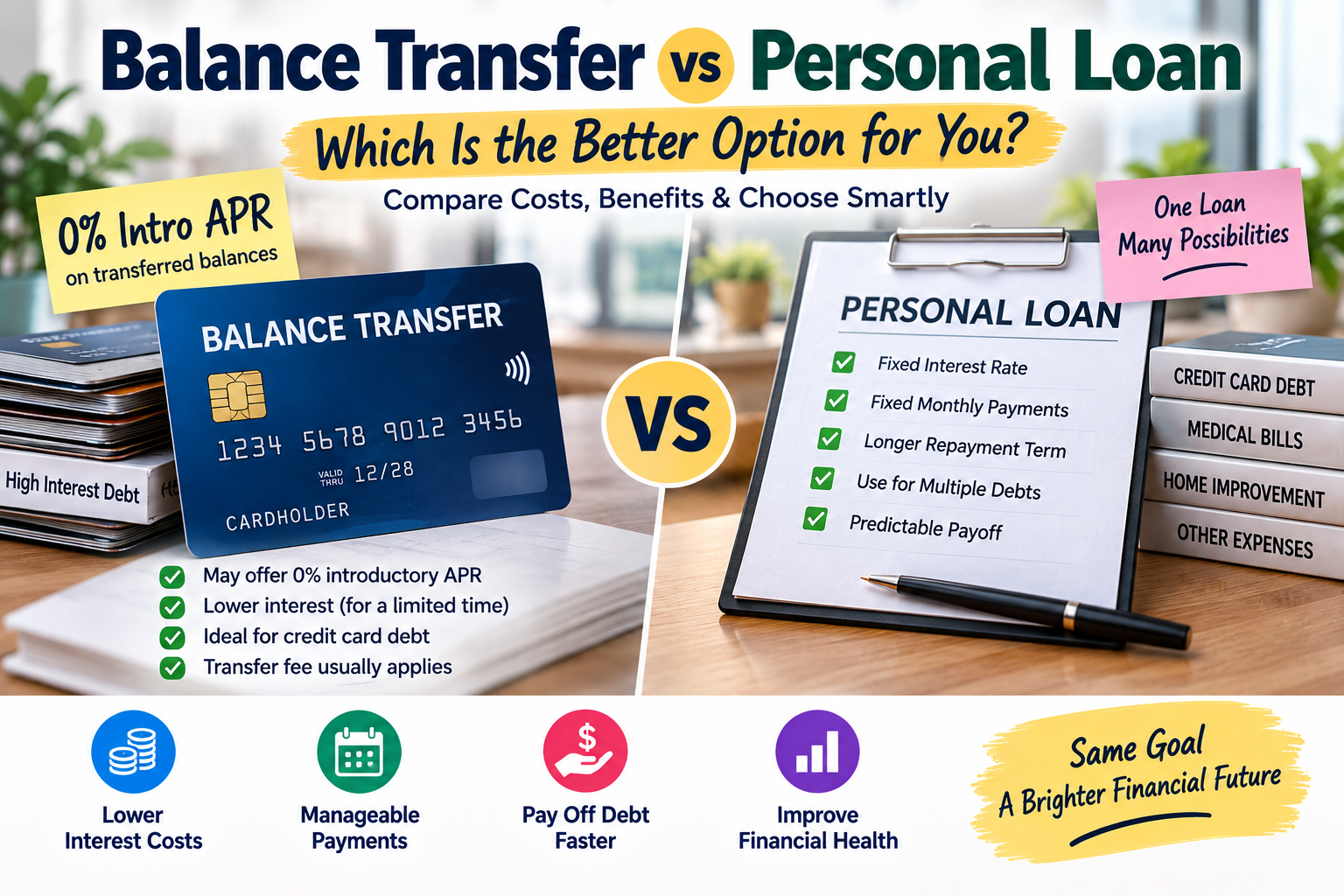
If you are comparing balance transfer vs personal loan, both options can help you consolidate high-interest debt, but they work very differently. A balance transfer can offer a temporary 0% introductory APR on transferred credit card debt, while a personal loan typically gives you a fixed interest rate, fixed monthly payment and a defined repayment period.
The better choice depends on how much debt you have, how quickly you can pay it off, your credit profile, the fees involved and whether you can qualify for favorable terms.
Quick Answer: Balance Transfer vs Personal Loan
A balance transfer may be better if you have mostly credit card debt, qualify for a strong introductory APR and can pay the balance off before the promotional period ends.
A personal loan may be better if you need more time to repay the debt, want predictable fixed payments or need to consolidate multiple types of unsecured debt.
There is no universally better option. The right choice depends on the total cost of borrowing, not just the advertised interest rate.
Balance Transfer vs Personal Loan: At a Glance
| Feature | Balance Transfer | Personal Loan |
|---|---|---|
| Best for | Credit card debt | Multiple unsecured debts |
| Interest | May have 0% introductory APR | Usually fixed interest |
| Repayment | Flexible card payments | Fixed monthly payments |
| Promotional period | Usually limited | No promotional period |
| Typical fees | Often 3%–5% transfer fee | May have origination fee |
| Repayment period | Promotional period is limited | Often 2–7 years |
| Credit requirement | Usually good to excellent credit for the best offers | Available across a wider credit range |
| Debt types | Primarily credit card balances | Credit cards and other eligible unsecured debts |
| Main risk | Promotional period ends | Interest continues throughout the loan term |
| Best advantage | Potentially very low interest during promo | Predictable payoff schedule |
Balance-transfer cards commonly charge a percentage fee for transferring a balance, while personal loans may charge origination fees. Exact fees and terms vary by lender and card issuer.
What Is a Balance Transfer?
A balance transfer allows you to move existing credit card debt to another credit card, usually one offering a low or 0% introductory APR for a limited period.
For example, suppose you have:
- Credit Card A: $5,000
- APR: 24%
You could potentially transfer that balance to a balance transfer card offering a 0% introductory APR.
Instead of paying interest during the promotional period, you focus your payments on reducing the transferred balance.
However, balance transfers often come with a fee, and the promotional APR does not last forever. The CFPB explains that balance transfers can involve a fee and that promotional rates generally last for a limited period.
What Is a Personal Loan for Debt Consolidation?
A personal loan is an installment loan that gives you a lump sum, which you can use to pay off eligible debts.
You then repay the loan through scheduled monthly payments over a specific period.
For example:
Credit Card 1: $4,000
Credit Card 2: $3,000
Medical debt: $2,000
You could potentially use a $9,000 personal loan to pay off those debts and then make one monthly loan payment.
Personal loans generally have a fixed repayment schedule, which can make your payoff date easier to predict.
7 Smart Ways to Compare a Balance Transfer vs Personal Loan
1. Compare the Interest Rate
A balance transfer can be extremely attractive when the card offers a 0% introductory APR for transferred balances.
However, that rate is temporary.
Once the promotional period ends, the remaining balance can begin accruing interest at the card’s regular APR.
A personal loan doesn’t typically work this way. Instead, you generally receive a fixed interest rate for the loan term if the loan has a fixed rate.
The key question is:
Can you completely repay the balance before the balance-transfer promotional period expires?
If yes, a balance transfer may offer significant interest savings.
2. Compare the Fees
Never compare these products using interest rate alone.
Balance transfer fees
Many balance transfer cards charge approximately 3% to 5% of the amount transferred, although fees vary by card.
For example:
Balance transferred: $10,000
3% fee: $300
5% fee: $500
That fee effectively increases the amount you need to repay.
Bankrate notes that balance-transfer fees are typically 3% or 5% of the transferred amount.
Personal loan fees
Personal loans may have an origination fee, depending on the lender.
The CFPB explains that APR incorporates interest and certain fees, making APR useful when comparing borrowing costs.
Always compare:
APR + fees + total repayment
rather than focusing on one number.
3. Consider How Much Debt You Have
The size of your debt can influence which option makes more sense.
A balance transfer may work well when:
- Your debt is primarily credit card debt.
- You qualify for a sufficiently high credit limit.
- You can repay the balance relatively quickly.
- You can take advantage of the promotional period.
A personal loan may be more practical when:
- Your debt is larger.
- You need several years to repay it.
- You have multiple types of unsecured debt.
- You want one fixed monthly payment.
NerdWallet notes that balance transfers can be better suited to smaller balances that can be repaid during the promotional period, while personal loans can make more sense for larger debts requiring longer repayment periods.
4. Look at Your Credit Score
Your credit profile can strongly influence which option you qualify for and the terms you receive.
The best balance-transfer offers are generally aimed at borrowers with good to excellent credit.
Personal loans can be available to a wider range of borrowers, although borrowers with weaker credit may receive higher rates.
That means:
Excellent credit + manageable credit card debt → Balance transfer may be attractive
Fair credit + larger debt + need for longer repayment → Personal loan may be more practical
Do not apply based solely on the advertised “starting APR.” Your actual offer may be different.
5. Think About Your Monthly Payment
A personal loan generally provides a fixed monthly payment and a defined repayment term.
That can make budgeting easier.
For example:
$10,000 personal loan
Fixed APR
60-month term
Fixed monthly payment
You know when the loan is scheduled to end.
A balance transfer works differently.
You usually have a minimum payment requirement, but you need to calculate how much you must pay each month to eliminate the balance before the promotional period ends.
6. Consider What Happens After the Introductory Period
This is one of the most important differences.
Suppose you transfer:
$8,000
Your promotional period lasts:
18 months
To pay the entire balance before the promotion ends, you would need to pay approximately:
$8,000 ÷ 18 = $444 per month
That is before considering any transfer fee.
If you cannot afford approximately that amount, you could still have a balance when the promotional APR ends.
At that point, the remaining balance may begin accruing interest at the card’s regular APR.
Balance-transfer promotional periods are limited, and NerdWallet reports that many current offers fall in the 15-to-21-month range, although terms vary by issuer.
7. Compare the Total Cost
This is ultimately what matters most.
Imagine you have $10,000 in credit card debt.
Option A: Balance Transfer
- Transfer amount: $10,000
- Transfer fee: 3%
- Fee: $300
- Promotional APR: 0%
- Promotional period: 18 months
If you pay the debt completely within the promotional period, your major financing cost could be the $300 transfer fee, assuming no other fees apply.
Option B: Personal Loan
Suppose you receive:
- Loan amount: $10,000
- Fixed APR: 12%
- Term: 3 years
You would pay interest over the repayment period, plus any applicable loan fees.
The personal loan could still be the better choice if the balance transfer’s promotional period is too short for your budget.
The cheapest option is the one with the lowest total cost that you can realistically repay.
Also Read: 10 Best Debt Consolidation Loans in the USA
Balance Transfer vs Personal Loan: Example
Let’s say you have:
$15,000 in credit card debt
Your current cards have high APRs.
You have two options.
Balance Transfer
- $15,000 transferred
- 3% transfer fee
- $450 fee
- 0% introductory APR
- 18-month promotional period
To eliminate $15,450 over 18 months, you would need to pay roughly:
$858 per month
Personal Loan
Suppose you qualify for a fixed-rate personal loan with a longer repayment period.
Your monthly payment may be lower because the debt is spread over several years.
However, you would pay interest over the loan term.
The important question
Don’t ask:
“Which has the lower monthly payment?”
Ask:
“Which option allows me to eliminate the debt at the lowest realistic total cost?”
Balance Transfer Pros and Cons
Advantages
Potential 0% introductory APR
You may avoid interest on transferred debt during the promotional period.
Can accelerate debt payoff
If you make aggressive payments, more of your money can go toward reducing the balance rather than interest during the promotional period.
No installment loan required
You continue using a credit-card account rather than taking out a separate loan.
Can simplify credit card debt
Multiple credit card balances may potentially be consolidated onto one account, subject to the card’s credit limit and issuer rules.
Disadvantages
Transfer fees
A 3%–5% fee can add hundreds of dollars to a large balance.
Promotional rate expires
The 0% APR does not last forever.
Qualification can be difficult
The most attractive offers generally require stronger credit.
Credit limit may be insufficient
You may not receive a high enough limit to transfer your entire debt.
Temptation to spend again
Moving debt to a new card does not eliminate the underlying debt.
Personal Loan Pros and Cons
Advantages
Fixed monthly payment
You generally know how much you need to pay each month.
Defined payoff date
The loan term gives you a specific repayment schedule.
Can consolidate different unsecured debts
Depending on the lender, personal loans may be used to consolidate credit cards and other eligible unsecured debts.
May offer a lower rate than existing credit cards
For qualified borrowers, a personal loan may have a lower APR than high-interest credit card debt.
Disadvantages
Interest charges
Unlike a 0% introductory balance transfer, a personal loan generally charges interest throughout the repayment period.
Origination fees
Some lenders charge an origination fee.
Fixed payment obligation
You generally need to make the required monthly payment even if your income changes.
Longer repayment can increase total interest
A lower monthly payment isn’t necessarily cheaper if you extend the loan over many years.
Balance Transfer vs Personal Loan for $5,000 Debt
If you owe $5,000, a balance transfer may make sense if:
- You have good credit.
- You qualify for a 0% introductory APR.
- The transfer fee is reasonable.
- You can repay the debt during the promotional period.
A personal loan may make more sense if:
- You need more time.
- You qualify for a competitive fixed APR.
- You want predictable monthly payments.
- You want a defined payoff date.
Balance Transfer vs Personal Loan for $10,000 Debt
At $10,000, both options can potentially work.
The deciding factors become:
- Transfer fee
- Promotional period
- Personal loan APR
- Origination fee
- Monthly payment
- Repayment timeline
- Credit score
- Ability to pay the debt aggressively
Don’t automatically assume that a 0% balance transfer is cheaper.
A transfer fee plus an unpaid balance after the promotional period could change the calculation.
Balance Transfer vs Personal Loan for $20,000 Debt
With $20,000 of debt, the size of the balance becomes particularly important.
A balance transfer card may not provide a credit limit large enough to move the entire amount.
Even if it does, the required monthly payment to eliminate $20,000 before the promotional period ends could be substantial.
A personal loan may provide a longer repayment period and fixed payments, but you will generally pay interest.
For larger debts, calculate the total cost before choosing.
Which Is Better for Credit Card Debt?
A balance transfer is often worth considering when your debt is entirely or primarily credit card debt and you can repay it during the promotional period.
A personal loan may be preferable when you need more time or want fixed monthly payments.
The right answer depends on the actual offers you qualify for.
Which Is Better for Bad Credit?
A personal loan may be easier to find for some borrowers with fair or poor credit, but the interest rate can be significantly higher.
The most attractive balance-transfer offers generally require stronger credit.
If you have bad credit, don’t accept a high-cost loan simply because you were approved.
Compare the APR, fees, repayment period and total repayment amount carefully.
Also Read: 10 Best Personal Loans for Bad Credit in the USA
Can a Balance Transfer Hurt Your Credit Score?
It can cause a temporary change in your credit score, but the long-term effect depends on how you manage the new account and your overall credit profile.
Applying for a new card can create a hard inquiry, and opening a new account can change factors such as the average age of your accounts.
On the other hand, paying down credit card balances can reduce your credit utilization, which may help your credit profile.
A balance transfer itself does not erase the debt—it moves it.
Can a Personal Loan Improve Your Credit Score?
It can potentially help your credit profile if you use it responsibly and make every payment on time.
Moving revolving credit card debt into an installment loan may reduce your credit utilization, although opening a new loan can also cause a temporary change to your credit profile.
The biggest benefit comes from consistently making payments and avoiding building new high-interest credit card debt.
Can You Transfer a Personal Loan to a Balance Transfer Card?
Sometimes, but it depends on the card issuer.
Some balance-transfer cards allow certain personal-loan balances to be transferred, while others restrict transfers to credit card debt or specific types of accounts.
Never assume that a personal loan is eligible.
Check the card issuer’s balance-transfer rules before applying.
Can You Use a Personal Loan to Pay Off a Balance Transfer Card?
Yes, potentially.
If your balance-transfer promotional period is ending and you still have a significant balance, you could compare personal loan offers.
However, don’t automatically refinance.
Compare:
- New personal loan APR
- Remaining balance
- Origination fee
- Remaining promotional period
- Monthly payment
- Total repayment
Refinancing only makes sense if the new arrangement improves your overall financial position.
What Happens If You Can’t Pay Off a Balance Transfer Before the 0% Period Ends?
The remaining balance will generally begin accruing interest at the card’s applicable regular APR after the promotional period ends.
That can significantly increase your cost of borrowing.
Before using a balance transfer, calculate the monthly amount you need to pay to eliminate the debt before the promotional period expires.
If that payment is unrealistic, a fixed-rate personal loan with a longer repayment period may be more practical.
How to Choose Between a Balance Transfer and Personal Loan
Use this simple decision framework.
Choose a balance transfer if:
- You have primarily credit card debt.
- You have good or excellent credit.
- You qualify for a strong promotional APR.
- You can pay the balance off before the promotional period ends.
- The transfer fee is reasonable.
- You won’t use the newly available credit to accumulate more debt.
Consider a personal loan if:
- You need several years to repay the debt.
- You want fixed monthly payments.
- You have multiple types of unsecured debt.
- You qualify for a competitive APR.
- You want a defined payoff date.
- You prefer an installment loan over revolving credit.
Balance Transfer vs Personal Loan: Decision Table
| If Your Situation Is… | Consider |
|---|---|
| $5,000 credit card debt and strong credit | Balance transfer |
| Can repay debt within 12–18 months | Balance transfer |
| Large credit card balance | Compare both carefully |
| Need 3–5 years to repay | Personal loan |
| Multiple unsecured debts | Personal loan |
| Want a fixed monthly payment | Personal loan |
| Want temporary 0% APR | Balance transfer |
| Don’t qualify for attractive balance-transfer offers | Personal loan |
| Want a defined payoff date | Personal loan |
| Can aggressively repay debt | Balance transfer |
5 Mistakes to Avoid
1. Looking only at the 0% APR
A 0% promotional rate sounds attractive, but the transfer fee and expiration date matter.
2. Making only minimum payments
Minimum payments may leave you with a large balance when the promotional period ends.
3. Ignoring personal loan fees
A low advertised interest rate can be less attractive if the loan carries substantial fees.
4. Choosing a longer loan just for a lower payment
A lower monthly payment can mean paying interest for many additional months.
5. Using the old credit cards again
Consolidation only works if you avoid rebuilding the debt you just paid off.
A Simple Break-Even Calculation
Before choosing either option, calculate:
Balance transfer cost
Transfer fee + interest paid during/after promotional period + other fees
Personal loan cost
Total interest + origination fee + other applicable fees
Then compare the totals.
For example:
Balance transfer: $400 total fees
Personal loan: $1,600 total interest and fees
The balance transfer may be cheaper.
But if:
Balance transfer: $2,200 total cost
Personal loan: $1,700 total cost
The personal loan may be the better financial choice.
The numbers—not the marketing headline—should make the decision.
Balance Transfer vs Personal Loan FAQs
Q1. Is a balance transfer better than a personal loan?
A balance transfer can be better if you have credit card debt and can repay it during the promotional period. A personal loan may be better if you need more time or want fixed payments.
Q2. Is a personal loan cheaper than a balance transfer?
Not always. A balance transfer may have little or no interest during its promotional period but usually charges a transfer fee. A personal loan charges interest and may also have an origination fee, so compare the total cost.
Q3. What is better for $10,000 in credit card debt?
Either option could work for $10,000. If you can repay the balance quickly and qualify for a strong 0% offer, a balance transfer may be attractive; otherwise, compare personal loan offers with fixed rates and terms.
Q4. Does a balance transfer hurt your credit score?
Applying for a new balance-transfer card can create a hard inquiry and change your credit profile temporarily. However, paying down revolving debt can reduce credit utilization, which may benefit your credit profile.
Q5. Does a personal loan hurt your credit score?
Applying for a personal loan can cause a temporary credit-score change because of the application and new account. Consistently making payments and reducing high-interest revolving debt can be beneficial over time.
Q6. What credit score do I need for a balance transfer?
There is no single minimum score for every balance-transfer card. However, the strongest promotional offers are generally aimed at borrowers with good to excellent credit, and approval depends on the issuer’s criteria.
Q7. What credit score do I need for a personal loan?
Personal-loan requirements vary significantly by lender. Some lenders work with fair or poor credit, but weaker credit can result in higher APRs, lower loan amounts or less favorable terms.
Q8. Can I transfer a personal loan to a credit card?
Sometimes. Some card issuers allow personal-loan balances to be transferred, while others don’t. Check the specific balance-transfer rules before applying.
Q9. What happens if I don’t pay off a balance transfer?
Any remaining balance may begin accruing interest at the card’s applicable regular APR after the promotional period ends. This is why calculating the required monthly payment before transferring the debt is important.
Q10. Is a balance transfer a good idea for a large debt?
It can be, but large balances may be difficult to transfer because the new card’s credit limit may not be high enough. A personal loan may provide a more predictable way to consolidate a larger amount.
Q11. Can I use a personal loan to pay off credit cards?
Yes. Debt-consolidation personal loans are commonly used to pay off eligible credit card balances. You then make one scheduled payment on the personal loan instead of managing multiple card balances.
Q12. Which is better for paying off debt faster?
A balance transfer can help you pay debt faster if the 0% promotional period allows you to direct more of each payment toward principal. A personal loan can also provide a structured payoff schedule with a fixed end date.
Q13. Does a balance transfer eliminate credit card debt?
No. A balance transfer moves the debt from one account to another. You still owe the transferred amount and any applicable fees, so you need a repayment plan.
Q14. Is debt consolidation always a good idea?
No. Consolidation can simplify payments or reduce interest, but it doesn’t solve overspending by itself. If you continue adding new debt after consolidation, your overall financial situation can become worse.
Q15. Should I choose a balance transfer or personal loan?
Start by comparing the actual offers you qualify for. Look at APR, fees, monthly payment, promotional period, repayment term and total cost before deciding.
Final Verdict: Balance Transfer vs Personal Loan
The best choice in the balance transfer vs personal loan debate depends on your debt, credit profile and repayment ability.
A balance transfer may be the better choice when:
You have credit card debt + strong credit + a realistic plan to repay it during the 0% promotional period.
A personal loan may be the better choice when:
You need more time + want fixed payments + qualify for a competitive APR.
Don’t choose based only on a 0% APR headline or a low monthly payment.
Instead, compare the total cost of getting out of debt.
If a balance transfer lets you eliminate your debt before the promotional period ends at a lower total cost, it may be the smarter option.
If you need more time and a personal loan gives you a manageable fixed payment at a reasonable APR, the loan may be the better path.
The goal isn’t simply to move debt.
The goal is to become debt-free at the lowest realistic cost while choosing a payment plan you can actually maintain.
Why Maintain Market Is Different
At Maintain Market, we focus on helping readers understand the real financial trade-offs behind popular debt strategies.
Instead of simply saying that one option is “better,” this guide compares:
- Promotional APRs
- Personal loan APRs
- Balance-transfer fees
- Origination fees
- Monthly payments
- Repayment periods
- Credit requirements
- Total borrowing costs
- Credit-score considerations
- Debt payoff strategies
Financial products and eligibility requirements can vary by lender and borrower. Always review the actual terms and disclosures before applying.
References
- CFPB — Credit Card Key Terms
- CFPB — Interest Rate vs. APR
- NerdWallet — Balance Transfer vs. Personal Loan
- Bankrate — Balance Transfer vs. Personal Loan
- Bankrate — Balance Transfer Fee Guide
Editorial Review
Written by the Maintain Market Editorial Team
Reviewed for accuracy by the Maintain Market Editorial Team
This article provides general educational information and should not be considered financial, legal or credit advice. Interest rates, fees, approval requirements and promotional offers vary by lender and card issuer.