
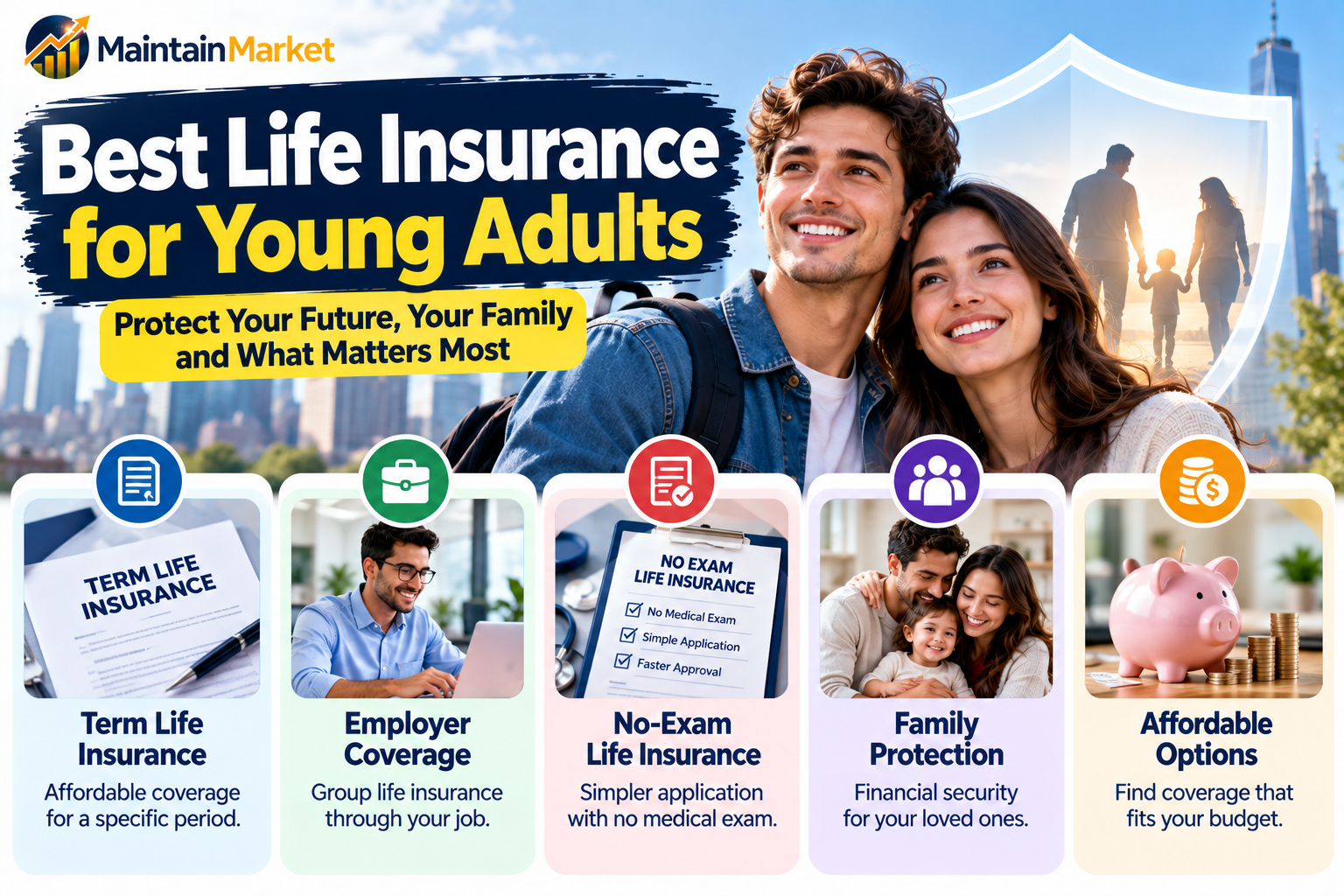
Finding the best life insurance for young adults depends on more than simply finding the lowest monthly premium. Your age, income, debts, family responsibilities, health, future plans, and the amount of coverage you need can all affect which type of policy makes sense.
For many young adults, term life insurance is one option worth comparing because it generally provides coverage for a specific period at a lower initial cost than permanent life insurance. But employer coverage, no-exam policies, whole life, and other options can also have a place depending on your situation.
Quick Answer: What Is the Best Life Insurance for Young Adults?
There is no single life insurance policy that is best for every young adult.
The right option depends on why you need coverage.
| Your situation | Option worth considering |
|---|---|
| You want affordable income protection | Term life insurance |
| You have a spouse or children | 20- or 30-year term life |
| You have student or other debts | Term life insurance |
| You want a simpler application | No-exam or simplified-issue coverage |
| Your employer offers life insurance | Employer coverage plus individual coverage if needed |
| You need lifelong coverage | Whole life or another permanent policy |
| You want flexibility as your needs change | Convertible term life |
| You have significant long-term financial planning needs | Permanent life insurance |
The National Association of Insurance Commissioners (NAIC) explains that term life insurance generally provides coverage for a specific period and is typically less expensive in younger years than permanent life insurance.
1. Term Life Insurance Is Often Worth Comparing First
Term life insurance provides coverage for a defined period.
Common terms include 10, 15, 20, or 30 years, depending on the insurer and policy.
If you die while the policy is active and premiums are paid as required, the beneficiaries generally receive the policy’s death benefit.
Term life does not normally build cash value.
Why young adults may consider term life
Term insurance can be useful when you have financial responsibilities that are expected to last for a specific period.
For example:
- You have a spouse who depends on your income.
- You have children.
- You have a mortgage.
- You have student or other debts.
- Someone depends on you financially.
- You want to replace your income if you die unexpectedly.
NAIC describes term insurance as coverage intended for a specific period and notes that it is generally more affordable than permanent insurance during the early years.
2. A 20-Year or 30-Year Term Can Match Major Life Goals
Young adults often have financial responsibilities that can change significantly over the next 10 to 30 years.
A longer term can potentially cover important years such as:
- Raising children
- Paying a mortgage
- Building a career
- Paying off major debts
- Replacing income while dependents are financially dependent on you
For example, a 28-year-old parent may consider a 20- or 30-year policy if the goal is to provide financial protection while children are growing up.
The important point is to match the policy term to the financial responsibility rather than automatically selecting the longest available term.
3. Employer Life Insurance Can Be Useful — But Check the Amount
Many employers provide some amount of group life insurance as an employee benefit.
This can be convenient because the employer may pay some or all of the premium.
However, don’t automatically assume that employer coverage is enough.
Check:
- Death benefit amount
- Premium you pay
- Whether coverage continues if you leave the company
- Whether you can convert or continue coverage
- Any eligibility requirements
- Available supplemental coverage
NAIC specifically notes that employer-provided coverage for young adults may only equal a limited amount of income and may not fully cover debts or other financial obligations.
If your employer provides $50,000 of coverage but your family would need substantially more to replace your income and pay debts, you may need to compare an individual policy as well.
4. No-Exam Life Insurance Can Be Convenient
Some insurers offer policies that do not require a traditional medical exam.
Depending on the insurer and policy, underwriting may use information such as:
- Health history
- Prescription history
- Medical records
- Lifestyle information
- Application answers
- Other underwriting data
No-exam does not automatically mean no underwriting.
The trade-off can also vary. A simplified application may be convenient, but the available coverage, pricing, eligibility requirements, and policy features can differ from fully underwritten policies.
Always compare the actual policy rather than assuming no-exam coverage will be cheaper.
5. Convertible Term Life Insurance Can Give You More Flexibility
Some term policies include a conversion option.
This can allow you to convert some or all of the term coverage to a permanent policy under the policy’s conversion rules.
This feature can become important if your circumstances change.
For example, you might initially buy term insurance when you are young because you want affordable temporary protection. Later, you may decide that lifelong coverage is more appropriate.
NAIC notes that some term policies have conversion provisions that can allow policyholders to move to permanent coverage. The exact conversion period, available products, and costs depend on the policy.
6. Whole Life Insurance May Fit Different Goals
Whole life insurance is permanent coverage rather than temporary coverage.
It generally provides:
- Lifetime coverage as long as policy requirements are met
- A death benefit
- Cash value
- Premiums that are generally structured differently from term coverage
Because of these additional features, whole life insurance generally costs more than term insurance.
It may make sense for some people who specifically need permanent coverage, but young adults should understand what they are paying for before choosing it.
NAIC distinguishes term insurance from cash-value policies such as whole life and universal life.
7. Compare Several Life Insurance Companies Before Buying
Instead of choosing an insurer simply because you recognize the brand, compare policies based on the coverage and terms available to you.
Some companies currently offering life insurance products that young adults may encounter include:
State Farm
State Farm offers term life insurance with 10-, 20-, and 30-year options, subject to eligibility and state availability. Its term products can also have conversion features.
Guardian
Guardian offers term life insurance and provides information about 10- to 30-year term coverage. Its policy options and pricing depend on the applicant and policy.
Protective
Protective offers term life insurance with term periods ranging from 10 to 40 years on its Classic Choice product, with coverage amounts and features subject to eligibility and policy terms.
New York Life
New York Life offers term life insurance with options including 10-, 15-, and 20-year level terms, along with other policy features and conversion options depending on the policy.
Northwestern Mutual
Northwestern Mutual offers term life insurance and also provides permanent life insurance products. Its term policies include different term structures and conversion options depending on the policy.
Important: These companies are examples to compare, not a universal ranking. Premiums, underwriting decisions, policy availability, and features can vary by state and applicant.
How Much Life Insurance Do Young Adults Need?
There is no single number that works for everyone.
Start with the financial responsibilities that would remain if you died.
Consider:
Income replacement
How much income would your family need to replace?
Debts
Consider debts that could create a financial burden for your survivors.
Examples can include:
- Mortgage
- Student loans
- Personal loans
- Other significant debts
Children
If you have children, consider future expenses such as:
- Housing
- Childcare
- Education
- Daily living expenses
Final expenses
Your family may also face funeral and other final expenses.
Existing assets
Savings and investments can reduce the amount of life insurance you need.
Existing insurance
Include any employer-provided or individually owned life insurance when calculating your total coverage.
NAIC recommends considering income, dependents, debts, final expenses, education costs, and other financial responsibilities when determining coverage needs.
Simple Example: How Much Coverage Might a Young Adult Need?
Imagine a 30-year-old parent earns $70,000 per year and has:
- A spouse
- Two young children
- $250,000 mortgage
- $30,000 other debt
- Limited savings
The person shouldn’t choose a policy simply because a certain coverage amount is popular.
Instead, they could estimate:
Income replacement + debts + future obligations + final expenses − existing assets and insurance
The result provides a starting point for comparing coverage amounts.
This is only an illustrative example. Actual insurance needs depend on your household’s finances and goals.
What Factors Affect Life Insurance Cost for Young Adults?
Your age is only one factor.
Insurers may consider:
- Age
- Health
- Tobacco or nicotine use
- Family medical history
- Occupation
- Hobbies and activities
- Coverage amount
- Policy term
- Type of policy
- Underwriting results
- State of residence
Generally, buying coverage at a younger age can result in lower premiums than waiting until later, although your actual price depends on your circumstances and underwriting.
Guardian and NAIC both note that life insurance generally becomes more expensive as people get older, while younger applicants may have lower premiums.
Term vs. Whole Life for Young Adults
| Feature | Term Life | Whole Life |
|---|---|---|
| Coverage period | Specific term | Lifetime, subject to policy requirements |
| Cash value | Generally no | Yes |
| Initial cost | Generally lower | Generally higher |
| Main purpose | Temporary financial protection | Permanent protection and cash value |
| Best suited to | Specific financial obligations | Long-term permanent coverage needs |
| Complexity | Generally simpler | More complex |
The choice depends on what you actually need from the policy.
A young adult who mainly wants income protection for a defined period may focus on term insurance.
Someone who specifically needs permanent coverage may compare whole life or other permanent policies.
Should Young Adults Buy Life Insurance If They Are Single?
Not necessarily.
If nobody depends on your income and you have limited financial obligations, you may have less immediate need for life insurance.
However, circumstances can change.
You may eventually:
- Get married
- Have children
- Buy a home
- Take on significant debt
- Become financially responsible for another family member
- Start a business
If you do need coverage, buying earlier may provide access to younger-age pricing, subject to underwriting and the policy you choose.
Should Young Adults With Student Loans Get Life Insurance?
It depends on the type of debt and who would be responsible for it.
If someone else could become financially responsible for a debt after your death, life insurance may help protect that person from the financial burden.
NAIC specifically highlights situations where someone has co-signed a loan and could become responsible for the debt if the borrower dies.
Check the specific loan agreement rather than assuming every student loan works the same way.
Is Employer Life Insurance Enough?
Sometimes it may be enough for a person’s needs, but you should calculate the actual amount.
For example, if your employer provides $100,000 but your household would need several years of income replacement plus debt repayment, the employer policy may not provide enough protection.
Also check what happens if you change jobs.
An individual policy can provide coverage that isn’t dependent on your current employer, depending on the policy terms.
What Should You Check Before Buying?
Use this checklist before applying:
1. Coverage amount
How much would your beneficiaries actually need?
2. Policy term
Does the term match your financial responsibilities?
3. Premium
Is the premium affordable today and throughout the guaranteed period?
4. Renewal terms
What happens after the initial term?
5. Conversion option
Can you convert the policy to permanent coverage?
6. Medical exam
Is an exam required?
7. Underwriting
What health and lifestyle information will the insurer evaluate?
8. Exclusions
Understand situations where the policy may not pay as expected.
9. Riders
Check whether optional riders are useful for your circumstances.
10. Insurer licensing
Make sure the insurer is authorized to operate in your state.
NAIC recommends checking that an insurer and agent are licensed in your state and comparing policies before purchasing.
Common Life Insurance Mistakes Young Adults Make
Buying only because the premium looks cheap
A cheap policy isn’t necessarily the right policy if the coverage amount or term is inadequate.
Assuming employer coverage is enough
Calculate your actual financial needs first.
Choosing permanent insurance without understanding the cost
Permanent policies can have more features but generally cost more than term coverage.
Ignoring the policy term
A 10-year policy may not be appropriate if you expect to need income protection for 20 or 30 years.
Forgetting to review beneficiaries
Your beneficiaries should reflect your current wishes and circumstances.
Not comparing policies
Prices and policy features can vary significantly between insurers.
Cancelling an existing policy too early
If you’re replacing an existing policy, don’t automatically cancel it before the replacement coverage is issued and confirmed.
NAIC specifically advises consumers not to cancel an existing policy until they have received the new policy.
Frequently Asked Questions
What is the best life insurance for young adults?
There is no single best policy for everyone. Term life insurance is often worth comparing when a young adult needs affordable protection for a specific period, while permanent insurance may be considered when lifelong coverage is a specific goal.
Is term life insurance good for young adults?
Term life insurance can be useful for young adults who want financial protection during specific years, such as while raising children, paying a mortgage, or replacing income. It generally costs less than comparable permanent coverage during the early years.
How much life insurance should a 25-year-old have?
There is no universal amount. Consider income replacement, debts, dependents, future expenses, final expenses, existing savings, and any employer or individual coverage you already have.
Is life insurance cheaper when you are young?
Generally, younger applicants may receive lower premiums than older applicants, assuming comparable health and other underwriting factors. Your actual premium depends on the insurer and your individual circumstances.
Do single young adults need life insurance?
Not everyone does. If nobody depends on your income and you have few financial obligations, your immediate need may be limited. Your need can change when you take on a spouse, children, mortgage, or other responsibilities.
Is employer life insurance enough?
It depends on the amount of coverage and your family’s financial needs. Employer coverage can be useful, but you should compare the benefit with the amount your beneficiaries would actually need.
Can I get life insurance without a medical exam?
Some insurers offer no-exam or simplified-issue policies. However, you may still need to provide health and lifestyle information, and eligibility and coverage limits vary.
Should young adults choose term or whole life insurance?
Term insurance may make sense when you need coverage for a defined period and want lower initial premiums. Whole life provides permanent coverage and cash value but generally costs more.
Can life insurance cover student loans?
Life insurance can provide a death benefit that beneficiaries may use toward financial obligations, but whether a particular student loan is discharged or transferred depends on the loan agreement and applicable rules.
Young Adult Life Insurance Checklist
Before buying a policy, ask yourself:
- Does anyone depend on my income?
- Do I have a spouse or children?
- Do I have significant debt?
- Do I have a mortgage?
- How much employer coverage do I already have?
- How much coverage would my family actually need?
- Do I need coverage for 10, 20, or 30 years?
- Would a convertible term policy be useful?
- Do I specifically need permanent coverage?
- Can I comfortably afford the premium?
- Have I compared multiple insurers?
- Is the insurer licensed in my state?
- Have I read the policy terms?
- Are my beneficiaries up to date?
Why Maintain Market Is Different
At Maintain Market, the goal isn’t simply to publish a list of insurance companies and tell readers to pick one.
We focus on helping readers understand:
- What type of insurance they are actually buying
- How term and permanent coverage differ
- How much coverage they may need
- What can affect premiums
- What to check before applying
- How employer coverage compares with individual coverage
- Which policy features deserve attention
Life insurance is a long-term financial decision, so readers should compare actual policy terms, costs, exclusions, and insurer information before purchasing.
Final Takeaway
The best life insurance for young adults depends on your financial responsibilities and the type of protection you need.
For many young adults who need coverage for a defined period, term life insurance is an important option to compare because it generally provides substantial protection at a lower initial cost than permanent insurance.
But don’t stop at the monthly premium.
Compare the coverage amount, policy term, renewal rules, conversion options, underwriting requirements, exclusions, riders, and insurer.
If your needs are temporary, term life may fit. If you need lifelong protection, permanent insurance may deserve consideration. And if your employer already provides coverage, calculate whether that amount is actually enough before deciding whether you need additional insurance.
References
- NAIC — Life Insurance
- NAIC — Life Insurance Roadmap
- NAIC — Tips for Buying Life Insurance
- State Farm — Term Life Insurance
- Guardian — Term Life Insurance
- Protective — Term Life Insurance
- New York Life — Term Life Insurance
- Northwestern Mutual — Term Life Insurance
Editorial Review
Reviewed for U.S. life insurance terminology, term versus permanent coverage, young-adult insurance considerations, employer coverage, underwriting, and policy comparison factors. Life insurance availability, pricing, eligibility, policy terms, and regulations can vary by state and applicant, so readers should verify current details directly with the insurer and their state insurance department.
Recommended Reads
- How to Get a High Credit Limit Card — Learn how credit history, income, and application factors can affect credit card approval and available credit.
- 10 Best Cash Back Credit Cards – Know more about best cash back credit cards.
- 10 Best Credit Cards for Rewards – Read about the best credit cards for great rewards.