
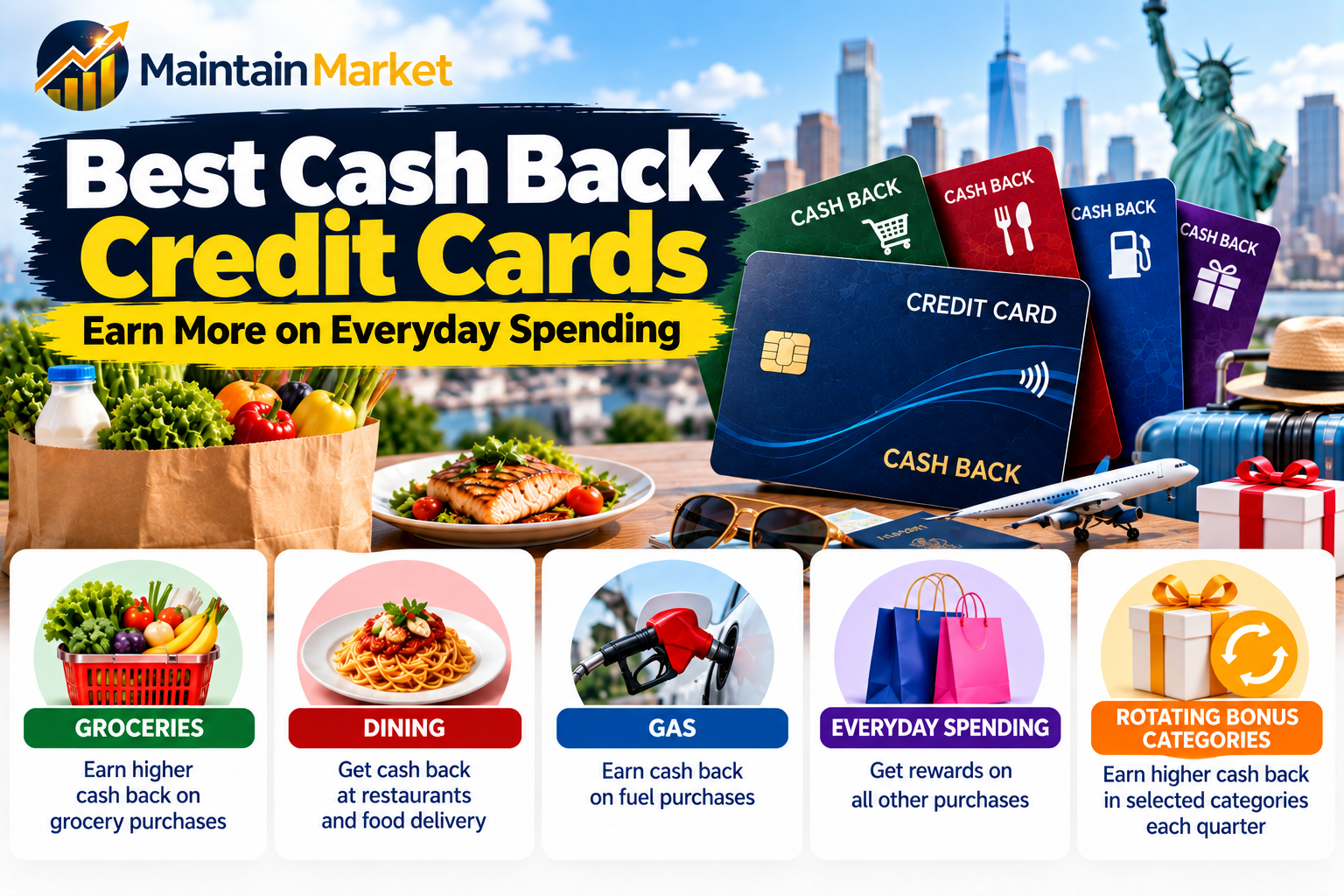
The best cash back credit cards can help you earn money back on purchases you already make, from groceries and dining to gas and everyday shopping. The right card depends on your spending habits, whether you prefer a simple flat cash-back rate or higher rewards in specific categories.
Quick Answer: What Are the Best Cash Back Credit Cards?
There is no single cash-back card that is best for every person. Some cards are built for simple rewards on every purchase, while others offer higher cash back on groceries, dining, gas or rotating categories.
| Credit Card | Cash Back Focus | Annual Fee | Best For |
|---|---|---|---|
| Citi Double Cash® | 2% on purchases | $0 | Simple everyday cash back |
| Capital One Quicksilver | 1.5% on every purchase | $0 | Straightforward rewards |
| Chase Freedom Unlimited® | 1.5%+ cash back | $0 | Everyday spending |
| Chase Freedom Flex® | Rotating 5% categories | $0 | Category-based rewards |
| Capital One Savor | Grocery, dining & entertainment | $0 | Food and entertainment |
| Blue Cash Preferred® from American Express | Grocery & streaming | $95 after first year | Grocery-heavy households |
| Wells Fargo Active Cash® | Flat-rate cash back | $0 | Simple everyday purchases |
| Discover it® Cash Back | Rotating categories | $0 | Maximizing quarterly categories |
| Capital One QuicksilverOne | 1.5% cash back | $39 | Some fair-credit borrowers |
| Chase Freedom Rise® | 1.5% cash back | $0 | People new to credit |
Rewards, fees, introductory offers and eligibility requirements can change. Always check the issuer’s current terms before applying.
1. Citi Double Cash® — Best for Simple 2% Cash Back
If you want a straightforward cash-back structure, Citi Double Cash is worth considering.
The card currently earns:
- 1% cash back when you make a purchase
- Another 1% when you pay for that purchase
- 2% total cash back when both parts are earned
- $0 annual fee
Citi also currently advertises additional rewards through Citi Travel on eligible bookings.
Why consider it?
You don’t need to keep track of rotating categories for the core 2% structure.
Example
If you spend $20,000 during a year and earn 2%:
$20,000 × 2% = $400
Your actual rewards depend on eligible purchases and the card’s current terms.
2. Capital One Quicksilver — Best for Flat-Rate Cash Back
Capital One Quicksilver is designed around a simple rewards structure.
The current card offers:
- 1.5% cash back on every purchase
- $0 annual fee
- A current $200 cash bonus offer for eligible new cardholders who meet the required spending conditions
Capital One also offers different versions of Quicksilver for different credit profiles.
Why consider it?
It’s simple. You don’t need to remember which grocery store, restaurant or gas station qualifies for a bonus category.
3. Chase Freedom Unlimited® — Best for Everyday Spending
Chase Freedom Unlimited combines a flat cash-back rate with higher rewards in selected categories.
Current earning includes:
- 1.5% cash back on most purchases
- 3% on dining
- 3% at drugstores
- 5% on travel purchased through Chase Travel
- $0 annual fee
Chase currently advertises a $200 bonus for eligible new cardmembers who meet the required spending threshold.
Why consider it?
It can work well if you want a basic cash-back rate but also spend regularly on dining or Chase Travel.
4. Chase Freedom Flex® — Best for Rotating Cash-Back Categories
Chase Freedom Flex is designed for people who are willing to track bonus categories.
The card currently offers:
- 5% cash back on activated quarterly bonus categories, up to the applicable quarterly spending limit
- 5% on eligible Chase Travel purchases
- 3% on dining
- 3% at drugstores
- 1% on other purchases
For the fourth quarter of 2026, Chase announced 5% cash back on eligible grocery-store purchases, dining and American Red Cross donations, subject to the quarterly limit and activation requirements.
Why consider it?
If you regularly spend in the bonus categories, you may be able to earn considerably more than a basic flat-rate card during those periods.
The trade-off is that you need to remember to activate and track the categories.
5. Capital One Savor — Best for Dining, Groceries and Entertainment
Capital One Savor is focused on several popular everyday spending categories.
Current rewards include:
- 3% cash back at grocery stores
- 3% on dining
- 3% on entertainment
- 3% on eligible streaming services
- 1% on other purchases
- 5% on eligible hotels, vacation rentals and rental cars booked through Capital One Travel
The card currently has a $0 annual fee.
Why consider it?
This type of card can make sense for households that spend heavily on food, entertainment and streaming.
6. Blue Cash Preferred® from American Express — Best for Grocery Spending
The Blue Cash Preferred card focuses heavily on grocery and streaming purchases.
Current rewards include:
- 6% cash back at U.S. supermarkets, subject to the annual spending limit
- 6% on select U.S. streaming subscriptions
- 3% at U.S. gas stations
- 3% on transit
- 1% on other eligible purchases
The card currently has no annual fee during the first year and a $95 annual fee afterward.
Why consider it?
If your household spends a lot on groceries, the higher grocery reward rate may be more important than having a flat 2% reward on every purchase.
7. Wells Fargo Active Cash® — Best for Straightforward Everyday Rewards
Wells Fargo Active Cash is another type of card worth comparing if you prefer a simple cash-back structure.
The main appeal is a straightforward reward rate rather than having to organize your spending around multiple categories.
Why consider it?
A flat-rate card can be easier to manage because you don’t have to remember rotating categories or specific merchants.
Before applying, check the current cash-back rate, welcome offer, annual fee and other terms directly with Wells Fargo.
8. Discover it® Cash Back — Best for Rotating Categories
Discover it Cash Back uses a rotating-category model.
The card can offer:
- 5% cash back in selected categories when activated
- 1% cash back on other purchases
- $0 annual fee
- Cashback Match for eligible new cardmembers during the first year under the applicable terms
The bonus categories change periodically.
Why consider it?
It can be useful for someone who is willing to plan purchases around the current bonus categories.
For example, if a category you already spend heavily in receives a 5% bonus, you may be able to increase your cash back without changing your normal spending.
9. Capital One QuicksilverOne — Cash Back for Some Fair-Credit Borrowers
Not every cash-back card is designed exclusively for consumers with excellent credit.
Capital One’s QuicksilverOne currently offers:
- 1.5% cash back on every purchase
- $39 annual fee
- Credit-building features when used responsibly
Why consider it?
It may be relevant for consumers who don’t qualify for some premium cash-back cards.
However, the annual fee means you should calculate whether the rewards you expect to earn are enough to justify the cost.
10. Chase Freedom Rise® — Cash Back for People New to Credit
Chase Freedom Rise is designed in part for people who are newer to credit.
The card currently offers:
- 1.5% cash back on purchases
- $0 annual fee
- Flexible ways to redeem rewards
Why consider it?
If you are building your credit history and want a cash-back card, a card designed for newer credit users may be worth researching.
Approval is still subject to the issuer’s eligibility requirements.
Flat-Rate vs. Category Cash Back
Before choosing a card, understand the difference between these two structures.
| Type | How It Works | Example |
|---|---|---|
| Flat-rate | Same reward rate on most purchases | 2% on eligible purchases |
| Tiered | Higher rewards on specific categories | 3% dining, 1% other purchases |
| Rotating | Bonus categories change periodically | 5% on selected quarterly categories |
| Grocery-focused | Higher rewards at qualifying supermarkets | 6% grocery rewards |
| Dining-focused | Higher rewards at restaurants | 3% or more on dining |
Which structure is easier?
A flat-rate card is generally easier to manage.
A category card can potentially generate more rewards if your spending matches its bonus categories.
How Much Cash Back Can You Earn?
Consider a hypothetical annual spending pattern:
- Groceries: $7,200
- Dining: $3,600
- Gas: $2,400
- Other purchases: $6,800
Total spending:
$20,000 per year
If you earned an average of 2% cash back:
$20,000 × 2% = $400
But a category-based card could produce a different result because some purchases may earn more while others earn less.
That’s why your personal spending pattern matters more than simply choosing the card with the biggest advertised percentage.
How to Choose the Best Cash Back Credit Card
Choose a flat-rate card if:
- You want simplicity
- Your spending is spread across many categories
- You don’t want to track rotating offers
- You want predictable rewards
Consider a category card if:
- You spend heavily on groceries
- You eat out frequently
- You spend a lot on gas
- You regularly use streaming services
- You’re willing to track bonus categories
Consider a rotating-category card if:
- You don’t mind activating categories
- You can plan spending around quarterly bonuses
- You want to maximize certain purchases
Don’t Ignore the Annual Fee
A higher reward rate doesn’t automatically make a card more valuable.
For example, imagine:
Card A
- $0 annual fee
- 2% cash back
Card B
- $95 annual fee
- Higher rewards in certain categories
If Card B earns an additional $150 in rewards compared with Card A, the extra rewards are not the full benefit.
You also need to account for the $95 annual fee.
$150 extra rewards − $95 annual fee = $55 additional value
That’s why you should compare net value, not just the headline reward percentage.
Rewards Should Not Encourage Extra Spending
Cash back is only useful if you don’t spend more than you otherwise would.
For example, spending $500 unnecessarily to earn an additional $10 in cash back doesn’t make financial sense.
A rewards card is generally most useful when you use it for purchases already included in your budget and pay your balance according to the card’s terms.
7 Common Cash Back Credit Card Mistakes
1. Choosing a card only because it advertises the highest percentage
A 6% reward in one category may be less useful than 2% everywhere if you rarely spend in that category.
2. Ignoring annual fees
Calculate whether the rewards and benefits justify the fee.
3. Forgetting reward limits
Some higher reward rates apply only up to a certain spending limit.
4. Forgetting to activate rotating categories
Some cards require activation before the higher reward rate applies.
5. Spending extra to earn rewards
Don’t change your budget just to earn cash back.
6. Ignoring redemption rules
Check how rewards can be redeemed and whether minimum redemption amounts or other restrictions apply.
7. Carrying a balance
Credit card interest can easily outweigh the value of your cash-back rewards.
Frequently Asked Questions
What are the best cash back credit cards?
The right card depends on your spending. Flat-rate cards can be useful for simple everyday rewards, while category cards may provide higher cash back on groceries, dining, gas or other purchases.
Which credit card gives the most cash back?
There is no single card that gives the highest cash back on every purchase. Some cards offer higher rewards in specific categories, while others provide a consistent rate across most purchases.
Is 2% cash back good?
A 2% flat cash-back rate can be a straightforward option for everyday spending. Whether it is valuable for you depends on the card’s fees, terms and the alternatives you qualify for.
Are cash-back credit cards worth it?
They can be worthwhile if you use the card for normal purchases, avoid unnecessary spending and manage your balance responsibly.
Do cash-back rewards expire?
The rules depend on the card issuer and rewards program. Check the current card agreement for expiration and account-closure rules.
Can I have multiple cash-back credit cards?
Yes, some consumers use different cards for different spending categories. However, managing multiple accounts requires keeping track of payment dates, fees and rewards rules.
Is cash back better than travel points?
Cash back is generally simpler because you receive a straightforward monetary reward. Travel points can provide different redemption options, but their value can vary depending on how you redeem them.
Final Takeaway
The best cash back credit cards aren’t necessarily the cards advertising the biggest percentage.
The better approach is to match the card with your actual spending.
If you want simplicity, consider a flat-rate cash-back card. If you spend heavily on groceries, dining or other specific categories, a category-focused card may provide more rewards. If you’re willing to track quarterly categories, rotating-category cards can offer another way to increase cash back.
Before applying, compare:
- Cash-back rate
- Annual fee
- Welcome offer
- Spending requirements
- Reward limits
- Eligible purchase categories
- Redemption options
- APR
- Foreign transaction fees
- Your actual spending habits
And remember: cash back should reward spending you were already planning to make—not encourage you to spend more.
Why Maintain Market Is Different
Maintain Market focuses on how rewards actually fit into a consumer’s spending rather than simply listing cards with the biggest advertised percentages.
We separate flat-rate, category-based and rotating cash-back cards so readers can understand how each structure works before applying.
References
- Chase Freedom Unlimited®
- Chase Freedom Flex®
- Capital One Quicksilver
- Capital One Savor
- Citi Double Cash®
- Blue Cash Preferred® from American Express
- Discover it® Cash Back
- Wells Fargo Active Cash® — Account Agreement
- CFPB — Credit Card Rewards Programs
Editorial Review
Reviewed for U.S. credit-card terminology, cash-back structures, annual-fee considerations and current issuer information. Card rewards, fees, offers and eligibility requirements can change, so readers should verify current terms directly with the issuer before applying.