
If someone gets injured at your home or you accidentally damage another person’s property, you could face unexpected medical bills, legal expenses, or a liability claim. This is where homeowners insurance liability coverage can help protect your finances.
Personal liability coverage is a part of a standard homeowners insurance policy that may help pay for covered bodily injury or property damage claims when you or another insured person is legally responsible. Depending on your policy, it may also cover legal defense costs and certain court-awarded damages.
However, liability coverage has limits, exclusions, and conditions. It does not protect against every accident or lawsuit, and the amount included in your policy may not be enough to protect all your assets.
In this guide, you will learn what homeowners insurance liability coverage includes, how it works, how much coverage you may need, and when additional protection such as umbrella insurance may be worth considering.
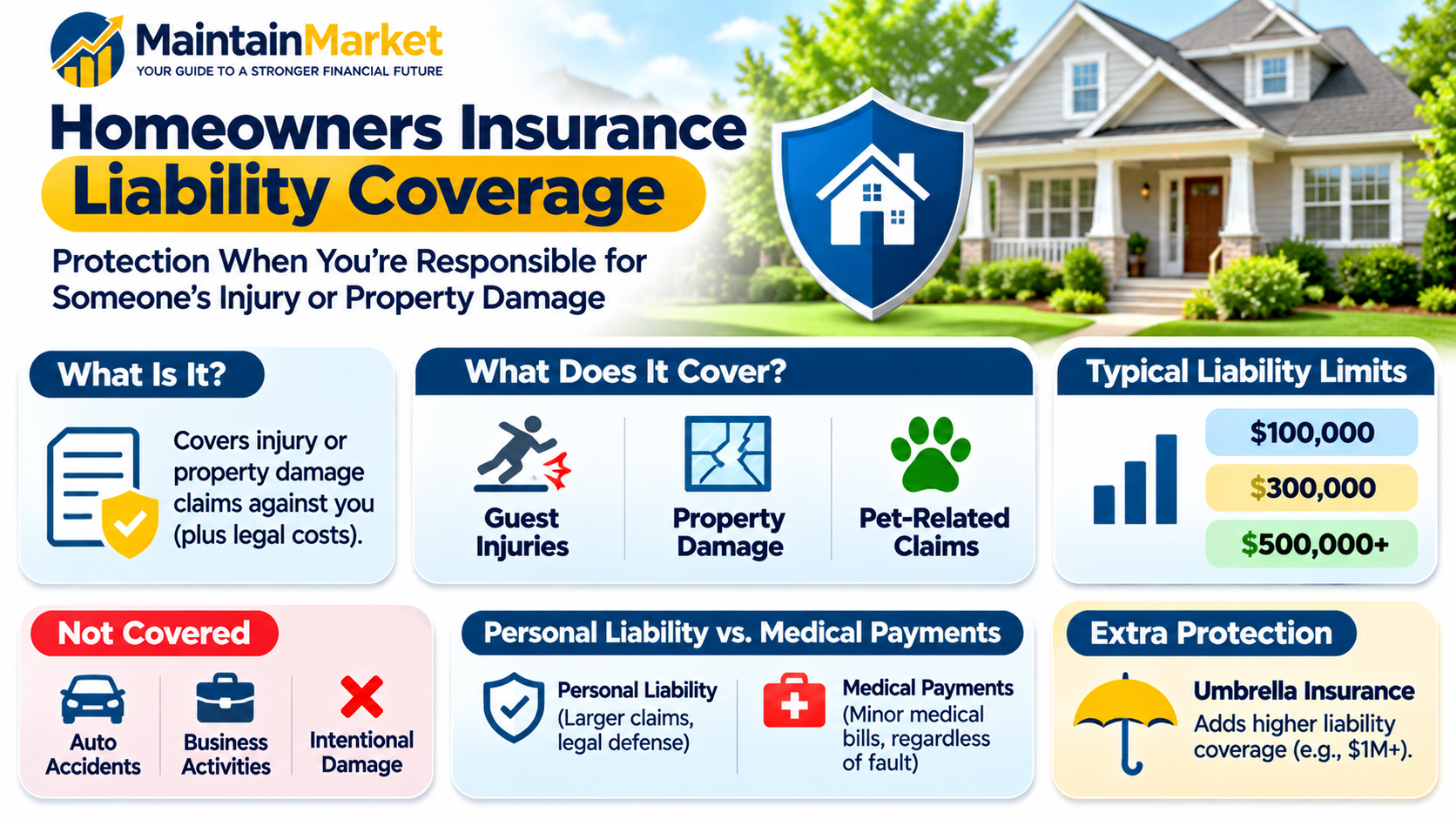
What Is Homeowners Insurance Liability Coverage?
Homeowners insurance liability coverage is the part of your home insurance policy that protects you financially against certain claims involving injuries to other people or damage to their property.
It is generally referred to as personal liability coverage or Coverage E in many standard homeowners insurance policies.
For example, imagine a guest visits your home, slips on a wet floor, and suffers an injury. If you are legally responsible for the accident, your homeowners insurance liability coverage may help pay covered medical expenses, legal defense costs, and damages, subject to your policy terms and coverage limit.
Liability protection may also apply to certain accidents involving you, eligible household members, or your pets, depending on the policy.
Unlike dwelling coverage, which protects the physical structure of your home, personal liability coverage is designed to protect you against covered claims made by other people.
What Does Homeowners Insurance Liability Coverage Cover?
Homeowners insurance liability coverage generally helps protect against covered bodily injury and property damage claims for which an insured person is legally responsible.
Common examples include the following.
1. Injuries to guests at your home
If a visitor is injured on your property and you are legally responsible, your personal liability coverage may help pay for covered damages and legal expenses.
Examples include:
- A visitor slipping on an icy walkway.
- A guest falling on damaged stairs.
- Someone getting injured because of an unsafe condition on your property.
- A visitor suffering an injury around a swimming pool.
Coverage depends on the circumstances, applicable law, and policy exclusions.
2. Accidental damage to someone else’s property
Liability coverage may also help if you accidentally damage another person’s property and are legally responsible.
For example:
- Your child accidentally breaks a neighbor’s expensive window.
- A tree on your property falls and damages a neighbor’s fence in circumstances where you are legally liable.
- You accidentally damage a visitor’s belongings in a covered incident.
The insurer evaluates the circumstances and whether the claim falls within your policy.
3. Certain injuries caused by your pets
Some homeowners insurance policies cover certain liability claims when an insured person’s pet injures someone.
For example, if your dog bites a visitor and you are legally responsible, your policy may help cover the resulting claim.
However, animal-related coverage varies significantly. Some insurers exclude certain animals or breeds, impose special conditions, or require additional coverage.
Always disclose your pets to your insurer and review the policy’s animal liability provisions.
4. Legal defense costs
A liability claim can become expensive even if you believe you did nothing wrong.
Depending on the policy, personal liability coverage may pay for an attorney, legal defense expenses, and certain court-awarded damages arising from a covered claim.
Check your policy to understand whether defense costs are paid in addition to or within the liability limit. The treatment can depend on the policy wording and applicable state law.
5. Certain accidents involving insured household members
Personal liability coverage may extend to other people who qualify as insureds under your policy, such as certain household family members.
For example, if an insured family member accidentally damages someone else’s property and is legally responsible, the policy may respond.
The exact definition of an insured person varies by policy.
What Does Homeowners Insurance Liability Coverage Not Cover?
Personal liability coverage is not unlimited. Certain accidents, activities, and types of claims are commonly excluded or may require separate insurance.
Here are important exclusions and limitations to understand.
1. Intentional injuries or damage
Homeowners insurance generally does not cover intentional harm or deliberate property damage caused by an insured person.
For example, intentionally damaging a neighbor’s car or deliberately injuring another person would generally not be covered.
2. Auto accidents
A standard homeowners policy generally does not cover liability arising from the use or ownership of a car.
If you cause an accident while driving, your auto insurance liability coverage is generally the relevant protection.
3. Business-related liability
If you operate a business from your home, your standard homeowners policy may not provide sufficient coverage for business-related liability claims.
For example, a customer visiting your home office and getting injured could create a coverage issue.
You may need a business insurance policy or a suitable endorsement, depending on the nature of your work.
4. Certain animal-related claims
Some policies exclude or restrict coverage for specific animals, breeds, or previous incidents involving a pet.
Do not assume every dog bite or animal injury is automatically covered.
5. Certain professional liability claims
Homeowners insurance is not a substitute for professional liability insurance.
If you provide professional services and someone claims your advice or work caused financial harm, a separate professional liability policy may be necessary.
6. Certain property or contractual obligations
Liability arising from certain contracts, agreements, or property-related activities may be excluded or limited.
Read your policy carefully, particularly if you rent out your home, operate a business, or participate in activities that create additional liability exposure.
Important: Exclusions vary between insurers and policy forms. The examples above are general and are not a complete list. Always review your policy and ask your insurer about activities that may create coverage gaps.
How Much Homeowners Insurance Liability Coverage Do You Need?
The amount of personal liability coverage you need depends on your financial situation, assets, property, and potential risks.
Many standard homeowners policies offer a starting liability limit of $100,000, although the amount available depends on the insurer and policy.
Homeowners may be able to choose higher limits, such as $300,000 or $500,000.
The right limit should reflect the amount of financial protection you want and the potential claims you could face.
Factors to consider when choosing liability coverage
1. Your financial assets
Consider your savings, investments, and other assets that could be exposed to a liability judgment.
2. Your property and lifestyle
Owning a swimming pool, trampoline, or other features that may increase the risk of injuries could affect your liability needs.
3. Pets
If you own a dog or another animal, review whether your policy provides the protection you need.
4. Visitors and household activities
A home that regularly hosts guests, gatherings, or events may present different liability exposures from a home with fewer visitors.
5. Your existing insurance
Review the liability limits on your homeowners and auto policies, as well as any umbrella coverage you may already have.
Example: Comparing different liability limits
Suppose you are comparing three hypothetical homeowners insurance options:
| Liability limit | Potential protection |
|---|---|
| $100,000 | Lower amount of liability protection |
| $300,000 | Higher protection for covered claims |
| $500,000 | Greater protection for covered claims |
These are illustrative coverage options, not a recommendation that one limit is suitable for every homeowner.
If a covered liability claim exceeds your policy limit, you may be personally responsible for the amount not covered, subject to applicable law and the details of the claim.
Consider discussing your assets and risk exposure with a licensed insurance professional before selecting a limit.
What Is the Difference Between Personal Liability and Medical Payments Coverage?
Homeowners insurance policies commonly include two separate liability-related coverages:
- Personal liability coverage, often called Coverage E.
- Medical payments to others coverage, often called Coverage F.
Although both may help with injuries involving other people, they work differently.
Personal liability coverage
Personal liability coverage generally applies when an insured person is legally responsible for covered bodily injury or property damage.
It may help pay for:
- Covered legal defense expenses.
- Covered settlements.
- Certain court-awarded damages.
For example, a visitor falls because of an unsafe condition on your property and brings a claim alleging negligence.
If you are legally responsible and the claim is covered, your personal liability insurance may respond.
Medical payments to others coverage
Medical payments coverage is generally designed to pay certain smaller medical expenses for eligible people injured on your property, regardless of whether you were legally responsible.
Depending on the policy, it may cover expenses such as:
- Emergency medical treatment.
- Doctor visits.
- Hospital expenses.
- Certain other necessary medical costs.
It generally has a separate, smaller limit than personal liability coverage.
Personal liability vs medical payments comparison
| Feature | Personal Liability | Medical Payments |
|---|---|---|
| Common policy label | Coverage E | Coverage F |
| Requires legal liability | Generally yes | Generally no |
| Main purpose | Covered injury and property damage claims | Certain medical expenses for injured others |
| Legal defense | May be included for covered claims | Not its main purpose |
| Coverage limit | Usually higher | Usually lower |
| Applies to insured household members’ own injuries | Generally no | Generally no |
The exact coverage, exclusions, and limits depend on your policy.
How Does Homeowners Insurance Liability Coverage Work?
Personal liability coverage generally comes into play when an accident causes injury or property damage and an insured person may be legally responsible.
Here is a simplified example.
Imagine a visitor slips on your front steps and suffers a serious injury.
The process may work as follows:
Step 1: The accident happens
The visitor suffers an injury and seeks medical attention.
Step 2: The incident is reported
You contact your insurance company and report the incident as soon as reasonably possible, following your policy’s reporting requirements.
Step 3: The insurer investigates
The insurer reviews the facts, applicable policy terms, and whether you may be legally responsible.
Step 4: The claim is evaluated
The insurer determines whether the claim is covered and evaluates the potential damages.
Step 5: Covered expenses are handled
If the claim is covered, the insurer may pay eligible defense expenses, settlements, or damages according to the policy.
Step 6: Policy limits apply
The insurer’s payment is subject to the applicable coverage limit, exclusions, conditions, and other policy provisions.
If the claim exceeds your available coverage, you may face additional financial exposure.
What Happens If a Liability Claim Exceeds Your Homeowners Insurance Limit?
Your homeowners insurance policy only provides liability protection up to its applicable limit, subject to the policy terms.
For example, suppose:
- Your personal liability limit is $300,000.
- A covered liability judgment is $450,000.
In this simplified illustration, the difference is $150,000.
You may be personally responsible for the amount exceeding your coverage limit, depending on the circumstances and applicable law.
This is one reason homeowners with significant assets or higher liability exposure sometimes consider an umbrella insurance policy.
What Is Umbrella Insurance, and Do Homeowners Need It?
Umbrella insurance provides an additional layer of personal liability protection above certain underlying insurance policies, such as homeowners and auto insurance.
It generally begins paying eligible claims after the applicable underlying liability limits have been exhausted, subject to its own conditions and exclusions.
For example:
- Homeowners liability limit: $300,000.
- Personal umbrella limit: $1 million.
- Potential combined liability protection: Up to $1.3 million for qualifying claims, subject to the policies’ terms.
This is a simplified illustration. The actual amount available depends on the underlying policy, umbrella policy, claim type, and applicable exclusions.
Who should consider umbrella insurance?
You may want to discuss umbrella coverage with an insurance professional if you:
- Have substantial savings or investments.
- Own multiple properties.
- Have a swimming pool or other higher-risk property features.
- Regularly host visitors.
- Own pets that may create additional liability exposure.
- Want more liability protection than your homeowners and auto policies provide.
Umbrella insurance does not cover every type of claim. Review its exclusions, required underlying limits, and coverage conditions before purchasing.
Does Homeowners Insurance Liability Coverage Apply Outside Your Home?
Personal liability coverage may extend beyond accidents that occur inside your house.
Depending on the policy, it can cover certain incidents involving insured people away from the insured residence.
For example, an insured person may accidentally damage someone else’s property while visiting another location.
However, coverage is not universal. Auto accidents, certain business activities, and other excluded situations may require different insurance.
Check your policy’s personal liability section to understand where and under what circumstances the protection applies.
How Much Does Homeowners Insurance Liability Coverage Cost?
There is no single price for personal liability coverage because it is usually included as part of a homeowners insurance policy.
The total premium depends on multiple factors, including:
- Property location.
- Home value and construction.
- Coverage limits.
- Claims history.
- Deductible.
- Insurer underwriting rules.
- Additional coverage and endorsements.
Increasing your liability limit may increase your premium, but the actual price difference depends on the insurer and your risk profile.
When comparing quotes, ask insurers to show the cost of different liability limits rather than assuming the highest limit will be unaffordable.
Also compare the entire homeowners policy. A low premium does not necessarily mean the policy offers the protection you need.
How to Increase Your Homeowners Insurance Liability Coverage
If your current personal liability limit does not provide the protection you want, there may be ways to increase it.
1. Contact your insurance company
Ask your insurer which higher personal liability limits are available under your current homeowners policy.
2. Compare quotes from other insurers
Different insurers may offer different coverage limits, endorsements, and pricing.
Request comparable quotes using similar policy limits and deductibles.
3. Consider an umbrella policy
If you want additional protection beyond your homeowners policy, ask about personal umbrella insurance.
Your insurer may require certain minimum underlying liability limits before offering an umbrella policy.
4. Review special risks
Tell your insurer about swimming pools, pets, rental activities, home businesses, or other circumstances that could affect coverage.
5. Read the exclusions carefully
Before increasing coverage, confirm that the types of risks you are concerned about are actually covered.
A higher liability limit does not automatically remove exclusions from your policy.
How to Choose the Right Homeowners Insurance Liability Coverage
Choosing liability coverage should involve more than selecting the cheapest policy.
Use the following checklist when reviewing your homeowners insurance.
- Check your current personal liability limit.
- Review the definition of an insured person.
- Confirm whether legal defense costs are included and how they affect the limit.
- Check medical payments coverage separately.
- Review exclusions involving pets and animals.
- Disclose swimming pools and other relevant property features.
- Check whether home business or rental activities require separate coverage.
- Compare higher liability limits.
- Consider umbrella insurance if your assets or risks justify additional protection.
- Review your coverage whenever your financial circumstances change.
If you are unsure whether a particular accident would be covered, ask your insurer or a licensed insurance professional for a written explanation.
Frequently Asked Questions About Homeowners Insurance Liability Coverage
1. What does homeowners insurance liability coverage cover?
It generally covers certain bodily injury and property damage claims when you or another insured person is legally responsible. It may also pay covered legal defense expenses, settlements, and damages, subject to policy limits and exclusions.
2. How much liability coverage should I have on my homeowners insurance?
The appropriate amount depends on your assets, financial situation, property risks, and lifestyle. Many policies offer starting limits such as $100,000, with higher options such as $300,000 or $500,000. Consider discussing your needs with a licensed insurance professional.
3. Does homeowners insurance cover someone getting injured on my property?
It may. Personal liability coverage can help when an insured person is legally responsible for a covered injury. Medical payments coverage may also pay certain eligible medical expenses regardless of legal responsibility.
4. Does homeowners insurance cover dog bites?
Some homeowners policies cover certain dog-bite liability claims. However, coverage may depend on the insurer, animal, breed restrictions, previous incidents, and policy exclusions.
5. Does homeowners insurance liability coverage pay for legal fees?
It may pay covered legal defense expenses arising from an eligible liability claim. Check whether those expenses are paid in addition to or within your policy limit.
6. What is the difference between personal liability and medical payments coverage?
Personal liability generally applies when an insured person is legally responsible for covered bodily injury or property damage. Medical payments coverage can pay certain smaller medical expenses for eligible injured visitors regardless of legal responsibility.
7. Does homeowners insurance cover damage I accidentally cause to someone else’s property?
It may cover certain accidental property damage claims for which you are legally responsible. However, coverage depends on the circumstances, exclusions, and policy conditions.
8. Does homeowners insurance liability coverage apply outside my home?
It may extend to certain incidents involving insured people away from the insured residence. However, coverage is subject to policy terms and exclusions, including restrictions involving auto and business activities.
9. What happens if a liability claim is higher than my insurance limit?
You may be personally responsible for the amount exceeding your available coverage. A personal umbrella policy can provide additional protection for certain qualifying claims above underlying policy limits.
10. Is homeowners insurance liability coverage mandatory?
There is generally no universal federal requirement to purchase homeowners liability coverage. However, homeowners insurance may be required by a mortgage lender, and liability coverage is commonly included in standard homeowners policies.
11. Does homeowners insurance liability coverage protect my family?
It may cover certain claims involving people who qualify as insureds under your policy. The definition of an insured person varies, so check your policy for details.
12. Can I increase my homeowners insurance liability limit?
Yes, many insurers offer higher personal liability limits. You can also ask about a personal umbrella policy if you need additional protection beyond your homeowners policy.
Final Thoughts
Homeowners insurance liability coverage is an important part of protecting your financial security. It can help pay for covered injury and property damage claims when you or another insured person is legally responsible.
However, the protection is not unlimited. Your policy has specific coverage limits, exclusions, and conditions that determine when the insurer will pay.
Review your current liability limit, understand the difference between personal liability and medical payments coverage, and consider whether umbrella insurance is appropriate for your financial situation.
The right coverage is not necessarily the policy with the highest limit or the lowest premium. It is the protection that fits your assets, lifestyle, and potential risks.
External authoritative sources
These are useful sources to cite within the article:
- NAIC – Homeowners Insurance
- NAIC – Consumer Homeowners Insurance Guide
- NAIC – Understanding Your Homeowners Policy
- NAIC – What’s an Umbrella Policy?
- Insurance Information Institute – Should I Purchase Umbrella Insurance?
- New York Department of Financial Services – Homeowners Insurance Coverage
Recommended Reads:
- Important Tips: Homeowners Insurance for First Time Homeowners
- Important Steps: Homeowners Insurance Claim Process Explained From Start to Finish
- Important Steps: Homeowners Insurance Claim Denied?
Disclaimer: This article is for educational purposes only and does not constitute insurance, legal, or financial advice. Homeowners insurance coverage, exclusions, limits, and pricing vary by insurer, state, and policy form. Review your policy and consult a licensed insurance professional about your individual coverage needs.