
Imagine a fire damages your kitchen, a severe storm makes your house unsafe, or a burst pipe causes extensive damage that requires major repairs. You cannot live in your home for several weeks or months. Where will you stay, and who will pay for the extra costs?
This is where homeowners insurance additional living expenses (ALE) coverage can help. Also known as Loss of Use coverage, ALE helps pay certain necessary and reasonable extra living costs when a covered loss makes your home uninhabitable.
Depending on your policy, this coverage may help with temporary housing, additional food expenses, laundry, transportation, storage, and other costs you would not normally have while living at home.
However, ALE does not pay every expense you incur. It generally covers the increase above your normal living expenses, subject to your policy’s limits and conditions.
In this guide, we’ll explain what additional living expenses coverage is, what it pays for, what it excludes, how limits work, and how to file a claim.
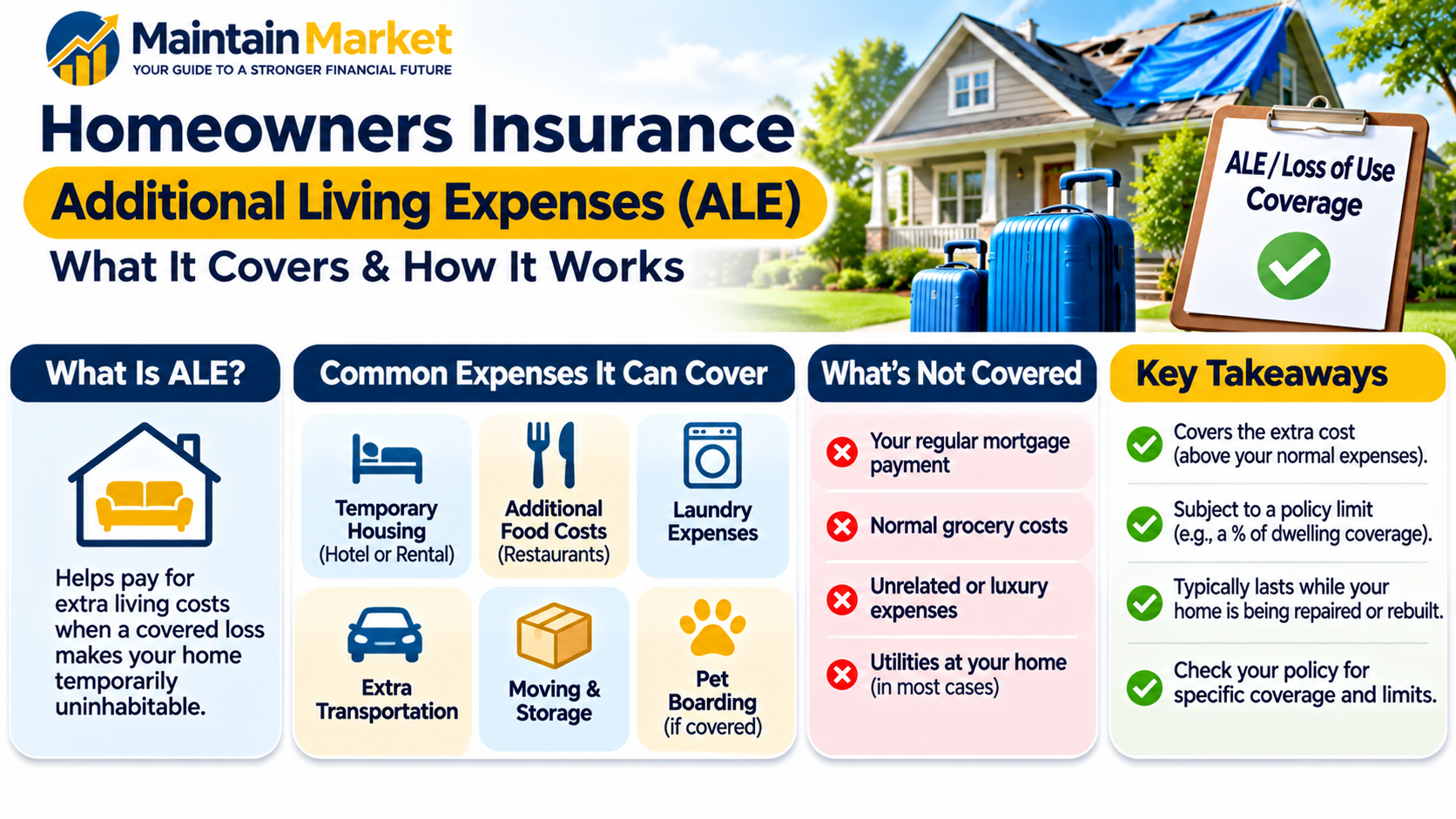
What Is Additional Living Expenses (ALE) Coverage?
Additional Living Expenses (ALE) coverage is a part of many homeowners insurance policies that helps pay for extra living costs when a covered event makes your home temporarily uninhabitable.
For example, if a covered fire damages your house and you need to stay in a hotel while repairs are underway, ALE may help pay the additional cost of your temporary accommodation.
This coverage is commonly listed under Coverage D – Loss of Use in homeowners insurance policies.
ALE is designed to help you maintain something close to your normal standard of living while your home is being repaired or rebuilt. It does not mean your insurer will pay all your regular bills.
According to the National Association of Insurance Commissioners (NAIC), ALE can cover temporary housing, reasonable restaurant meals, and other additional costs incurred because you cannot live in your home after a covered loss.
What Does Homeowners Insurance Additional Living Expenses Cover?
The exact expenses covered depend on your policy, but ALE may help with several costs associated with temporarily relocating.
Here are some common examples.
1. Temporary Housing and Hotel Expenses
If your home becomes uninhabitable after a covered loss, your insurer may help pay for temporary accommodation.
Examples include:
- Hotel rooms
- Short-term apartment rentals
- Temporary house rentals
- Other reasonable accommodation
The temporary housing generally needs to be reasonable and comparable to your normal living arrangements. An insurer may not pay for an unnecessarily expensive luxury property.
2. Additional Food and Restaurant Expenses
If you move into a hotel or temporary accommodation without a kitchen, you may need to eat at restaurants more frequently.
ALE may cover the additional food expense above what you would normally spend on groceries and meals.
For example, if your usual food budget is $700 per month but your temporary living arrangements increase it to $1,000, the additional $300 may qualify, subject to your policy.
The insurer generally does not pay your entire food bill.
3. Laundry and Dry-Cleaning Expenses
If your temporary accommodation does not have laundry facilities, you may need to use a laundromat or laundry service.
The additional cost may qualify for ALE reimbursement when it is necessary and covered by your policy.
4. Additional Transportation Costs
Moving away from your home may increase your daily travel expenses.
For example:
- Longer commutes to work
- Additional transportation to school
- Extra mileage because your temporary home is farther away
- Other necessary transportation expenses caused by relocation
Keep records of additional travel costs and ask your adjuster which expenses qualify.
5. Moving and Storage Expenses
If your home needs major repairs, you may need to move some belongings into temporary storage.
Depending on the policy, ALE may help pay for:
- Moving services
- Temporary storage units
- Transportation of household belongings
- Certain relocation-related expenses
6. Pet Boarding or Temporary Pet Accommodation
If your temporary housing does not allow pets, you may need to arrange alternative accommodation for them.
Some policies may cover reasonable additional pet boarding expenses, depending on the circumstances and policy terms.
Always confirm this with your insurance company before assuming it will be reimbursed.
What Does Additional Living Expenses Insurance Not Cover?
ALE is not designed to pay every household expense while you are away from home.
It generally covers necessary additional costs caused by a covered loss, not expenses you would have paid anyway.
Here are some examples of expenses that generally are not covered by ALE.
| Expense | Generally covered? | Explanation |
|---|---|---|
| Regular mortgage payment | No | You remain responsible for your normal mortgage payment. |
| Normal grocery expenses | No | ALE generally covers only the additional food cost. |
| Hotel or temporary rent | Potentially | Must be necessary, reasonable, and covered by the policy. |
| Luxury accommodation upgrade | Usually no | Insurers generally consider reasonable and comparable housing costs. |
| Unrelated shopping | No | Personal purchases are not additional living expenses caused by displacement. |
| Regular utility bills at your home | Generally no | Normal household expenses do not become ALE simply because you relocate. |
| Additional laundry costs | Potentially | May qualify when caused by temporary living arrangements. |
| Extra commuting costs | Potentially | Depends on necessity and policy terms. |
Important: These are general examples, not universal policy rules. Your insurer and policy wording determine which expenses qualify.
How Much Does Homeowners Insurance Pay for Additional Living Expenses?
There is no single ALE limit that applies to every homeowners insurance policy.
Your coverage may be based on:
- A specific dollar amount
- A percentage of your dwelling coverage
- A time limit
- A combination of dollar and time limits
Your declarations page and policy documents should explain the applicable limit.
Example: Calculating an ALE Coverage Limit
Suppose your homeowners insurance policy has:
- Dwelling coverage: $300,000
- ALE limit: 20% of dwelling coverage
Your potential ALE coverage limit would be:
$300,000 × 20% = $60,000
This means the policy could provide up to $60,000 for eligible additional living expenses, subject to its terms and conditions.
The 20% figure is an illustrative example, not a standard limit offered by every insurer.
Some policies use different percentages or fixed dollar amounts. Check your declarations page rather than assuming a particular percentage applies.
How Does an Additional Living Expenses Claim Work?
Let’s understand how ALE reimbursement may work through a practical example.
Imagine a covered fire makes your home uninhabitable, and you need temporary accommodation for two months.
Your normal monthly living expenses and temporary living expenses look like this:
| Expense | Normal monthly cost | Temporary monthly cost | Additional cost |
|---|---|---|---|
| Housing | $1,500 | $2,300 | $800 |
| Food | $700 | $1,000 | $300 |
| Laundry | $50 | $120 | $70 |
| Transportation | $200 | $280 | $80 |
| Total | $2,450 | $3,700 | $1,250 |
In this hypothetical example, your additional monthly living expenses are $1,250.
For two months:
$1,250 × 2 = $2,500
Your potential ALE reimbursement would be $2,500, assuming all the expenses qualify and the insurer approves them.
The insurer would not simply pay the full $3,700 temporary monthly budget. The calculation focuses on the additional expenses caused by having to live elsewhere.
Actual claim calculations may use different methods and documentation requirements depending on the policy and insurer.
How Long Does Additional Living Expenses Coverage Last?
The duration of ALE coverage depends on your policy and the circumstances of the loss.
Some policies have a specific time limit, while others also impose a maximum dollar amount. Coverage may end when the home is repaired, when you reach the applicable limit, or when the policy’s time limit expires, depending on the contract.
For example, a policy might provide:
- A maximum dollar amount for ALE
- A maximum period of coverage
- Both a dollar limit and a time limit
Major repairs can take longer than expected because of contractor availability, building permits, inspections, material shortages, or additional damage discovered during construction.
That is why you should ask your insurer about both the dollar limit and the time limit before accepting temporary accommodation.
Do not assume your coverage will automatically continue until your home is completely rebuilt.
Does ALE Cover Evacuation Expenses?
Sometimes, but it depends on the policy and the reason for evacuation.
Certain homeowners policies may provide additional living expense coverage when a government authority orders residents to evacuate because of a covered event.
However, evacuation coverage can have special conditions. Some policies require physical damage to the insured property, while others may provide limited coverage for certain mandatory evacuation situations.
For example, a wildfire evacuation order may force you to leave your home even before flames or smoke physically damage the property.
Whether your ALE coverage applies depends on the policy wording, applicable state law, and circumstances.
Before relying on this protection, ask your insurer:
- Does my policy cover mandatory evacuation expenses?
- Must my home have physical damage?
- Is there a waiting period?
- How long can evacuation-related expenses be reimbursed?
- Is there a separate coverage limit?
What Is the Difference Between Additional Living Expenses and Loss of Use?
These terms are closely related, but they are not always interchangeable.
Loss of Use is a broader homeowners insurance coverage category. It can include additional living expenses and, where applicable, other types of financial protection such as fair rental value.
Additional Living Expenses generally refers to the extra costs you incur to maintain your normal standard of living when a covered loss makes your home uninhabitable.
| Feature | Additional Living Expenses (ALE) | Loss of Use |
|---|---|---|
| Meaning | Extra living costs caused by displacement | Broader coverage category |
| Temporary housing | May be covered | May be included |
| Additional food expenses | May be covered | May be included |
| Fair rental value | Not necessarily part of ALE | May be included, depending on policy |
| Coverage limit | Subject to policy terms | Subject to policy terms |
Check your policy because coverage labels and structures can differ between insurers.
How to File an Additional Living Expenses Insurance Claim
If a covered incident makes your home uninhabitable, take these steps to help manage your ALE claim.
Step 1: Contact Your Insurance Company
Report the damage as soon as reasonably possible.
Explain why you cannot safely live in your home and ask whether your policy includes ALE or Loss of Use coverage.
Step 2: Confirm That Your Home Is Uninhabitable
Your insurer may arrange an inspection or ask an adjuster to assess the damage.
Ask what documentation is needed to establish that your home cannot be occupied.
Step 3: Ask About Temporary Accommodation
Before booking an expensive hotel or rental, contact your adjuster.
Ask about:
- Approved accommodation arrangements
- Reasonable nightly or monthly costs
- Rental options
- Family size and accessibility needs
- Pet accommodation
- Direct billing or reimbursement options
Some insurers may help arrange temporary housing directly.
Step 4: Keep Every Receipt
Documentation is essential.
Save receipts and records for:
- Hotel stays
- Temporary rent
- Restaurant meals
- Laundry services
- Moving and storage
- Additional transportation
- Pet boarding
- Other potentially eligible expenses
Also keep records showing your normal expenses before the incident when requested.
Step 5: Track Your Spending
Create a simple spreadsheet to record the date, expense type, amount, and receipt.
This makes it easier to submit your expenses and understand how much of your ALE limit remains.
Step 6: Review Reimbursement Decisions
If your insurer rejects an expense, ask for the reason and the policy provision used to make the decision.
If you disagree with the decision, provide supporting documentation and request a review.
You can also contact your state department of insurance for consumer assistance.
How to Make Sure You Have Enough ALE Coverage
A major disaster can leave a family displaced for months. Choosing an appropriate ALE limit before an incident can help reduce the financial pressure.
Consider these points when reviewing your homeowners insurance.
1. Understand your current limit
Check the declarations page and identify your ALE or Loss of Use limit.
2. Estimate temporary housing costs
Research hotel and rental prices in your area. Consider how much a suitable temporary home could cost for your household.
3. Consider your household size
A family with children or pets may have different temporary accommodation needs from a single homeowner.
4. Consider local rebuilding conditions
In areas exposed to wildfires, hurricanes, or other major disasters, repairs and rebuilding may take longer because many properties may need work at the same time.
5. Ask about increasing your coverage
Some insurers may offer higher ALE limits or additional coverage options. Ask what is available and how it affects your premium.
6. Review your policy every year
Your household expenses, housing needs, and local rental costs can change. Review your coverage when renewing your homeowners insurance.
Frequently Asked Questions About Homeowners Insurance Additional Living Expenses
1. What does additional living expenses coverage mean in homeowners insurance?
Additional living expenses coverage helps pay necessary and reasonable extra living costs when a covered loss makes your home uninhabitable. It may cover temporary housing, additional meals, laundry, transportation, and other eligible expenses, subject to policy limits.
2. Does homeowners insurance pay for a hotel after a fire?
It may. If a covered fire makes your home uninhabitable, ALE coverage can help pay for reasonable temporary hotel accommodation. The amount paid depends on your policy, coverage limit, and claim circumstances.
3. Does ALE cover my mortgage payment?
No. Your regular mortgage payment is generally still your responsibility. ALE is intended to cover additional expenses caused by displacement, not your ordinary financial obligations.
4. Does additional living expenses coverage pay for food?
It may cover the additional cost of meals when you cannot prepare food normally because of your temporary living arrangements. For example, reasonable restaurant expenses above your usual food budget may qualify.
5. Does ALE cover temporary apartment rent?
Yes, it may cover reasonable temporary apartment rent if a covered loss makes your home uninhabitable. The accommodation should generally be comparable to your normal living arrangements and meet your insurer’s requirements.
6. Is additional living expenses coverage included in every homeowners insurance policy?
Many standard homeowners policies include Loss of Use or ALE coverage, but coverage terms and availability vary. Some policies, endorsements, and special insurance arrangements may have different provisions. Always check your policy documents.
7. How much ALE coverage should I have?
There is no universal amount that works for every household. Consider local temporary rental costs, your household size, potential rebuilding delays, and the dollar and time limits in your policy. Ask your insurer whether you can increase the limit.
8. Does ALE cover expenses during a mandatory evacuation?
Some policies provide coverage for certain mandatory evacuations, but conditions vary. A policy may require physical damage to the home or impose other restrictions. Review your policy and ask your insurer before assuming evacuation expenses will be covered.
9. Can I stay with family and receive ALE payments?
If staying with family does not create additional living expenses, there may be no extra costs to reimburse. If you incur eligible additional expenses, ask your insurer whether those costs qualify under your policy.
10. What happens when I reach my ALE coverage limit?
Once you reach your applicable dollar limit or coverage period, the insurer may stop paying additional living expenses, depending on the policy. You may need to pay subsequent temporary living costs yourself. Contact your adjuster regularly to monitor your remaining coverage.
11. Does ALE cover pet boarding?
Some policies may cover reasonable additional pet boarding expenses when temporary accommodation does not allow pets. This is not guaranteed, so confirm the coverage with your insurer.
12. Is ALE coverage separate from dwelling coverage?
ALE is generally provided under Loss of Use coverage and is separate from the amount available for repairing or rebuilding the dwelling. However, the applicable limits and policy terms determine how much can be paid.
Final Thoughts: Review Your Additional Living Expenses Coverage Before a Disaster
Homeowners insurance additional living expenses coverage can provide important financial support when a covered disaster makes your home uninhabitable.
It may help pay for temporary housing, additional meals, laundry, transportation, storage, and other necessary expenses while your home is being repaired or rebuilt.
But remember that ALE does not cover every household bill. It generally pays eligible additional expenses above your normal living costs, subject to the policy’s dollar limits, time restrictions, and conditions.
Before an emergency happens, review your Loss of Use coverage, understand your ALE limit, and ask your insurer whether your protection is sufficient for your household.
Understanding this coverage today can help you avoid unexpected temporary living costs after a major home insurance claim.
Disclaimer: This article is for general educational purposes only and is not insurance, financial, or legal advice. Additional living expenses coverage varies by insurer, policy form, state law, and claim circumstances. Review your policy documents and speak with your insurance company or a licensed insurance professional for details about your coverage.
Authoritative Sources
- National Association of Insurance Commissioners (NAIC): What Are Additional Living Expenses and How Can Insurance Help?
- NAIC: Consumer Homeowners Insurance Guide
- Washington State Office of the Insurance Commissioner: Additional Living Expenses Coverage
- Maryland Insurance Administration: Additional Living Expenses
- Texas Department of Insurance: When Do Policies Pay for Additional Living Expenses?
- California Department of Insurance: Residential Property Claims Guide
Recommended Reads:
- Homeowners Insurance Liability Coverage — use anchor text such as “understanding homeowners insurance coverage.”
- Homeowners Insurance Replacement Cost vs Actual Cash Value — use anchor text such as “how homeowners insurance calculates replacement costs.”