
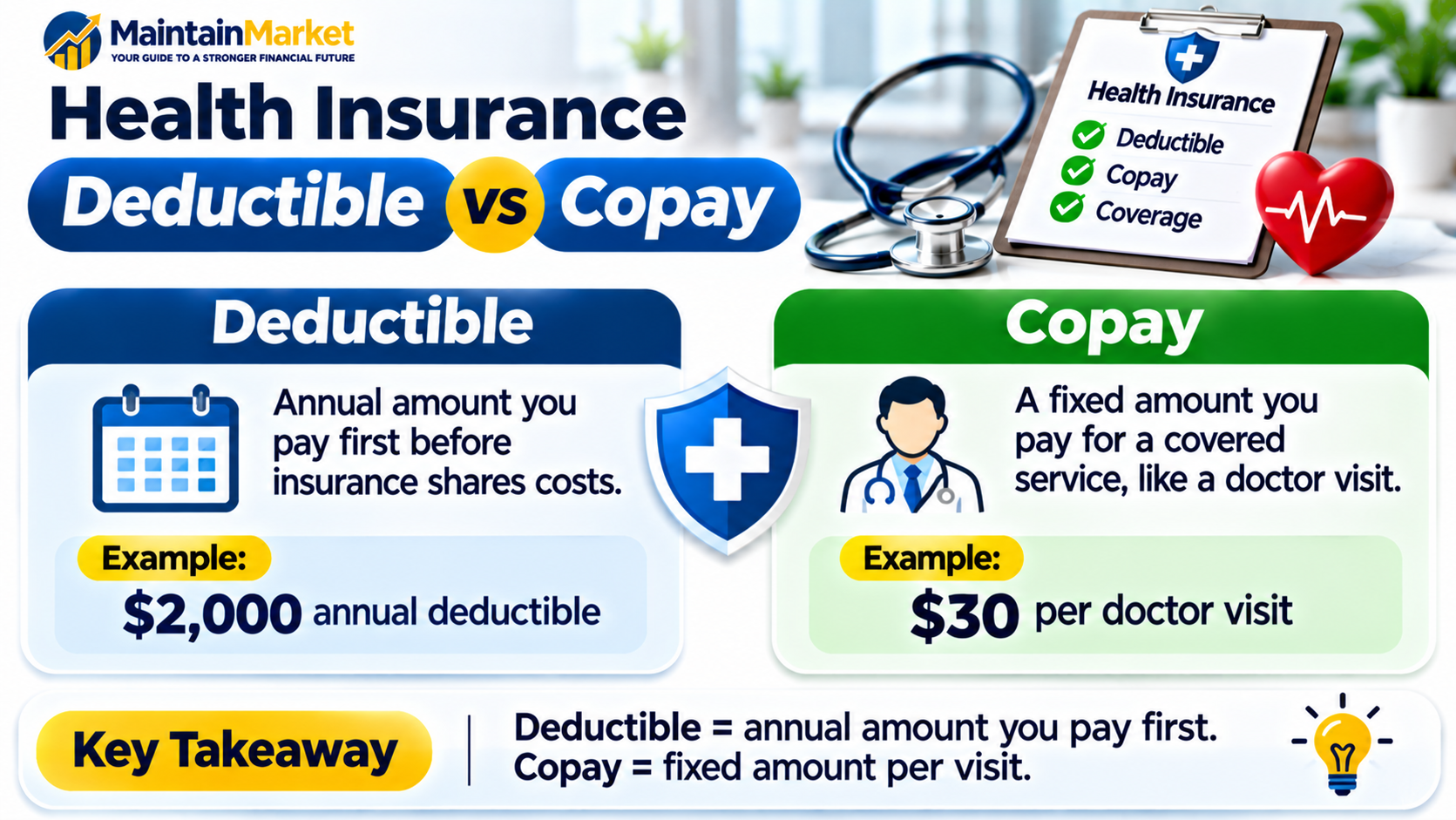
Understanding health insurance deductible vs copay is important when choosing a health insurance plan in the United States. Both affect how much you pay for medical care, but they work differently. A deductible is the amount you pay toward eligible covered medical expenses before your plan begins sharing certain costs. A copay is a fixed amount you pay for a covered service, such as a doctor’s visit or prescription.
These costs can make a significant difference to your healthcare budget. A plan with a low monthly premium might have a high deductible, while another plan may charge a higher premium but offer lower copays or a lower deductible.
In this guide, we’ll explain what deductibles and copays mean, how they work together, provide practical examples, and show you what to compare before choosing a health insurance plan.
Health Insurance Deductible vs Copay: Key Differences
The main difference is how each cost is calculated and when you pay it.
- Deductible: The amount you pay for eligible covered services subject to the deductible before your health plan starts sharing those costs.
- Copay: A fixed dollar amount you pay for a covered healthcare service, such as $25 for a primary care visit.
| Feature | Deductible | Copay |
|---|---|---|
| Meaning | Amount you pay before the plan shares certain costs | Fixed amount you pay for a covered service |
| How it is calculated | Dollar amount | Fixed dollar amount |
| When you pay | As you receive eligible care until the deductible is met | Usually when you receive the service or are billed |
| Example | $2,000 per year | $30 per doctor visit |
| Applies to | Services subject to the deductible | Specific covered services |
| Can vary by service? | May have separate deductibles for certain services | Yes, different services can have different copays |
Important: Your plan may charge a copay before you meet your deductible for certain services, while other services may require you to pay the full negotiated cost until the deductible is met. Always check the plan’s Summary of Benefits and Coverage (SBC).
What Is a Health Insurance Deductible?
A health insurance deductible is the amount you must pay for covered healthcare services subject to the deductible during your plan’s coverage period before your insurance plan begins sharing those costs.
For example, suppose your health insurance plan has a $2,000 annual deductible.
If you receive covered medical services that are subject to the deductible, you generally pay the negotiated cost yourself until your eligible payments reach $2,000. After that, your plan starts sharing costs according to its rules. You may still owe copays or coinsurance.
Example of How a Deductible Works
Imagine you have the following health insurance plan:
- Annual deductible: $2,000
- Covered medical expenses subject to deductible: $1,500 so far
- New eligible medical bill: $800
You have already paid $1,500 toward your deductible. You therefore have $500 remaining.
For the new $800 bill:
- You pay the remaining $500 to meet your deductible.
- Your plan then begins sharing the remaining $300 according to its coverage rules.
If the plan requires 20% coinsurance after the deductible, you would pay $60 of the remaining $300, and the insurer would pay $240.
Your total payment for this example would be $560, assuming the full $800 is an eligible in-network allowed amount and no other cost-sharing rules apply.
Types of Health Insurance Deductibles
Health insurance plans can have different deductible structures.
1. Individual deductible
This is the amount one covered person must pay toward eligible healthcare expenses before the plan begins sharing costs under the deductible rules.
2. Family deductible
A family plan may have a combined deductible that applies to covered family members. Some plans also have individual deductibles within the family plan.
3. Separate deductible
Some plans have separate deductibles for particular services or categories, such as prescription drugs. The plan documents explain which expenses count toward each deductible.
What Is a Copay in Health Insurance?
A copay, also called a copayment, is a fixed amount you pay for a covered healthcare service.
Unlike a deductible, a copay is not calculated as a percentage of the medical bill.
For example, your health insurance plan might charge:
- $25 for a primary care visit
- $50 for a specialist visit
- $15 for a generic prescription
These are illustrative amounts, not standard prices. Your actual copays depend on your health insurance plan.
Example of How a Copay Works
Suppose your plan charges a $30 copay for an in-network primary care visit.
If you visit your doctor for a covered appointment, you pay $30 under the plan’s copay rules.
The amount you pay does not automatically increase just because the provider’s negotiated charge is higher.
However, the plan may apply different rules if you have not met your deductible, if the service is not covered, or if the provider is out of network.
Common Types of Copays
Health insurance plans may have different copays for different services.
| Healthcare service | Illustrative copay |
|---|---|
| Primary care visit | $25 |
| Specialist visit | $50 |
| Urgent care visit | $40 |
| Generic prescription | $15 |
| Emergency room visit | $250 |
These figures are examples only. Actual copays vary by insurer, plan, network, service, and coverage terms.
Do You Pay a Deductible and Copay Together?
Yes, it is possible to pay both a deductible and a copay under the same health insurance plan. However, whether you owe both for a particular service depends on the plan’s benefit rules.
Some plans allow fixed copays for certain services before the deductible is met. Other services may be subject to the deductible first.
For example, imagine your plan has:
- Annual deductible: $1,500
- Primary care copay: $30
- Specialist copay: $50
Your plan might let you pay the $30 primary care copay even before meeting the deductible. But a diagnostic test or specialist service could be subject to the deductible instead.
The important point: Do not assume every copay is charged in addition to the deductible. Check the service-specific cost-sharing rules in your plan documents.
Deductible vs Copay vs Coinsurance
Deductibles and copays are not the only expenses you may pay when using health insurance. Coinsurance is another important form of cost sharing.
Here’s how all three differ:
| Feature | Deductible | Copay | Coinsurance |
|---|---|---|---|
| Payment type | Amount you pay first for services subject to deductible | Fixed amount | Percentage of allowed cost |
| Example | $1,500 | $30 | 20% |
| How it works | You pay eligible costs until deductible is met | You pay a set amount for a covered service | You pay a percentage of eligible costs |
| When it applies | Before the plan shares costs for services subject to deductible | According to service-specific plan rules | Generally after deductible, when applicable |
For a deeper explanation, read our guide to health insurance copay vs coinsurance.
What Is an Out-of-Pocket Maximum?
An out-of-pocket maximum is the most you have to pay during a plan year for eligible covered services that count toward the limit, subject to your plan’s rules.
Once you reach this limit, your plan generally pays 100% of covered in-network benefits for the rest of the plan year.
For most ACA-compliant plans, covered in-network deductibles, copayments, and coinsurance count toward the out-of-pocket maximum. Monthly premiums, non-covered services, and certain out-of-network or balance-billed charges generally do not count.
Example
Suppose your plan has:
- Annual deductible: $2,000
- Out-of-pocket maximum: $6,000
During the year, you pay eligible deductibles, copays, and coinsurance for covered in-network services.
Once your qualifying payments reach $6,000, your plan generally covers 100% of eligible covered in-network costs for the rest of the plan year.
Your monthly premium is still your responsibility.
How to Choose Between Plans With Different Deductibles and Copays
When comparing health insurance plans, do not focus only on the deductible or copay. Consider the total cost of coverage.
Here are five things to review.
1. Compare Monthly Premiums
Your premium is the amount you pay each month to maintain health insurance coverage, whether or not you use medical services.
A plan with a lower premium may have a higher deductible or greater costs when you receive care.
2. Check the Annual Deductible
If you expect to use healthcare services regularly, check how much you may need to pay before the plan begins sharing costs for services subject to the deductible.
A lower deductible can reduce your initial expenses, but it may come with a higher monthly premium.
3. Review Copays for Common Services
Check the copays for services you are likely to use, including:
- Primary care appointments
- Specialist consultations
- Prescription medications
- Urgent care
- Emergency room services
A plan with affordable copays may help make routine healthcare expenses more predictable.
4. Check the Out-of-Pocket Maximum
The out-of-pocket maximum can help you understand your potential financial exposure for eligible covered services.
Compare this amount across plans, especially if you anticipate significant medical expenses.
5. Review the Provider Network
Check whether your preferred doctors, hospitals, pharmacies, and specialists are included in the plan’s network.
Out-of-network care can cost significantly more, and some plans may not cover routine out-of-network services at all.
Which Is Better: A Low Deductible or a Low Copay?
Neither is automatically better. The right choice depends on your expected healthcare needs, monthly budget, and the plan’s complete cost-sharing structure.
A lower deductible may be useful if:
- You expect regular medical treatment.
- You have planned procedures or ongoing healthcare needs.
- You want to reduce the amount you pay before insurance shares costs.
Lower copays may be useful if:
- You visit doctors regularly.
- You take prescription medications.
- You want more predictable costs for certain covered services.
However, compare the premium, deductible, copays, coinsurance, out-of-pocket maximum, and network together. A plan with low copays may still have a high deductible for other services.
How to Find Your Deductible and Copay in Your Health Insurance Plan
You do not have to guess what your health insurance plan charges. You can find these details in your plan documents.
Follow these steps:
- Log in to your health insurance provider’s member portal.
- Open your plan’s Summary of Benefits and Coverage (SBC).
- Find the section titled “What You Will Pay for Covered Services.”
- Check the deductible amount for individual and family coverage.
- Review copays for primary care, specialists, prescriptions, and other services.
- Check whether each service is subject to the deductible.
- Review the coinsurance rate and out-of-pocket maximum.
You can also contact your insurer and ask how a specific service will be billed before receiving non-emergency care.
Frequently Asked Questions
1. What is the difference between a deductible and a copay?
A deductible is the amount you pay for eligible covered healthcare services subject to the deductible before your plan begins sharing those costs. A copay is a fixed amount you pay for a specific covered service, such as a doctor visit or prescription.
2. Do I have to pay a copay before meeting my deductible?
It depends on your health insurance plan. Some plans charge copays for certain services before you meet the deductible, while other services may require you to pay the full negotiated cost until the deductible is met.
3. Is a copay included in the deductible?
Not always. Whether copayments count toward your deductible depends on your plan. Check your Summary of Benefits and Coverage or contact your insurer.
4. Can I have a $0 deductible and still pay copays?
Yes. Some health insurance plans have no general deductible but still charge copays or coinsurance for covered services.
5. What happens after I meet my deductible?
Your insurance plan generally begins sharing the cost of covered services subject to the deductible. You may still owe copays or coinsurance until you reach your out-of-pocket maximum.
6. Is a higher deductible better?
A higher deductible may come with a lower monthly premium, but you could pay more out of pocket before your plan begins sharing costs. Whether it is suitable depends on your budget and expected healthcare needs.
7. Do preventive care services require a deductible or copay?
Many ACA-compliant health plans cover certain recommended preventive services at no cost when you use an in-network provider, even before meeting your deductible. Coverage conditions and exceptions apply.
8. Do prescription medications count toward the deductible?
It depends on your plan. Some plans apply the main medical deductible to prescriptions, while others have a separate prescription drug deductible or charge copays before the deductible is met.
9. Does the deductible reset every year?
Most health insurance deductibles reset at the beginning of a new plan year. However, the exact timing depends on the plan’s coverage period.
10. Where can I check my health insurance deductible and copay?
You can find these amounts in your Summary of Benefits and Coverage, member portal, plan documents, or by contacting your insurance provider.
Final Thoughts
Understanding health insurance deductible vs copay can help you make better decisions when comparing health insurance plans in the United States.
A deductible determines how much you may need to pay toward eligible covered services before your plan starts sharing certain costs. A copay is a fixed payment for a specific covered service.
Before choosing a plan, compare the monthly premium, deductible, copays, coinsurance, out-of-pocket maximum, and provider network. Looking at the complete cost structure can help you avoid unexpected medical expenses and choose coverage that better fits your needs.
Disclaimer: This article is for educational purposes only and does not provide insurance, medical, or financial advice. Health insurance benefits, costs, exclusions, and coverage rules vary by insurer, plan, state, and policy terms. Always review your plan documents or contact your insurer for details about your coverage.
Authoritative Sources
- HealthCare.gov – Deductible
- HealthCare.gov – Copayment
- HealthCare.gov – Coinsurance
- HealthCare.gov – Your Total Costs for Health Care
- CMS – Summary of Benefits and Coverage