
Severe weather can cause expensive damage to your home, from missing roof shingles and broken windows to fallen trees and water entering your property. If a storm damages your house, you may wonder: Does homeowners insurance cover storm damage?
In many cases, yes. Standard homeowners insurance policies commonly cover certain types of sudden storm damage, including damage caused by wind, hail, lightning, and falling trees. However, coverage depends on your policy, the cause of damage, exclusions, and applicable deductibles.
One important exception is flooding. Standard homeowners insurance generally does not cover flood damage, even when flooding happens during a hurricane or severe storm. You typically need a separate flood insurance policy for that protection.
In this guide, we’ll explain what storm damage homeowners insurance may cover, what it excludes, how storm deductibles work, and what to do after your home is damaged.
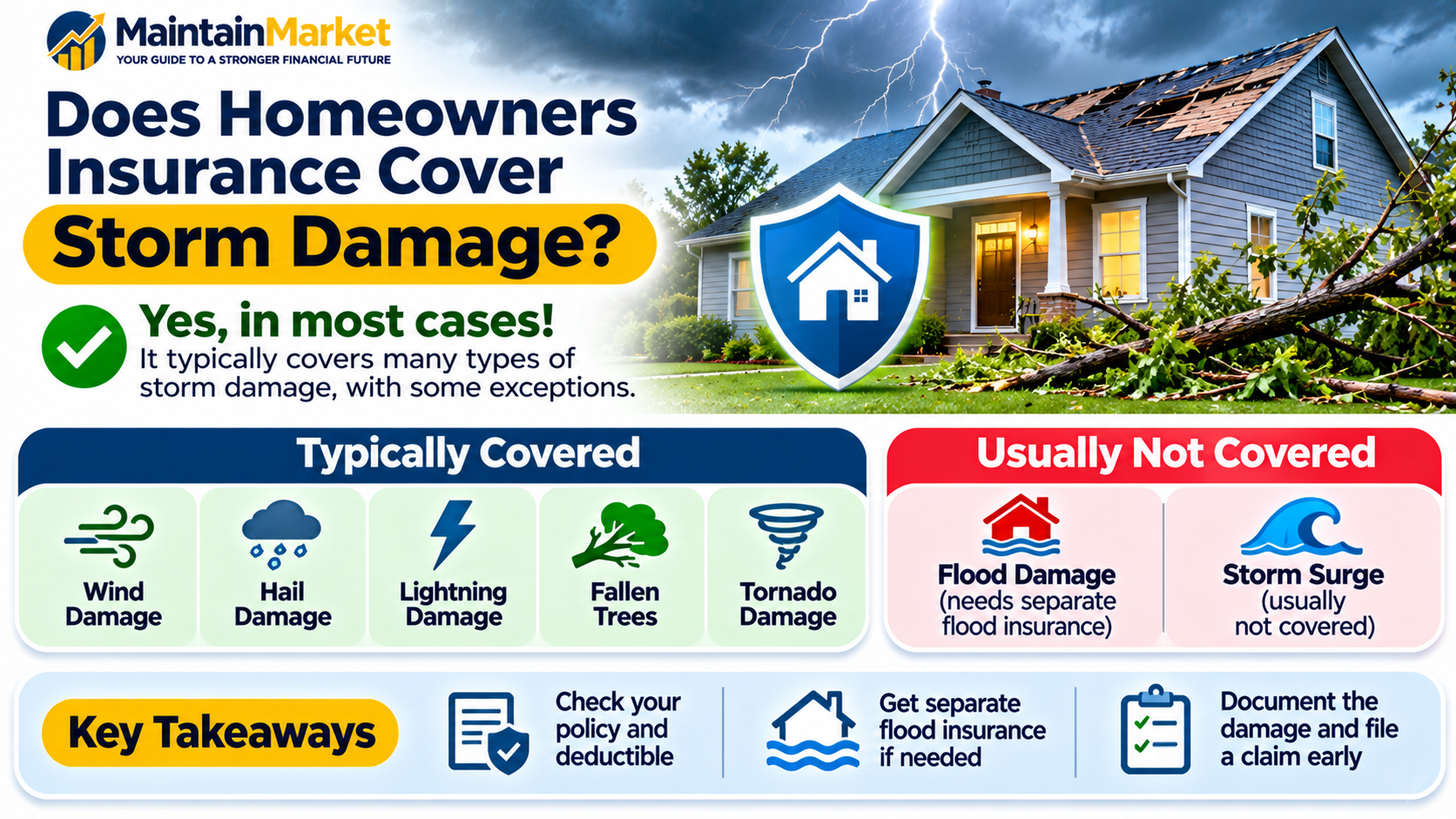
Does Homeowners Insurance Cover Storm Damage?
Yes, homeowners insurance generally covers many types of sudden and accidental storm damage, provided the cause of loss is included in your policy and not excluded.
Common covered storm-related events may include:
- Wind damage to roofs, siding, and windows
- Hail damage to roofing and other property
- Lightning strikes and resulting covered damage
- Trees or branches falling on your home
- Damage caused by certain wind-driven rain events
- Damage to covered personal belongings
- Additional living expenses if a covered storm makes your home uninhabitable
However, not every weather-related loss is covered. Flooding, storm surge, gradual deterioration, and certain maintenance-related problems may be excluded or require additional coverage.
The National Association of Insurance Commissioners (NAIC) explains that homeowners policies commonly include windstorm and hail among their covered perils, but the policy contract determines how coverage applies.
What Types of Storm Damage Does Homeowners Insurance Cover?
The following are common examples of storm-related losses that may qualify for coverage.
1. Wind Damage
Strong winds can damage different parts of your home.
Examples include:
- Roof shingles blown away
- Damaged siding
- Broken windows
- Garage door damage
- Trees falling onto the house
- Wind damaging an attached structure
If strong winds damage your roof and rain enters through the opening, the resulting interior damage may also be covered, depending on the circumstances and policy terms.
However, an insurer may investigate whether the damage resulted from a covered storm or an existing maintenance problem.
2. Hail Damage
Hailstorms can damage roofs, windows, siding, gutters, and outdoor structures.
For example, large hailstones may:
- Crack roof shingles
- Dent metal roofing
- Break skylights
- Damage gutters and downspouts
- Crack windows
- Damage exterior equipment
Many homeowners policies cover hail damage, but some insurers or policies may have specific windstorm or hail exclusions, restrictions, or separate deductibles.
Check your policy before assuming all hail damage is covered.
3. Lightning Damage
Lightning can cause sudden and expensive damage to a home.
A lightning strike may result in:
- Fire damage
- Electrical system damage
- Damage to household wiring
- Damage to televisions and computers
- Damage to other connected electronics
Homeowners insurance commonly covers lightning-related losses, subject to policy conditions and exclusions.
If a lightning strike causes a fire that damages your home, dwelling coverage may help pay for covered structural repairs. Personal property coverage may help replace covered belongings damaged by the fire.
4. Damage From Falling Trees and Branches
Severe storms can weaken trees and cause large branches or entire trees to fall.
If a tree falls onto your home, garage, or another insured structure, homeowners insurance may cover the resulting damage.
For example, imagine a storm causes a large tree to fall onto your roof. Your policy may help pay for covered roof repairs and other resulting damage.
Coverage for removing the fallen tree itself can be more limited. Policies may pay for removal when the tree damages an insured structure, subject to specific conditions and limits. A fallen tree that does not damage insured property may not qualify for the same coverage.
If your neighbor’s tree falls on your home, your own homeowners policy will generally handle the damage to your property, although responsibility can depend on the circumstances.
5. Wind-Driven Rain Damage
Heavy rain can cause water to enter a home during a severe storm.
For example:
- Wind breaks a window and rain enters the room.
- Wind damages the roof and rain enters through the opening.
- A storm damages exterior doors and allows water inside.
Depending on the policy and circumstances, resulting damage may be covered.
However, water entering through an old, damaged roof or an unrepaired opening may be treated differently. Insurers may consider whether the loss resulted from a covered storm or gradual deterioration.
6. Tornado Damage
Tornadoes can cause extensive damage through powerful winds and flying debris.
A standard homeowners policy commonly covers tornado-related wind damage, including covered damage to:
- Roofs
- Walls
- Windows
- Attached garages
- Personal belongings
- Other insured structures
The policy’s limits, deductibles, and exclusions still apply.
What Storm Damage Is Not Covered by Homeowners Insurance?
Not all storm-related damage is covered by a standard homeowners insurance policy.
Some losses require separate insurance, while others may be excluded because of maintenance issues or policy restrictions.
| Type of damage | Generally covered by standard homeowners insurance? |
|---|---|
| Wind damage | Often yes, subject to policy terms |
| Hail damage | Often yes, subject to policy terms |
| Lightning damage | Generally yes |
| Tornado wind damage | Generally yes |
| Falling tree damage to insured structures | Often yes |
| Flood damage | Generally no |
| Hurricane storm surge | Generally no; separate flood insurance is usually needed |
| Gradual roof deterioration | Generally no |
| Normal wear and tear | Generally no |
| Earthquake damage | Generally no; separate coverage may be needed |
| Sewer or drain backup | May require an endorsement |
These are general coverage guidelines. Your policy may include different exclusions, endorsements, or restrictions.
1. Flood Damage
Flood damage is one of the biggest exclusions homeowners need to understand.
Standard homeowners insurance generally does not cover damage caused by flooding.
Flooding can happen because of:
- Heavy rainfall accumulating on the ground
- Rivers or lakes overflowing
- Flash floods
- Storm surge
- Coastal flooding
- Rapid surface-water accumulation
For example, imagine a hurricane causes heavy rainfall, and floodwater enters your home, damaging flooring, furniture, and electrical equipment.
Your standard homeowners policy generally will not cover the flood damage. You would typically need separate flood insurance.
The National Flood Insurance Program (NFIP), administered by FEMA, provides flood insurance through participating communities. Private flood insurance is another option.
You can learn more at FloodSmart.gov.
2. Hurricane Storm Surge
A hurricane can cause different types of damage.
Wind may damage your roof, while storm surge pushes seawater or other floodwater into your property.
These losses are treated differently by insurance policies.
| Hurricane-related damage | Typical insurance treatment |
|---|---|
| Wind damages the roof | May be covered by homeowners insurance |
| Hail damages windows | May be covered by homeowners insurance |
| Lightning causes a fire | Generally covered, subject to policy terms |
| Storm surge floods the house | Generally requires flood insurance |
| Heavy rainfall causes flooding | Generally requires flood insurance |
This distinction is especially important for homeowners in coastal areas.
3. Normal Wear and Tear
Homeowners insurance is not a home maintenance plan.
If your roof has deteriorated over many years because of age, exposure, or lack of maintenance, the insurer may deny a claim for the underlying deterioration.
For example, if old roof shingles gradually crack and eventually allow water to enter during ordinary rainfall, the insurer may consider the damage a maintenance issue rather than a covered storm loss.
However, if a covered storm causes sudden damage to an otherwise maintained roof, the resulting claim may qualify.
4. Earthquake Damage
Earthquake damage is generally excluded from standard homeowners insurance.
If an earthquake causes structural damage, you may need a separate earthquake policy or an earthquake endorsement.
This is worth considering if you live in an area with significant earthquake exposure.
5. Sewer and Drain Backup
Heavy storms can overwhelm drainage systems and cause water or sewage to back up into a home.
Standard homeowners insurance may not cover every type of sewer or drain backup.
Some insurers offer a water-backup endorsement that provides additional protection, subject to its limits and exclusions.
Ask your insurer whether this coverage is available.
Does Homeowners Insurance Cover Hurricane Damage?
It may cover certain types of hurricane damage, but the cause of the damage matters.
Hurricanes can produce strong winds, hail, heavy rainfall, storm surge, and flooding.
Homeowners insurance may cover qualifying wind or hail damage, while flood damage and storm surge generally require separate flood insurance.
Another important consideration is the hurricane or named-storm deductible.
Some homeowners policies in coastal states use a special deductible for damage caused by hurricanes or other named storms.
What Is a Hurricane Deductible?
A hurricane deductible is the amount you must pay toward a covered hurricane-related loss before your insurer pays the remaining covered amount.
Unlike a standard flat-dollar deductible, a hurricane deductible is often calculated as a percentage of your dwelling coverage limit.
For example:
- Dwelling coverage: $300,000
- Hurricane deductible: 2%
- Your deductible: $6,000
Calculation:
$300,000 × 2% = $6,000
If you have a qualifying covered hurricane loss, you may be responsible for the first $6,000, subject to the policy’s deductible trigger and conditions.
Some policies also have named-storm or wind/hail deductibles. These are not necessarily identical to hurricane deductibles.
According to the NAIC, hurricane and named-storm deductibles can vary by state and insurer. Review your policy to understand when a special deductible applies.
Does Homeowners Insurance Cover Roof Damage From a Storm?
In many cases, yes.
Storm-related roof damage may be covered if it results from a covered event such as wind or hail.
Examples include:
- Shingles blown off by strong winds
- Hail damage to roofing materials
- A tree falling onto the roof
- Storm debris damaging the roof
- Covered water damage resulting from a storm-created opening
However, your insurer may inspect the roof to determine the cause of the damage.
If the roof was already deteriorating, poorly maintained, or damaged before the storm, the insurer may exclude some or all of the loss.
Will Insurance Pay for a Completely New Roof?
Not necessarily.
The insurer generally pays for covered damage according to the policy’s loss settlement provisions.
Your claim may be settled using:
- Replacement cost value (RCV)
- Actual cash value (ACV)
- A special roof payment schedule or endorsement
For example, a policy may cover the cost of repairing storm-damaged shingles without paying to replace an entire roof if the rest of the roof is not damaged.
Some policies also use actual cash value settlement for older roofs, which may result in a lower payment after depreciation.
Review your roof coverage carefully before filing a claim.
Does Homeowners Insurance Cover Storm Damage to Personal Belongings?
Yes, covered storm events may also damage personal belongings inside your home.
Personal property coverage, often known as Coverage C, may help pay for covered losses involving:
- Furniture
- Clothing
- Televisions
- Computers
- Household appliances
- Other personal belongings
For example, if a covered windstorm damages your roof and rain enters through the storm-created opening, damaging furniture and electronics, your personal property coverage may apply.
However, flood damage to belongings is generally excluded under standard homeowners insurance.
Special limits may also apply to jewelry, artwork, collectibles, and other valuable items.
Will Homeowners Insurance Pay for Temporary Housing After Storm Damage?
It may.
If a covered storm damages your home so severely that it becomes uninhabitable, your policy’s Additional Living Expenses (ALE), also known as Loss of Use coverage, may help pay certain extra living costs.
Eligible expenses may include:
- Temporary hotel accommodation
- Short-term rental housing
- Additional food expenses
- Laundry costs
- Certain additional transportation expenses
For example, if a covered tornado damages your roof and makes your home unsafe to occupy, ALE coverage may help pay for reasonable temporary housing while repairs are completed.
The coverage is subject to policy limits, time restrictions, and eligible expense requirements.
For more details, read our guide to Homeowners Insurance Additional Living Expenses.
How Much Does Homeowners Insurance Pay for Storm Damage?
There is no fixed payout for every storm damage claim.
The amount depends on:
- The extent of the damage
- Your dwelling or personal property coverage limits
- Your deductible
- Whether the policy uses replacement cost or actual cash value
- Any special wind, hail, or hurricane deductible
- Policy exclusions and endorsements
Example: Storm Damage Roof Claim
Imagine a windstorm damages your roof.
Your estimated covered repair cost is $15,000, and your policy has a standard deductible of $1,000.
| Claim detail | Amount |
|---|---|
| Estimated covered roof repair | $15,000 |
| Deductible | $1,000 |
| Potential insurance payment | $14,000 |
| Your responsibility | $1,000 |
This is a simplified example assuming the full repair amount is covered, the deductible is $1,000, and there are no other applicable limits or depreciation adjustments.
If a percentage-based windstorm deductible applies instead, your out-of-pocket cost could be considerably higher.
What Should You Do After Storm Damage to Your Home?
Taking the right steps after a storm can help protect your property and make the insurance claim process easier.
Step 1: Make Sure Everyone Is Safe
Your safety comes first.
Avoid damaged electrical wiring, unstable structures, broken glass, and areas where water may have reached electrical equipment.
If the property is unsafe, follow local emergency instructions and stay away until it is safe to return.
Step 2: Document the Damage
Take photographs and videos of the affected areas.
Document:
- Roof damage
- Broken windows
- Damaged siding
- Fallen trees
- Water entering the home
- Damaged furniture and electronics
Take pictures before cleaning up, if it is safe to do so.
Step 3: Prevent Further Damage
Take reasonable emergency steps to protect your home from additional damage.
For example:
- Use a temporary tarp to protect an exposed roof.
- Cover broken windows safely.
- Move undamaged belongings away from water.
- Arrange emergency mitigation if necessary.
Keep receipts for temporary repairs and emergency services.
Do not put yourself at risk or make permanent repairs before discussing the claim with your insurer.
Step 4: Contact Your Insurance Company
Report the storm damage as soon as reasonably possible.
Provide basic details about:
- When the storm occurred
- What areas of your home were damaged
- Whether the home is safe to occupy
- Any emergency repairs already completed
Ask for your claim number and the next steps.
Step 5: Review Your Deductible
Check whether your claim is subject to:
- A standard deductible
- A windstorm deductible
- A wind/hail deductible
- A hurricane deductible
- A named-storm deductible
This can make a major difference in your final claim payment.
Step 6: Meet the Insurance Adjuster
Your insurer may send an adjuster to inspect the property.
Provide photographs, receipts, repair estimates, and other available evidence.
Ask the adjuster to explain the damage assessment and how the settlement amount was calculated.
Step 7: Review the Claim Settlement
Before accepting a settlement, review:
- Covered repair costs
- Depreciation deductions
- Deductible calculations
- Policy limits
- Any excluded items or damage
If you disagree with the settlement, ask for a written explanation and provide supporting evidence.
You may also contact your state’s department of insurance for consumer assistance.
How Can You Prepare Your Home for Future Storms?
You cannot prevent every storm, but basic preparation may help reduce damage.
Consider these steps:
- Inspect your roof regularly.
- Replace damaged or missing shingles.
- Clean gutters and downspouts.
- Trim weak or overhanging tree branches.
- Secure outdoor furniture and equipment.
- Check windows, doors, and exterior seals.
- Review your homeowners insurance limits.
- Understand your windstorm and hurricane deductibles.
- Consider separate flood insurance if your property is exposed to flood risk.
- Keep a digital home inventory and photographs of valuable belongings.
Also review your policy at renewal. Coverage restrictions, deductibles, and available endorsements can change.
Frequently Asked Questions About Homeowners Insurance and Storm Damage
1. Does homeowners insurance cover storm damage?
Yes, many homeowners policies cover sudden storm damage caused by wind, hail, lightning, and certain falling trees. However, flood damage is generally excluded, and coverage depends on your policy terms and deductibles.
2. Does homeowners insurance cover damage from heavy rain?
It depends on how the water entered your home. Rain entering through a storm-created opening in a roof or window may be covered, depending on the policy. Flooding from accumulated surface water is generally excluded under standard homeowners insurance.
3. Does homeowners insurance cover wind damage?
Most standard homeowners policies cover wind damage, but some policies have windstorm exclusions, restrictions, or separate deductibles. Check your policy, particularly if you live in a coastal or high-risk area.
4. Does homeowners insurance cover hail damage to a roof?
Many homeowners policies cover sudden hail damage to roofs. However, some policies have special hail deductibles, roof settlement schedules, or exclusions. The insurer may also consider the roof’s age and condition.
5. Does homeowners insurance cover tornado damage?
Tornado-related wind damage is generally covered by standard homeowners insurance, subject to policy terms, deductibles, and limits. Flooding caused by the same storm generally requires separate flood insurance.
6. Does homeowners insurance cover hurricane damage?
It may cover wind and hail damage caused by a hurricane. However, storm surge and flood damage generally require separate flood insurance. A special hurricane or named-storm deductible may also apply.
7. Does homeowners insurance cover a tree falling on my house?
Generally, yes, if a covered event such as a storm causes the tree to fall onto an insured structure. Tree removal coverage may have separate conditions and limits.
8. Does homeowners insurance cover a flooded basement after a storm?
Standard homeowners insurance generally excludes flooding caused by surface water or rising water. However, certain water-backup losses may be covered if you have an applicable endorsement. The cause of the water intrusion matters.
9. Does homeowners insurance cover storm damage to a fence?
It may. Fences are generally considered other structures, often listed under Coverage B. Coverage depends on the cause of damage, policy limits, exclusions, and deductible.
10. Does homeowners insurance cover storm damage to my car?
No. Damage to your vehicle from falling trees, hail, or storm debris is generally handled through auto insurance, usually comprehensive coverage if you purchased it.
11. Will insurance pay for a new roof after storm damage?
Not automatically. The insurer pays for covered damage according to the policy’s settlement provisions. The claim may be based on replacement cost, actual cash value, or a special roof payment schedule.
12. Can I file a homeowners insurance claim after a storm?
Yes, if you believe your property has suffered a covered loss. Document the damage, take reasonable steps to prevent further damage, contact your insurer, and follow the claim instructions in your policy.
Final Thoughts: Understand Your Storm Damage Coverage Before Severe Weather Hits
So, does homeowners insurance cover storm damage?
In many situations, yes. Wind, hail, lightning, tornadoes, and certain falling-tree incidents may be covered under a standard homeowners policy.
But flooding and storm surge are major exceptions. They generally require separate flood insurance, even when they happen during a hurricane or severe storm.
Before the next storm arrives, review your policy, understand your deductibles, check your roof coverage, and consider whether you need additional flood protection.
Knowing exactly what your insurance covers can help you make better decisions and avoid unexpected expenses after severe weather.
Disclaimer: This article is for general educational purposes only and does not constitute insurance, financial, or legal advice. Homeowners insurance coverage, exclusions, deductibles, and claim settlement rules vary by insurer, state, and policy. Review your policy documents and consult your insurance company or a licensed insurance professional for details about your coverage.
Authoritative Sources
- National Association of Insurance Commissioners (NAIC): Homeowners Insurance — Common covered perils, policy coverage types, and how coverage is applied.
- NAIC: Hurricane Deductibles — Hurricane, named-storm, and windstorm deductible explanations.
- NAIC: Consumer Homeowners Insurance Guide — Flood and earthquake exclusions and homeowners coverage basics.
- FEMA FloodSmart: Flood Insurance Eligibility and FAQs — Why standard homeowners insurance generally does not cover flooding.
- NAIC: What You Should Know About Named Storm Deductibles — How named-storm deductibles work.
- North Carolina Department of Insurance: Homeowners Insurance FAQs — Falling trees, hail damage, and storm-related claim guidance.
- Maryland Insurance Administration: Homeowners and Post-Disaster Claim FAQs — Wind damage, flood coverage, and deductible examples.