
Choosing health insurance can be confusing, especially when you have to decide between an HMO and a PPO plan. Both are common types of health insurance in the United States, but they differ in provider networks, referral requirements, out-of-network coverage, and costs.
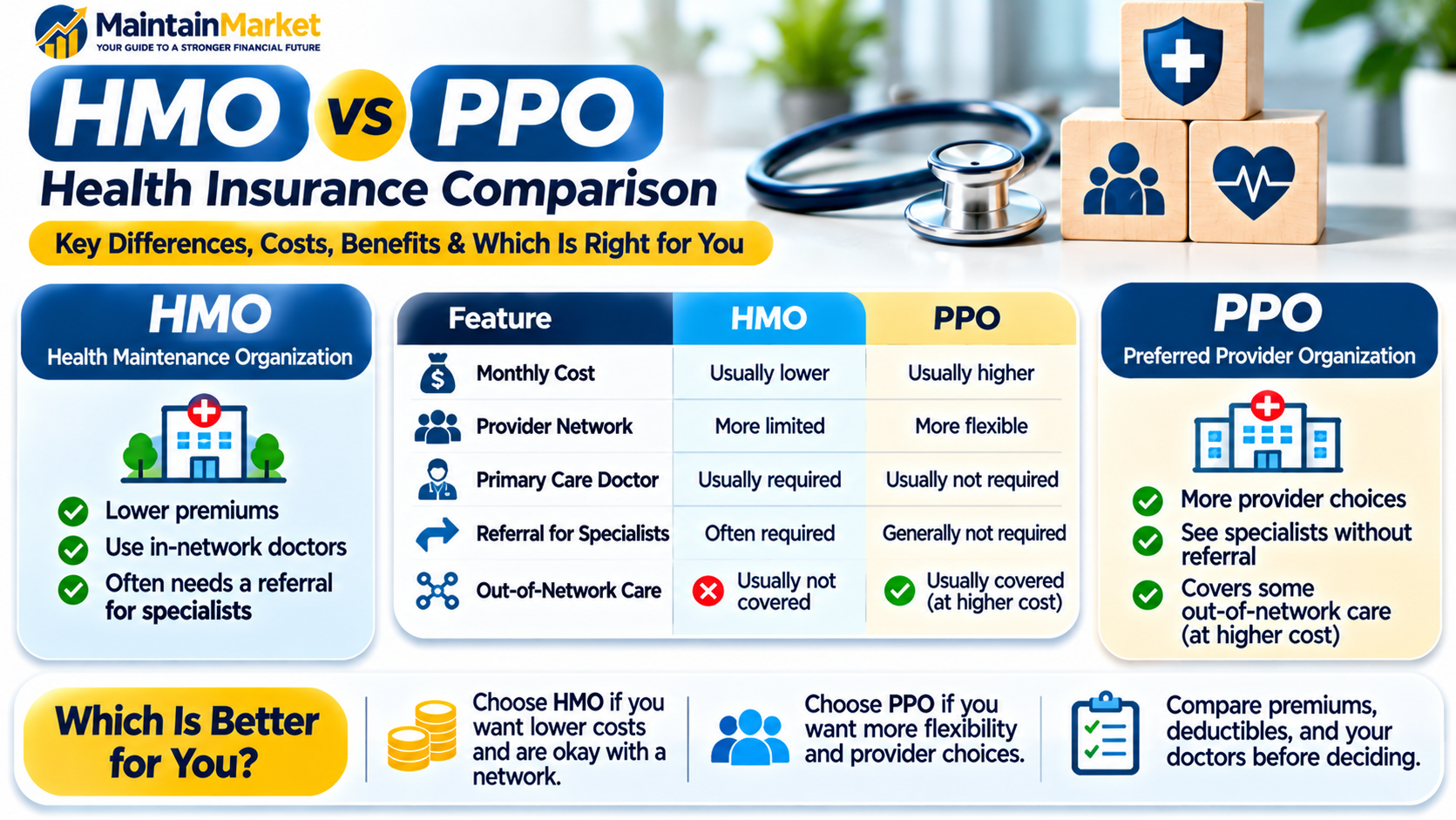
When comparing HMO vs PPO, the biggest difference is flexibility. An HMO (Health Maintenance Organization) generally requires you to receive care within its provider network and may require referrals to see specialists. A PPO (Preferred Provider Organization) usually gives you more freedom to choose healthcare providers, including certain doctors and hospitals outside its network, at a higher cost.
For example, an HMO may be a good option if you are comfortable using a specific network of doctors and want to keep premiums relatively affordable. A PPO may be more suitable if you travel frequently, want greater provider flexibility, or prefer seeing specialists without referrals.
In this guide, we’ll explain how HMO and PPO plans work, compare their costs and benefits, and help you understand which type of health insurance may suit your needs.
What Is an HMO Health Insurance Plan?
An HMO, or Health Maintenance Organization, is a type of health insurance plan that generally provides healthcare through a specific network of doctors, hospitals, specialists, and other medical providers.
When you enroll in an HMO plan, you typically select a primary care physician (PCP). This doctor helps coordinate your healthcare and may refer you to specialists when necessary.
HMOs generally require you to use in-network healthcare providers for covered services. Out-of-network care is usually not covered except in emergencies or other situations specifically permitted by the plan.
How Does an HMO Plan Work?
An HMO plan generally works through the following steps:
- Choose an HMO plan that serves your location.
- Select a primary care physician from the plan’s network, if required.
- Visit your primary care physician when you need routine medical care.
- Obtain a referral if your plan requires one to see a specialist.
- Receive covered treatment from eligible in-network providers.
- Pay the applicable premium, deductible, copayment, or coinsurance.
HMO plans often emphasize coordinated care and preventive healthcare.
Advantages of HMO Health Insurance
- Potentially lower premiums: HMO plans often have lower monthly premiums than comparable PPO plans.
- Coordinated healthcare: Your primary care physician can help manage your treatment.
- Defined provider network: You know which doctors and hospitals participate in your plan.
- Preventive care focus: Many HMO plans emphasize routine checkups and preventive services.
- Potentially lower out-of-pocket costs: In-network care may be more affordable than using out-of-network providers under a PPO.
Disadvantages of HMO Health Insurance
- Limited provider choices: You generally need to use the plan’s network.
- Referral requirements: Some HMOs require referrals before specialist appointments.
- Limited out-of-network coverage: Non-emergency care outside the network is generally not covered.
- Service area restrictions: Some plans require you to live or work within a specified service area.
- Less flexibility when travelling: Routine care outside the service area may be difficult to access, depending on the plan.
What Is a PPO Health Insurance Plan?
A PPO, or Preferred Provider Organization, is a type of health insurance plan that contracts with doctors, hospitals, and other healthcare providers to create a network.
Unlike most traditional HMO arrangements, PPO plans generally allow members to receive covered care from both in-network and out-of-network providers.
You usually pay less when you use providers within the plan’s network. However, you may still receive some coverage for eligible out-of-network services at a higher cost.
PPO plans also generally allow members to visit specialists without obtaining a referral from a primary care physician.
How Does a PPO Plan Work?
A PPO plan generally works like this:
- Choose a PPO plan based on your healthcare needs.
- Review the plan’s network of doctors and hospitals.
- Select healthcare providers according to your preferences.
- Visit in-network doctors for lower negotiated costs.
- Use eligible out-of-network providers when necessary, understanding that you may pay more.
- Pay your premiums, deductibles, copayments, and coinsurance according to the plan.
You generally do not need to select a primary care physician or obtain a referral to visit a specialist, although certain services may still require prior authorization.
Advantages of PPO Health Insurance
- Greater provider flexibility: You can generally choose from a wider range of healthcare providers.
- Out-of-network coverage: Many PPO plans cover eligible out-of-network services at a higher cost.
- Fewer referral requirements: You can generally see specialists without a PCP referral.
- Useful for frequent travellers: A broader provider network may make accessing care easier when away from home.
- More control over provider choices: You may have more options when selecting specialists and hospitals.
Disadvantages of PPO Health Insurance
- Higher premiums: PPO plans often cost more than comparable HMO plans.
- Higher out-of-network expenses: You may pay more when receiving care outside the network.
- Separate deductibles: Some plans have different deductibles for in-network and out-of-network care.
- More complex cost sharing: Understanding negotiated rates, coinsurance, and out-of-network charges can require additional attention.
- No guarantee of nationwide coverage: A PPO network may still have geographic limitations, and out-of-network coverage is not the same as having every provider available at in-network rates.
HMO vs PPO: What’s the Difference?
The most important difference between HMO and PPO health insurance plans is how they manage healthcare providers and out-of-network services.
Here is a side-by-side comparison:
| Feature | HMO | PPO |
|---|---|---|
| Full form | Health Maintenance Organization | Preferred Provider Organization |
| Monthly premium | Often lower | Often higher |
| Provider network | Generally more restrictive | Generally more flexible |
| Primary care physician | Usually required or encouraged | Usually optional |
| Specialist referrals | Often required | Generally not required |
| Out-of-network coverage | Generally unavailable except for emergencies and permitted exceptions | Usually available at a higher cost |
| Provider flexibility | More limited | Greater flexibility |
| Service area | May have geographic restrictions | Depends on the network and plan |
| Healthcare coordination | Often coordinated through a PCP | More flexibility to manage provider choices |
| Best suited for | People comfortable using a defined network | People who value provider flexibility |
Important: These are general characteristics. Individual plans may have different referral rules, deductibles, networks, and coverage conditions. Always check the actual plan documents.
HMO vs PPO: Which Is Cheaper?
HMO plans often have lower monthly premiums than comparable PPO plans.
However, the cheapest monthly premium does not necessarily mean the lowest overall healthcare cost.
When comparing plans, consider:
- Monthly premiums
- Annual deductibles
- Copayments
- Coinsurance
- Out-of-pocket maximums
- Prescription drug costs
- Out-of-network expenses
Example: Comparing HMO and PPO Costs
Imagine you are comparing two hypothetical health insurance plans.
| Expense | HMO Plan | PPO Plan |
|---|---|---|
| Monthly premium | $250 | $400 |
| Annual premium | $3,000 | $4,800 |
| Annual deductible | $1,500 | $2,000 |
| In-network doctor visit | $25 copay | $35 copay |
| Out-of-network coverage | Generally unavailable | Available at higher cost, subject to plan terms |
These figures are illustrative and are not actual insurance quotes.
In this example, the HMO costs $1,800 less in annual premiums.
However, the PPO may provide additional flexibility if you need to visit doctors outside its network.
To make a fair comparison, calculate your expected annual healthcare spending rather than choosing based only on the monthly premium.
HMO vs PPO: Which Plan Is Better for Specialist Visits?
Specialist access is another major difference between HMO and PPO plans.
HMO Specialist Visits
Many HMO plans require members to visit their primary care physician before seeing a specialist.
For example, if you need to consult a dermatologist, your primary care physician may need to provide a referral first.
This approach helps coordinate treatment within the HMO network.
However, referral requirements vary. Some HMO plans allow direct access to certain specialists or waive referrals for specific services.
PPO Specialist Visits
PPO plans generally allow you to visit specialists without obtaining a referral from a primary care physician.
For example, you may be able to schedule an appointment directly with a dermatologist, cardiologist, or orthopedic specialist.
You still need to check whether the provider is in-network and whether the treatment requires prior authorization.
Which is better?
A PPO may be more convenient if you frequently visit specialists and want greater freedom to choose them.
An HMO may work well if you prefer coordinated healthcare through a primary care physician.
HMO vs PPO: What Happens If You Visit an Out-of-Network Doctor?
This is one of the most important differences between these two health insurance plans.
Out-of-Network Care Under an HMO
HMO plans generally do not cover routine care from providers outside their network.
If you visit an out-of-network doctor without an applicable exception or prior approval, you may have to pay the full cost yourself.
Emergency services are treated differently under applicable federal and state protections.
Out-of-Network Care Under a PPO
PPO plans generally provide some coverage for eligible out-of-network services.
However, you may face:
- Higher deductibles
- Higher coinsurance
- Higher copayments
- A separate out-of-network deductible
- Additional charges if the provider bills more than the plan’s allowed amount, where permitted
You should also understand that out-of-network coverage does not necessarily protect you from every additional charge.
Federal surprise billing protections apply to certain emergency services and other specified situations, but they do not cover every out-of-network service.
HMO vs PPO: Which Is Better for Families?
Both plans can work for families, but the right choice depends on how each family member uses healthcare.
When an HMO May Be Better for a Family
An HMO may be worth considering if:
- Your family already uses doctors within the network.
- You prefer coordinated healthcare.
- You want to keep monthly premiums lower.
- You do not regularly need out-of-network specialists.
- Your preferred hospitals and pediatricians participate in the plan.
When a PPO May Be Better for a Family
A PPO may be worth considering if:
- Different family members use different specialists.
- You want greater freedom to choose doctors.
- You travel frequently.
- You prefer fewer referral requirements.
- You are comfortable paying more for additional provider flexibility.
Before enrolling, verify that your preferred pediatrician, primary care doctor, specialists, and hospitals are included in the network.
HMO vs PPO: Which Is Better for People Who Travel Frequently?
People who travel regularly should pay close attention to provider networks and out-of-area coverage.
An HMO may restrict routine healthcare to its service area. If you travel outside that area, you may have limited access to covered routine care.
A PPO may provide more flexibility because it generally includes out-of-network coverage, although you will usually pay more.
However, a PPO does not automatically guarantee nationwide in-network access.
If you travel frequently, ask the insurer:
- Does the plan have a nationwide provider network?
- Are out-of-area doctors covered?
- What happens during a medical emergency?
- Are urgent care services covered while travelling?
- Are telehealth services available?
- Does the plan include any travel-related provider arrangements?
Review these details before making your decision.
How to Choose Between HMO and PPO Health Insurance
There is no single answer that works for everyone.
The right plan depends on your healthcare needs, budget, preferred doctors, and willingness to use a specific provider network.
Use these steps to compare your options.
1. Compare Monthly Premiums
Start by checking the monthly cost of each plan.
A lower premium can help reduce your regular insurance expenses, but do not ignore deductibles and other out-of-pocket costs.
2. Check Your Preferred Doctors
Search the insurer’s provider directory to confirm whether your current doctors and hospitals are included.
Do not rely only on a general company network list. Provider participation can vary by specific plan.
3. Review Referral Requirements
If you frequently visit specialists, find out whether the plan requires a referral.
Some HMO plans have referral requirements, while PPO plans generally do not.
4. Compare Deductibles and Out-of-Pocket Maximums
Your deductible is the amount you generally pay for covered services before the plan begins paying according to its terms.
The out-of-pocket maximum is the most you pay for covered in-network services during the plan year, excluding premiums and certain other expenses.
Check both figures before enrolling.
5. Check Prescription Drug Coverage
If you take regular medication, compare each plan’s drug formulary.
Look at:
- Covered medications
- Generic drug options
- Brand-name drug costs
- Pharmacy networks
- Prescription deductibles
- Copayments and coinsurance
6. Review Specialist and Hospital Access
Make sure the hospitals and specialists you may need are included in the plan’s network.
If you have a preferred hospital, confirm its participation for the exact plan you are considering.
7. Read the Summary of Benefits and Coverage
Every Marketplace and many employer-sponsored health plans provide a Summary of Benefits and Coverage (SBC).
It helps you compare deductibles, copayments, coinsurance, covered services, and other important plan details.
You can also request the full policy or plan document for additional information.
HMO vs PPO vs EPO: What Is the Difference?
While HMO and PPO are two common health insurance options, you may also come across EPO plans.
An EPO, or Exclusive Provider Organization, generally covers care only when you use in-network providers, except for emergencies or other permitted exceptions.
Unlike many HMOs, EPO plans generally do not require referrals to see in-network specialists.
Here is a quick comparison:
| Feature | HMO | PPO | EPO |
|---|---|---|---|
| In-network care | Covered | Covered | Covered |
| Routine out-of-network care | Generally not covered | Usually covered at higher cost | Generally not covered |
| Primary care physician | Usually required or encouraged | Usually optional | Usually optional |
| Specialist referrals | Often required | Generally not required | Generally not required |
| Monthly premium | Often lower | Often higher | Varies |
| Provider flexibility | Limited | Greater | Limited to network |
An EPO may offer a middle ground for people who want to avoid referrals but are comfortable using a defined network.
The exact rules vary by plan.
Frequently Asked Questions About HMO vs PPO
1. What is the main difference between HMO and PPO?
The main difference is provider flexibility. HMO plans generally require members to use in-network providers and may require specialist referrals. PPO plans generally allow more provider choices, including eligible out-of-network care at a higher cost.
2. Is HMO cheaper than PPO?
HMO plans often have lower monthly premiums than comparable PPO plans. However, total costs also depend on deductibles, copayments, coinsurance, prescription expenses, and healthcare usage.
3. Is PPO better than HMO?
A PPO may be better if you value provider flexibility and want access to eligible out-of-network care. An HMO may be better if you are comfortable using a defined network and prefer potentially lower premiums.
4. Do HMO plans require referrals?
Many HMO plans require referrals from a primary care physician before members can visit specialists. However, referral requirements vary by plan and certain services may not require referrals.
5. Do PPO plans require a primary care physician?
PPO plans generally do not require members to select a primary care physician. However, having one can still be useful for coordinating healthcare.
6. Can I see an out-of-network doctor with an HMO?
Generally, routine out-of-network care is not covered under an HMO. Exceptions may apply for emergencies, approved services, and other situations required by law or the policy.
7. Does a PPO cover out-of-network doctors?
Many PPO plans cover eligible out-of-network care, but members usually pay more. Separate deductibles, coinsurance, and other restrictions may apply.
8. Which is better for families: HMO or PPO?
An HMO may suit families whose preferred doctors and hospitals are already in-network and who want lower premiums. A PPO may suit families that need greater specialist access or provider flexibility.
9. Can I switch from HMO to PPO?
You may be able to switch during your employer’s open enrollment period or an eligible Marketplace enrollment period. The available options depend on how you receive insurance and whether you qualify for a Special Enrollment Period.
10. What is the difference between HMO, PPO, and EPO?
An HMO generally requires network-based care and may require referrals. A PPO generally provides more flexibility, including eligible out-of-network coverage. An EPO generally restricts coverage to in-network providers but usually does not require specialist referrals.
11. Which health insurance plan is better for people who travel?
A PPO may offer more flexibility for people who travel frequently, especially when it has a broad network. However, check the plan’s actual out-of-area coverage because PPO does not automatically mean nationwide in-network care.
12. Do HMO and PPO plans cover the same medical services?
Both types of plans may cover many of the same essential medical services, depending on the policy. The major differences are often provider networks, referral requirements, and cost-sharing arrangements rather than the names of the plans alone.
Final Thoughts: Should You Choose HMO or PPO?
When comparing HMO vs PPO, remember that the best health insurance plan is not necessarily the one with the lowest monthly premium.
An HMO may be a good option if you want coordinated healthcare, are comfortable using in-network doctors, and want to manage your monthly insurance costs.
A PPO may be a better fit if you want greater provider flexibility, fewer referral requirements, and access to eligible out-of-network healthcare services.
Before choosing, compare the premiums, deductibles, out-of-pocket maximums, provider networks, prescription benefits, and referral requirements.
Most importantly, check whether your preferred doctors and hospitals participate in the exact plan you are considering.
Choose a health insurance plan based on the healthcare access and financial protection you need, not just the monthly price.
Disclaimer: This article is for general educational purposes only and does not constitute health insurance, financial, or medical advice. HMO and PPO plan benefits, provider networks, referral requirements, deductibles, and out-of-network coverage vary by insurer, state, and policy. Review the Summary of Benefits and Coverage and official plan documents before enrolling.
Authoritative Sources
- HealthCare.gov: Health Insurance Plan and Network Types — Official explanations of HMO, PPO, EPO, and POS plans.
- HealthCare.gov: Glossary of Health Coverage and Medical Terms — Definitions of referrals, out-of-network providers, deductibles, and out-of-pocket limits.
- California Department of Insurance: Compare PPO, EPO, and HMO Plans — State insurance regulator’s comparison of networks, referrals, and costs.
- Centers for Medicare & Medicaid Services: What You Should Know About Provider Networks — Explanation of provider networks and out-of-network care.
- MedlinePlus: Understanding Health Insurance Plans — Consumer guide to HMO, PPO, POS, and EPO plans.
- New York Attorney General: How to Shop for Health Insurance — Consumer comparison of provider networks, referrals, and costs.