
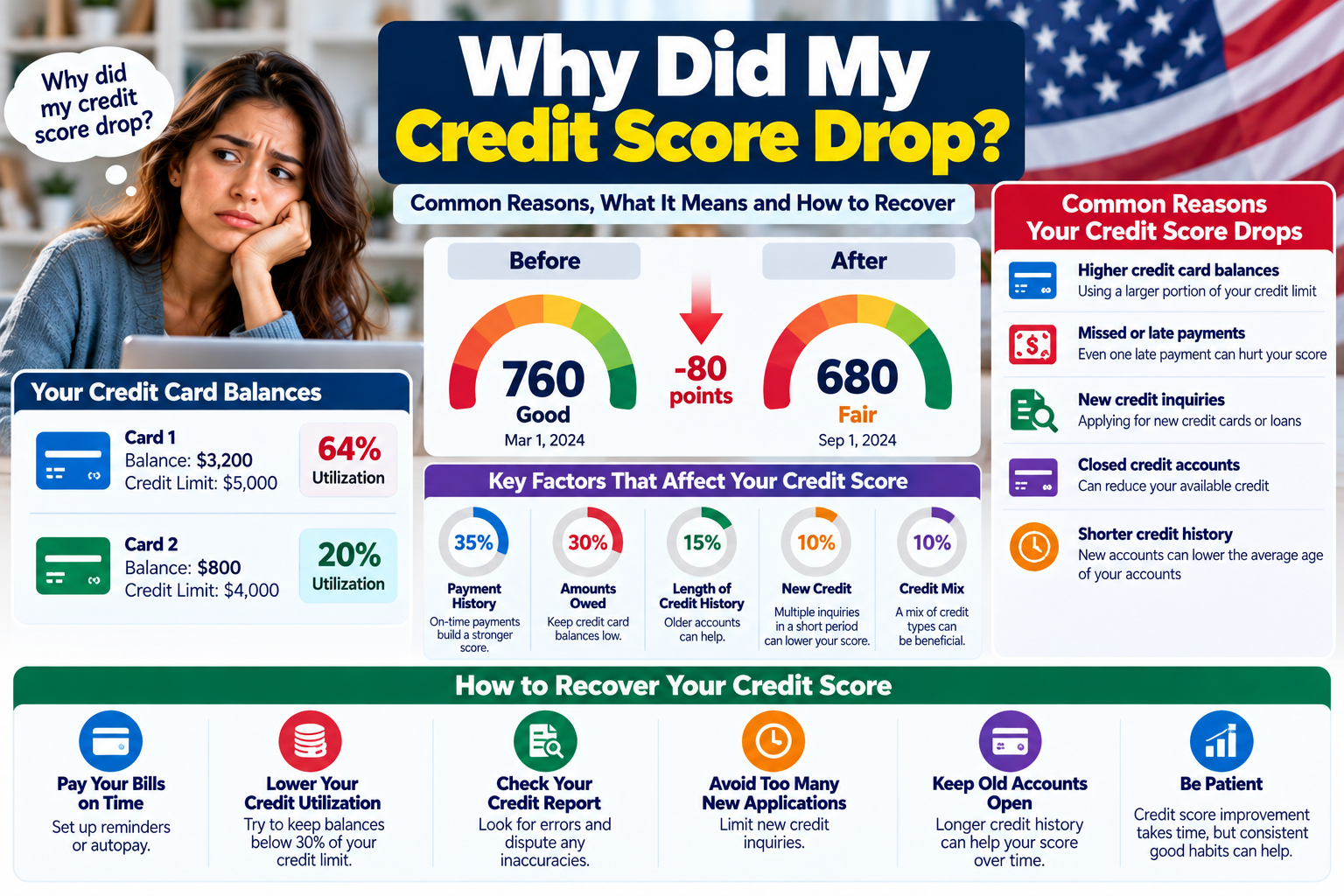
If your credit score dropped 100 points, it can be frustrating and worrying, especially when you have been paying your bills on time and managing your money responsibly. A sudden decline of this size deserves attention, but it does not automatically mean your credit is permanently damaged or that someone has stolen your identity.
A credit score can fall because of higher credit card balances, a newly reported late payment, a reduced credit limit, a collection account, inaccurate credit report information, or a change in the scoring model used. The key is to identify what changed before taking action.
In this guide, you will learn why your credit score may have dropped 100 points, how to investigate the cause, and what steps you can take to address the problem.
Quick Answer: Why Did My Credit Score Drop 100 Points?
A credit score dropped 100 points may indicate a significant change in your credit report, such as a missed payment, sharply increased credit utilization, a collection account, or incorrect account information. However, comparing scores from different credit bureaus or scoring models can also make a change appear larger than it is.
What to do first: Confirm which score changed, review your latest credit reports, and compare the account information with your previous records. Look for new late payments, higher balances, unfamiliar accounts, hard inquiries, and reduced credit limits.
Do not immediately apply for another credit card or pay a credit repair company. First, establish whether the decline reflects a real change in your credit history, an error, or a difference between score providers.
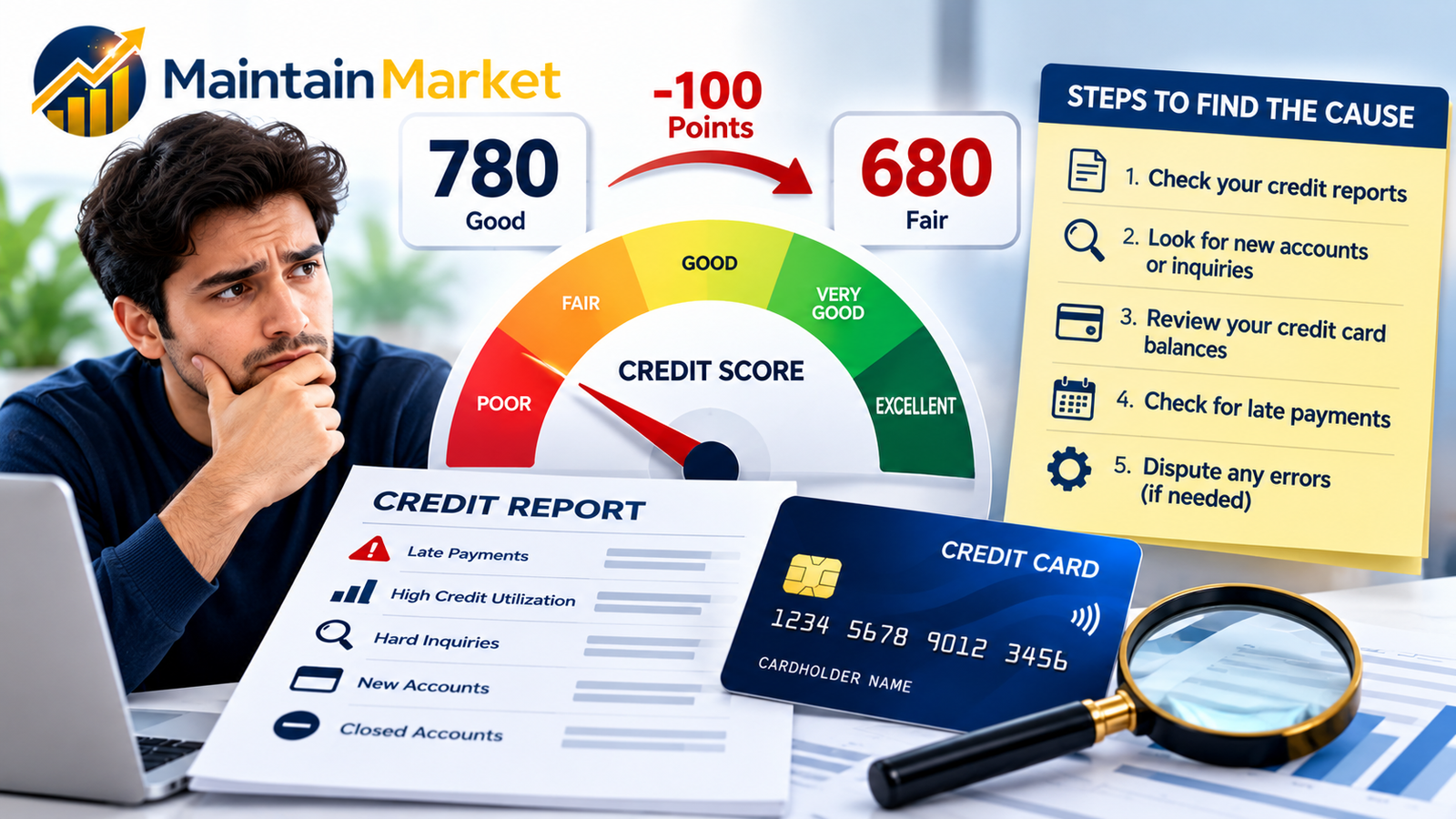
Is a 100-Point Credit Score Drop Normal?
A 100-point decline is substantial, but its meaning depends on your starting score, credit history, scoring model, and the information in your credit report.
For example:
- A drop from 780 to 680 may affect the rates or credit products available to you.
- A drop from 650 to 550 may create different challenges when applying for credit.
- A change between two different scoring models may not represent an equivalent change in your creditworthiness.
These are illustrative examples, not predictions about loan approval or interest rates.
FICO explains that the impact of a credit event depends on the person’s existing credit profile. The same event can affect two people differently. You can read more in myFICO’s explanation of how credit actions affect scores.
Before assuming that your credit is seriously damaged, confirm that you are comparing the same score type, credit bureau, and approximate reporting date.
8 Common Reasons Your Credit Score Dropped 100 Points
1. Your Credit Card Utilization Increased
Credit utilization measures how much of your available revolving credit you are using. It is an important factor in many credit scoring models.
Suppose your total credit card limits are $10,000.
| Total reported balance | Credit limit | Utilization |
|---|---|---|
| $1,000 | $10,000 | 10% |
| $3,000 | $10,000 | 30% |
| $5,000 | $10,000 | 50% |
| $8,000 | $10,000 | 80% |
If your reported balances rise sharply, your score may decline even if you have not missed a payment.
A large purchase, unexpected expense, or balance reported before you paid it down could explain the change. Your score may reflect the balance reported by the card issuer rather than the balance you see after a later payment.
What to do:
- Check the reported balances on all your credit cards.
- Review your credit limits and calculate utilization.
- Pay down balances as your budget allows.
- Avoid unnecessary new charges while you investigate.
- Continue making at least the required payments on time.
Lower utilization may help your score, but the exact improvement cannot be guaranteed.
For more detail, read Maintain Market’s guide to credit utilization ratios.
2. A Payment Was Reported Late
Payment history is an important factor in credit scoring. A newly reported late payment can have a substantial effect, particularly if you previously had a strong payment history.
Check whether you missed a credit card payment, fell behind on a loan, or had a payment incorrectly recorded by a lender.
A payment being a few days late does not automatically mean it was reported as 30 days delinquent to the credit bureaus. However, your lender may still charge a late fee or take other action under your account terms.
What to do:
- Check the payment due date and your payment confirmation.
- Contact the lender if you believe the payment was reported incorrectly.
- Bring an overdue account current if possible.
- Set up payment reminders or automatic minimum payments to help prevent future missed payments.
Accurate late-payment information generally cannot be removed simply because it hurts your score. You can ask the lender whether it will consider a goodwill adjustment, but approval is not guaranteed.
3. A Collection Account or Other Negative Item Appeared
Your credit score may fall when a collection account, charge-off, or other negative item appears in your credit history. The impact depends on your credit profile and the scoring model.
If you notice a new collection account, check:
- Whether the debt belongs to you.
- Whether the reported balance is accurate.
- Whether the account has been reported more than once.
- Whether the dates and payment history are correct.
- Whether the account could be connected to identity theft.
Do not assume that an unfamiliar account is valid, but do not ignore it either.
What to do: Gather your records and investigate the account. If the information is inaccurate, dispute it with the credit reporting company and the business that supplied the information. If the debt is valid, review your options before deciding how to handle it.
The Consumer Financial Protection Bureau’s credit report dispute guide explains how to challenge inaccurate information.
4. Your Credit Card Issuer Reduced Your Credit Limit
A credit card issuer may lower your credit limit. If your balance remains the same, your utilization ratio increases because you have less available credit.
For example:
| Situation | Balance | Credit limit | Utilization |
|---|---|---|---|
| Before limit reduction | $2,000 | $10,000 | 20% |
| After limit reduction | $2,000 | $5,000 | 40% |
Your debt has not increased, but your utilization has doubled.
What to do: Check your account for a credit limit change notice. You can contact the issuer to ask whether the decision can be reconsidered, although it is not required to restore the previous limit. Paying down the balance may help reduce utilization.
Do not open several new cards simply to replace the lost credit limit without considering fees, inquiries, and the risk of taking on more debt.
Read myFICO’s guide to credit limit decreases for further information.
5. You Closed a Credit Card or an Account Was Updated
Closing a credit card can reduce your total available revolving credit. If you still have balances on other cards, your utilization may increase.
For example, imagine you have two cards with a combined credit limit of $12,000. You close a card with a $7,000 limit and still owe $2,000 across your remaining accounts.
Your utilization could rise from approximately 17% to 40%.
Closing a card does not automatically cause a score decrease. The effect depends on your balances, other accounts, credit history, and scoring model.
Other account updates can also affect your score. A paid-off installment loan may be reported as closed, an old account may be removed, or a lender may update a balance or account status.
What to do: Review your reports to confirm what changed. Consider the annual fee and risks of keeping a card open, rather than keeping an account solely to protect your score. Paying off debt is generally a positive financial step, even if your score changes afterward.
6. You Applied for New Credit
When you apply for a credit card, auto loan, personal loan, or mortgage, the lender may conduct a hard inquiry. A hard inquiry can cause a small, temporary score decrease.
Opening a new account can also affect other aspects of your credit profile, including the average age of your accounts.
However, hard inquiries alone should not automatically be assumed to explain a 100-point drop. Investigate other changes as well.
What to do:
- Review recent inquiries and newly opened accounts.
- Confirm that the applications are yours.
- Avoid unnecessary applications while investigating the decline.
- If you see an inquiry you do not recognize, contact the relevant lender and investigate possible identity theft.
Checking your own credit report or score generally counts as a soft inquiry and does not lower your FICO Score.
7. Your Credit Report Contains an Error or Unfamiliar Account
Sometimes a score decline points to inaccurate or unfamiliar information.
Look for:
- A payment incorrectly marked late.
- A balance that does not match your records.
- An account that does not belong to you.
- An unfamiliar hard inquiry.
- Duplicate debts or incorrect account statuses.
- Signs that someone used your identity to apply for credit.
You can obtain credit reports through AnnualCreditReport.com, the federally authorized source for free credit reports. Review your reports from Equifax, Experian, and TransUnion because the information held by each bureau may differ.
What to do: Dispute inaccurate information with the relevant credit reporting company and contact the business that supplied the information when appropriate. Keep copies of your statements, payment confirmations, and dispute submissions.
If you suspect identity theft, visit IdentityTheft.gov for official guidance. You can also consider placing a credit freeze with each of the three major credit bureaus.
8. You Are Comparing Different Credit Scores or Scoring Models
Your credit score is not one permanent number. Different providers may show different scores because they use different scoring models, credit bureaus, report dates, or versions of a scoring formula.
For example, a credit card app may show one score while a mortgage lender uses another. The numbers can differ even when neither is incorrect.
What to do: Compare the score provider, scoring model, credit bureau, and date associated with each score. Then review the underlying credit report for actual changes.
A difference between two models does not necessarily mean your creditworthiness suddenly deteriorated.
Why Did My Credit Score Drop Even Though I Paid Everything on Time?
If you have not missed any payments, focus first on changes that can occur without a late payment.
| Possible reason | What to check | What to do |
|---|---|---|
| Higher credit card balances | Recent statements and reported balances | Pay down balances where possible |
| Credit limit reduction | Issuer notices and account limits | Review utilization and contact the issuer |
| New hard inquiry | Credit reports and recent applications | Confirm the inquiry is legitimate |
| Closed or updated account | Account status and history | Verify that the information is accurate |
| Different scoring model | Score provider, model, and date | Compare equivalent scores |
| Reporting error | Account details and payment history | Dispute incorrect information |
A useful first step is to compare your latest report with an earlier report. Focus on what actually changed instead of guessing based on the score alone.
What to Do Immediately After a 100-Point Credit Score Drop
Follow this checklist before applying for another credit card or loan.
Step 1: Confirm Which Score Changed
Write down your previous score, current score, the date of each score, and the provider showing it.
Make sure you are comparing the same score type and, where possible, the same credit bureau.
Step 2: Get Your Credit Reports
Visit AnnualCreditReport.com to access your credit reports.
Review your reports from Equifax, Experian, and TransUnion. Look for new late payments, higher balances, new inquiries, unfamiliar accounts, closed accounts, and reduced credit limits.
Remember that a credit report and a credit score are not the same thing. A report contains credit-history information, while a scoring model uses information from a credit file to calculate a score.
Step 3: Compare What Changed
Look for information added or updated since your previous score:
- Higher credit card balances or utilization.
- New hard inquiries or accounts.
- Late payments.
- Closed accounts or reduced credit limits.
- Changes to installment loans.
- Errors or unfamiliar activity.
If your credit score provider supplies reason codes or negative factors, use them as clues. They may not explain every change.
Step 4: Dispute Incorrect Information
If you find inaccurate information, file a dispute with the credit reporting company and contact the company that supplied the information when appropriate.
Explain what is incorrect and provide copies of supporting documents. Keep records of your submissions and review the investigation results.
The CFPB explains the process in its official guide to disputing credit report errors.
Step 5: Take Action Based on the Cause
Do not take the same action for every score drop.
- High utilization: Focus on reducing revolving balances.
- Late payment: Bring the account current where possible and prevent further missed payments.
- Hard inquiry: Confirm that it is legitimate and avoid unnecessary applications.
- Incorrect information: Dispute the error.
- Identity theft: Contact the affected companies and follow official identity-theft guidance.
- Different scoring model: Compare equivalent scores before drawing conclusions.
How Long Does It Take for a Credit Score to Recover?
There is no universal recovery timeline. It depends on why your score fell, when lenders report updated information, and which scoring model is used.
| Cause of the drop | What may happen next |
|---|---|
| Higher credit card utilization | Your score may improve after lower balances are reported, if other factors remain similar |
| Hard inquiry | Its impact may fade over time; FICO Scores generally consider hard inquiries for up to 12 months, although inquiries can remain on reports for up to two years |
| Incorrect information | Your score may change after a successful correction and a new calculation |
| Late payment | Recovery can take longer because accurate negative payment history may remain on a report for years |
| Different scoring model | Scores may continue to differ because the models are not identical |
A score may improve after one issue is corrected, but that outcome is not guaranteed. Other information in your credit file can affect the result.
Be cautious of any company that promises to restore 100 points within a specific number of days.
Example: A Credit Score Drops After a Credit Card Purchase
Imagine a consumer has a $5,000 credit limit and a reported balance of $500. Their utilization is 10%.
After making a $1,500 purchase, the reported balance rises to $2,000. Their utilization becomes 40%.
If the lender reports the higher balance, a credit scoring model may calculate a lower score even though the consumer has not missed a payment.
The consumer then pays down the balance before the next reporting update. Once the lower balance is reported, utilization may decrease again. The score may respond, but the exact change depends on the rest of the credit file and the scoring model.
This is an illustrative example, not a prediction of a 100-point change.
The lesson: A score drop does not always mean you missed a payment or made a long-term financial mistake. Check the information being reported before deciding what to do.
Mistakes to Avoid After a Credit Score Drop
Applying for Multiple Cards Immediately
Opening new accounts can create additional inquiries and may complicate your credit profile. Identify the reason for the drop before applying for more credit.
Closing Every Credit Card
Closing accounts can reduce available credit and increase utilization. Consider an account’s costs and risks before deciding whether to close it.
Paying a Company That Promises an Instant Score Increase
Be cautious of services promising guaranteed results or claiming they can remove accurate negative information. You can dispute inaccurate information yourself through official channels.
Ignoring an Unexpected Inquiry
An inquiry you do not recognize deserves investigation. Confirm whether it is legitimate and take appropriate identity-protection steps if necessary.
Assuming a Small Drop Means Financial Trouble
Scores can change for several reasons, and different models may produce different results. Review the underlying data before drawing conclusions.
Frequently Asked Questions
1. Why did my credit score drop 100 points overnight?
A sudden drop may be associated with a newly reported late payment, higher credit card utilization, a collection account, an account update, or a difference in the score provider or model. Review your credit reports and score details to identify what changed.
2. Can a credit score really drop 100 points in one month?
Yes, a large decline can occur, but it is not typical for every consumer or every credit event. The effect depends on your starting credit profile, the information reported, and the scoring model. Check your reports before assuming a particular cause.
3. Can a credit card balance cause a 100-point credit score drop?
A large increase in reported credit card balances can contribute to a substantial decline, especially when utilization rises sharply. However, a 100-point drop should prompt you to investigate other possible changes as well.
4. Why did my credit score drop when I paid off a credit card?
Paying off a card generally reduces its balance and can lower utilization. However, the score may be affected by other changes occurring at the same time, and the reported balance may not update immediately. Do not carry interest-bearing debt simply to maintain a particular score.
5. Can checking my credit score lower it?
Checking your own credit score or report generally does not lower your FICO Score because it is normally treated as a soft inquiry. Applying for credit can trigger a hard inquiry, which may affect your score.
6. Why did my credit score drop after paying off a loan?
Paying off an installment loan changes the information in your credit file and may affect credit mix or other characteristics considered by a scoring model. The result varies by person. Do not keep a loan open or pay unnecessary interest solely to avoid a possible score change.
7. Should I dispute a 100-point credit score drop?
You generally dispute inaccurate information on a credit report rather than the score number itself. A score decline alone does not prove an error. Review the report, identify incorrect information, and submit supporting documentation through the appropriate process.
8. How can I raise my credit score after it drops?
Start by correcting inaccurate information, making every payment on time, reducing high revolving balances where possible, and avoiding unnecessary applications. The right steps depend on what caused the decrease, and no specific point increase or recovery date can be guaranteed.
9. Can identity theft cause my credit score to drop 100 points?
It can if someone opens accounts, runs up balances, or causes negative information to appear in your credit file. If you see unfamiliar accounts or inquiries, contact the relevant companies and credit bureaus, and follow the guidance at IdentityTheft.gov.
10. How long will a 100-point credit score drop stay on my report?
There is no single timeline for a score drop itself. The timing depends on the underlying information. For example, a utilization change may be reflected after a lender reports a new balance, while accurate negative payment information can remain on a credit report for years. Corrected errors may affect the score after the information is updated.
Why Maintain Market Is Different
At Maintain Market, we focus on helping readers understand the reason behind a financial change and the practical steps they can take next.
Instead of treating every credit score decrease as a crisis, this guide separates utilization changes, payment issues, credit inquiries, account updates, and reporting errors. That helps readers investigate the cause before making decisions that could add unnecessary debt or new credit applications.
Credit scoring models differ, and no single action guarantees a particular score. Use your credit reports and official resources to make an informed decision.
References
- Consumer Financial Protection Bureau — Understand Your Credit Score
- myFICO — Not-So-Obvious Causes for a Dropping FICO Score
- myFICO — How Credit Actions Impact FICO Scores
- myFICO — How Credit Limit Decreases Can Affect Your Score
- AnnualCreditReport.com — Official Free Credit Reports
- Consumer Financial Protection Bureau — How to Dispute an Error on Your Credit Report
- IdentityTheft.gov — Report Identity Theft
Editorial Review
This article is for general educational purposes for U.S. consumers. Credit scoring models, credit reporting practices, and the impact of individual actions can vary. Check your credit reports and consult the relevant credit bureau or lender for account-specific concerns.