
Your credit utilization ratio is an important factor that can influence your credit score in the United States. It measures how much of your available revolving credit you are using compared with your total credit limits. If your credit card balances are close to their limits, your credit score may be affected even when you make payments on time.
Understanding this ratio can help you interpret your credit reports, monitor your credit card balances, and make more informed financial decisions. In this guide, you’ll learn how credit utilization works, how to calculate it for individual cards and across multiple accounts, and why it matters to your credit profile.
Quick Answer: What Is a Credit Utilization Ratio?
A credit utilization ratio is the percentage of your available revolving credit that you are currently using. It is generally calculated by dividing your credit card balance by your credit limit and multiplying the result by 100.
For example, if your credit card has a $5,000 limit and a reported balance of $1,000, your utilization ratio is 20%.
Credit utilization formula:
Credit utilization ratio = (Credit card balance ÷ Credit limit) × 100
A lower ratio is generally favorable for many credit scoring models. Keeping utilization below 30% is a commonly used guideline, but it is not a universal scoring threshold or a guarantee of a particular credit score.
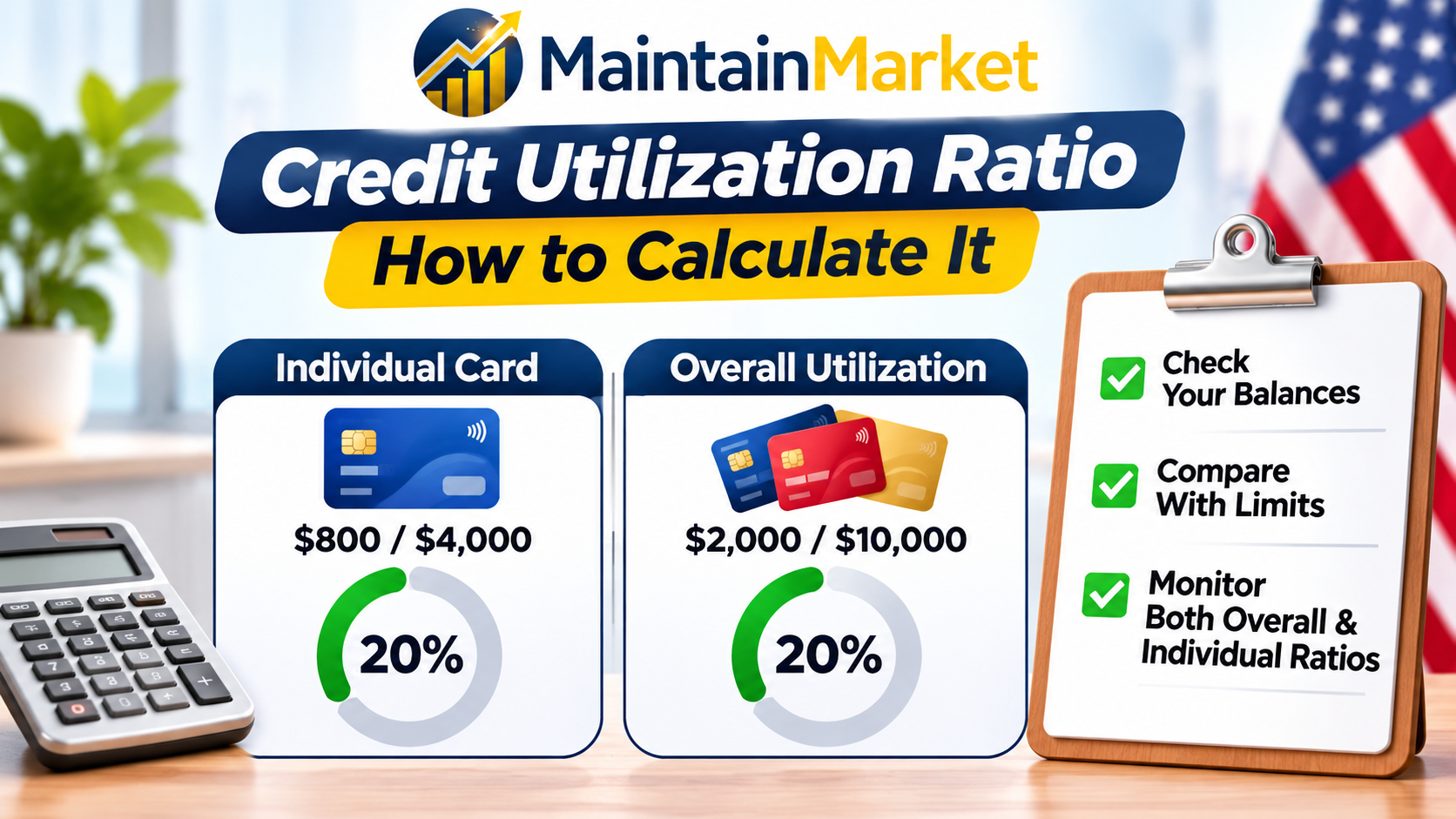
How to Calculate Your Credit Utilization Ratio
You can calculate credit utilization in two ways:
- Individual credit card utilization
- Overall credit utilization across multiple cards
Understanding the difference is important because credit scoring models may consider both.
1. Individual Credit Card Utilization
Individual utilization measures how much of one credit card’s limit you are using.
Example:
Suppose your credit card has:
- Credit limit: $4,000
- Reported balance: $800
Calculation:
$800 ÷ $4,000 × 100 = 20%
Your individual credit utilization ratio is 20%.
This means you are using 20% of that card’s available credit.
2. Overall Credit Utilization
Overall utilization measures the combined balances across your relevant revolving credit accounts compared with their combined credit limits.
Consider this example:
| Credit Card | Credit Limit | Reported Balance |
|---|---|---|
| Card A | $5,000 | $1,000 |
| Card B | $3,000 | $600 |
| Card C | $2,000 | $400 |
| Total | $10,000 | $2,000 |
Calculation:
$2,000 ÷ $10,000 × 100 = 20%
Your overall credit utilization ratio is 20%.
Although each card has a different credit limit, the combined calculation gives you a picture of how much of your total available revolving credit you are using.
Important: Overall utilization does not tell the whole story. One card could have a very high utilization ratio even when your combined percentage is relatively low.
Overall vs. Individual Credit Utilization: What’s the Difference?
Both calculations help explain your credit usage, but they measure different things.
| Feature | Overall Utilization | Individual Utilization |
|---|---|---|
| What it measures | Combined balances against combined limits | One card’s balance against its limit |
| Calculation | Total relevant balances ÷ total relevant limits | Individual card balance ÷ individual card limit |
| Example | $2,000 ÷ $10,000 = 20% | $900 ÷ $1,000 = 90% |
| What it shows | Your overall revolving credit usage | How heavily one card is being used |
Example of why the difference matters:
Imagine you have two credit cards:
- Card A: $1,000 credit limit and $900 balance
- Card B: $9,000 credit limit and $100 balance
Your total credit limit is $10,000, and your total balance is $1,000.
Overall utilization:
$1,000 ÷ $10,000 × 100 = 10%
However, Card A has an individual utilization ratio of 90%.
This example shows why checking only your overall percentage may not give you the complete picture of your credit usage.
What Is a Good Credit Utilization Ratio?
There is no single credit utilization percentage that guarantees an excellent credit score. However, keeping revolving balances relatively low compared with available credit is generally a sensible approach.
The following table provides general educational guidance:
| Credit Utilization | General Interpretation |
|---|---|
| 0% | No reported revolving balance; not inherently bad |
| 1%–9% | Low utilization |
| 10%–29% | Below the commonly cited 30% guideline |
| 30%–49% | Higher utilization |
| 50%–74% | High utilization |
| 75%–99% | Very high utilization |
| 100% or more | At or above the available credit limit |
These are practical descriptions, not official credit scoring bands. Different scoring models may evaluate credit utilization differently.
Is 30% Credit Utilization Good?
Keeping your utilization below 30% is a commonly recommended guideline. However, 30% is not a guaranteed safe threshold.
For example, if your total credit limit is $10,000:
- A $3,000 balance represents 30% utilization.
- A $2,000 balance represents 20% utilization.
- A $1,000 balance represents 10% utilization.
Lower utilization may be favorable for some credit profiles, but your complete credit history and the scoring model used also matter.
You do not need to carry a balance or pay interest to build good credit.
How Does Credit Utilization Affect Your Credit Score?
Credit utilization is one of the factors used by many credit scoring models to evaluate revolving credit usage.
For example, FICO includes amounts owed as a major scoring category. The amount of available revolving credit you use is one component of that category.
Here are some important aspects of credit utilization:
1. Overall Credit Utilization
Scoring models may consider the combined balances and credit limits across relevant revolving accounts.
A high combined balance relative to your total available credit may negatively affect your credit score.
2. Individual Credit Card Utilization
Your balance on each individual card can also matter.
For example, one card could be close to its limit even if your other credit cards have very low balances.
This is why it is useful to understand both individual and overall utilization.
3. Reported Credit Card Balances
The balance shown on your credit report may differ from your current account balance.
Credit card issuers generally report account information periodically. If an issuer reports your balance before a payment is reflected, your credit report may show the earlier amount.
For example, you might pay your credit card in full before the payment due date, but the issuer may already have reported the balance from an earlier date.
4. Changes in Utilization Over Time
Some widely used scoring models place substantial emphasis on recently reported revolving balances. Other models may also consider trends over time.
When updated information reaches the credit bureaus, a change in reported utilization may affect your score. However, the size and timing of any change depend on your complete credit profile and the scoring model.
How Often Is Credit Utilization Updated?
Credit utilization can change whenever your credit card balances or limits change.
Credit card issuers generally report account information to the credit bureaus periodically, often around the billing cycle. However, reporting schedules are not identical across all issuers.
Your credit report may therefore show a balance that is different from what you currently see in your banking app.
To understand your reported utilization:
- Check your credit card statement.
- Review your credit reports.
- Compare the reported balances with your current account balances.
- Check with your issuer if an account balance or credit limit appears incorrect.
For official free credit reports from the nationwide credit bureaus, visit AnnualCreditReport.com.
How to Calculate the Balance Needed for a Target Utilization
You can use a simple calculation to estimate the balance associated with a particular utilization percentage.
Formula:
Target balance = Total credit limit × Target utilization percentage
Suppose your combined credit limit is $12,000.
| Target Utilization | Target Balance |
|---|---|
| 30% | $3,600 |
| 20% | $2,400 |
| 10% | $1,200 |
| 5% | $600 |
For example, if your current reported balance is $4,200 and your target balance is $2,400, the difference is $1,800.
This is a mathematical illustration, not a recommendation to make a payment you cannot afford. Your financial priorities and essential expenses should come first.
For practical repayment strategies, read our guide: How to Lower Credit Utilization.
Credit Utilization Ratio vs. Debt-to-Income Ratio
Credit utilization and debt-to-income ratio are two different financial measurements. Although both can be relevant when applying for credit, they do not measure the same thing.
| Feature | Credit Utilization Ratio | Debt-to-Income Ratio |
|---|---|---|
| What it measures | Revolving balances compared with credit limits | Monthly debt payments compared with gross monthly income |
| Common use | Credit scoring and credit risk assessment | Mortgage and lending decisions |
| Calculation | Relevant revolving balances ÷ relevant credit limits | Monthly debt payments ÷ gross monthly income |
| What affects it | Credit card balances and available limits | Debt obligations and income |
For example, someone may have low credit utilization but a high debt-to-income ratio because of substantial mortgage or auto loan payments.
Similarly, someone may have a low debt-to-income ratio but high credit utilization because of large credit card balances.
Both measurements can be relevant to lending decisions, but they should not be used interchangeably.
Common Credit Utilization Mistakes to Avoid
Understanding the calculation is useful, but some common misunderstandings can lead to poor financial decisions.
1. Assuming 30% Is a Guaranteed Cutoff
The 30% guideline is not an official threshold that guarantees a good credit score. Different scoring models may evaluate utilization differently.
2. Paying Interest to Build Credit
You do not need to carry an unpaid credit card balance or pay interest to build a credit history.
If your account has a grace period and your purchases qualify, paying the statement balance in full by the due date can help you avoid interest.
3. Ignoring Individual Card Balances
Your overall utilization may look low while one card is close to its limit. Check both individual and combined utilization.
4. Confusing Current Balances With Reported Balances
Your credit report may show the last balance reported by your issuer rather than your current account balance. Reporting schedules can differ.
5. Expecting a Guaranteed Score Increase
There is no universal formula that predicts how many credit score points you will gain after changing your utilization ratio. Your overall credit profile and the scoring model determine the result.
Frequently Asked Questions About Credit Utilization Ratio
1. What is the ideal credit utilization ratio?
There is no single ideal percentage for everyone. Lower utilization is generally favorable in many scoring models, and below 30% is a commonly used guideline. A ratio below 10% may be beneficial for some profiles, but it does not guarantee a particular credit score.
2. Is 0% credit utilization bad?
No. A 0% reported utilization ratio is not inherently bad. You do not need to carry a balance or pay interest to build good credit. Some scoring models may evaluate a small reported balance differently from zero utilization, but this is not a reason to pay interest.
3. How quickly can credit utilization affect my credit score?
The timing depends on when your credit card issuer reports updated information and when your score is calculated. A change may be reflected after new account data reaches the credit bureaus, but no specific score change or timeline is guaranteed.
4. Does credit utilization include all my loans?
No. Credit utilization generally relates to revolving credit accounts, such as credit cards and certain lines of credit. Mortgages, auto loans, and most personal installment loans are not calculated using the same balance-to-credit-limit formula. However, installment debt can affect your credit score in other ways.
5. Should I pay my credit card before the statement closes?
An early payment may reduce the balance reported to credit bureaus, depending on your issuer’s reporting practices. However, always make at least the required payment by the payment due date.
6. Can a credit limit increase lower my utilization ratio?
Yes. If your balance stays the same and your credit limit increases, your utilization percentage may decrease. However, an increase is not guaranteed, and you should consider whether the issuer may conduct a hard inquiry.
7. Does credit utilization reset every month?
Reported utilization can change as issuers update account information. Many commonly used scoring models emphasize recently reported balances, while some newer models may consider trends over time. Your credit report may not update immediately after a payment.
8. Can high credit utilization affect loan approval?
Yes, it may. High utilization can negatively affect some credit scores, which lenders may consider during an application. However, loan approval also depends on factors such as income, payment history, existing debt, assets, and lender-specific requirements.
9. Can I improve credit utilization without paying off all my debt?
Yes. Your utilization can change when your reported balances decrease or your available credit increases. However, a credit limit increase is not guaranteed, and opening new accounts may have other consequences. If you need a practical repayment approach, see our guide on how to lower credit utilization.
Final Thoughts
Your credit utilization ratio helps show how much of your available revolving credit you are using. Understanding both individual and overall utilization gives you a clearer picture of your credit card balances and how they may be viewed by credit scoring models.
Remember that there is no universal percentage that guarantees an excellent credit score. Monitor your credit reports, understand your reported balances, and manage your credit responsibly rather than focusing only on reaching a particular number.
References
- Consumer Financial Protection Bureau (CFPB) – How to Get and Keep a Good Credit Score
- CFPB – Understand Your Credit Score
- FICO – Amounts Owed and Credit Utilization
- Experian – Credit Utilization
- AnnualCreditReport.com – Official Free Credit Reports
Editorial Review
Disclaimer: This article is for general educational purposes for consumers in the United States. Credit scoring models, credit reporting practices, and lender requirements vary. No utilization percentage guarantees a particular credit score or loan approval.