
A personal loan early payoff penalty is a fee a lender may charge when you repay some or all of your loan principal before the scheduled repayment date. Whether you face this fee depends on your loan agreement, the type of loan, and applicable state and federal rules.
Paying off a personal loan early can reduce the interest you pay and free up money in your monthly budget. However, an early payoff fee or other contract terms could reduce those savings. Before sending a large payment, check your loan agreement and request an official payoff quote from your lender.
Quick Answer: Do Personal Loans Have Early Payoff Penalties?
Some personal loans have prepayment penalties, while many lenders allow borrowers to repay their loans early without an additional fee.
There is no blanket federal rule that makes every personal loan penalty-free when repaid early. Federal disclosure requirements and state laws may apply, but the terms of your specific loan agreement are important.
Before paying off your loan, check for:
- A prepayment penalty or early repayment fee
- Restrictions on partial or full early repayment
- Any minimum interest or finance charge requirements
- The lender’s method for calculating your payoff amount
- Applicable state consumer lending rules
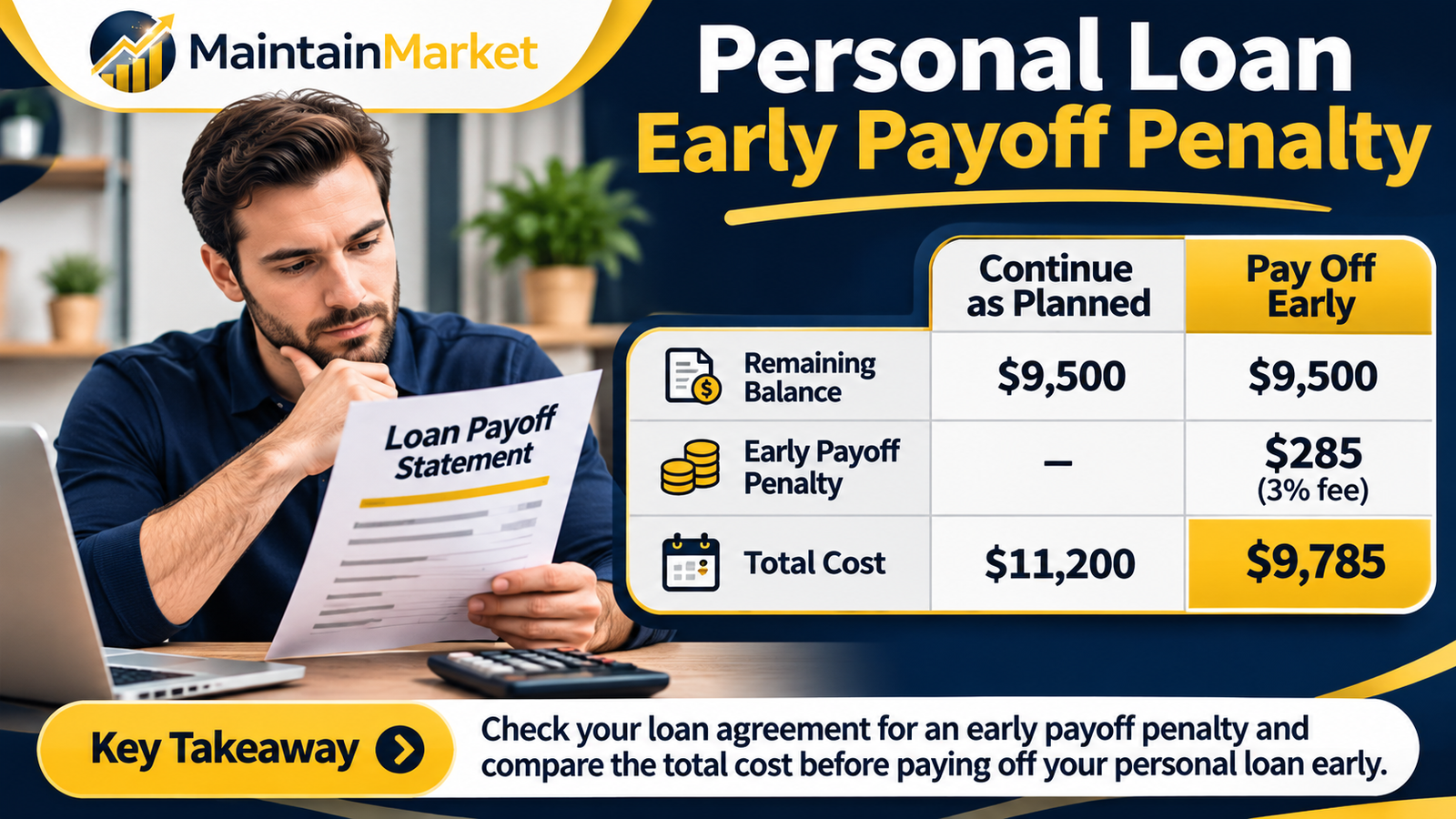
What Is a Personal Loan Early Payoff Penalty?
A personal loan early payoff penalty, also called a prepayment penalty, is a charge associated with repaying loan principal before it is due under the original repayment schedule.
Lenders collect interest over the agreed loan term. When a borrower repays the loan early, the lender may receive less interest than it expected. A prepayment penalty is one way a lender may seek compensation, if permitted by the applicable law and loan agreement.
For example, imagine you borrow $10,000 and plan to repay it over 36 months. After making payments for 12 months, you decide to pay the remaining balance in full.
If your contract includes an applicable early repayment fee, the lender may include that charge in your payoff amount. If your agreement has no such fee, you generally should not be charged a prepayment penalty.
The example is illustrative. Actual charges depend on your contract and applicable law.
Are Personal Loan Early Payoff Penalties Legal in the United States?
Personal loan prepayment penalties are not automatically prohibited across the entire United States. The rules can depend on the loan type, lender, applicable federal requirements, and state law.
The federal Truth in Lending Act (TILA), implemented through Regulation Z, includes disclosure requirements for certain closed-end consumer credit transactions.
Under 12 CFR § 1026.18(k), covered creditors must disclose whether a prepayment penalty or prepayment rebate will apply when the relevant requirements are met. This helps borrowers understand the terms of their credit agreement before committing to a loan.
However, a disclosure requirement is not the same as a nationwide ban on prepayment penalties.
State laws may impose additional restrictions on particular lenders or loan products. Therefore, borrowers should check the law applicable to their loan rather than assume that every early payoff fee is legal or illegal.
Useful official reference: CFPB – Regulation Z, Section 1026.18
How to Check Whether Your Personal Loan Has an Early Payoff Penalty
Do not rely only on what a lender’s advertisement says. Review the actual loan agreement and disclosures.
1. Review Your Loan Agreement
Look for sections titled:
- Prepayment
- Early Repayment
- Prepayment Penalty
- Loan Payoff
- Additional Payments
- Finance Charges
Read the full section. A loan may allow extra monthly payments but have different terms for paying the entire balance before the scheduled maturity date.
2. Check Your Truth in Lending Disclosure
For covered transactions, Regulation Z requires relevant prepayment information to be disclosed.
Review the disclosure for a statement explaining whether a charge may apply when you repay all or part of the principal early.
Do not assume that a fee does not exist simply because you cannot find a clearly labeled section. Ask the lender for written confirmation.
3. Contact Your Lender
Ask these questions:
- Can I pay off the loan in full today?
- Is there an early payoff or prepayment penalty?
- Are partial principal payments allowed without a fee?
- How much interest will accrue through the payoff date?
- Will any unused finance charge be refunded or adjusted?
- How long is the payoff quote valid?
Request the answers and payoff amount in writing.
4. Check Applicable State Rules
Consumer lending laws differ by state and loan type. If your agreement includes an early repayment fee, check whether your state’s law restricts that fee for your particular loan.
You can also contact your state financial regulator or a qualified consumer finance attorney if you believe a lender is charging an unlawful fee.
How Much Can a Personal Loan Early Payoff Penalty Cost?
There is no single standard fee for every personal loan. If a penalty is permitted and included in your agreement, its calculation may depend on the contract.
For illustration, consider these hypothetical examples:
| Loan payoff balance | Illustrative fee | Total before other charges |
|---|---|---|
| $5,000 | 2% ($100) | $5,100 |
| $10,000 | 3% ($300) | $10,300 |
| $15,000 | 4% ($600) | $15,600 |
These percentages are examples only, not typical or legally permitted rates in every state. Your lender may use a different calculation, or your loan may have no prepayment penalty at all.
Also remember that the final payoff amount may include accrued interest through the payoff date and other amounts allowed under your agreement.
Does Paying Off a Personal Loan Early Save Money?
It can. Paying off a loan early may reduce the interest you would otherwise pay over the remaining repayment period.
However, your actual savings depend on:
- Your remaining principal balance
- Your interest rate
- The number of payments remaining
- The loan’s interest calculation method
- Any prepayment penalty or other payoff charges
Example: Paying Off a Personal Loan Early
Suppose you have:
| Loan detail | Amount |
|---|---|
| Original loan amount | $10,000 |
| Interest rate | 12% APR |
| Original term | 36 months |
| Monthly payment | Approximately $332.14 |
After making 12 scheduled payments, you decide to repay the remaining balance.
With a typical amortizing loan, some interest has already been paid through those monthly payments. Your payoff amount is therefore not simply the original loan amount minus the total payments made.
The lender calculates the remaining principal and any interest accrued through the payoff date. You should compare that official amount with the cost of continuing your scheduled payments.
Important: This is an illustrative loan calculation. Actual payment schedules and savings depend on the lender’s calculation method, payment dates, and contract terms.
Prepayment Penalty vs. Regular Loan Interest
These two costs are different and should not be confused.
| Feature | Regular loan interest | Prepayment penalty |
|---|---|---|
| What it is | Cost of borrowing money | Contractual charge for early repayment |
| When it applies | While the loan balance accrues interest | When a qualifying early repayment triggers the charge |
| How it is calculated | According to the loan’s interest method | According to the contract and applicable law |
| Can it be avoided? | Reducing the outstanding balance may reduce future interest | Depends on the loan terms and applicable law |
A lender charging interest up to the actual payoff date is not automatically charging an early payoff penalty. Ask for an itemized payoff statement if the amounts are unclear.
Simple Interest vs. Precomputed Interest: Why It Matters
The way a lender calculates interest can affect how much you save by repaying early.
Simple Interest Loans
With a simple interest loan, interest is generally calculated using the outstanding principal balance and the applicable rate.
As the principal decreases, the interest charged on that balance generally decreases as well.
Making additional principal payments may reduce the total interest paid, depending on the loan terms and how the lender applies those payments.
Precomputed Interest Loans
With a precomputed interest loan, the finance charge is calculated in advance using the agreed repayment schedule.
If you repay the loan early, the lender’s calculation of any rebate or unearned finance charge may differ from the calculation used for a simple interest loan.
Ask the lender how early repayment affects the remaining finance charge. Do not assume that every loan will produce the same interest savings.
When Does Paying Off a Personal Loan Early Make Sense?
Early repayment may be worth considering when:
- Your loan has a relatively high interest rate.
- Your agreement does not impose a costly early payoff penalty.
- You have enough savings left for emergencies.
- You are not sacrificing payments on higher-priority debts.
- The interest savings exceed the penalty and other costs.
For example, if your personal loan has a high APR and you have sufficient emergency savings, paying it off early may reduce your overall borrowing cost.
However, using all your available cash to eliminate a loan may leave you financially vulnerable if an unexpected expense occurs.
When Should You Avoid Paying Off a Personal Loan Early?
Early repayment may not be the best decision in every situation.
Consider keeping your scheduled repayment plan if:
- The penalty is too expensive: The fee may reduce or eliminate the interest savings.
- Your emergency savings are insufficient: You may need accessible cash for unexpected expenses.
- You have higher-interest debt: Paying down a more expensive debt may save more money.
- Your loan has unusual interest terms: A precomputed finance charge or other contract provision may affect the benefit of early repayment.
- You have other important financial obligations: Do not compromise essential bills or minimum payments to repay one loan early.
The right choice depends on your total financial situation, not simply the desire to become debt-free faster.
How to Pay Off a Personal Loan Early Without Unexpected Fees
Follow these steps before making your final payment.
Step 1: Read the loan agreement.
Confirm whether full or partial prepayment is permitted and whether any charge applies.
Step 2: Request an official payoff quote.
Ask your lender for the exact amount required to close the loan on your intended payment date.
Step 3: Request an itemized breakdown.
Check the remaining principal, accrued interest, any applicable penalty, and other charges.
Step 4: Compare the costs.
Calculate how much you would pay by continuing the scheduled installments versus paying the loan off now.
Step 5: Make the payment using the lender’s official method.
Follow the lender’s instructions so the payment is applied correctly.
Step 6: Obtain written confirmation.
After payment, request confirmation that the loan balance is zero and the account is closed or paid in full, as applicable.
Keep the confirmation and payment records for your files.
What to Do If a Lender Charges an Unexpected Early Payoff Fee
If you believe a lender has charged an unexpected or incorrect penalty, take the following steps:
- Request an itemized explanation of the fee.
- Compare the charge with your signed loan agreement and disclosures.
- Ask the lender to identify the contract provision authorizing the charge.
- Check whether applicable state or federal rules restrict it.
- Submit a written complaint to the lender if the fee appears inconsistent with your agreement.
- If the issue remains unresolved, consider submitting a complaint to the Consumer Financial Protection Bureau.
Keep copies of your loan agreement, payoff quote, payment confirmation, and all correspondence.
A complaint does not guarantee a refund, but it can help bring an unresolved issue to the regulator’s attention.
Personal Loan Early Payoff Checklist
Before paying off your loan, make sure you have completed these checks:
- Reviewed the signed loan agreement
- Checked the prepayment penalty clause
- Confirmed whether partial payments are treated differently
- Requested an official payoff quote
- Checked accrued interest and other charges
- Compared early payoff costs with remaining scheduled payments
- Kept enough emergency savings
- Obtained written confirmation after repayment
Frequently Asked Questions
1. Can I pay off a personal loan early without a penalty?
Yes, if your loan agreement allows early repayment without a penalty and applicable law does not impose a restriction. Many lenders permit early repayment without an additional fee, but you should verify your own contract.
2. Is there a federal law that bans personal loan prepayment penalties?
There is no blanket federal ban covering every personal loan. The Truth in Lending Act and Regulation Z include disclosure requirements for covered credit transactions, while other federal or state laws may restrict penalties for particular loan types or borrowers.
3. How do I know if my lender charges an early payoff fee?
Review your loan agreement and Truth in Lending disclosures. Search for terms such as “prepayment penalty,” “early repayment,” and “loan payoff.” You can also ask the lender for written confirmation.
4. Do all personal loan lenders charge prepayment penalties?
No. Some lenders allow borrowers to pay off personal loans early without an additional penalty. Policies vary, so compare the actual loan terms rather than assuming all lenders follow the same rules.
5. Does paying off a personal loan early hurt your credit score?
It may affect your credit score because closing an installment loan changes your credit account information and overall credit mix. The impact varies by credit profile and scoring model. Paying off debt can still be a sensible financial decision, and you should not keep an unnecessary loan open solely to influence your score.
6. Can I make extra payments toward my personal loan principal?
Many lenders allow additional payments, but you should confirm how they are applied. Ask whether the extra amount reduces principal immediately, advances your next due date, or is handled differently under your agreement.
7. Is a loan payoff quote the same as my remaining balance?
Not necessarily. A payoff quote may include the remaining principal, interest accrued through a specified date, and any applicable charges. Your current account balance may not reflect the exact amount needed to close the loan.
8. Can a lender charge a penalty for partial early repayment?
It depends on the loan agreement and applicable law. Some contracts distinguish between making additional principal payments and repaying the entire loan early. Check both provisions before sending an extra payment.
9. Can I negotiate a personal loan prepayment penalty?
You can ask the lender to remove or reduce a proposed fee before signing the agreement. Once the loan is active, whether the lender can waive a contractual fee depends on its policies and the agreement. Always obtain any waiver in writing.
10. Should I pay off my personal loan early or invest the money?
Compare the loan’s effective borrowing cost with the potential return and risk of an investment. Also consider taxes, liquidity, emergency savings, and your risk tolerance. Investment returns are not guaranteed, while avoiding future loan interest may provide a more predictable saving.
Final Thoughts
A personal loan early payoff penalty can reduce the financial benefit of repaying a loan ahead of schedule. Before making an early payment, review your agreement, check the applicable rules, and request an itemized payoff quote.
If your lender allows penalty-free repayment and the interest savings outweigh other costs, paying off your personal loan early may be a sensible financial decision. Just make sure you retain enough cash for emergencies and other important obligations.
References
- Consumer Financial Protection Bureau – Regulation Z, Section 1026.18
- Consumer Financial Protection Bureau – Can I Prepay My Loan at Any Time Without Penalty?
- Consumer Financial Protection Bureau – Submit a Complaint
Editorial Review
Review focus: Loan agreement terms, early repayment costs, federal disclosure requirements, state law considerations, and responsible debt repayment.
Disclaimer: This article is for educational purposes only and does not constitute legal, tax, or personalized financial advice. Loan terms and applicable laws vary. Review your loan agreement and consult a qualified professional about your specific circumstances.