
Unexpected expenses can create financial pressure when your savings are not enough. A medical bill, urgent car repair, home emergency, or temporary income gap may require money sooner than your next paycheck.
Emergency personal loans can help eligible borrowers cover urgent expenses through a lump-sum loan that is repaid in scheduled installments. However, fast funding does not always mean affordable borrowing, and approval is never guaranteed.
Before applying, understand how emergency personal loans work, how quickly lenders may release funds, what fees to check, and which alternatives could cost less.
Quick Answer: What Are Emergency Personal Loans?
Emergency personal loans are typically unsecured installment loans used to cover unexpected expenses. You receive an approved amount and repay it over an agreed period, usually through fixed monthly payments.
Depending on the lender, your credit profile, application time, and verification requirements, funding may arrive the same day or take several business days.
Before accepting an offer, compare its annual percentage rate (APR), origination fees, repayment period, monthly payment, and total repayment amount.
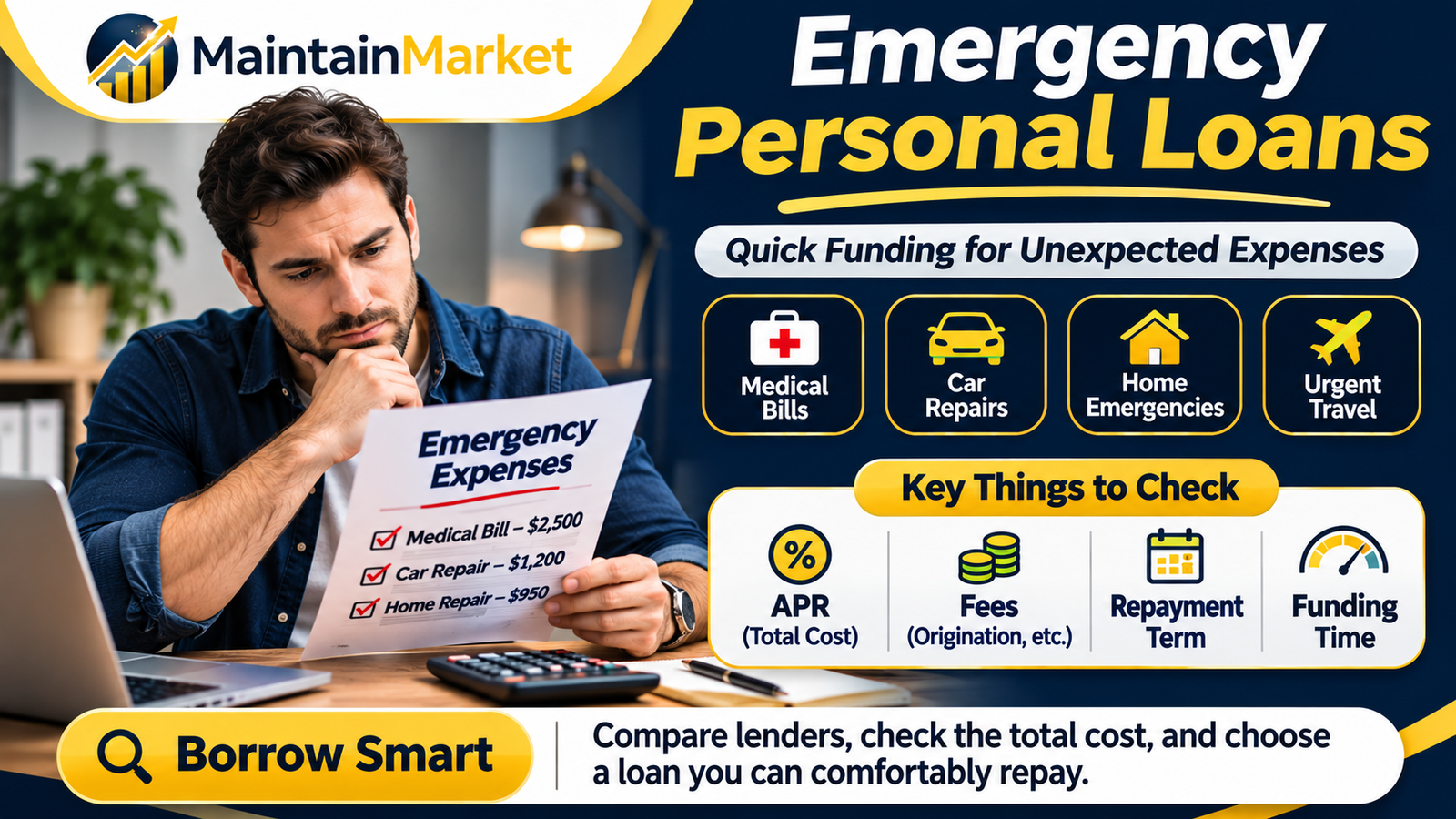
What Can You Use an Emergency Personal Loan For?
Borrowers commonly consider emergency personal loans for necessary, unexpected expenses, including:
- Medical bills: Unexpected treatment, dental procedures, prescriptions, or other healthcare costs.
- Car repairs: Essential repairs needed to commute to work or meet family responsibilities.
- Home repairs: Urgent plumbing, electrical, heating, or appliance problems.
- Emergency travel: Unexpected travel involving a family emergency.
- Temporary essential expenses: Necessary bills during a short-term income disruption.
Not every lender permits every use. Review the lender’s loan agreement and restrictions before applying.
It is generally better to borrow only for an essential expense rather than use emergency financing for discretionary purchases.
How Do Emergency Personal Loans Work?
Most emergency personal loans follow a straightforward process.
1. Check Your Financial Need
Calculate the exact amount required to handle the emergency. Include necessary expenses, but avoid borrowing extra simply because a lender offers a larger amount.
2. Compare Lenders
Compare banks, credit unions, and reputable online lenders. Look at APR, fees, repayment terms, eligibility requirements, and funding timelines.
3. Check Your Eligibility
Lenders may review:
- Credit score and credit history
- Income and employment information
- Existing monthly debt payments
- Debt-to-income ratio
- Bank account and identity information
Requirements vary by lender. Some lenders consider applicants with less-than-perfect credit, but a lower credit score may result in a higher interest rate or less favorable terms.
4. Submit Your Application
You may need to provide identification, proof of income, employment details, and bank account information.
Some lenders allow you to check potential rates through prequalification using a soft credit inquiry. A full application may involve a hard inquiry, so confirm this before proceeding.
5. Review the Loan Agreement
Before accepting, check the APR, origination fee, amount deposited into your account, monthly payment, due dates, late fees, and total repayment amount.
6. Receive Your Funds
After approval and completion of the lender’s verification process, funds may be deposited into your bank account. The timing depends on the lender, application time, and receiving bank.
How Quickly Can You Get Emergency Personal Loans?
Funding speed varies. An online application does not guarantee immediate approval or same-day deposits.
| Funding stage | What to expect |
|---|---|
| Application | May take minutes to complete |
| Initial decision | Some lenders provide decisions quickly |
| Verification | Additional documents may be required |
| Loan agreement | Funds are released after required acceptance and checks |
| Bank deposit | May take the same day or several business days |
Important: Ask the lender whether its advertised funding time means approval, loan disbursement, or money actually available in your bank account.
If you need money immediately, confirm the exact deposit timeline before relying on the loan to pay a time-sensitive bill.
What Are the Requirements for Emergency Personal Loans?
There is no single eligibility standard across all U.S. lenders. Common requirements include:
- Being at least 18 years old, subject to state law.
- Having a valid government-issued identification document.
- Providing a verifiable source of income.
- Having an eligible bank account, if required.
- Meeting the lender’s credit and debt requirements.
- Living in a state where the lender offers the loan.
Some lenders accept applications from people with fair or poor credit. However, approval, loan size, APR, and repayment terms depend on the complete application.
Do not assume that having a job or a bank account automatically qualifies you.
Can You Get Emergency Personal Loans With Bad Credit?
Yes, some lenders consider applicants with bad credit, limited credit history, or previous credit difficulties. However, qualifying may be harder, and borrowing can be more expensive.
Before applying:
- Check your credit reports for errors.
- Review your current income and monthly debt obligations.
- Compare lenders that disclose their eligibility requirements.
- Check whether prequalification is available.
- Compare the full repayment cost, not just the advertised monthly payment.
Be cautious of lenders promising guaranteed approval regardless of credit history. Legitimate lenders generally evaluate your ability to repay.
If the only available loan has an extremely high APR or an unaffordable payment, consider other options before accepting it.
How Much Do Emergency Personal Loans Cost?
The cost depends on the loan amount, APR, repayment term, and fees.
APR is particularly important because it reflects the annualized borrowing cost and can include certain fees. Comparing APRs helps you evaluate offers more accurately than comparing interest rates alone.
Example: Borrowing $5,000 for an Emergency
The following is an illustrative comparison of two fixed-rate loans. It assumes monthly payments, no additional fees, and a fully amortizing loan.
| Detail | Offer A | Offer B |
|---|---|---|
| Loan amount | $5,000 | $5,000 |
| Illustrative APR | 12% | 24% |
| Repayment term | 24 months | 24 months |
| Approx. monthly payment | $235.37 | $264.09 |
| Approx. total repayment | $5,648.88 | $6,338.16 |
| Approx. interest cost | $648.88 | $1,338.16 |
In this example, the higher-rate loan costs approximately $689 more over the repayment period.
Actual lender offers may differ, and origination fees or other charges can change the total cost.
Key lesson: A loan with a lower monthly payment is not automatically cheaper. Compare the APR and total amount you will repay.
Emergency Personal Loans vs. Payday Loans
These products are not the same.
An emergency personal loan is generally an installment loan with scheduled payments over a longer repayment period. A payday loan is typically a small, short-term loan due around the borrower’s next payday.
Payday loans can be particularly expensive.
According to the Consumer Financial Protection Bureau, a typical payday loan fee of $15 for every $100 borrowed can result in an APR of approximately 391% for a two-week loan.
| Feature | Emergency personal loan | Payday loan |
|---|---|---|
| Loan structure | Usually installment-based | Usually short-term |
| Repayment | Scheduled payments | Often due on payday |
| Cost | Depends on lender and credit profile | Can be extremely expensive |
| Loan amount | Varies by lender | Usually smaller |
| Main concern | Interest, fees, and affordability | High fees and repeated borrowing |
Do not choose a payday loan simply because it advertises quick cash. Consider less expensive alternatives first.
Alternatives to Emergency Personal Loans
Borrowing is not always the best solution. Depending on your situation, these alternatives may help you handle an urgent expense.
1. Credit Union Payday Alternative Loans
Some federal credit unions offer Payday Alternative Loans (PALs), which are designed as alternatives to high-cost payday lending.
Under the applicable federal credit union PAL program rules, eligible loans have specific limits on loan amounts, terms, fees, and borrower eligibility. For example, PAL I loans can range from $200 to $1,000 and have terms of one to six months.
Check with a participating credit union to understand its membership requirements and available products.
2. Ask Your Bank About Small-Dollar Loans
Your existing bank may offer a small-dollar loan or another short-term borrowing option. Ask about the APR, fees, repayment schedule, and eligibility requirements.
3. Negotiate Your Bill
If the emergency involves a medical bill, utility payment, rent, or another outstanding obligation, contact the provider or creditor.
Ask whether it offers:
- Payment extensions
- Hardship programs
- Reduced payment arrangements
- Interest-free installment plans
A payment arrangement may help you avoid taking on another loan.
4. Consider a Credit Card
If you already have an available credit limit, a credit card may be an option for an expense that accepts card payments.
However, check the purchase APR, promotional terms, and fees. A cash advance is different from a regular purchase and may have a separate fee and higher APR, with interest generally starting immediately.
5. Ask About an Employer Paycheck Advance
Some employers offer paycheck advances or employee assistance programs. Check whether the advance carries fees or reduces your next paycheck.
6. Use Emergency Savings
If you have accessible savings, using some of them may cost less than borrowing. Try to preserve enough money for essential expenses and upcoming bills.
7. Seek Community or Nonprofit Assistance
Depending on your circumstances, local nonprofits, community organizations, and government assistance programs may help with food, utilities, housing, or medical expenses.
How to Choose the Right Emergency Personal Loan
If borrowing is necessary, compare offers using the following checklist.
| What to compare | What to check |
|---|---|
| APR | Compare the annual percentage rate across offers |
| Origination fee | Check whether the lender deducts a fee from the loan proceeds |
| Monthly payment | Make sure the payment fits your budget |
| Repayment term | Understand how long you will remain in debt |
| Total repayment | Calculate the total amount paid over the loan term |
| Funding time | Confirm when money will actually reach your account |
| Credit inquiry | Ask whether checking rates requires a soft or hard inquiry |
| Prepayment | Check whether paying off the loan early involves a charge |
| Late payment | Understand the consequences and fees for missed payments |
Avoid choosing a lender based only on how quickly it advertises approval.
How to Avoid Emergency Loan Scams
Financial emergencies can make borrowers more vulnerable to fraudulent lenders.
Watch for these warning signs:
- A lender guarantees approval without checking your application.
- Someone demands an upfront payment to release your loan.
- You are pressured to act immediately without reviewing the agreement.
- The lender does not clearly disclose the APR and repayment terms.
- The company requests unusual payment methods, such as gift cards or cryptocurrency.
- You cannot verify the lender’s identity, address, or state licensing.
Never send money simply to secure a promised loan. Verify the lender and review the contract before sharing sensitive financial information.
The Federal Trade Commission provides guidance on identifying risky payday and car title lending practices.
Frequently Asked Questions About Emergency Personal Loans
Can I get an emergency personal loan on the same day?
Some lenders may approve applications and release funds on the same day. However, same-day funding is not guaranteed. Verification requirements, application timing, lender processing, and bank deposit times can delay access to the money.
Can I get an emergency personal loan with a 500 credit score?
Some lenders consider applicants with low credit scores, but approval is not guaranteed. You may face higher APRs, lower loan amounts, or additional eligibility requirements. Compare the full loan cost before accepting an offer.
Are emergency personal loans unsecured?
Many emergency personal loans are unsecured, meaning they do not require collateral such as a car or home. However, product structures vary, so check the lender’s agreement.
How much can I borrow for an emergency?
The amount depends on the lender, your income, credit history, existing debts, and state availability. Borrow only what you need and can reasonably repay.
Do emergency personal loans affect your credit score?
Applying may result in a hard credit inquiry, which can temporarily affect your credit score. Once you receive the loan, payment history and outstanding debt may also affect your credit profile. The impact depends on the lender’s reporting practices and your overall credit situation.
Are emergency personal loans better than payday loans?
A reasonably priced installment personal loan may be less expensive and provide a more manageable repayment schedule than a high-cost payday loan. However, compare the actual APR, fees, and repayment terms rather than assuming every personal loan is affordable.
Can unemployed people get emergency personal loans?
Some lenders may consider alternative or non-employment income, such as certain benefits or other verifiable recurring income. Requirements differ, and you must be able to demonstrate that you can repay the loan.
What should I do if I cannot repay my emergency loan?
Contact your lender as soon as possible. Ask about hardship options, payment arrangements, or other available assistance. Review your agreement and avoid taking another expensive loan just to make the current payment.
Final Thoughts
Emergency personal loans can provide financial support when an unexpected expense cannot wait. However, quick access to money should not come at the cost of an unaffordable repayment obligation.
Compare multiple lenders, understand the APR and fees, verify the funding timeline, and consider lower-cost alternatives before applying. Most importantly, borrow only what you need and have a realistic plan to repay.
Financial Disclaimer: This article is for educational purposes only and does not constitute financial, legal, or lending advice. Loan availability, interest rates, eligibility requirements, and lending regulations vary by lender and state. Review all loan documents and consult a qualified professional if you need help evaluating a borrowing decision.
Sources and Further Reading
- Consumer Financial Protection Bureau – Payday Loan Costs and Alternatives
- MyCreditUnion.gov – Payday Alternative Loans
- Consumer.gov – Payday Loans and Cash Advances
- Federal Trade Commission – Payday and Car Title Loans
Editorial Review: Review lender-specific claims, state lending restrictions, and product terms before publication. Do not present illustrative loan calculations as actual lender offers.