
Personal loan interest rates determine how much you pay to borrow money, but the rate you receive can vary significantly depending on your credit profile, income, existing debt, loan amount, repayment term, and lender. In the United States, lenders may advertise different starting rates, but not every borrower qualifies for those offers.
Before accepting a personal loan, it is important to understand the difference between an interest rate and an annual percentage rate (APR), compare the total borrowing cost, and check whether the loan includes origination fees or other charges.
In this guide, you’ll learn how personal loan interest rates work, what affects your APR, how much interest you could pay, and how to compare offers before borrowing.
Quick Answer: What Are Personal Loan Interest Rates?
Personal loan interest rates are the costs lenders charge borrowers for using borrowed money. They are generally expressed as an annual percentage.
For unsecured personal loans, the rate you receive depends on the lender and your financial profile. A borrower with strong credit and manageable debt may qualify for a lower rate than someone with missed payments, high existing debt, or limited credit history.
For context, the Bankrate Monitor unsecured personal loan index was 12.48% as of November 18. This is a national benchmark based on a defined borrower profile, not a guaranteed rate or an offer available to every applicant.
The Federal Reserve also publishes commercial-bank personal loan rate data. Its reported average for 24-month personal loans was 11.86% in the second quarter. This measure uses a different methodology, so it should not be directly compared with the Bankrate index.
Sources: Bankrate Monitor data via FRED and Federal Reserve Consumer Credit Report.
Important: Always compare actual loan offers. A national average is useful for context, but it does not tell you the rate you will personally receive.
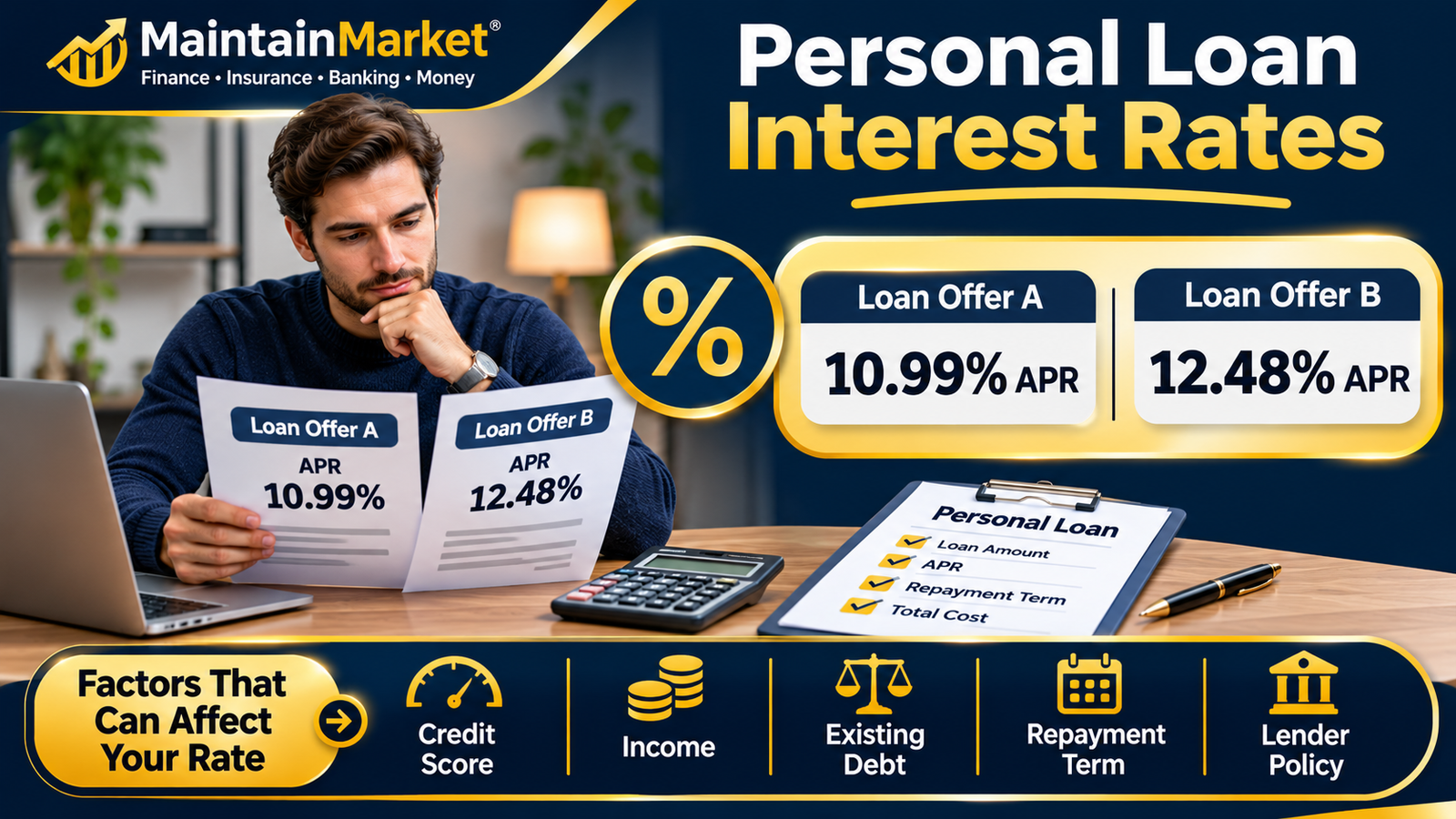
1. What Is the Difference Between a Personal Loan Interest Rate and APR?
Interest rate and annual percentage rate (APR) are related, but they are not identical.
The interest rate represents the cost of borrowing the principal. APR provides a broader measure of the annual borrowing cost and generally reflects the interest rate plus certain loan fees.
| Feature | Interest Rate | APR |
|---|---|---|
| What it measures | Cost of borrowing the principal | Broader annual borrowing cost |
| Includes interest | Yes | Yes |
| Includes certain fees | Not necessarily | Generally includes applicable fees |
| Useful for | Understanding the interest charged | Comparing loan costs |
For example, imagine two lenders offer the following loans:
| Detail | Lender A | Lender B |
|---|---|---|
| Advertised interest rate | 10.00% | 9.50% |
| APR | 10.00% | 11.00% |
| Loan amount | $10,000 | $10,000 |
Although Lender B advertises a lower interest rate, its APR is higher in this illustration because of additional loan costs.
This is why you should compare APRs and review the fee disclosures rather than choosing a loan based only on its advertised interest rate.
2. What Is the Average Personal Loan Interest Rate?
There is no single average that represents every personal loan borrower in the United States.
Rates vary based on:
- Credit score and credit history
- Lender type
- Loan amount
- Repayment term
- Income and existing debt
- Whether the loan is secured or unsecured
- Origination fees and other loan terms
The Bankrate Monitor unsecured personal loan index provides one useful benchmark. Its methodology uses a specific borrower profile, including a 700 FICO score, a $5,000 loan amount, and a three-year repayment term.
The Federal Reserve publishes another measure based on the most common rates charged by commercial banks for 24-month personal loans.
These figures are not interchangeable. They use different borrower assumptions, lender samples, and measurement methods.
Why Do Advertised Rates Differ From the Rate You Receive?
A lender may advertise a starting APR to attract applicants who meet its strongest eligibility criteria.
Your actual offer could be higher because:
- Your credit history differs from the lender’s preferred profile.
- Your income or debt obligations affect its assessment.
- The requested loan amount or repayment term changes the pricing.
- The lender applies an origination fee.
- You do not qualify for a promotional or relationship-based discount.
Always review the personalized offer before agreeing to borrow.
3. What Factors Affect Personal Loan Interest Rates?
Lenders evaluate several aspects of an application when deciding whether to approve a loan and what rate to offer.
1. Credit Score
Your credit score is one factor that may influence your personal loan APR.
A stronger credit profile may help you qualify for more competitive offers. A lower score or limited credit history may result in a higher rate or fewer available options.
However, lenders do not all use the same scoring model or approval criteria. A particular credit score does not guarantee a specific interest rate.
2. Payment History
Your payment history shows how consistently you have managed previous credit obligations.
Recent late payments, defaults, or accounts in collections may affect how a lender evaluates your application.
Review your credit reports before applying so you can identify inaccurate information.
3. Debt-to-Income Ratio
Your debt-to-income ratio (DTI) compares your monthly debt payments with your gross monthly income.
Formula:
DTI = (Total Monthly Debt Payments ÷ Gross Monthly Income) × 100
For example:
| Financial detail | Amount |
|---|---|
| Gross monthly income | $5,000 |
| Monthly debt payments | $1,500 |
| DTI | 30% |
A lender may consider your DTI when evaluating whether you can manage another monthly payment.
There is no single DTI threshold that applies to every personal loan lender.
4. Loan Amount
The amount you request may affect the lender’s pricing and eligibility decision.
A larger loan creates a greater repayment obligation. The lender may consider whether your income, credit profile, and existing financial commitments support the requested amount.
Borrow only what you reasonably need and can afford to repay.
5. Repayment Term
The repayment term is the length of time you have to repay the loan.
A longer term may reduce the required monthly payment, but it can increase the total interest paid because you borrow for a longer period.
A shorter term may involve a higher monthly payment but could reduce the total interest cost.
6. Income and Employment Stability
Lenders may review your income and employment information to assess your ability to repay.
Depending on the lender, acceptable income sources may include employment, self-employment, retirement income, or other eligible sources.
A high income alone does not guarantee a low APR or loan approval.
7. Lender Policies
Banks, credit unions, and online lenders use different underwriting and pricing methods.
Two lenders may offer different APRs to the same applicant. This is why comparing multiple offers can be worthwhile.
4. How Much Interest Will You Pay on a Personal Loan?
The total interest depends on the principal, APR, repayment term, and payment schedule.
Consider this illustrative example:
Loan amount: $10,000
APR: 12.48%
Repayment term: 36 months
| Detail | Approximate amount |
|---|---|
| Original loan amount | $10,000 |
| Monthly payment | $334 |
| Total of payments | $12,038 |
| Total interest | $2,038 |
These figures are estimates using a fixed-rate amortizing loan, monthly payments, and no additional fees. Actual lender calculations may differ.
Why Does the Repayment Term Matter?
Consider the same loan amount and APR with different repayment periods.
A longer term generally spreads the payments over more months. This can make each payment smaller, but it may increase the total interest cost.
A shorter term generally means higher monthly payments and less time for interest to accumulate.
Do not select a longer repayment term solely because the monthly payment looks more affordable. Compare the total repayment amount as well.
5. Fixed vs. Variable Personal Loan Interest Rates
Personal loans may have fixed or variable interest rates, depending on the product and lender.
| Feature | Fixed Interest Rate | Variable Interest Rate |
|---|---|---|
| Rate | Generally stays the same | Can change under the loan agreement |
| Monthly payment | Usually predictable | May change |
| Budget planning | Easier | Requires flexibility |
| Rate risk | Less exposure to future rate increases | Payments or costs may rise |
Fixed-Rate Personal Loans
A fixed-rate personal loan keeps the interest rate unchanged throughout the agreed loan term.
This can make budgeting easier because the scheduled principal-and-interest payment is generally predictable.
Variable-Rate Personal Loans
A variable-rate loan may change according to a benchmark or index described in the loan agreement.
If the applicable rate increases, your borrowing costs may rise. Check how frequently the rate can change, whether caps apply, and how payment adjustments work.
Always read the loan agreement before accepting a variable-rate offer.
6. How to Get a Lower Personal Loan Interest Rate
You cannot control every part of a lender’s pricing decision, but you can take practical steps to prepare before applying.
1. Review Your Credit Reports
Check your credit reports for incorrect account details, unfamiliar activity, and inaccurate payment information.
You can access your reports through AnnualCreditReport.com.
If you find an error, follow the appropriate dispute process.
2. Pay Down Existing Debt
Reducing outstanding debt may improve your overall financial position and lower your debt-to-income ratio if monthly debt payments decrease.
Avoid taking on new debt simply to qualify for a personal loan.
3. Compare Multiple Lenders
Consider offers from:
- Banks
- Credit unions
- Online personal loan lenders
Compare APR, loan amount, repayment term, origination fees, late fees, and prepayment conditions.
4. Check Prequalification Options
Some lenders allow you to check potential rates through prequalification using a soft credit inquiry.
A soft inquiry generally does not affect your credit score. However, a full application may involve a hard inquiry.
Prequalification is not a guarantee of approval or the final APR.
5. Choose a Suitable Repayment Term
Compare the monthly payment and total repayment amount for different loan terms.
Choose a payment that fits your budget without unnecessarily extending the borrowing period.
6. Avoid Applying Without Comparing Offers
Submitting several full applications can result in multiple hard inquiries.
Compare eligibility requirements and use prequalification tools where available before submitting formal applications.
7. Consider a Credit Union
Credit unions may offer competitive personal loan products to eligible members.
Membership requirements, rates, fees, and underwriting standards vary. Compare the complete loan terms rather than assuming a credit union will always be cheaper.
7. Personal Loan Interest Rates by Lender Type
Different types of financial institutions offer personal loans, but no universal rate ranking applies to every borrower.
| Lender type | Potential advantages | What to compare |
|---|---|---|
| Banks | Established lending products and existing customer relationships | Eligibility, APR, fees and repayment terms |
| Credit unions | May offer competitive member loan options | Membership eligibility, rates and fees |
| Online lenders | Convenient applications and rate comparison | APR, origination fees and customer support |
| Peer-to-peer platforms | Alternative lending marketplace | Investor funding terms, fees and APR |
A lender’s category does not guarantee the lowest rate.
8. What Fees Should You Check Before Taking a Personal Loan?
The interest rate is only one part of the cost.
Review the following fees and conditions before signing a loan agreement.
Origination Fee
Some lenders charge an origination fee for processing the loan.
It may be deducted from the loan proceeds or added to the borrowing cost, depending on the agreement.
For example, if you are approved for a $10,000 loan with a 5% origination fee deducted upfront, you would receive $9,500 before any other deductions.
You may still be required to repay the full $10,000 principal.
Late Payment Fee
If you miss a scheduled payment, the lender may charge a late fee under the loan agreement.
Late payments may also affect your credit history.
Prepayment Penalty
Some loan agreements may include charges for paying off the loan early. Others do not.
Check the contract to understand whether you can make extra payments or repay the balance ahead of schedule without a penalty.
Other Charges
Review any additional fees listed in the loan agreement, including returned-payment or other account-related charges.
9. Personal Loan vs. Credit Card: Which Has a Lower Interest Rate?
A personal loan and a credit card work differently.
A personal loan generally provides a lump sum with scheduled repayments. A credit card provides a revolving credit line that can be used repeatedly within the available limit.
| Feature | Personal Loan | Credit Card |
|---|---|---|
| Borrowing structure | Lump sum | Revolving credit |
| Repayment | Scheduled installments | Minimum payment and additional balance payments |
| Interest | Often fixed, but variable products exist | Depends on card terms |
| Loan amount | Approved loan amount | Available credit limit |
| Best comparison | APR and total repayment | APR, fees and repayment terms |
A personal loan may cost less than carrying a high-interest credit card balance, but this is not guaranteed.
Compare the actual APRs, fees, repayment periods, and total costs before deciding.
10. What to Check Before Accepting a Personal Loan Offer
Before signing, review these details carefully:
- The approved loan amount
- The interest rate and APR
- Whether the rate is fixed or variable
- The repayment period
- The monthly payment
- The origination fee
- The amount you will actually receive
- The total repayment amount
- Late-payment charges
- Prepayment conditions
- Whether the lender reports payments to credit bureaus
Do not accept an offer based only on the advertised monthly payment.
Frequently Asked Questions About Personal Loan Interest Rates
1. What is a good interest rate for a personal loan?
A good personal loan rate depends on current market conditions, your credit profile, the lender, the loan amount, and the repayment term. Compare personalized APR offers rather than relying on a single national average.
2. What is the average personal loan interest rate in the USA?
Different sources publish different benchmarks. The Bankrate Monitor unsecured personal loan index was 12.48% as of November 18. The Federal Reserve’s commercial-bank 24-month personal loan rate was 11.86% in the second quarter. These measures use different methodologies and should not be treated as identical.
3. Can I get a personal loan with a low credit score?
Some lenders consider applicants with lower credit scores, but rates may be higher and eligibility may be more restrictive. Compare the APR and total cost carefully before accepting an offer.
4. Does checking personal loan rates affect my credit score?
Many lenders offer prequalification using a soft inquiry, which generally does not affect your credit score. A full application may trigger a hard inquiry. Confirm the process with the lender.
5. Are personal loan interest rates fixed or variable?
Both types exist. Many personal loans have fixed rates, but variable-rate products may also be available. Check the loan agreement to understand how the rate can change.
6. Does a longer loan term mean a lower interest rate?
Not necessarily. A longer term may reduce your monthly payment, but it can increase the total interest you pay. The APR depends on the lender’s pricing and your application.
7. Can I negotiate my personal loan interest rate?
You can ask a lender whether it can offer a more competitive rate or whether discounts are available. However, lenders are not required to negotiate, and the final offer depends on their policies and your application.
8. What credit score do I need to qualify for a personal loan?
There is no universal minimum credit score across all personal loan lenders. Each lender has its own eligibility criteria and may consider income, debt, payment history, and other information.
9. Do personal loans have origination fees?
Some lenders charge origination fees, while others do not. Review the APR and loan disclosures to understand how any fee affects the amount you receive and the total cost.
10. Is it better to choose a lower monthly payment or a lower total interest cost?
A lower monthly payment can make a loan easier to manage, but it may involve a longer repayment term and higher total interest. Choose a payment that fits your budget while considering the total borrowing cost.
11. Can I pay off a personal loan early?
Some lenders allow early repayment without a penalty, while others may have specific conditions. Check the loan agreement before making extra payments or paying off the balance.
12. Are credit union personal loan rates lower than bank rates?
Credit unions may offer competitive rates, but the result depends on the lender, membership requirements, and your credit profile. Compare actual APR offers from both types of institutions.
Final Thoughts: Compare APRs Before Choosing a Personal Loan
Personal loan interest rates can make a substantial difference to the total amount you repay.
Before borrowing, compare APRs from multiple lenders, review origination fees, understand the repayment term, and calculate the total cost of the loan.
A low advertised rate does not guarantee that you will qualify for it. Focus on the personalized offer and make sure the monthly payment fits your financial situation.
Borrow only what you need, understand the loan agreement, and avoid choosing a loan based solely on a low monthly payment.
Disclaimer: This article is for general educational purposes for U.S. consumers and is not individualized financial advice. Personal loan rates, fees, eligibility criteria, and repayment terms vary by lender and borrower. Review the lender’s current disclosures and loan agreement before borrowing.
Sources and References
- Federal Reserve – Consumer Credit, G.19
- FRED – Bankrate Monitor Unsecured Personal Loan Rate
- AnnualCreditReport.com – Official Free Credit Reports
- Consumer Financial Protection Bureau
Editorial Review: Reviewed for U.S. personal loan terminology, APR and interest-rate distinctions, rate benchmark context, repayment examples, lender comparisons, and consumer borrowing considerations.