
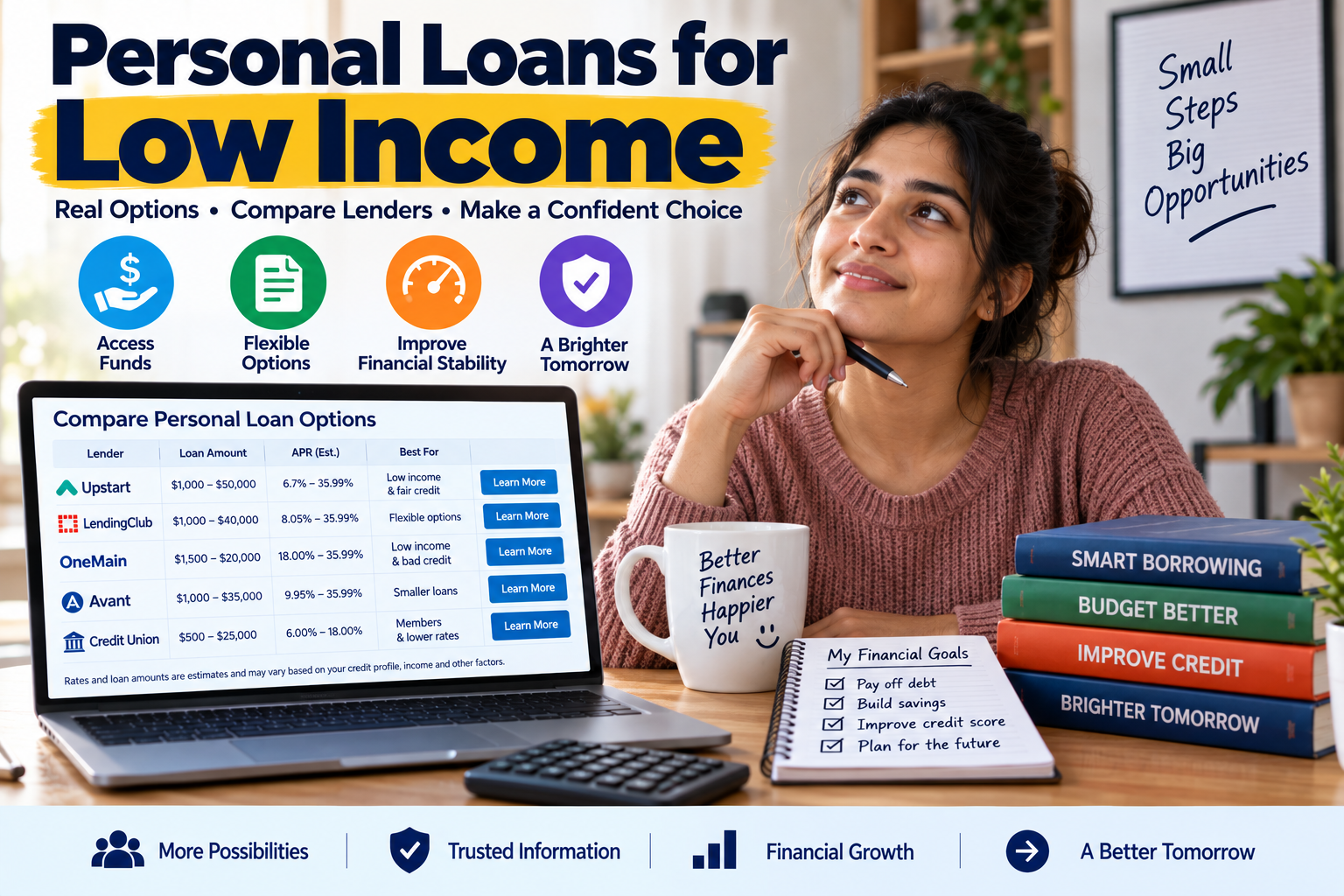
Finding personal loans for low income borrowers can be challenging, especially when your monthly income makes it harder to meet a lender’s requirements. However, having a lower income does not automatically mean you cannot qualify for a personal loan.
Lenders may consider several factors, including your income, credit history, existing debts, debt-to-income ratio, employment, requested loan amount, and ability to repay. The goal should not simply be finding a lender willing to approve you—it should be finding borrowing that you can realistically afford.
Quick Answer: Can You Get a Personal Loan With Low Income?
Yes, you may be able to get a personal loan with low income.
There is no single income level that automatically qualifies or disqualifies everyone. Different lenders have different eligibility criteria, and some may consider your overall financial profile rather than income alone.
If your income is limited but stable, your existing debts are manageable, and the requested loan amount is reasonable, you may have borrowing options.
However, low-income borrowers should pay particular attention to the APR, fees, monthly payment, and total repayment cost before accepting an offer.
What Are Personal Loans for Low Income?
A personal loan is generally an installment loan that provides a lump sum that you repay through regular payments over a specified period.
Depending on the lender, borrowers may use personal loans for:
- Emergency expenses
- Car repairs
- Home repairs
- Medical expenses
- Moving expenses
- Debt consolidation
- Necessary large purchases
- Unexpected bills
The important consideration is whether the new payment fits comfortably into your monthly budget.
10 Smart Options for Personal Loans With Low Income
1. Online Personal Loan Lenders
Online lenders can be an option for borrowers whose income may not meet the requirements of some traditional banks.
Some lenders evaluate several aspects of an applicant’s financial profile, including income, credit history, employment and existing debt.
Before accepting an online personal loan, compare:
- APR
- Loan amount
- Monthly payment
- Origination fee
- Repayment period
- Late-payment fees
- Prepayment terms
- Funding time
Don’t choose a lender simply because it advertises fast approval or loans for low-income borrowers.
2. Credit Union Personal Loans
Credit unions can be another option worth exploring.
If you already belong to a credit union, ask about its personal-loan products and eligibility requirements. Some credit unions also offer smaller-dollar loan products that may provide an alternative to expensive short-term borrowing.
Compare the credit union’s APR and fees with other available offers before making a decision.
3. Apply for a Smaller Loan Amount
If you have limited income, borrowing less may help keep the monthly payment manageable.
For example, if you need $2,000 for an emergency repair, there may be little reason to borrow $7,000 simply because a lender offers that amount.
A smaller loan also means you are taking on less debt.
Borrow only what you actually need and can afford to repay.
4. Consider a Co-Borrower
Some lenders allow applications with a co-borrower.
A co-borrower shares responsibility for the loan and can potentially strengthen an application if their income or credit profile is stronger.
However, both borrowers are generally responsible for repayment according to the loan agreement.
Before applying together, make sure both people understand the monthly payment, total cost and consequences of missed payments.
5. Consider a Qualified Cosigner
A cosigner may also be an option with certain lenders.
A cosigner agrees to take responsibility for the debt if the primary borrower fails to repay it.
A financially stronger cosigner could potentially improve the application’s chances or help the borrower access better terms.
But cosigning is a serious financial commitment. Missed payments can affect the cosigner’s finances and credit history.
6. Look at Secured Loan Options
A secured loan is backed by collateral.
Because the lender has an asset securing the loan, this can provide an alternative for borrowers who have difficulty qualifying for certain unsecured loans.
However, there is an important risk: if you fail to repay the loan, the collateral may be at risk under the terms of the agreement.
Never use an important asset as collateral unless you fully understand the consequences and are confident you can make the payments.
7. Compare Prequalified Offers
If a lender offers prequalification, you may be able to see potential loan terms before submitting a full application.
Some lenders use a soft credit inquiry during prequalification, although policies vary.
Check the lender’s terms to determine whether the initial inquiry is soft or hard.
When comparing offers, look beyond the monthly payment and examine the:
- APR
- Fees
- Loan term
- Total repayment
- Loan amount
- Funding conditions
8. Improve Your Credit Before Applying
If you don’t need the money immediately, waiting can sometimes be the more affordable choice.
Use the time to improve your financial profile by:
- Paying bills on time
- Reducing credit card balances
- Paying down existing debt
- Checking your credit reports for errors
- Avoiding unnecessary new credit applications
- Building emergency savings
A stronger credit profile may give you access to more lenders and potentially better terms.
9. Consider a Smaller-Dollar Credit Union Program
Some credit unions offer products specifically designed to provide smaller amounts of credit.
These may be worth comparing when you need a relatively small amount and want an alternative to high-cost short-term loans.
Eligibility, loan limits and fees vary, so review the specific product before applying.
10. Explore Alternatives Before Borrowing
Sometimes the best option is not another loan.
Depending on why you need the money, you could investigate:
- Payment plans
- Employer assistance
- Nonprofit assistance programs
- Credit counseling
- Existing emergency savings
- Negotiating directly with the company you owe
For example, if you’re dealing with a medical bill, ask the provider about a payment plan before taking out a high-cost personal loan.
What Income Counts When Applying for a Personal Loan?
Many borrowers assume that only a traditional full-time salary qualifies as income.
That isn’t necessarily true.
Depending on the lender and applicable requirements, income can potentially include:
- Full-time employment
- Part-time employment
- Self-employment
- Retirement income
- Pension income
- Certain government benefits
- Other qualifying recurring income
Federal consumer-protection rules generally prohibit lenders from refusing to consider certain sources of income solely because of where the income comes from.
However, lenders can consider the amount of income and whether they reasonably expect it to continue.
Always check the lender’s current eligibility requirements.
How Much Income Do You Need for a Personal Loan?
There is no universal minimum income requirement for all personal loans.
Each lender establishes its own requirements.
A lender may consider your income together with:
- Existing monthly debt
- Credit history
- Loan amount
- Employment
- Housing costs
- Debt-to-income ratio
- Repayment ability
For example, consider two borrowers earning $2,500 per month.
Borrower A
- Monthly income: $2,500
- Existing debt payments: $300
Borrower B
- Monthly income: $2,500
- Existing debt payments: $1,500
Although both earn the same amount, Borrower A has considerably more income available after existing debt payments.
That’s why lenders generally look beyond income alone.
Understanding Debt-to-Income Ratio
Your debt-to-income ratio, or DTI, compares your monthly debt payments with your gross monthly income.
The basic calculation is:
DTI = Monthly Debt Payments ÷ Gross Monthly Income × 100
If you have $600 in monthly debt payments and earn $2,500 in gross monthly income:
$600 ÷ $2,500 × 100 = 24% DTI
Lenders can use different DTI standards, so there isn’t one percentage that guarantees approval.
Generally, having less existing debt relative to your income can make it easier to demonstrate that you can handle another monthly payment.
Can You Get a Personal Loan With Low Income and Bad Credit?
It may be possible, but the combination of low income and poor credit can significantly limit your options.
You may encounter:
- Higher APRs
- Smaller loan amounts
- Higher fees
- More documentation requirements
- Stricter eligibility criteria
- Shorter repayment periods
If you are in this situation, don’t focus solely on finding a lender that says it accepts bad credit.
Focus on whether the total cost of the loan is affordable.
You can also read our guide to personal loans for bad credit in the USA.
Can You Get a Personal Loan Without a Job?
Being unemployed does not necessarily mean you have no qualifying income.
Depending on the lender, income could come from sources other than traditional employment.
However, lenders generally need to assess your ability to repay the loan. If you have no income or insufficient income, qualifying for an affordable personal loan can be very difficult.
Be cautious of anyone promising guaranteed approval without reviewing your financial situation.
How to Improve Your Chances of Approval
Check Your Credit Reports
Review your credit reports before applying.
Look for inaccurate information that could affect your credit profile.
Reduce Existing Debt
Paying down existing debt can reduce your monthly obligations and potentially improve your overall financial position.
Request Only What You Need
A smaller loan can mean a smaller monthly obligation.
Avoid borrowing extra money simply because you qualify for it.
Document Your Income
Keep relevant income documentation available, such as pay stubs, bank statements or other records requested by the lender.
Compare Multiple Lenders
Different lenders can offer very different APRs and fees to borrowers with similar financial profiles.
Shopping around can help you find a more suitable offer.
Consider a Co-Borrower
If permitted, a qualified co-borrower may strengthen an application.
Both parties should understand their responsibilities before applying.
What Documents Might a Lender Request?
Depending on the lender, you may need:
- Government-issued identification
- Social Security number
- Proof of income
- Employment information
- Bank-account information
- Address
- Housing-cost information
- Existing debt information
Self-employed borrowers may need to provide additional financial documentation.
Requirements vary between lenders.
How Much Should You Borrow With a Low Income?
Don’t determine your loan amount based only on what a lender says you qualify for.
Instead, calculate what your budget can handle.
A simple approach is:
Monthly income − essential expenses − existing debt payments − new loan payment = remaining cash flow
If the new loan leaves you unable to cover essential expenses or handle an emergency, the loan may be too expensive.
Remember:
Loan approval does not automatically mean the loan is affordable.
Example: Choosing Between Two Loan Offers
Suppose you need $3,000.
Offer A
- Lower APR
- $3,000 loan
- Moderate monthly payment
- Lower overall borrowing cost
Offer B
- Higher APR
- $3,000 loan
- Lower monthly payment because of a longer repayment period
- Higher total repayment
Offer B may initially look attractive because of the lower monthly payment.
But if you can comfortably afford Offer A, its lower overall borrowing cost could make it the better financial choice.
Always compare the total amount you will repay, not just the monthly payment.
What Should You Compare Before Accepting a Loan?
| Factor | Why It Matters |
|---|---|
| APR | Shows the cost of borrowing and helps compare offers |
| Loan amount | Determines how much debt you take on |
| Loan term | Determines how long you make payments |
| Monthly payment | Shows the impact on your budget |
| Origination fee | Can increase the cost of the loan |
| Late fee | Adds cost if you miss payments |
| Prepayment terms | Important if you plan to repay early |
| Funding time | Matters if the expense is urgent |
| Total repayment | Shows the overall borrowing cost |
Be Careful With Payday Loans
Low-income borrowers may encounter payday loans when searching for fast financing.
These loans can be easy to access in some situations, but they can also carry extremely high costs.
Before considering one, compare its total repayment cost with alternatives such as credit-union products, payment plans or other forms of financing.
A loan that is easy to obtain can still be very expensive.
How to Spot a Personal Loan Scam
Be especially cautious if a company promises:
- Guaranteed approval
- “No matter your income”
- “Everyone qualifies”
- “No credit check”
- A loan without reviewing your financial information
- Approval in exchange for an upfront payment
The FTC warns consumers about advance-fee loan scams, where scammers promise loans and then demand money before providing the funds.
Never assume that a company is legitimate simply because it has a professional-looking website or advertises heavily online.
Verify the lender and carefully review the loan agreement before providing sensitive information or sending money.
What If a Lender Denies Your Application?
Don’t immediately submit applications to dozens of other lenders.
First, determine why you were denied.
Potential reasons may include:
- Insufficient income
- High debt-to-income ratio
- Poor credit history
- Excessive existing debt
- Recent credit applications
- Requested loan amount
- Insufficient employment history
Once you know the reason, you can work on the specific issue before applying again.
Personal Loan Alternatives for Low-Income Borrowers
A personal loan isn’t always the best solution.
Payment Plans
If you need money for a specific bill, ask the company you owe whether it offers a payment plan.
Credit Union Products
A credit union may have smaller-dollar lending options worth considering.
Nonprofit Assistance
Depending on your location and circumstances, nonprofit or community assistance may be available for certain essential expenses.
Credit Counseling
A nonprofit credit counselor can help you review your debts and budget and identify potential repayment strategies.
Emergency Savings
If the expense isn’t urgent, using savings rather than high-interest debt can potentially save significant money.
Frequently Asked Questions
Q1. Can I get a personal loan with low income?
Yes, it may be possible. Lenders can consider income along with credit history, existing debt, requested loan amount and repayment ability. Requirements vary significantly between lenders.
Q2. What is the minimum income required for a personal loan?
There is no universal minimum income requirement. Each lender establishes its own criteria and may evaluate your income alongside your credit history, debt obligations and other financial information.
Q3. Can I get a personal loan with low income and bad credit?
You may qualify with certain lenders, but your options may be more limited and expensive. Consider smaller loan amounts, credit unions, secured financing or a qualified co-borrower when appropriate.
Q4. Can I get a personal loan if I am unemployed?
Possibly, if you have another qualifying and sufficiently reliable source of income. Without any income, getting an affordable personal loan can be considerably more difficult.
Q5. Can Social Security or other government benefits count as income?
Depending on the lender, certain government benefits may qualify as income. Federal law generally prevents lenders from refusing to consider certain income sources solely because they come from public assistance. Lenders can still consider the amount and likelihood that the income will continue.
Q6. Can I get a personal loan with a $1,000 monthly income?
It may be possible with some lenders, but income alone doesn’t determine approval. Your existing debt, credit history, requested loan amount and other financial information can also affect eligibility.
Q7. How can I get a personal loan with low income?
Start by calculating how much you can afford, checking your credit, comparing lenders and requesting only the amount you need. If permitted, a qualified co-borrower may also provide another option.
Q8. Are personal loans for low-income borrowers expensive?
They can be, particularly when the borrower also has poor credit or significant existing debt. Compare APR, fees and total repayment costs carefully before accepting an offer.
Q9. Are no-income-check personal loans safe?
Be cautious. A lender that promises guaranteed approval without assessing your ability to repay can be a warning sign. Never pay an upfront fee simply because someone promises to guarantee a loan.
Q10. Does applying for multiple personal loans hurt your credit?
It depends on the lender’s process. Some lenders may use a soft inquiry for prequalification, while a formal application can result in a hard inquiry. Check the lender’s terms before applying.
Final Takeaway
Finding personal loans for low income borrowers is possible in some circumstances, but getting approved should not be your only objective.
Start by calculating what you can realistically afford, reviewing your credit, checking your debt-to-income ratio and comparing multiple loan offers. Credit unions, smaller loan amounts, co-borrowers and alternative financing may also be worth considering.
Most importantly, compare the APR, fees, monthly payment and total repayment cost before signing a loan agreement.
If the only loan available would put your essential expenses at risk, borrowing less—or waiting and improving your financial position—may be the smarter choice.
Why Maintain Market Is Different
Maintain Market doesn’t believe that the easiest loan to get is automatically the best loan.
For borrowers with limited income, the more important questions are whether the loan is affordable, what it will actually cost and whether a lower-cost alternative exists.
Our goal is to explain personal loans, credit cards, debt consolidation and other financial products in straightforward language so readers can make more informed financial decisions.
References
Consumer Financial Protection Bureau — What Is a Personal Installment Loan?
Consumer Financial Protection Bureau — Personal Loan Fees
Consumer Financial Protection Bureau — Debt-to-Income Ratio
Consumer Financial Protection Bureau — Income and Lending Decisions
Consumer Financial Protection Bureau — What to Do if Your Credit Application Is Denied
Federal Trade Commission — What to Know About Advance-Fee Loans
Federal Trade Commission — Loans and Mortgages Consumer Guidance
Editorial Review
This article is intended for general educational purposes and does not constitute financial advice. Personal-loan eligibility, APRs, fees, loan amounts and lender requirements vary by lender and state and can change over time. Review the lender’s current disclosures and loan agreement before borrowing.
Recommended Reads
Personal Loans for Bad Credit in the USA