
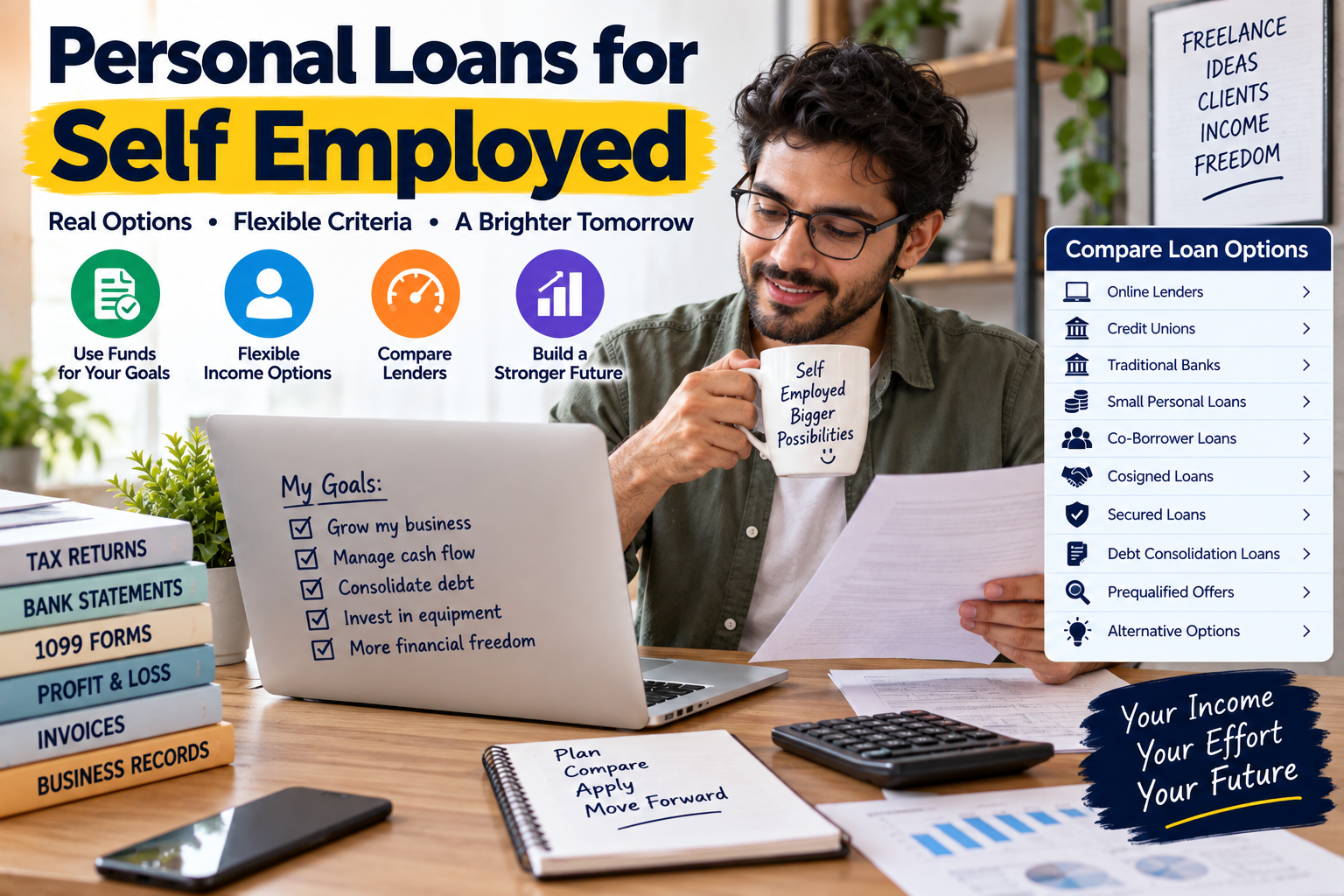
Finding personal loans for self employed borrowers can be more complicated than applying as a traditional W-2 employee. Instead of recent pay stubs, lenders may ask self-employed applicants for tax returns, 1099 forms, bank statements, profit-and-loss statements, or other documents that demonstrate income and repayment ability.
The good news is that being self-employed does not automatically prevent you from getting a personal loan. The key is being prepared to document your income and choosing a loan that fits your financial situation.
Quick Answer: Can Self-Employed People Get Personal Loans?
Yes. Self-employed people can qualify for personal loans.
Lenders generally care about whether you have sufficient, verifiable income and the ability to repay the loan—not simply whether you receive a traditional paycheck.
For self-employed borrowers, the income-verification process may look different. Instead of W-2s and pay stubs, a lender may request tax returns, 1099s, bank statements or other financial records.
Requirements vary by lender, so check the lender’s current documentation requirements before applying.
10 Personal Loan Options for Self-Employed Borrowers
There is no single personal loan that is best for every freelancer, contractor, business owner or independent professional. The right option depends on your income stability, credit profile, existing debt, loan amount and documentation.
| Loan Option | Best For | Typical Income Documentation | Main Advantage | Main Consideration |
|---|---|---|---|---|
| Online Personal Loan | Freelancers and independent professionals | Tax returns, 1099s, bank statements | Convenient online application | Rates vary significantly |
| Credit Union Personal Loan | Members seeking competitive financing | Tax returns, bank statements or other proof | May offer personalized service | Membership may be required |
| Bank Personal Loan | Established self-employed borrowers | Tax returns and financial records | Traditional banking relationship | Requirements can be stricter |
| Small Personal Loan | Borrowers needing a smaller amount | Income documentation requested by lender | Smaller debt obligation | Fees can have a larger impact |
| Co-Borrower Loan | Applicants with variable income | Documents from both borrowers | Combined financial profile may help | Both borrowers share responsibility |
| Cosigned Loan | Borrowers needing stronger credit support | Applicant and cosigner documentation | May strengthen application | Cosigner takes on financial responsibility |
| Secured Personal Loan | Borrowers with qualifying collateral | Income plus collateral documentation | Collateral may support qualification | Asset can be at risk |
| Prequalified Personal Loan | Borrowers comparing offers | Basic financial information initially | May allow rate comparison before full application | Prequalification doesn’t guarantee approval |
| Debt-Consolidation Loan | Self-employed borrowers managing multiple debts | Income and debt documentation | Combines eligible debts into one payment | Only useful if new terms make financial sense |
| Alternative to Borrowing | Borrowers who can delay the expense | Not applicable | Avoids new interest and debt | May not work for urgent expenses |
What Documents Do Self-Employed Borrowers Need?
This is one of the biggest differences between applying as a self-employed borrower and applying as a traditional employee.
A lender may request some combination of:
- Recent federal tax returns
- Business tax returns
- 1099 forms
- Bank statements
- Profit-and-loss statements
- Business records
- Invoices or contracts
- Government-issued identification
- Proof of address
- Social Security number
The exact requirements depend on the lender and your business structure.
Upstart, for example, says self-employed applicants may be asked for tax returns, profit-and-loss statements, 1099 forms or bank statements showing business income.
Some lenders may also request more than one year’s financial history when evaluating self-employment income.
Do You Need Pay Stubs If You’re Self-Employed?
Not necessarily.
Self-employed borrowers often don’t receive traditional pay stubs or W-2s.
Instead, lenders may use other documentation to verify income, such as:
- Tax returns
- 1099 forms
- Bank statements
- Profit-and-loss statements
- Business financial records
This is why organizing your financial documents before applying can make the process easier.
The CFPB notes that self-employed or irregular-income borrowers may need additional documentation, with requirements varying by lender and individual circumstances.
How Do Lenders Calculate Self-Employed Income?
Self-employed income can be more complicated than a simple annual salary.
For example, a freelancer may receive:
- $4,000 in January
- $7,000 in February
- $2,500 in March
- $8,000 in April
A lender may therefore examine your financial records to understand the consistency and reliability of your income rather than simply looking at one month’s deposits.
The lender may also distinguish between business revenue and the income actually available to you personally.
This is one reason accurate tax returns and organized financial records can be important.
Does Being Self-Employed Make It Harder to Get a Personal Loan?
It can make documentation more complicated, but self-employment itself does not automatically prevent approval.
A lender may be more interested in whether your income is:
- Verifiable
- Sufficient
- Consistent enough to support repayment
- Reasonably expected to continue
Federal lending rules recognize self-employment income as a potential source of income when evaluating repayment ability in applicable credit transactions.
The practical challenge is often proving the income, not simply being self-employed.
What If Your Self-Employment Income Fluctuates?
Variable income doesn’t necessarily mean you cannot qualify.
However, fluctuating income can make documentation more important.
For example, if your income changes significantly from month to month, a lender may want additional information to understand your overall financial position.
You can make the process easier by keeping:
- Business and personal finances organized
- Tax returns readily available
- Bank statements accessible
- Invoices and contracts organized
- Profit-and-loss records updated
The more clearly you can document your financial situation, the easier it may be for a lender to evaluate your application.
Can Freelancers and Independent Contractors Get Personal Loans?
Yes.
Freelancers and independent contractors can potentially qualify for personal loans if they meet the lender’s requirements.
Instead of W-2 employment records, lenders may use documents such as:
- 1099 forms
- Tax returns
- Bank statements
- Contracts
- Invoices
- Other evidence of recurring income
Some lenders may require a history of self-employment or contractor income before considering it for loan qualification.
Can Business Owners Use Personal Loans?
A business owner may be able to obtain a personal loan, but it is important to understand the distinction between personal borrowing and business financing.
A personal loan is generally made to you as an individual and may have restrictions on how the funds can be used.
If the money is specifically for business purposes, compare personal financing with business-loan options before applying.
Don’t assume that a personal loan can be used for every type of business expense.
Check the lender’s loan-use restrictions first.
Personal Loan vs. Business Loan for Self-Employed Borrowers
| Feature | Personal Loan | Business Loan |
|---|---|---|
| Borrower | Individual | Business or business owner |
| Credit evaluation | Often based heavily on personal credit | May involve personal and business credit |
| Income documentation | Personal income may be reviewed | Business financial information may be required |
| Typical use | Personal expenses | Business expenses |
| Funding purpose | Depends on lender | Generally business-related |
| Collateral | May or may not be required | Depends on product |
| Application | Often simpler | Can require more business documentation |
The better option depends on what you need the money for and the lender’s requirements.
How to Improve Your Chances of Approval
1. Organize Your Tax Returns
Have your recent filed tax returns available before starting an application.
2. Keep Bank Statements Ready
Recent statements can help document recurring deposits and cash flow when a lender requests them.
3. Know Your Credit Score
Check your credit profile before applying so you understand the type of loan offers you may realistically receive.
4. Reduce Existing Debt
Lower existing debt can improve your overall financial position and may make a new payment easier to manage.
5. Don’t Borrow More Than You Need
A smaller loan can mean a smaller monthly obligation.
6. Separate Business and Personal Finances
Keeping accounts organized can make it easier to demonstrate where your income comes from.
7. Maintain Consistent Financial Records
Updated bookkeeping, tax documents and business records can make income verification easier.
8. Compare Multiple Lenders
Don’t assume your first offer is your best offer.
Compare APR, fees, loan amount and repayment terms.
9. Consider Prequalification
If available, prequalification can help you compare potential offers before completing a full application.
10. Apply Only When You Can Afford the Payment
Approval doesn’t automatically mean the loan is affordable.
Calculate the payment alongside your existing expenses before accepting an offer.
What Credit Score Do You Need for a Personal Loan if You’re Self-Employed?
There is no single credit score requirement for all personal loans.
Different lenders have different credit standards.
A self-employed borrower with excellent credit may have many options, while another borrower with a lower score may face higher APRs or fewer choices.
Your credit score is also only one part of the overall application.
Lenders may consider:
- Income
- Debt
- Credit history
- Loan amount
- Repayment term
- Employment or self-employment history
- Other information in the application
If your credit is less than ideal, you can also read our guide to personal loans for bad credit in the USA.
Can You Get a Personal Loan With No Proof of Income?
Be careful with the phrase “no proof of income.”
Some lenders may not require traditional proof such as pay stubs or W-2s, but they may still verify your ability to repay using tax returns, bank statements, 1099s or other information.
A lender offering a true “no verification” loan should be approached cautiously, particularly if it guarantees approval regardless of your financial circumstances.
A legitimate lender still needs a way to assess repayment risk.
What About Personal Loans for Self-Employed People With Bad Credit?
It may be possible, but combining self-employment with bad credit can make borrowing more difficult.
You may face:
- Higher APRs
- Smaller loan amounts
- Additional documentation
- More restrictive eligibility requirements
- Higher fees
If you need financing, compare several legitimate options rather than accepting the first loan that approves you.
How Much Can a Self-Employed Person Borrow?
There is no universal loan amount for self-employed borrowers.
The amount you can qualify for depends on factors such as:
- Income
- Credit profile
- Existing debt
- Debt-to-income ratio
- Lender requirements
- Requested loan purpose
- Repayment ability
For example, someone earning $70,000 a year with relatively little existing debt could have a very different borrowing profile from another self-employed person earning the same amount but already carrying substantial monthly obligations.
How to Compare Personal Loans as a Self-Employed Borrower
Don’t compare loans based only on the advertised monthly payment.
Look at:
| Factor | Why It Matters |
|---|---|
| APR | Helps you compare borrowing costs |
| Loan amount | Determines how much you borrow |
| Loan term | Determines how long you repay |
| Monthly payment | Shows the impact on your budget |
| Origination fee | Can increase the cost of borrowing |
| Late fees | Add costs if payments are missed |
| Prepayment terms | Important if you want to repay early |
| Funding time | Matters if you need money quickly |
| Total repayment | Shows the overall cost |
Example: Self-Employed Borrower Comparing Two Loans
Imagine a freelance designer needs $8,000 to cover a major personal expense.
Loan A
- Lower APR
- Three-year repayment term
- Moderate monthly payment
- Small origination fee
Loan B
- Higher APR
- Five-year repayment term
- Lower monthly payment
- Higher total interest cost
Loan B may look better at first because the monthly payment is lower.
But if the borrower can comfortably afford Loan A, the shorter repayment period and lower borrowing cost could make it the better option.
Always compare the total repayment amount, not just the monthly payment.
Personal Loan Alternatives for Self-Employed Borrowers
A personal loan isn’t always the best solution.
Depending on your situation, consider:
Business Financing
If the money is specifically for business purposes, compare business financing before using personal debt.
Credit Union Financing
A credit union may offer personal-loan products with different eligibility requirements.
Payment Plans
If you’re borrowing to cover a specific bill, ask the provider about a payment plan.
Existing Savings
If you can cover the expense without putting your emergency fund at risk, using savings may be less expensive than borrowing.
Waiting and Improving Your Credit
If the expense isn’t urgent, improving your credit and reducing existing debt may help you qualify for better terms later.
Watch for Personal Loan Scams
Self-employed borrowers searching for flexible income verification may encounter misleading loan advertisements.
Be cautious if a company promises:
- Guaranteed approval
- No matter your credit
- No income verification
- Money before reviewing your application
- A loan in exchange for an upfront fee
The FTC warns consumers about advance-fee loan scams in which scammers promise loans and then demand money before providing the funds.
Never send money simply because someone promises to guarantee your loan approval.
What If Your Personal Loan Application Is Denied?
If you’re denied, don’t immediately submit applications to numerous lenders.
First, find out why.
Potential reasons could include:
- Insufficient documented income
- High debt
- Poor credit
- Inconsistent income history
- Requested loan amount
- Insufficient documentation
- Recent credit activity
If the issue is insufficient documentation, gathering additional financial records may help.
If the issue is high debt or weak credit, addressing those problems before applying again may be more useful.
Frequently Asked Questions
Can self-employed people get personal loans?
Yes. Self-employed people can qualify for personal loans if they meet a lender’s eligibility requirements. Instead of W-2s and traditional pay stubs, lenders may use tax returns, 1099s, bank statements and other documentation to verify income.
What documents do I need for a personal loan if I’m self-employed?
Depending on the lender, you may need recent tax returns, 1099 forms, bank statements, profit-and-loss statements or other documentation showing your income. Requirements vary by lender and business structure.
Can I get a personal loan without pay stubs if I’m self-employed?
Yes, potentially. Self-employed borrowers often don’t have traditional pay stubs, so lenders may use tax returns, 1099s, bank statements or other income documentation instead.
How long do I need to be self-employed to get a personal loan?
There is no universal requirement across all lenders. Some lenders may want to see a history of self-employment income before accepting it for loan qualification. Check each lender’s current requirements before applying.
Can freelancers get personal loans?
Yes. Freelancers can potentially qualify if they can document sufficient income and meet the lender’s credit and repayment requirements. Tax returns, 1099s, bank statements and other records may be used for verification.
Can I get a personal loan if my self-employed income fluctuates?
Possibly. Variable income doesn’t automatically disqualify you, but the lender may request additional documentation to evaluate the consistency and reliability of your earnings.
Can I get a personal loan with bad credit if I’m self-employed?
You may qualify with certain lenders, but your options can be more limited and expensive. Higher APRs, lower loan amounts or additional documentation may apply.
Can I use a personal loan for my business?
It depends on the lender and loan agreement. Some personal loans may restrict business use, so check the lender’s terms before using personal-loan funds for business expenses.
Do self-employed borrowers pay higher personal-loan rates?
Not necessarily. Your APR depends on your overall financial profile and the lender’s underwriting criteria. Credit history, income, debt and other factors can affect the rate you receive.
Should I use a personal loan or business loan?
If the money is for a business expense, compare business financing with personal borrowing. The better option depends on the purpose of the funds, loan cost, eligibility requirements and repayment terms.
Final Takeaway
Getting personal loans for self employed borrowers is possible, but the application process can require more detailed income documentation than a traditional W-2 application.
Before applying, organize your tax returns, 1099s, bank statements and other financial records. Then compare lenders based on APR, fees, loan terms, monthly payments and total repayment cost.
Most importantly, don’t assume that the lender offering the fastest approval is offering the best deal.
For self-employed borrowers, documented income, manageable debt and a realistic repayment plan can be just as important as simply finding a lender willing to approve the application.
Why Maintain Market Is Different
Maintain Market focuses on helping readers understand the real cost and requirements of financial products, rather than simply directing them toward the easiest approval.
For self-employed borrowers, that means explaining income verification, documentation, credit requirements and repayment costs in straightforward language.
The goal is simple: help you compare your options before taking on new debt.
References
CFPB — Loan Application Documentation
CFPB — Income and Lending Decisions
Upstart — Documents Needed to Apply for a Personal Loan
Upstart — Personal Loans for Independent Contractors
SoFi — Income Documents for Self-Employed Applicants
Editorial Review
This article is intended for general educational purposes and does not constitute financial advice. Personal-loan eligibility, APRs, fees, loan amounts, documentation requirements and lender policies vary and can change over time. Always review the lender’s current terms and disclosures before borrowing.
Recommended Reads
Personal Loans for Bad Credit in the USA