
First time driver insurance cost can be significantly higher than what an experienced driver pays, especially if you’re young and have little or no driving history. In 2026, the cost can range from a few hundred dollars per month for some young drivers to considerably more depending on age, state, vehicle, coverage and insurer. There is no single price that applies to every first-time driver.
For context, current 2026 data from Insurance.com shows average full-coverage rates of about $8,013 per year for a 16-year-old, $5,964 for an 18-year-old, $3,712 for a 21-year-old, $2,446 for a 25-year-old and $2,223 for a 30-year-old. These are age-based market averages, not guaranteed prices for a first-time driver.
So if you’re buying your first car or getting your license for the first time, the most important question isn’t simply “How much is insurance?” It’s:
How can I get adequate coverage without paying more than I need to?
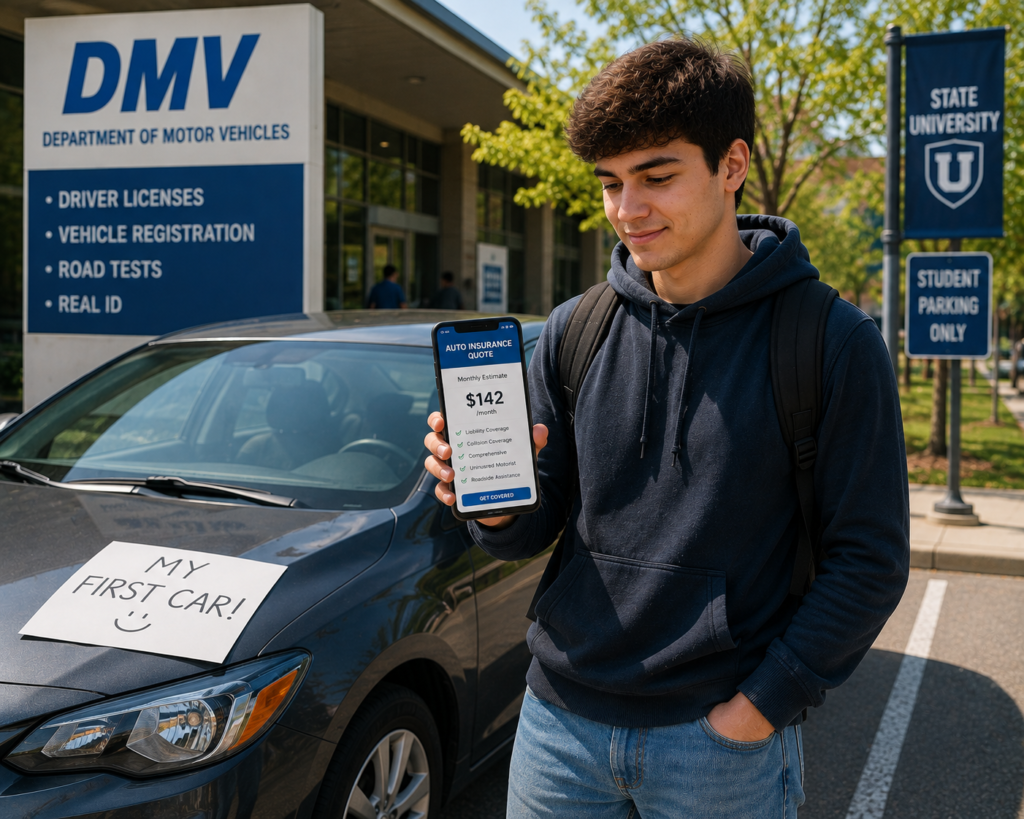
Quick Answer: How Much Does Insurance Cost for a First-Time Driver?
There is no universal first-time driver rate.
Your price can be much higher if you’re a teenager or young adult because insurers generally consider age and driving experience when assessing risk. But being a first-time driver at age 30 is very different from being a first-time driver at age 17.
Current 2026 Insurance.com averages for full coverage illustrate how much age can matter:
| Driver age | Average annual full coverage | Approx. monthly equivalent |
|---|---|---|
| 16 | $8,013 | $668 |
| 18 | $5,964 | $497 |
| 21 | $3,712 | $309 |
| 25 | $2,446 | $204 |
| 30 | $2,223 | $185 |
These figures are general age-based averages, not quotes specifically for first-time drivers. Your actual premium can be much lower or higher depending on your state, vehicle, driving record, coverage and insurer.
Why Is First-Time Driver Insurance So Expensive?
The biggest reason is lack of driving experience.
Insurance companies use underwriting and rating to estimate the likelihood and potential cost of future claims. The National Association of Insurance Commissioners (NAIC) lists factors such as age, driving experience, driving record, location, claims history, vehicle type, miles driven and selected coverage among factors that can affect premiums.
For a first-time driver, the insurer has little or no personal driving history to evaluate.
That doesn’t mean you’re a bad driver.
It simply means the insurer has less evidence that you are a low-risk driver.
First-Time Driver vs. Young Driver: What’s the Difference?
These terms are often used interchangeably, but they’re not exactly the same.
First-time driver
Someone who is getting their first driver’s license or has little driving history.
Young driver
Usually someone in their teens or early 20s.
You can be:
- A 17-year-old first-time driver
- A 21-year-old first-time driver
- A 30-year-old first-time driver
- A 40-year-old first-time driver
Those drivers won’t necessarily receive the same insurance quote.
Age and experience are separate factors.
That’s why a 30-year-old who gets their first U.S. driver’s license may pay considerably less than a 17-year-old first-time driver.
First-Time Driver Insurance Cost by Age
Age can make a huge difference in insurance pricing.
Here is a useful 2026 benchmark from Insurance.com:
| Age | Average full coverage per year |
|---|---|
| 16 | $8,013 |
| 17 | $6,858 |
| 18 | $5,964 |
| 19 | $5,086 |
| 20 | $4,641 |
| 21 | $3,712 |
| 22 | $3,263 |
| 23 | $3,000 |
| 24 | $2,811 |
| 25 | $2,446 |
| 30 | $2,223 |
Again, these are age-based averages, not guaranteed first-time-driver prices.
The general pattern is clear: insurance costs tend to be substantially higher for younger drivers and generally decline as drivers get older and build experience.
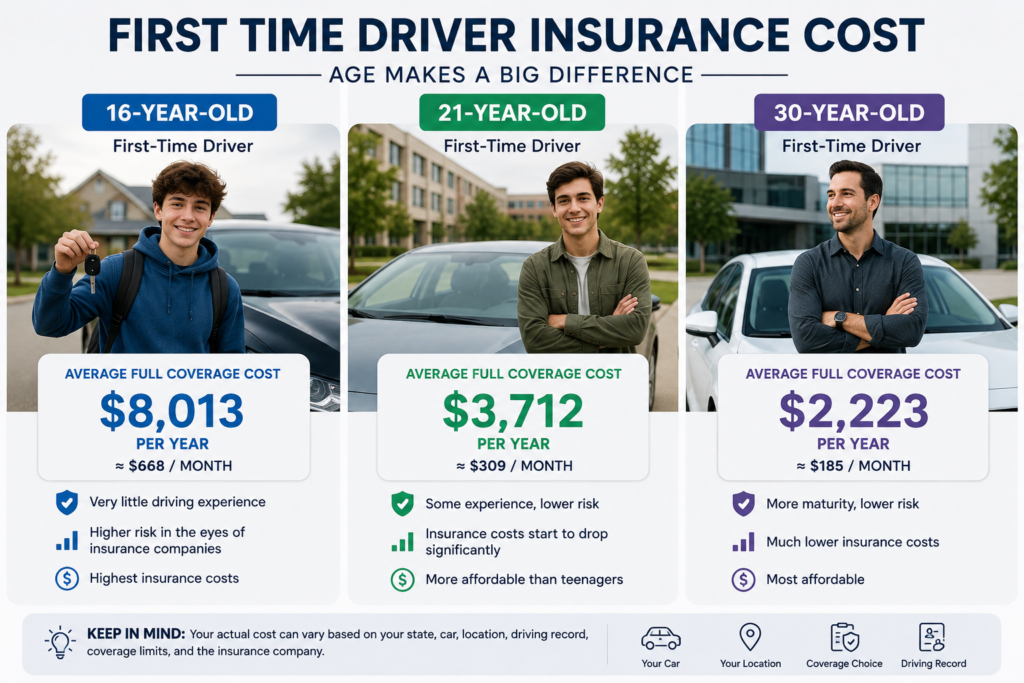
A current 2026 analysis from The Wall Street Journal’s Buy Side found that drivers ages 16–25 typically pay substantially more than 35-year-old drivers, reflecting the higher risk associated with youth and limited experience.
How Much Is Insurance for a 16-Year-Old First-Time Driver?
A 16-year-old first-time driver is generally among the most expensive driver profiles to insure.
Insurance.com’s 2026 data puts the average full-coverage cost for a 16-year-old at approximately $8,013 per year, or about $668 per month when divided into monthly equivalents.
However, a teenager may not need to purchase a completely separate policy.
In many situations, adding a teen driver to an existing family policy can be a more affordable option than purchasing a standalone policy.
The NAIC recommends comparing options such as adding a young driver to an existing policy and considering the vehicle the young driver will operate.
How Much Is Insurance for an 18-Year-Old First-Time Driver?
An 18-year-old first-time driver can still face very high premiums.
Insurance.com’s 2026 average for an 18-year-old is approximately:
$5,964 per year
or roughly:
$497 per month
for full coverage.
But actual quotes can vary dramatically.
Your state, ZIP code, vehicle, coverage and whether you’re on a parent’s policy can all change the price.
How Much Is Insurance for a 21-Year-Old First-Time Driver?
At 21, age-related pricing is generally less severe than for teenagers, but a driver with no experience may still pay more than someone the same age who has been driving safely for several years.
Insurance.com’s 2026 average full-coverage rate for a 21-year-old is about $3,712 per year, or approximately $309 per month.
If you’re 21 and getting your first license, don’t assume that your quote will match the average.
Your lack of driving history can still matter.
How Much Is Insurance for a 30-Year-Old First-Time Driver?
This is where the distinction between age and experience becomes especially important.
A 30-year-old first-time driver generally won’t be priced the same way as a teenager.
Insurance.com’s 2026 average full-coverage rate for a 30-year-old is approximately $2,223 per year, or about $185 per month.
However, someone who is 30 and has never driven before may still receive a higher quote than an experienced 30-year-old.
What Factors Affect First-Time Driver Insurance Cost?
Your first insurance quote can depend on many factors.
1. Your Age
Age is one of the biggest factors, particularly for younger drivers.
2. Driving Experience
A driver with several years of safe driving history generally gives an insurer more information than someone who has just received a license.
3. Your State
Insurance rules and prices vary considerably across the U.S.
The NAIC explains that each state has its own auto-insurance requirements and that location is one of the factors insurers consider when pricing policies.
4. Your ZIP Code
Two drivers living only a few miles apart can potentially receive different quotes because insurers evaluate local risk.
5. Your Vehicle
A $10,000 used sedan and a $50,000 sports car won’t necessarily cost the same to insure.
Vehicle repair costs, theft rates, safety features and claim history can all matter.
6. Coverage Level
Liability-only insurance is generally cheaper than a policy that also includes comprehensive and collision coverage.
7. Deductible
A higher deductible can reduce your premium, but it means you’ll pay more yourself after a covered claim.
8. Annual Mileage
Driving 5,000 miles per year isn’t the same risk exposure as driving 20,000 miles.
9. Credit-Based Insurance Information
Where permitted by state law, insurers may use credit-based insurance information when determining rates.
Rules differ by state.
10. Discounts
Eligible discounts can reduce your premium.
Also read: Car Insurance Claim Denied in USA? 7 Hidden Reasons You’re Losing Money
Does Your First Car Affect Insurance Cost?
Yes, significantly.
This is one of the easiest areas where a first-time driver can make an expensive mistake.
Imagine two first-time drivers.
Driver A
- Used Toyota Corolla
- Moderate repair costs
- Standard safety equipment
- Reasonable coverage
Driver B
- New sports sedan
- Expensive replacement parts
- Higher theft risk
- Full coverage
Even if both drivers are the same age and live at the same address, their insurance costs could be very different.
The NAIC specifically recommends considering the vehicle’s make, model and cost when evaluating insurance for young drivers.
Get an insurance quote before buying the car.
Is Liability Insurance Cheaper for a First-Time Driver?
Generally, yes.
Liability coverage protects against covered bodily injury and property-damage liability you cause to others.
Most states require some form of liability insurance. The NAIC notes that most states require drivers to carry at least a basic level of coverage.
However, choosing the minimum legal coverage simply because it’s cheaper can leave you with significant financial exposure.
Your state’s minimum isn’t necessarily the amount of coverage you actually need.
Is Full Coverage Worth It for a First-Time Driver?
It depends on your vehicle and financial situation.
“Full coverage” generally refers to having liability coverage plus collision and comprehensive coverage, although the exact combination can vary.
The NAIC explains that:
- Collision can cover damage to your vehicle from a collision.
- Comprehensive can cover certain non-collision events such as theft, fire and weather damage.
If you finance or lease your vehicle, your lender may require comprehensive and collision coverage.
If you own an inexpensive older car outright, paying for physical-damage coverage may require more careful consideration.
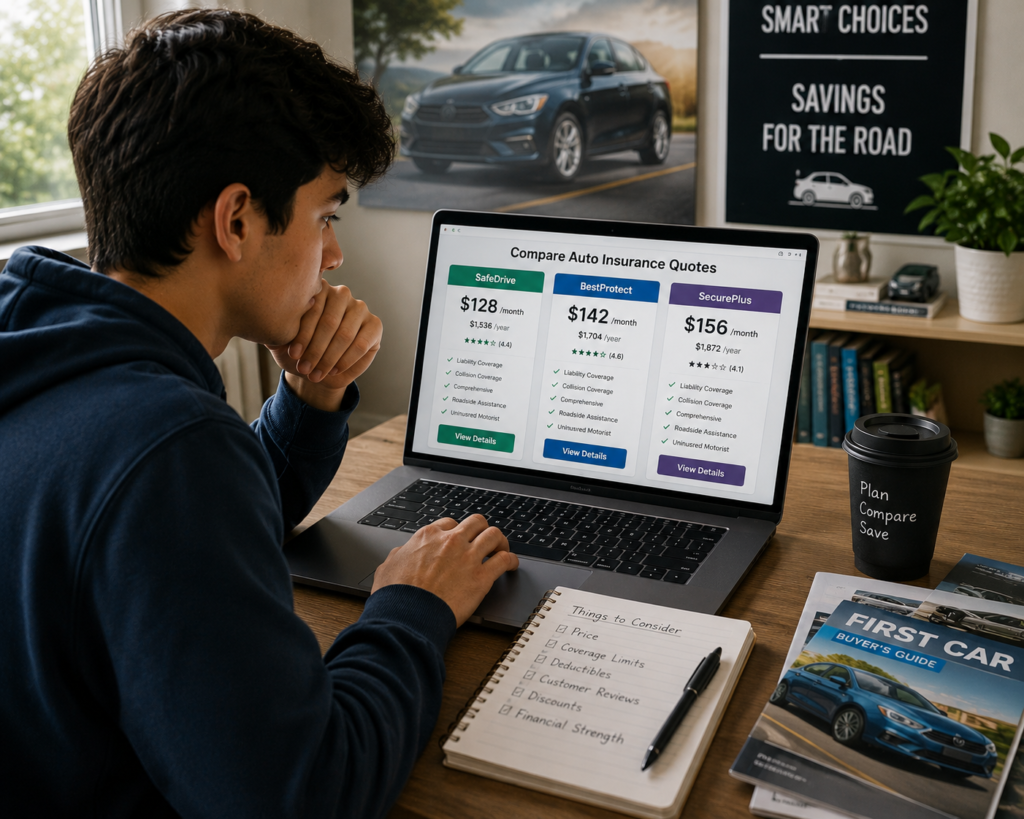
How to Get Cheaper First-Time Driver Insurance
You don’t necessarily have to accept the first quote you receive.
Compare Multiple Insurance Companies
This is probably the most important step.
The NAIC recommends shopping around because different insurers can offer noticeably different premiums.
Get quotes using the same coverage limits and deductibles so you’re actually comparing equivalent policies.
Consider Staying on a Parent’s Policy
If you’re a young driver living with your parents, adding you to their existing policy may be more affordable than purchasing your own standalone policy.
This depends on the household, insurer and state.
Ask the insurer for both prices before making a decision.
Ask About Good Student Discounts
If you’re a student with good grades, ask insurers about available discounts.
The NAIC lists good-student discounts among the types of discounts consumers should ask insurers about, although availability varies by state and company.
Take an Approved Driver Education Course
Some insurers offer discounts for qualifying driver education or defensive-driving courses.
Check with the insurer before taking a course to make sure it qualifies.
Consider Usage-Based Insurance
Some insurers offer telematics or usage-based insurance programs.
These programs may evaluate factors such as:
- Mileage
- Hard braking
- Time of day
- Driving behavior
The NAIC notes that usage-based insurance is increasingly used to connect premiums with driving behavior.
Choose a Higher Deductible Carefully
A higher deductible can lower your premium.
But don’t choose a $1,500 deductible if you don’t have $1,500 available after an accident.
Choose a Sensible Car
Don’t underestimate this.
For a first-time driver, choosing a reliable used vehicle instead of an expensive performance car can potentially make a substantial difference in the total cost of ownership.
Can a First-Time Driver Get Cheap Car Insurance?
Yes, but “cheap” is relative.
A 17-year-old first-time driver may never receive a quote as low as an experienced 40-year-old driver.
The goal should instead be:
Find the lowest reasonable price for the coverage you actually need.
Current 2026 data shows how wide the pricing gap can be between young and older drivers.
That makes comparison shopping particularly important.
What Is the Cheapest Car Insurance for a First-Time Driver?
There isn’t one insurer that is cheapest for every first-time driver.
Rates vary by:
- State
- Age
- ZIP code
- Vehicle
- Coverage
- Driving history
- Credit-based insurance information where permitted
- Discounts
- Household policy
Current 2026 research from the Wall Street Journal’s Buy Side found that insurers such as Auto-Owners, Erie, GEICO and USAA can be competitive for different young-driver profiles, but availability and eligibility vary. USAA, for example, is restricted to eligible military families.
Don’t choose an insurer based on a nationwide ranking alone. Get personalized quotes.
First-Time Driver Insurance Cost: Parent’s Policy vs. Your Own
This is an important decision for young drivers.
| Option | Potential Advantage | Potential Disadvantage |
|---|---|---|
| Parent’s policy | May be cheaper | Parent’s premium increases |
| Own policy | More independence | Can be significantly more expensive |
| Shared family vehicle | May reduce vehicle costs | Less flexibility |
| Own older vehicle | Potentially lower insurance cost | Maintenance costs |
The best choice depends on your household and insurer.
If you’re eligible, ask the insurer to quote both options.
How Long Does It Take for First-Time Driver Insurance to Get Cheaper?
There isn’t a universal date when your premium suddenly drops.
Rates can change as you:
- Gain driving experience
- Maintain a clean record
- Avoid claims
- Avoid tickets
- Get older
- Build continuous insurance history
For young drivers, premiums often decline substantially as they move through their early 20s and beyond, although the timing varies by insurer and state. Current 2026 age-based data shows a large difference between teen rates and rates for drivers in their mid-20s.
Does Your First Driving Ticket Affect Insurance?
Yes, it can.
A traffic violation can increase your insurance cost because insurers may consider your driving record when evaluating risk.
The NAIC identifies driving record and claims history among important rating factors.
For a new driver, keeping a clean record is particularly valuable because you don’t have years of positive driving history to offset a violation.
Does Your Credit Score Affect First-Time Driver Insurance?
It can in states where insurers are permitted to use credit-based insurance information.
The NAIC lists credit history among factors that can influence auto-insurance pricing, while also noting that rating factors can vary under state laws.
This is one reason two drivers with similar ages and vehicles can receive very different quotes.
What Coverage Should a First-Time Driver Buy?
There isn’t one coverage package that works for everyone.
A sensible starting point is to compare:
Liability
Required by most states and protects against covered liability to others.
Uninsured/Underinsured Motorist
Can provide protection when you’re involved in an accident with a driver who doesn’t have enough insurance, subject to state rules and policy terms.
Collision
Useful if you want protection for covered collision damage to your own vehicle.
Comprehensive
Useful for covered non-collision risks such as theft, hail, fire and certain weather events.
Medical/PIP Coverage
Required or available in some states.
The NAIC’s auto insurance guide provides an overview of these coverage types and explains that state requirements differ.
What Should a First-Time Driver Look for in an Insurance Quote?
Don’t look at the price alone.
Compare:
Premium
Liability limits
Comprehensive deductible
Collision deductible
Uninsured/underinsured motorist coverage
Rental reimbursement
Roadside assistance
Discounts
Exclusions
Claims service
Two quotes that look similar at first glance may provide very different protection.
Example: Comparing Two First-Time Driver Quotes
Suppose you’re 22 and buying a used Honda Civic.
You receive:
Quote A
- $1,900/year
- $50,000/$100,000 liability
- $1,000 deductible
- Comprehensive included
- Collision included
Quote B
- $2,150/year
- $100,000/$300,000 liability
- $500 deductible
- Comprehensive included
- Collision included
- Roadside assistance
Quote A is cheaper.
But is it actually better?
Not necessarily.
Quote B provides higher liability limits and a lower deductible.
The cheapest quote isn’t always the best-value quote.
First-Time Driver Insurance Checklist
Before buying your first policy, check these:
☐ Compare at least three insurers
☐ Get quotes before buying the vehicle
☐ Compare identical coverage limits
☐ Check your state’s minimum requirements
☐ Ask about good-student discounts
☐ Ask about driver-training discounts
☐ Check usage-based insurance options
☐ Compare deductibles
☐ Review comprehensive and collision coverage
☐ Ask whether you can join a parent’s policy
☐ Check whether credit-based insurance information is used in your state
☐ Read the policy exclusions
☐ Keep your driving record clean
Common Mistakes First-Time Drivers Should Avoid
Choosing the Cheapest Quote Automatically
Cheap insurance can mean less coverage.
Buying the Car Before Getting Insurance Quotes
The vehicle can have a major effect on your premium.
Choosing the State Minimum Without Understanding the Risk
Minimum coverage is designed to satisfy legal requirements, not necessarily to fully protect your finances.
Ignoring Discounts
Ask specifically about student, driver education, telematics and other discounts.
Choosing a Deductible You Can’t Afford
A lower premium isn’t useful if you can’t pay the deductible after an accident.
Not Comparing Insurers
The NAIC recommends shopping around because insurers can price similar risks differently.
Frequently Asked Questions
Q1. What is the average first time driver insurance cost?
There isn’t a single national average specifically for first-time drivers. Current 2026 age-based data shows full-coverage averages ranging from about $8,013 per year at age 16 to $2,223 at age 30. Your actual first-time-driver quote can be significantly different.
Q2. How much is car insurance for a first-time driver per month?
It depends on age, state, vehicle and coverage. For context, 2026 full-coverage averages are approximately $668/month for age 16, $497 for age 18, $309 for age 21 and $185 for age 30 when annual averages are divided by 12.
Q3. Is insurance more expensive for first-time drivers?
It can be, particularly when the driver is young. Limited driving experience gives insurers less information to evaluate risk, and age is also a major rating factor.
Q4. What is the cheapest insurance for a first-time driver?
There is no insurer that is cheapest for everyone. Compare several companies using identical coverage and deductibles.
Q5. Can a first-time driver stay on their parent’s insurance?
In many situations, a young driver living with their parents may be able to remain on the household policy, but eligibility depends on the insurer and state. Ask your insurer for the cost of adding the driver versus purchasing a separate policy.
Q6. Does a first-time driver need full coverage?
Not necessarily. However, lenders often require comprehensive and collision coverage on financed or leased vehicles.
Q7. Can a first-time driver get insurance without a driving history?
Yes. Insurance companies can insure new drivers, but the absence of driving history can affect the quote.
Q8. Does being a student lower car insurance?
It can. Some insurers offer good-student or driver-education discounts, although availability varies by company and state.
Q9. Does the car I drive affect my first-time driver insurance cost?
Yes. Vehicle type, make, model and usage can affect insurance premiums.
Q10. How can I reduce my first-time driver insurance cost?
Compare insurers, ask about discounts, choose a reasonably priced vehicle, consider a qualifying telematics program and select a deductible you can afford.
Q11. Does insurance get cheaper after your first year?
It can, particularly if you maintain a clean driving and claims record, but there is no guaranteed reduction after exactly one year.
Q12. How long are you considered a new driver?
There isn’t one nationwide period. Insurers can use their own rating methods, and the importance of driving experience varies by company and state.
Final Verdict: What Should a First-Time Driver Expect to Pay?
The first time driver insurance cost can be surprisingly high, especially for teenagers and young adults, but there is no single price that applies to everyone.
As a rough 2026 benchmark, current full-coverage averages are around:
- $668/month at age 16
- $497/month at age 18
- $309/month at age 21
- $204/month at age 25
- $185/month at age 30
These figures are market averages by age, not guaranteed first-time-driver quotes.
The biggest things you can control are your vehicle, coverage choices, deductible, driving behavior and how much you shop around.
If you’re buying your first car, one of the smartest things you can do is:
Get insurance quotes before buying the car.
A vehicle that looks affordable at the dealership can become much more expensive once insurance, fuel, maintenance, registration and financing are added.
And remember: the cheapest policy isn’t necessarily the best policy.
Compare the price and the protection.
Why Maintain Market Is Different
At Maintain Market, we don’t believe an insurance article should simply give you a random average price and send you on your way.
For a first-time driver, the real question is:
“What will my insurance probably cost, why is it expensive, and what can I realistically do about it?”
That’s why we explain the numbers in context.
We separate age-related costs from first-time-driver costs, explain why quotes vary, show how coverage affects the price and give practical ways to reduce your premium.
We also use authoritative sources such as the National Association of Insurance Commissioners and clearly identify when a number is an industry average rather than a guaranteed quote.
Our goal isn’t to tell every driver to buy the same policy.
Our goal is to help you understand your options and make a smarter financial decision.
Maintain Market — Clear information. Smarter financial decisions.
Also read: Insurance Claim Denied? How to Lower Your Premium Fast