
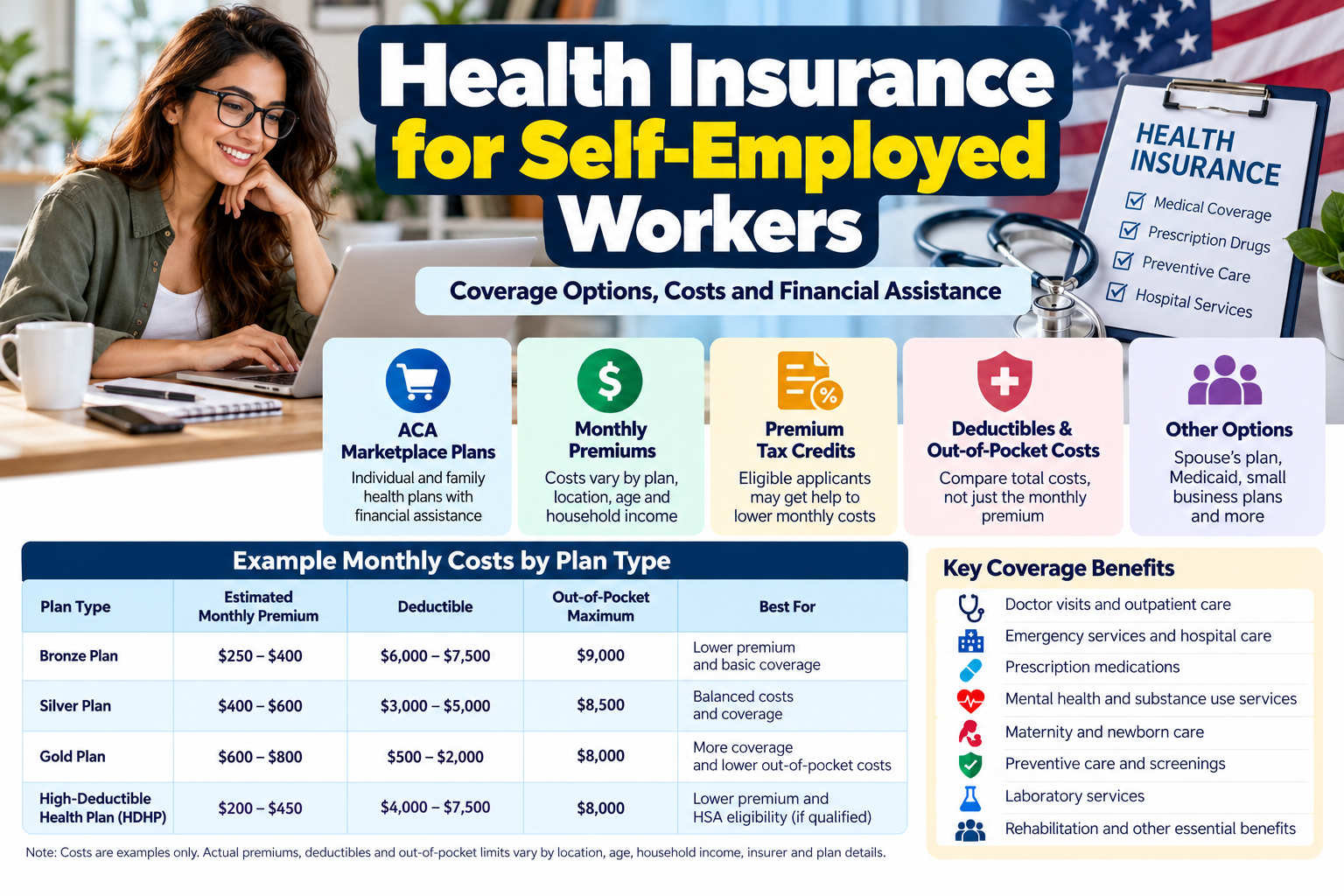
Health insurance for self employed workers can be challenging to arrange when you do not receive benefits from an employer. Freelancers, independent contractors, consultants, and small-business owners must compare premiums, deductibles, provider networks, and financial assistance themselves. Fortunately, several coverage options may be available depending on your income, household, location, and eligibility.
Quick Answer: What Is the Best Health Insurance for Self-Employed People?
For many self-employed people in the United States, the ACA Health Insurance Marketplace is the best place to start. It offers individual and family health plans, and eligible applicants may qualify for premium tax credits or other cost-sharing assistance.
However, the cheapest monthly premium is not necessarily the best choice. Compare your deductible, out-of-pocket maximum, prescription coverage, doctors, hospitals, and expected medical expenses before enrolling.
| Health insurance option | Best for | What to consider |
|---|---|---|
| ACA Marketplace plan | Freelancers and independent contractors | Financial assistance may be available if eligible |
| Spouse’s employer plan | Self-employed people with a working spouse | Compare dependent premiums and benefits |
| Medicaid | Eligible people with lower incomes | Eligibility varies by state |
| Direct individual health plan | People comparing private coverage | Marketplace tax credits generally cannot be applied |
| Small-business group plan | Eligible businesses with employees | Business and employee eligibility rules apply |
| COBRA continuation coverage | People recently leaving employer coverage | You may have to pay the full premium plus an administrative charge |
| High-deductible health plan | People comfortable with higher initial costs | Check deductible, risk exposure, and HSA eligibility |
1. Explore ACA Marketplace Health Insurance
The federal Health Insurance Marketplace at HealthCare.gov is a practical starting point if you work for yourself. Depending on your state, you may use the federal Marketplace or a state-run enrollment website.
Marketplace plans cover essential health benefits, including:
- Doctor visits and outpatient care
- Emergency services and hospital care
- Prescription medications
- Mental health and substance use services
- Maternity and newborn care
- Laboratory services
- Preventive care and certain screenings
- Rehabilitation and other covered services
ACA-compliant plans also cannot deny coverage or charge higher premiums because of a pre-existing condition.
Why this matters: If you do not have employer-sponsored insurance, a Marketplace plan can provide comprehensive individual or family coverage without requiring you to work for a company that offers benefits.
Start with the official HealthCare.gov self-employed coverage guide.
2. Check Whether You Qualify for Premium Tax Credits
One of the most important steps is checking whether you qualify for financial assistance. Eligible Marketplace applicants may receive a premium tax credit that reduces their monthly insurance premium.
Eligibility can depend on:
- Estimated annual household income
- Household size
- Where you live
- Access to qualifying employer-sponsored coverage
- Tax-filing circumstances
- Other applicable eligibility requirements
Do not assume that being self-employed automatically qualifies you for a subsidy. Your household and financial circumstances matter.
How do premium tax credits work?
Suppose a Marketplace plan has a hypothetical full premium of $650 per month. If you qualify for $300 in monthly assistance, your estimated premium payment could fall to $350 per month.
| Item | Illustrative amount |
|---|---|
| Full monthly premium | $650 |
| Monthly premium tax credit | $300 |
| Estimated monthly payment | $350 |
| Estimated annual premium payment | $4,200 |
These amounts are examples only, not actual insurance quotes or estimates of your eligibility.
Financial assistance rules can change. Check your current eligibility through the Marketplace instead of relying on older articles or assuming that a particular subsidy amount will remain available.
3. Estimate Your Self-Employment Income Correctly
When applying for Marketplace coverage, you generally need to estimate your expected household income for the coverage period. For self-employed applicants, this usually involves estimating net business income rather than entering total business revenue.
For example, imagine your freelance business earns $90,000 but has $25,000 in allowable business expenses. Your estimated net business profit would be $65,000 before considering other applicable income and tax adjustments.
This is a simplified illustration, not a complete tax calculation.
Follow these steps:
- Review your recent earnings and business expenses.
- Estimate your expected annual net business income realistically.
- Include other relevant household income when completing your application.
- Update your Marketplace application when your expected income changes.
- Keep records of the income and expenses you report.
If you receive advance premium tax credits based on an income estimate that turns out to be too low, you may have to repay some or all of the excess assistance when filing your federal tax return.
Read the official HealthCare.gov guide to reporting self-employment income.
4. Compare Premiums, Deductibles, and Out-of-Pocket Maximums
A low monthly premium can look attractive when your business income changes from month to month. But the premium is only one part of your total health insurance cost.
Understand these three terms:
- Premium: The amount you pay to keep your insurance active.
- Deductible: The amount you generally pay for covered services subject to the deductible before the plan begins paying its share.
- Out-of-pocket maximum: The annual limit on what you pay for covered, in-network essential health benefits under the plan. Premiums and certain other expenses are not included.
Your actual costs depend on the plan’s rules, the medical services you use, and whether the care is in-network.
Example: Two health insurance plans
| Feature | Plan A | Plan B |
|---|---|---|
| Monthly premium | $280 | $390 |
| Annual premium | $3,360 | $4,680 |
| Deductible | $6,500 | $2,000 |
| Out-of-pocket maximum | $9,000 | $6,000 |
Illustrative figures only. These are not actual insurance offers.
Plan A saves $1,320 in annual premiums. However, Plan B has a lower deductible and a lower out-of-pocket maximum. If you expect frequent medical treatment, Plan B may offer better financial protection, depending on copays, coinsurance, network rules, and the services you need.
Compare the total potential cost rather than choosing solely on the monthly premium.
5. Check Whether You Can Join a Spouse’s Employer Plan
If your spouse receives health insurance through an employer, check whether you can join that plan.
Compare:
- The additional premium to cover you
- The deductible and out-of-pocket maximum
- Whether your preferred doctors and hospitals are in-network
- Prescription drug coverage
- Enrollment deadlines and qualifying life events
- How the employer plan affects your eligibility for Marketplace financial assistance
An offer of employer-sponsored coverage can affect your eligibility for Marketplace subsidies. The rules depend on whether the coverage meets applicable affordability and minimum-value requirements, among other factors.
Do not assume that joining your spouse’s plan is automatically cheaper. Compare the actual plan documents and total costs.
6. Consider Medicaid if Your Income Is Low
Medicaid provides health coverage to eligible individuals and families. If your self-employed income is limited or fluctuates significantly, applying through the Marketplace can help determine whether you may qualify.
Eligibility depends on your state, household circumstances, income, and other rules. States differ in how they administer Medicaid and which groups qualify.
If your business income changes during the year, keep your information current and follow the reporting requirements for your coverage.
You can begin at HealthCare.gov, which can direct you to the relevant state process.
7. Understand High-Deductible Health Plans and HSAs
Some self-employed people consider a high-deductible health plan (HDHP) to reduce their monthly premium. Certain qualifying HDHPs can be paired with a Health Savings Account (HSA), which offers tax advantages when the eligibility requirements are met.
An HSA can help eligible individuals save for qualified medical expenses. However, not every health plan qualifies for HSA contributions.
Before choosing this approach, consider:
- Whether the plan is HSA-eligible
- The deductible and out-of-pocket maximum
- Whether you can afford medical care before meeting the deductible
- Expected prescription, specialist, and hospital expenses
- HSA contribution rules and tax implications
A lower premium may work well if you rarely need care and can comfortably manage the deductible. It may be less suitable if a large unexpected medical bill would strain your finances.
8. Check Whether You Can Deduct Health Insurance Premiums
Self-employed taxpayers may qualify for a federal self-employed health insurance deduction. Depending on their circumstances, eligible premiums for medical, dental, vision, and certain qualified long-term care coverage may be deductible.
However, the deduction has eligibility requirements and limitations. The amount you can deduct may be affected by earned income from the relevant business and whether you were eligible to participate in certain employer-subsidized health plans.
This deduction is different from a Marketplace premium tax credit.
Keep your premium records and speak with a qualified tax professional about your circumstances. The IRS explains the rules in its Form 7206 guidance.
Important: If you receive Marketplace premium tax credits, the interaction between the credit and the self-employed health insurance deduction can affect your tax calculation. Do not automatically deduct the full amount of premiums without checking the applicable rules.
9. Know When COBRA or Private Insurance May Make Sense
If you recently left a job to start a freelance business, COBRA may allow you to continue your previous employer-sponsored coverage for a limited period if you meet the applicable requirements. However, you may have to pay the full group premium plus an administrative charge, making it expensive.
Marketplace coverage may be another option. Losing qualifying job-based coverage generally creates a Special Enrollment Period, subject to the applicable rules and deadlines.
You can also compare private individual plans outside the Marketplace. However, plans purchased outside the Marketplace generally do not qualify for Marketplace premium tax credits.
Be particularly careful with short-term or limited-benefit products. They may not provide the same protections or benefits as ACA-compliant comprehensive health insurance.
Before purchasing any plan, check its benefits, exclusions, provider network, prescription coverage, and conditions for paying claims.
10. Choose a Plan Based on Your Real Health Needs
Before enrolling, review your likely medical expenses and the details of each plan.
Ask yourself:
- Do I need regular specialist visits or prescription medication?
- Are my preferred doctors and hospitals in-network?
- Can I afford the deductible if an emergency occurs?
- Is the out-of-pocket maximum manageable?
- Does the plan cover the services I expect to use?
- Are there separate deductibles or restrictions for certain services?
- How much will the plan cost after any financial assistance?
- Can I afford the premium during a slow business month?
If you have a family, compare family premiums, individual and family deductibles, pediatric coverage, and dependent eligibility as well.
The goal is not simply to find the cheapest plan. It is to find coverage that fits your budget and protects you against medical expenses you could not comfortably pay on your own.
How to Get Health Insurance for Self-Employed Workers
Use this checklist to get started.
- Gather your information: Estimate your annual net self-employment income and household income.
- Check enrollment eligibility: Review open enrollment dates or determine whether you qualify for a Special Enrollment Period.
- Compare Marketplace plans: Review premiums, deductibles, out-of-pocket maximums, provider networks, and benefits.
- Check financial assistance: Complete the Marketplace application to determine whether you qualify for premium tax credits or other savings.
- Compare alternatives: Review a spouse’s employer plan, Medicaid eligibility, and other legitimate coverage options.
- Read the plan documents: Check the Summary of Benefits and Coverage and the provider directory.
- Enroll and pay the premium: Follow the insurer’s instructions so coverage can begin.
- Update your income when needed: Report material changes to the Marketplace and retain tax records.
Marketplace enrollment is generally limited to the annual Open Enrollment Period unless you qualify for a Special Enrollment Period. Verify the current dates and rules for your state before applying.
Common Mistakes Self-Employed People Should Avoid
Choosing the lowest premium without checking the deductible. A low premium can come with substantial costs when you receive care.
Using business revenue instead of estimating net income. Marketplace income estimates for self-employed people generally need to account for business expenses and applicable income rules.
Ignoring changes in income. Failing to update your application can result in receiving more advance premium tax credit than you ultimately qualify for.
Assuming every private plan qualifies for subsidies. Marketplace premium tax credits are generally available only through Marketplace coverage, subject to eligibility requirements.
Forgetting provider networks. A plan may cost less but exclude a preferred doctor or hospital from its network.
Missing enrollment deadlines. Outside the standard enrollment period, you generally need a qualifying event to enroll through the Marketplace.
Confusing a tax deduction with a subsidy. The self-employed health insurance deduction and Marketplace premium tax credits work differently.
Frequently Asked Questions
1. What is the best health insurance for self-employed people?
For many freelancers and independent contractors, the ACA Marketplace is a good starting point because it offers comprehensive individual and family coverage and checks eligibility for financial assistance. The best plan depends on your state, income, household, medical needs, and budget.
Compare the total cost of coverage, including premiums, deductibles, copays, coinsurance, and out-of-pocket limits, before enrolling.
2. Can self-employed people get health insurance through the Marketplace?
Yes. Freelancers, consultants, and independent contractors can generally apply for individual or family coverage through the Marketplace if they meet the eligibility rules. You do not need to work for a company that offers insurance.
The application can also check whether you qualify for premium tax credits or Medicaid. Eligibility for assistance depends on your household and circumstances.
3. Is health insurance tax-deductible for self-employed people?
You may qualify for the federal self-employed health insurance deduction if you meet the IRS requirements. Eligible premiums may include qualifying medical, dental, and vision insurance, subject to applicable limitations.
The deduction is separate from a Marketplace premium tax credit. Consult the IRS Form 7206 guidance and a tax professional to determine what applies to you.
4. Can I get health insurance if my freelance income changes every month?
Yes. You can generally apply using your best estimate of expected annual net self-employment income. If your income changes during the year, update your Marketplace application promptly.
Keeping your estimate current helps reduce the risk of receiving more advance premium tax credit than you ultimately qualify for.
5. Is private health insurance cheaper than Marketplace insurance?
Not necessarily. The answer depends on your location, age, plan benefits, provider network, and eligibility for Marketplace financial assistance. An off-Marketplace plan may have different costs and benefits, and it generally does not qualify for Marketplace premium tax credits.
Compare equivalent coverage and review exclusions before deciding based on price alone.
6. Can I get health insurance if I have a pre-existing condition?
ACA-compliant Marketplace plans cannot deny you coverage or charge you more because of a pre-existing condition. They also cover essential health benefits as required by law.
Do not assume that every product marketed as health insurance provides these protections. Check the plan type, benefits, exclusions, and applicable rules before buying.
7. What happens if I earn more than I estimated on my Marketplace application?
If you receive advance premium tax credits and your final income makes you eligible for less assistance, you may need to repay some or all of the excess when you file your federal tax return. The amount depends on the applicable tax rules and your circumstances.
Update your Marketplace application when your income changes and keep records of the information you report.
8. Can a self-employed person buy health insurance at any time?
Usually, Marketplace enrollment is limited to the annual Open Enrollment Period unless you qualify for a Special Enrollment Period. Certain life events, such as losing qualifying job-based coverage, may create an opportunity to enroll outside the normal window.
Private coverage has its own enrollment rules, and many products sold outside Open Enrollment are not comprehensive ACA-qualified coverage. Verify eligibility before relying on a plan.
Final Takeaway
Health insurance for self employed workers does not have to mean paying for the first plan you find. Start by checking Marketplace options, estimate your income carefully, compare the full cost of coverage, and review whether a tax credit or deduction may apply to you.
A suitable plan should fit your current budget while providing meaningful protection against medical expenses. Revisit your coverage when your income, household, or health care needs change.
Why Maintain Market Is Different
Maintain Market focuses on practical financial decisions rather than simply listing insurance products. This guide explains how to compare coverage, understand income-based assistance, avoid common enrollment mistakes, and distinguish tax deductions from premium subsidies.
Our goal is to help readers evaluate health insurance options using official resources and the details of each plan—not to promise a particular premium or amount of savings.
References
- HealthCare.gov — Self-Employed Health Coverage
- HealthCare.gov — Reporting Self-Employment Income
- HealthCare.gov — Coverage for Self-Employed People and Small Businesses
Editorial Review
This article is for general educational purposes and focuses on U.S. health insurance. Eligibility, benefits, premiums, enrollment periods, and tax treatment depend on individual circumstances and may change. Confirm current details with HealthCare.gov, your state Marketplace, your insurer, and a qualified tax professional where appropriate.