
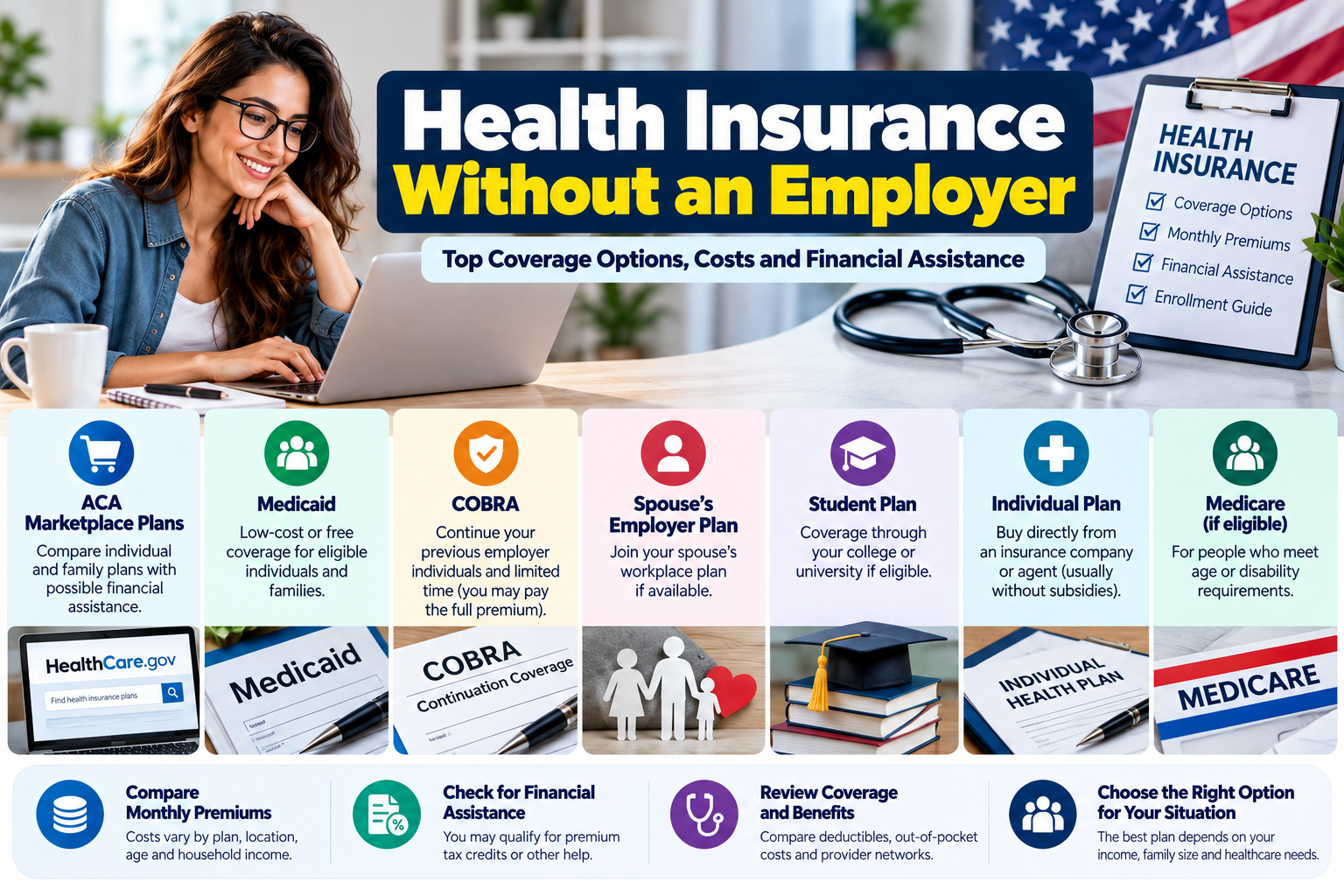
Health insurance without employer benefits can feel expensive and confusing, especially when you must pay the entire premium yourself. Whether you are unemployed, working part-time, self-employed, freelancing, or employed by a company that does not offer health benefits, you still have several ways to obtain coverage in the United States.
The best option depends on your household income, age, location, family size, medical needs, and eligibility for financial assistance. This guide explains where to find coverage, how to compare plans, and what to check before enrolling.
Quick Answer: How Can You Get Health Insurance Without an Employer?
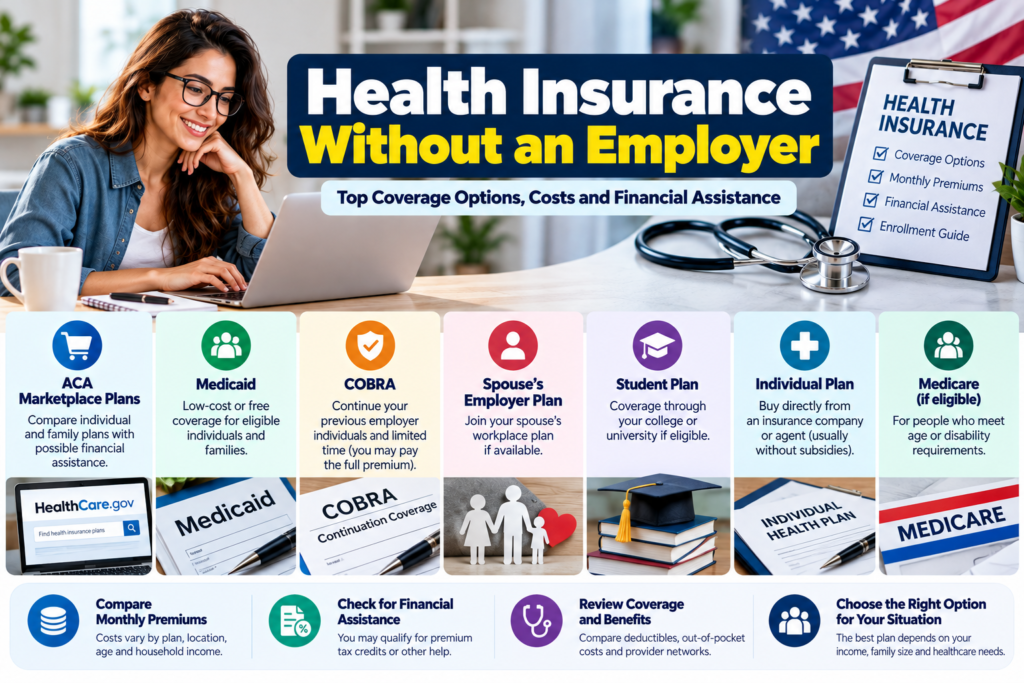
For most people in the United States who do not have employer-sponsored coverage, the ACA Health Insurance Marketplace is a good place to start. You can compare individual and family health plans and find out whether you qualify for premium tax credits or other assistance.
Other options may include Medicaid, a spouse’s employer plan, COBRA continuation coverage, Medicare if eligible, or an individual plan purchased directly from an insurance company.
| Coverage option | Best for | Main consideration |
|---|---|---|
| ACA Marketplace | People without job-based coverage | Financial assistance may be available |
| Medicaid | Eligible people with limited income | Eligibility varies by state |
| Spouse’s employer plan | People whose spouse has workplace benefits | Check dependent premiums and enrollment rules |
| COBRA | People leaving a job with health insurance | You may pay the full premium |
| Medicare | People who meet Medicare eligibility rules | Enrollment and coverage depend on your circumstances |
| Direct individual insurance | People comparing private plans | Marketplace subsidies generally cannot be applied |
| Parent’s health plan | Eligible young adults | Dependent coverage generally may continue until age 26 |
| Student health plan | Eligible college or university students | Review benefits, provider networks, and costs |
1. Get Health Insurance Through the ACA Marketplace
The federal Health Insurance Marketplace is often the most useful starting point if you do not receive insurance through your employer.
You can compare available plans, review coverage details, and apply for financial assistance in one place. Depending on where you live, you may use HealthCare.gov or your state’s own Marketplace.
Marketplace plans can cover essential health benefits, including:
- Doctor visits and outpatient care
- Emergency services and hospital treatment
- Prescription medications
- Mental health and substance use services
- Maternity and newborn care
- Laboratory services
- Preventive care
- Rehabilitation services
ACA-compliant plans also cannot deny coverage or charge higher premiums because of a pre-existing condition.
How to get started:
- Visit HealthCare.gov.
- Enter your state and household details.
- Estimate your household income.
- Compare available plans and estimated premiums.
- Review the deductible, provider network, prescription coverage, and out-of-pocket maximum.
- Complete the application and follow the enrollment and payment instructions.
Marketplace enrollment is generally limited to the annual Open Enrollment Period unless you qualify for a Special Enrollment Period. Check the current enrollment rules before applying.
2. Check Whether You Qualify for Premium Tax Credits
If you buy health insurance without an employer, you may have to pay the full premium unless you qualify for financial assistance.
Eligible Marketplace applicants may receive a premium tax credit that reduces their monthly premium. Eligibility depends on household income, household size, access to qualifying employer-sponsored coverage, tax-filing circumstances, and other applicable rules.
Example of how financial assistance works
Suppose a health plan has a hypothetical full premium of $600 per month. If you qualify for $250 in monthly premium tax credits, your estimated payment would be $350 per month.
| Item | Illustrative amount |
|---|---|
| Full monthly premium | $600 |
| Monthly premium tax credit | $250 |
| Estimated monthly payment | $350 |
| Estimated annual premium payment | $4,200 |
These are illustrative figures, not a quote or a prediction of your eligibility.
Premium tax credit rules can change. Use the Marketplace application to check the assistance currently available to you rather than relying on a subsidy amount mentioned in an older article.
Important: If your income or household circumstances change after enrollment, update your Marketplace application. Advance tax credits are based on estimates, and you may need to reconcile the amount received with the credit you ultimately qualify for when filing your federal tax return.
Official resource: IRS — Premium Tax Credit.
3. Consider Medicaid if Your Income Is Limited
Medicaid provides health coverage to eligible people and families. If you are unemployed, have a low income, or are experiencing a significant reduction in earnings, it may be worth checking whether you qualify.
Medicaid eligibility varies by state and can depend on income, household circumstances, residency, and other eligibility criteria. Some states have expanded Medicaid eligibility to cover additional low-income adults, while others have different rules.
You do not need to assume that you are ineligible just because your employment status has changed.
What to do:
- Apply through HealthCare.gov or your state’s Medicaid agency.
- Provide accurate household and income information.
- Check whether your state has expanded adult Medicaid coverage.
- Follow the agency’s instructions about documentation and eligibility decisions.
If you qualify for Medicaid, you may be able to enroll outside the regular Marketplace Open Enrollment Period.
Official resource: Medicaid.gov — Eligibility Policy.
4. Join Your Spouse’s Employer Health Insurance Plan
If your spouse receives health insurance through work, joining their plan may be a practical alternative to purchasing an individual policy.
However, do not assume that family coverage is automatically cheaper. Some employers pay most of the employee’s premium but contribute less toward spouses or dependents.
Compare:
- The additional monthly premium for adding you
- The deductible and out-of-pocket maximum
- Whether your preferred doctors are in-network
- Prescription medication coverage
- Family deductibles and dependent benefits
- Enrollment deadlines and qualifying life events
An offer of employer-sponsored coverage can also affect your eligibility for Marketplace premium tax credits. Check the rules before deciding which option is more affordable.
5. Use COBRA if You Recently Lost Job-Based Coverage
If you recently left a job that provided health insurance, you may be eligible to continue the same employer-sponsored plan through COBRA.
COBRA can help you avoid an immediate change in doctors, benefits, or provider networks. However, it can be expensive because you generally pay the full group premium yourself, plus an administrative charge.
Before choosing COBRA, compare it with an ACA Marketplace plan.
| Feature | COBRA | Marketplace plan |
|---|---|---|
| Existing employer plan | Generally continues | You choose a new plan |
| Monthly premium | Often expensive | May be lower if eligible for assistance |
| Doctors and network | Usually retains the existing plan’s network | Depends on the selected plan |
| Financial assistance | Generally no Marketplace premium tax credit while enrolled in COBRA | Marketplace tax credits may be available if eligible |
| Enrollment | Subject to COBRA eligibility and deadlines | Open Enrollment or a qualifying Special Enrollment Period |
Losing qualifying job-based coverage generally gives you a 60-day window to enroll in Marketplace coverage through a Special Enrollment Period. Other timing rules may apply, so verify your deadline promptly.
Official resource: HealthCare.gov — Options if You Lose Job-Based Coverage.
6. Check Whether You Can Stay on a Parent’s Health Plan
Young adults can generally remain on a parent’s qualifying health insurance plan until age 26, subject to the applicable plan rules.
This can be a useful option if you are:
- Looking for your first job
- Working part-time
- Studying at college
- Starting a business
- Moving between jobs
You do not generally have to be a full-time student or a tax dependent to qualify for this protection.
Before relying on a parent’s plan, confirm the coverage end date, enrollment procedures, provider network, and whether your location affects access to in-network care.
If you are approaching the age limit, compare individual Marketplace coverage before your existing coverage ends.
7. Compare Individual Plans Bought Directly From Insurers
You can also purchase individual health insurance directly from an insurance company or through a licensed insurance agent or broker.
This may be useful if you want to compare additional plan options. However, plans sold outside the Marketplace generally do not qualify for Marketplace premium tax credits.
Also, not every product marketed as health insurance provides comprehensive ACA-compliant coverage.
Before buying, verify:
- Whether the plan is comprehensive major medical insurance
- Whether pre-existing conditions are covered under applicable rules
- The annual deductible and out-of-pocket maximum
- Prescription and hospital coverage
- Provider networks
- Exclusions, limitations, and waiting periods
- The insurer’s licensing and the plan’s legal status in your state
Be cautious with short-term policies, fixed-indemnity products, discount cards, and health care sharing arrangements. They may not offer the same benefits and consumer protections as comprehensive health insurance.
8. Explore Student Health Insurance
If you attend college or university, your institution may offer a student health insurance plan.
Student plans can be useful if you do not have coverage through a parent or employer. Some schools require eligible students to maintain qualifying coverage, while others make their plans optional.
Compare the student plan with Marketplace coverage before enrolling.
Check whether the plan covers:
- Primary care and specialist visits
- Emergency and hospital services
- Prescription medications
- Mental health services
- Care away from campus
- Dependents, if applicable
Do not choose a plan solely because it is offered through your college. Confirm that it fits your medical needs and budget.
9. Check Medicare Eligibility if You Are Older or Have a Qualifying Disability
Medicare may be an option if you meet its eligibility requirements, including certain age-related or disability-related criteria.
It is not a general replacement for employer insurance for every adult. Eligibility, enrollment periods, premiums, and coverage choices depend on your circumstances.
If you are nearing Medicare eligibility, compare the available Medicare options and understand how enrollment interacts with any Marketplace or other coverage you currently have.
Start with the official Medicare website.
10. Choose a Plan Based on Total Costs, Not Just Premiums
When you pay for your own health insurance, the monthly premium is important—but it is not the only cost.
Compare these key features:
- Premium: What you pay each month for coverage.
- Deductible: What you generally pay for covered services subject to the deductible before the plan pays its share.
- Copayment: A fixed amount you pay for a covered service.
- Coinsurance: Your share of the cost of a covered service, expressed as a percentage.
- Out-of-pocket maximum: The annual limit on your spending for covered, in-network essential health benefits under the plan, excluding premiums and certain other expenses.
Example: Comparing two hypothetical plans
| Feature | Plan A | Plan B |
|---|---|---|
| Monthly premium | $275 | $390 |
| Annual premium | $3,300 | $4,680 |
| Deductible | $6,000 | $2,000 |
| Out-of-pocket maximum | $9,000 | $6,000 |
These figures are illustrative only and are not actual insurance quotes.
Plan A has lower annual premiums, but Plan B offers a lower deductible and out-of-pocket maximum in this example. If you need frequent treatment, Plan B could provide better financial protection depending on the plan’s copays, coinsurance, network rules, and covered services.
If you rarely need medical care, the lower premium of Plan A may be attractive—but you should be prepared for its higher potential costs.
What Is the Cheapest Way to Get Health Insurance Without an Employer?
There is no single cheapest option for everyone. The lowest-cost choice depends on your eligibility, state, age, household, and health care needs.
Start by comparing these possibilities:
| Option | Why it may cost less | What to verify |
|---|---|---|
| Medicaid | Eligible members may receive coverage with low or no premiums | State eligibility and covered benefits |
| Marketplace plan with tax credits | Financial assistance may reduce premiums | Income and household eligibility |
| Spouse’s employer plan | Employer contributions may reduce the cost | Additional premium for dependent coverage |
| Parent’s plan | May avoid purchasing a separate policy | Eligibility and coverage end date |
| Student plan | School-sponsored coverage may be competitively priced | Benefits, network, and total costs |
Do not judge affordability by the premium alone. A plan that is inexpensive each month may expose you to medical expenses you cannot comfortably afford.
How to Apply for Health Insurance Without an Employer
Follow these steps to narrow down your options.
- Identify your current coverage status. Determine whether you are uninsured, losing job-based insurance, or still covered temporarily.
- Check enrollment timing. Review Open Enrollment and any Special Enrollment Period that may apply.
- Estimate your household income. Use a realistic estimate for the relevant coverage period.
- Apply through the Marketplace. Check plan options and possible financial assistance.
- Review Medicaid eligibility. Your application may help identify whether you qualify.
- Compare alternatives. Consider a spouse’s plan, COBRA, student coverage, or Medicare if eligible.
- Review the plan documents. Check benefits, exclusions, providers, premiums, deductibles, and out-of-pocket limits.
- Complete enrollment. Follow the insurer’s payment instructions and confirm when your coverage begins.
If you are losing employer coverage, do not wait until the last day to investigate your options. Enrollment deadlines can affect when your new coverage starts.
Common Mistakes to Avoid
Choosing the cheapest premium without reviewing the deductible. Lower monthly payments can mean higher expenses when you need treatment.
Assuming you qualify for financial assistance. Marketplace subsidies depend on eligibility rules and your household circumstances.
Missing a Special Enrollment Period. If you lose qualifying job-based coverage, act promptly and confirm your deadline.
Buying limited coverage without understanding the exclusions. Short-term and fixed-benefit products may not replace comprehensive health insurance.
Ignoring provider networks. A plan that excludes your preferred doctors may be inconvenient or more expensive to use.
Forgetting to update your income. If you receive advance premium tax credits, changes to your household or income may affect your final tax calculation.
Failing to compare COBRA with Marketplace coverage. Keeping your old plan may be convenient, but it may not be the most affordable option.
Frequently Asked Questions – Health Insurance Without Employer
1. Can I get health insurance without having a job?
Yes. You can generally apply for individual health insurance through the ACA Marketplace even if you are unemployed. Depending on your circumstances, you may also qualify for Medicaid or another coverage option.
Marketplace financial assistance depends on eligibility rules, including household income and access to qualifying coverage. You do not need an employer to apply for an individual Marketplace plan.
2. What is the best health insurance if my employer does not offer benefits?
The ACA Marketplace is often the best starting point because it lets you compare individual plans and check for financial assistance. However, the right option depends on your budget, location, medical needs, and household.
Also compare Medicaid if eligible, a spouse’s employer plan, and direct individual coverage. Review the total cost and benefits before enrolling.
3. Can I get health insurance without an employer for free?
Some eligible people may qualify for Medicaid with little or no premium, depending on their state and circumstances. Other people may qualify for Marketplace financial assistance that reduces their monthly premium.
However, not everyone qualifies for free coverage. Even when a plan has a low premium, check deductibles, copays, prescription costs, and other potential expenses.
4. Can I buy health insurance immediately after losing my job?
You may qualify for a Special Enrollment Period if you lose qualifying job-based coverage. HealthCare.gov generally provides a 60-day enrollment window surrounding the loss of coverage, subject to applicable rules.
Apply promptly and confirm the exact deadline and start date. You may also have the option to continue your previous coverage through COBRA if eligible.
5. Is COBRA better than Marketplace health insurance?
COBRA can be useful if you want to keep your existing employer plan and provider network. However, it often costs more because you generally pay the full premium yourself.
Marketplace coverage may be less expensive if you qualify for financial assistance. Compare the premium, deductible, provider network, benefits, and enrollment deadlines before choosing.
6. Can I get health insurance without an employer if I have a pre-existing condition?
ACA-compliant Marketplace plans cannot deny you coverage or charge you more because of a pre-existing condition. They also cover essential health benefits as required by law.
Be careful with limited-benefit or short-term products, which may follow different rules. Confirm the type of coverage and its exclusions before buying.
7. Can I get health insurance without an employer if I work part-time?
Yes. You can explore individual Marketplace coverage, and you may qualify for financial assistance depending on your circumstances. You should also check whether your part-time employer offers coverage and whether you are eligible to enroll.
If you have an offer of employer-sponsored coverage, it can affect Marketplace subsidy eligibility. Review your options before making a decision.
8. Can I get health insurance without an employer if I am self-employed?
Yes. Self-employed people can generally apply for individual Marketplace coverage and may qualify for premium tax credits or other assistance if eligible.
Estimate your household income carefully, compare plan costs, and update your application if your income changes. You may also qualify for a self-employed health insurance deduction under applicable IRS rules.
Final Takeaway
Getting health insurance without an employer is possible, even if you are unemployed, working part-time, freelancing, or moving between jobs. The ACA Marketplace is a practical place to begin because you can compare plans and check whether you qualify for financial assistance.
Before choosing coverage, compare the premium, deductible, provider network, prescription benefits, and out-of-pocket maximum. If you recently lost job-based insurance, check your enrollment deadlines promptly so you do not miss an opportunity to obtain coverage.
Why Maintain Market Is Different
Maintain Market focuses on helping readers make informed financial and insurance decisions. Instead of suggesting that one plan is best for everyone, this guide compares realistic coverage routes, explains important costs, and points readers toward official resources.
Our goal is to help you understand your options and identify the questions to ask before enrolling—not to promise a specific premium or guarantee eligibility for assistance.
References
- HealthCare.gov — If You Lose Job-Based Coverage
- HealthCare.gov — Marketplace Coverage When You’re Unemployed
- Medicaid.gov — Eligibility Policy
- IRS — Premium Tax Credit Overview
- Medicare.gov
Editorial Review
This article is for general educational purposes and focuses on health insurance in the United States. Plan availability, premiums, enrollment rules, financial assistance, and eligibility vary by location and individual circumstances. Confirm current details with HealthCare.gov, your state Marketplace, the insurer, or the relevant government agency before enrolling.