
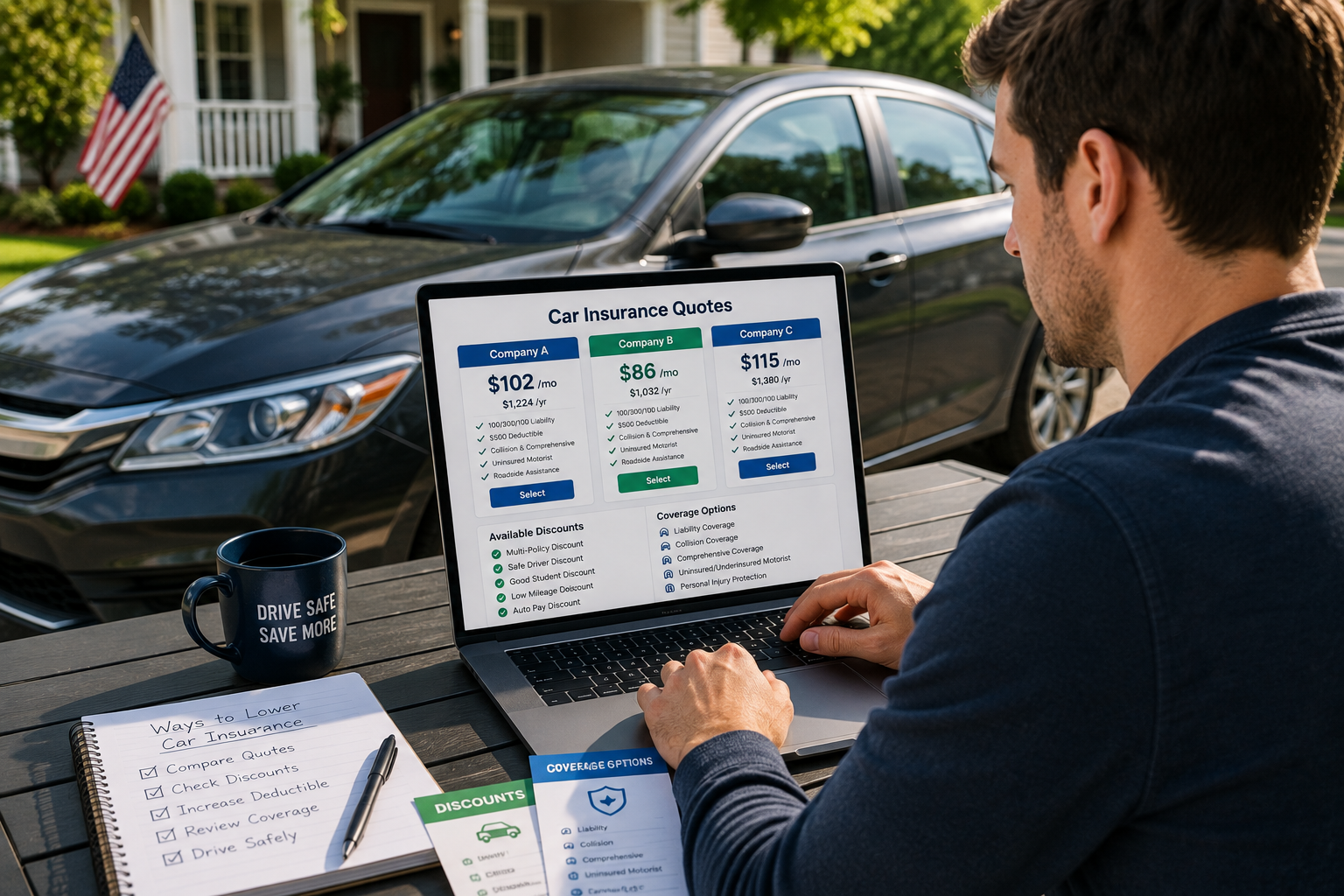
If you’re looking for how to lower car insurance, there are several practical ways to reduce your premium without giving up coverage you actually need. Comparing quotes, asking about discounts, adjusting your deductible, driving less and maintaining a clean driving record can all help lower your costs.
How to Lower Car Insurance Without Sacrificing the Coverage You Need
If you’re wondering how to lower car insurance, the best approach isn’t always to simply choose the cheapest policy. Your premium can be affected by factors such as your driving record, location, vehicle, annual mileage, coverage choices, deductible and claims history. The good news is that there are several practical ways to reduce your car insurance costs without automatically giving up important protection.
The National Association of Insurance Commissioners (NAIC) recommends regularly reviewing your policy, checking available discounts, comparing insurers and making sure the information used to calculate your premium is accurate.
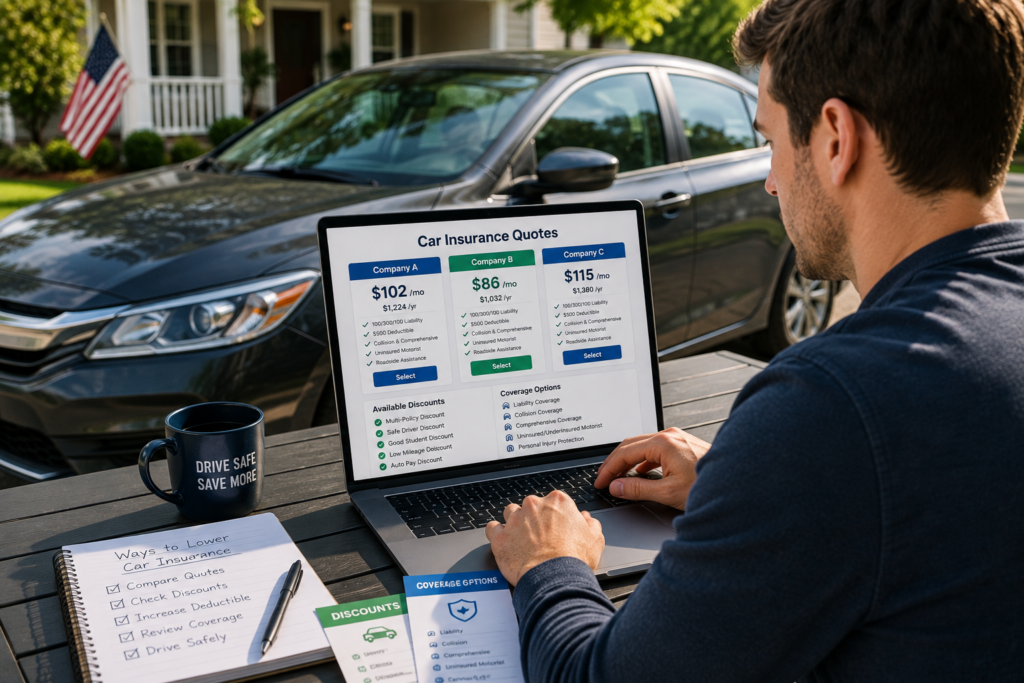
Quick Answer: How Can You Lower Your Car Insurance?
You may be able to lower your car insurance by:
- Comparing quotes from multiple insurers
- Asking about every available discount
- Maintaining a clean driving record
- Increasing your deductible if you can afford it
- Reviewing unnecessary optional coverage
- Driving fewer miles when possible
- Considering usage-based insurance
- Bundling auto and other insurance policies
- Improving your credit-based insurance profile where permitted
- Choosing a vehicle that costs less to insure
- Removing drivers who no longer live in your household or use the vehicle
- Taking an approved defensive-driving course
- Checking that your policy information is accurate
- Reviewing your insurance after major life changes
- Shopping around again at renewal
Not every strategy works for every driver, and insurance rules vary by state.
1. Compare Car Insurance Quotes From Multiple Companies
One of the simplest ways to potentially lower your car insurance is to shop around.
Different insurers can charge different premiums for the same driver and vehicle because companies use their own underwriting and rating methods.
The NAIC recommends getting quotes from several companies and comparing policies with similar coverage rather than choosing based only on price.
When comparing quotes, keep these the same:
- Liability limits
- Collision coverage
- Comprehensive coverage
- Deductibles
- Uninsured/underinsured motorist coverage
- Optional coverage
Otherwise, a cheaper quote may simply provide less coverage.
Example
Suppose you receive:
- Company A: $145/month
- Company B: $118/month
- Company C: $132/month
At first glance, Company B looks cheapest.
But if Company B has lower liability limits or a higher deductible, the comparison isn’t really equal.
Compare like-for-like coverage before switching.
2. Ask Your Insurer About Every Discount
You may already qualify for discounts that aren’t being fully applied to your policy.
The NAIC lists several discounts insurers may offer, including:
- Multi-car discounts
- Good-student discounts
- Driver education discounts
- Safety-equipment discounts
- Anti-theft discounts
- Home-and-auto bundling
- Low-mileage discounts
- Good-driver discounts
Availability varies by insurer and state.
Instead of asking:
“Can you make my insurance cheaper?”
ask:
“Can you check whether I’m receiving every discount I’m eligible for?”
That question can lead to a much more useful conversation.
3. Maintain a Clean Driving Record
Your driving history is one of the factors insurers may use when determining your premium.
Tickets, accidents and other violations can increase your perceived risk.
The NAIC lists driving record and claims history among the factors insurers may consider when pricing auto insurance.
Simple habits that can help
- Follow speed limits
- Avoid distracted driving
- Don’t drive under the influence
- Leave enough following distance
- Avoid unnecessary aggressive driving
- Use defensive-driving techniques
A clean record won’t guarantee a lower premium, but avoiding violations and preventable accidents can help your insurance profile over time.
4. Increase Your Deductible
If you have collision and comprehensive coverage, your deductible is the amount you generally pay toward a covered loss before the insurer pays the remaining covered amount.
A higher deductible can reduce your premium.
For example:
| Deductible | Possible effect |
|---|---|
| $250 | Higher premium |
| $500 | Moderate premium |
| $1,000 | Lower premium |
The NAIC specifically notes that higher deductibles generally mean lower premiums.
But there’s an important catch.
If you raise your deductible from $500 to $1,000, you need to be comfortable paying that $1,000 if you have a covered claim.
Don’t choose a deductible you couldn’t realistically afford.
5. Review Your Coverage
Sometimes the reason your insurance is expensive isn’t the insurer—it’s the amount or type of coverage you’re carrying.
That doesn’t mean you should simply remove coverage.
Instead, review your policy and ask:
- Do I still need every optional coverage?
- Is my vehicle still worth carrying comprehensive and collision coverage?
- Has my financial situation changed?
- Are any optional benefits no longer useful?
- Does my lender require certain coverage?
The NAIC recommends evaluating the value of an older vehicle against the cost of comprehensive and collision coverage before dropping those coverages.
Be careful with this strategy
Dropping coverage can lower your premium, but it also increases your financial risk.
If you have a newer vehicle, a financed vehicle or a car you couldn’t afford to replace yourself, reducing coverage may not be a good trade-off.
6. Drive Fewer Miles
Your annual mileage can affect your insurance premium.
Generally, driving less means less exposure to accidents.
The NAIC identifies annual mileage and vehicle use as factors insurers may consider when calculating premiums.
If you’ve recently:
- Started working from home
- Changed jobs
- Started using public transportation
- Moved closer to work
- Started carpooling
- Stopped commuting regularly
tell your insurer.
You may qualify for a lower-mileage rate or discount depending on the company and state.
Don’t underestimate your mileage just to get a lower quote. Give your insurer accurate information.
7. Consider Usage-Based Insurance
Usage-based insurance, sometimes called telematics-based insurance, uses technology to evaluate aspects of how and how much you drive.
Depending on the program, insurers may look at factors such as:
- Mileage
- Braking
- Acceleration
- Speed
- Time of day
- Driving patterns
The NAIC notes that usage-based programs can use driving data to determine premiums or discounts, although availability varies.
Who might benefit?
Usage-based insurance may be worth considering if you:
- Drive relatively few miles
- Usually drive safely
- Avoid aggressive braking
- Don’t frequently drive late at night
- Are comfortable sharing driving data with your insurer
One thing to consider
Understand exactly what information the program collects and how it can affect your rate before enrolling.
8. Bundle Your Insurance Policies
If you have multiple insurance policies, ask whether combining them with one company could reduce your overall cost.
For example, you may have:
- Auto insurance
- Renters insurance
- Homeowners insurance
Some insurers offer a multi-policy or bundling discount.
The NAIC lists auto/home insurance with the same company as one potential discount.
But don’t assume bundling is automatically cheaper.
Compare the total cost of all policies before switching.
9. Ask About Good Student Discounts
If you’re a student, ask your insurer whether you qualify for a good-student discount.
The NAIC lists good-student discounts among discounts some insurers may offer, particularly for younger drivers.
Requirements vary.
You may need to provide proof of academic performance or meet other eligibility criteria.
If you’re a college student, this can be particularly useful when combined with other discounts.
Internal link opportunity: Link naturally here to your Maintain Market article about car insurance for college students.
10. Take an Approved Defensive-Driving Course
Some insurers offer discounts to drivers who complete approved defensive-driving or driver-education courses.
The NAIC identifies defensive-driving and driver-education discounts as potential ways to reduce premiums.
However, not every course qualifies.
Before paying for a course, ask your insurer:
“Which defensive-driving courses qualify for an insurance discount in my state?”
This prevents you from spending money on a course that doesn’t actually reduce your premium.
11. Choose a Car That Costs Less to Insure
Your vehicle can have a significant effect on insurance pricing.
Insurers may consider:
- Repair costs
- Replacement costs
- Theft frequency
- Vehicle safety
- Accident claims
- Vehicle value
- Performance
The NAIC notes that luxury and sports cars can have higher average claim costs, while vehicle safety features can influence pricing.
Before buying a car
Don’t ask only:
“Can I afford the monthly car payment?”
Also ask:
“How much will this car cost me to insure?”
Get an insurance quote before purchasing the vehicle.
That small step can prevent an unpleasant surprise later.
12. Check for Vehicle Safety and Anti-Theft Discounts
Some insurers offer discounts for qualifying safety or anti-theft features.
Potential examples include:
- Airbags
- Anti-lock brakes
- Automatic emergency braking
- Anti-theft systems
- Vehicle recovery systems
- Other approved safety equipment
The NAIC lists safety equipment and anti-theft devices among potential discount categories.
Don’t assume every safety feature automatically produces a discount.
Ask your insurer which features qualify.
13. Make Sure Your Policy Information Is Accurate
An incorrect address, vehicle classification or driver detail can affect your premium.
Review your declarations page and check:
- Your address
- Vehicle make and model
- Vehicle use
- Annual mileage
- Driver information
- Discounts
- Coverage limits
- Deductibles
The NAIC specifically recommends checking that the information used to determine your premium is accurate.
Example
If you used to commute 15,000 miles per year but now work from home and drive only 6,000 miles, your insurer should have accurate information about your current usage.
14. Remove Drivers Who No Longer Use Your Vehicle
If someone who was previously listed on your policy no longer lives in your household or no longer drives your vehicle, ask your insurer whether they should remain listed.
Removing an unnecessary driver can potentially reduce your premium.
However, don’t remove someone simply to get a cheaper rate if they still regularly drive the vehicle.
Your policy should accurately reflect who uses the car.
15. Review Your Insurance Every Year
Your insurance needs can change.
Maybe:
- You moved
- You got married
- You started working from home
- Your teenager left for college
- You paid off your car
- You bought another vehicle
- Your annual mileage dropped
- Your driving record improved
- Your vehicle became much older
These changes can affect your insurance situation.
The NAIC recommends regularly reviewing your policy and updating it when circumstances change.
Also read: Car Insurance Claim Denied in USA? 7 Hidden Reasons You’re Losing Money
Can Improving Your Credit Lower Car Insurance?
In some states, potentially yes.
Some insurers use credit-based insurance information or insurance scores when permitted by state law.
The NAIC lists credit history among factors that may affect auto insurance pricing, but rules vary by state.
If your state permits this practice, improving your overall financial and credit profile may eventually help with insurance pricing at some insurers.
However, don’t assume that paying off one credit card will immediately lower your premium.
Insurance pricing is based on multiple factors.
Should You Pay Car Insurance Monthly or Annually?
The answer depends on the insurer and payment options.
Some insurers may offer discounts for certain payment methods or paperless/autopay arrangements.
For example, Progressive lists bundling, autopay and online policy options among potential ways to reduce certain insurance costs.
Before choosing a payment plan, compare the total annual cost, not just the monthly amount.
A smaller monthly payment isn’t necessarily a cheaper policy overall.
Does Moving Affect Car Insurance Rates?
Yes, it can.
Your location is an important rating factor because insurers consider factors such as local claims experience and risk.
The NAIC identifies geographic territory and garaging location as factors that can affect premiums.
Moving from a dense urban area to a lower-risk area could potentially reduce your premium.
But moving to another ZIP code—even within the same city—can sometimes change your rate.
Always update your insurer when your primary address changes.
Can Parking Your Car in a Garage Lower Insurance?
Potentially.
Where your vehicle is stored can be considered when calculating your premium.
The NAIC notes that parking in a garage or off-street location can sometimes result in lower premiums.
If you’ve moved from street parking to a garage, ask your insurer whether the change affects your rate.
Should You Drop Comprehensive and Collision Coverage to Save Money?
Not automatically.
This is one of the most important decisions to make carefully.
Comprehensive and collision coverage can protect your vehicle from different types of damage.
Before removing them, consider:
Your car’s value
A very old vehicle may not justify the same coverage as a newer vehicle.
Your deductible
If you have a high deductible, the amount of protection you’re buying may need to be evaluated differently.
Your ability to replace the car
Could you afford to repair or replace your vehicle yourself?
Your lender
If your car is financed or leased, your lender may require comprehensive and collision coverage.
The NAIC recommends weighing the vehicle’s value and replacement/repair cost against the premium savings before removing these coverages.
What Is the Fastest Way to Lower Your Car Insurance?
If you want to try to reduce your premium right now, start with these five steps:
1. Get three to five quotes
Compare equivalent coverage.
2. Ask for every available discount
Don’t assume the insurer has automatically applied everything.
3. Review your deductible
See what happens to your premium if you increase it.
4. Check your mileage
Make sure your insurer has accurate annual mileage.
5. Review unnecessary coverage
Especially if your vehicle is older or your circumstances have changed.
These steps can often be completed without buying a new vehicle or making major lifestyle changes.
How Much Can You Save by Lowering Your Car Insurance?
There is no universal savings amount.
Your potential savings depend on:
- Current premium
- State
- Age
- Driving history
- Vehicle
- ZIP code
- Coverage
- Deductible
- Discounts
- Mileage
- Claims history
For that reason, be skeptical of websites promising that everyone can save a specific percentage.
A better approach is to calculate your actual savings.
Example
Current premium:
$2,160/year
New comparable quote:
$1,680/year
Potential annual savings:
$480
Monthly equivalent:
$40/month
But before switching, confirm that the new policy provides comparable coverage.
What Should You Not Do to Lower Car Insurance?
Trying to save money can backfire if you provide inaccurate information or remove protection you actually need.
Don’t:
- Lie about your address
- Underreport mileage
- Hide household drivers
- Misrepresent how you use the vehicle
- Give false information about your driving record
- Choose a deductible you can’t afford
- Drop required coverage
- Remove required coverage from a financed vehicle
- Buy dramatically lower liability limits without understanding the risk
A lower premium isn’t a good deal if it leaves you financially exposed or creates problems with your policy.
A Simple Car Insurance Savings Checklist
Before your next renewal, ask yourself:
□ Have I compared quotes from other insurers?
□ Am I receiving every discount I qualify for?
□ Has my annual mileage changed?
□ Has my driving record improved?
□ Can I comfortably afford a higher deductible?
□ Do I still need every optional coverage?
□ Has my vehicle’s value changed significantly?
□ Do I qualify for a good-student or defensive-driving discount?
□ Can I save through bundling?
□ Is my address and vehicle information correct?
□ Does my insurer offer a telematics program that makes sense for me?
□ Am I paying for coverage I no longer need?
If you answer these questions before renewal, you’ll have a much better idea of where your money is going.
Frequently Asked Questions About Lowering Car Insurance
Q1. How can I lower my car insurance quickly?
Start by comparing quotes, asking about discounts, checking your mileage, reviewing your deductible and making sure your policy information is accurate.
Q2. What is the best way to lower car insurance?
There isn’t one strategy that works for everyone. Comparing insurers and checking all available discounts are two of the most broadly useful starting points. The NAIC recommends shopping around and reviewing your coverage regularly.
Q3. Does raising my deductible lower my car insurance?
Generally, yes. A higher deductible usually means a lower premium, but you will have to pay more out of pocket if you file a covered claim.
Q4. Does driving less lower car insurance?
It can. Mileage is one factor insurers may consider, and some insurers offer low-mileage or usage-based programs.
Q5. Can a good driving record lower car insurance?
A clean driving record can help because insurers may consider violations and accident history when assessing risk and pricing.
Q6. Can bundling home and auto insurance lower my premium?
It can. Some insurers offer multi-policy discounts when you purchase auto and home or renters insurance from the same company.
Q7. Can a defensive-driving course lower car insurance?
Some insurers offer discounts for qualifying defensive-driving or driver-education courses. Requirements vary by state and insurer.
Q8. Can students get cheaper car insurance?
Some students may qualify for good-student discounts or other programs. Eligibility varies by insurer and state.
Q9. Does a higher credit score lower car insurance?
It can in states where insurers are permitted to use credit-based insurance information. State rules differ, and credit is only one of several factors that may affect premiums.
Q10. Can changing cars lower my insurance?
Potentially. Vehicle type, repair costs, theft rates, safety features and value can all affect insurance pricing.
Q11. Should I switch car insurance companies to save money?
If you find a lower quote with comparable coverage and the insurer meets your needs, switching may make sense. Compare the complete policy rather than the premium alone.
Q12. How often should I shop for car insurance?
It’s reasonable to compare periodically, especially at renewal or after a major life change. There is no requirement to stay with the same insurer indefinitely.
Final Takeaway
Learning how to lower car insurance doesn’t have to mean sacrificing the coverage you need.
Start with the simplest steps:
Compare quotes.
Ask about discounts.
Check your mileage.
Review your deductible.
Maintain a clean driving record.
Review your coverage.
Make sure your policy information is accurate.
Then look at more situation-specific options such as telematics, defensive-driving courses, bundling and changing vehicles.
Most importantly, don’t judge a policy by its premium alone.
A policy that costs $100 less per year isn’t necessarily better if it has significantly lower liability limits, a higher deductible or less useful coverage.
The goal isn’t simply to get the cheapest car insurance.
The goal is to get the right protection at a price you can reasonably afford.
Why Maintain Market Is Different
At Maintain Market, we don’t believe saving money means blindly choosing the cheapest option.
With insurance, the cheapest policy can sometimes leave you with less protection than you actually need.
That’s why our approach is different.
We focus on explaining:
- What actually affects your insurance cost
- Which discounts may be available
- Where you can potentially save
- What you should think about before reducing coverage
- How deductibles affect your costs
- How mileage and driving behavior can matter
- What questions to ask your insurer
- How to compare policies properly
We also use authoritative sources such as the National Association of Insurance Commissioners (NAIC) when explaining important insurance concepts, rather than presenting unsupported savings claims.
Our goal isn’t to tell every driver:
“Do this and you’ll save exactly 30%.”
Your insurance premium is personal.
Instead, we want to give you enough practical information to identify where you may be overpaying and what you can realistically change.
Maintain Market — Clear information. Smarter financial decisions.