
A cracked windshield can happen when you least expect it, leaving many drivers wondering, does car insurance cover windshield replacement? The answer depends on your coverage, deductible, and state laws. This guide explains everything you need to know.
Quick Answer
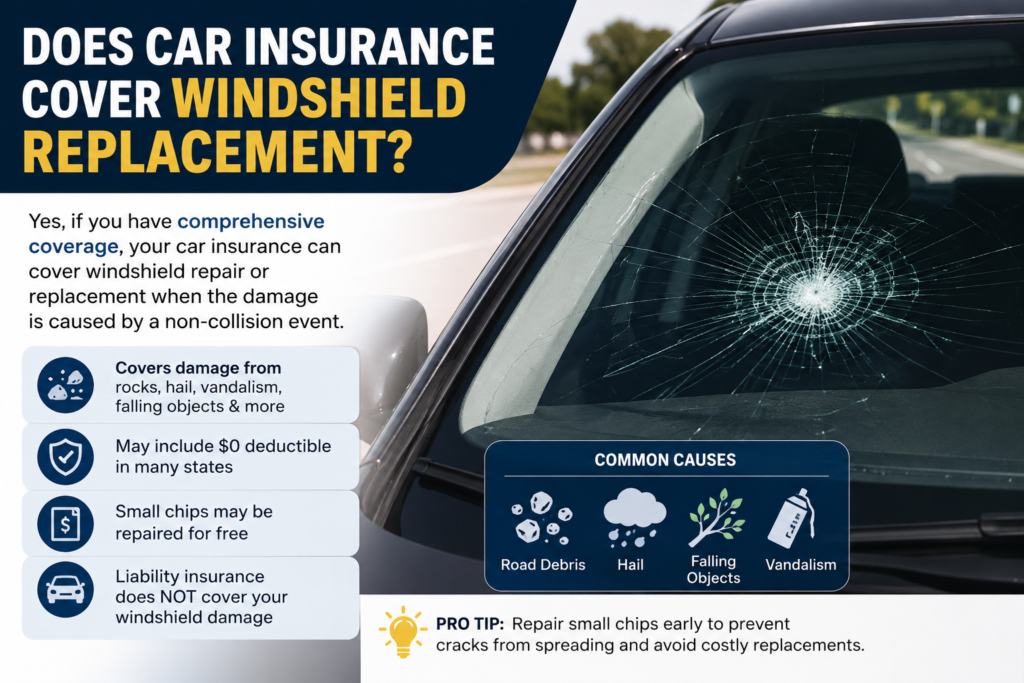
Yes, car insurance can cover windshield replacement if you have comprehensive coverage. Depending on your state and insurer, you may pay a deductible or receive free windshield replacement. Coverage typically applies when damage is caused by rocks, hail, vandalism, falling objects, or other non-collision incidents.
AI Overview Answer
If your windshield cracks because of road debris, hail, vandalism, or another non-collision event, comprehensive car insurance generally pays for repairs or replacement. Some U.S. states even require insurers to waive deductibles for windshield replacement. Whether you’ll pay anything depends on your policy, deductible, and state laws.
Key Takeaways
- Comprehensive insurance usually covers windshield replacement.
- Liability insurance does not pay for your windshield damage.
- Many insurers repair small chips for free.
- Some states offer zero-deductible windshield replacement.
- Repairing chips early can prevent expensive replacements.
- Filing a glass claim often has little or no impact on premiums, but policies vary by insurer.
Does Car Insurance Cover Windshield Replacement?
Imagine you’re driving to work on a peaceful Monday morning.
Traffic is moving smoothly. You’re sipping your coffee, listening to your favorite podcast, and thinking about the day ahead.
Then…
Crack!
A tiny rock flies off the truck in front of you and hits your windshield.
At first, it looks like a tiny chip.
By lunchtime, that chip has stretched halfway across the windshield.
Now you’re asking yourself the same question millions of Americans ask every year:
“Will my car insurance pay for this?”
The good news is that in many cases, yes—it will.
However, the answer isn’t always that simple.
Your coverage depends on:
- Your insurance policy
- The cause of the damage
- Your deductible
- Your insurance company
- The state where you live
Understanding these factors can save you hundreds—or even thousands—of dollars.
Why Windshield Damage Happens More Often Than You Think
Most drivers assume accidents are the biggest threat to their vehicles.
Surprisingly, that’s not always true.
Every day across the United States, thousands of windshields are damaged by events completely outside a driver’s control.
Common causes include:
- Flying rocks
- Gravel from construction trucks
- Hailstorms
- Falling tree branches
- Severe weather
- Road debris
- Vandalism
- Animal impacts
Many of these incidents happen without warning.
You may be driving carefully, following every traffic law, and still end up with a cracked windshield.
That’s why comprehensive insurance exists—to protect you from unexpected events that aren’t caused by a collision.
Which Insurance Covers Windshield Replacement?
Not every type of car insurance pays for windshield damage.
Here’s a simple comparison:
| Insurance Type | Covers Windshield Replacement? | Why? |
|---|---|---|
| Liability Insurance | ❌ No | Covers damage you cause to others only. |
| Collision Coverage | Usually No | Applies when your vehicle collides with another vehicle or object. |
| Comprehensive Coverage | ✅ Yes | Covers non-collision damage like rocks, hail, vandalism, and falling objects. |
| Full Coverage | ✅ Usually Yes | Includes comprehensive coverage if it’s part of your policy. |
The most important coverage is comprehensive insurance.
Without it, you’ll likely have to pay for repairs yourself unless another driver’s insurance is responsible.
Understanding Comprehensive Coverage
Think of comprehensive insurance as protection against life’s unexpected surprises.
It helps cover damage caused by events you can’t reasonably prevent.
Examples include:
- A baseball crashes through your windshield during a neighborhood game.
- A tree branch falls during a storm.
- Hail shatters your windshield overnight.
- Someone vandalizes your parked car.
- Road debris cracks the glass on your morning commute.
These situations aren’t your fault.
That’s exactly why comprehensive insurance exists.
Real-Life Example: Mike’s Highway Commute
Mike, a software engineer from Colorado, drove nearly 40 miles each day.
One morning, a dump truck merged into his lane.
Tiny gravel pieces flew from the truck’s tires.
Within seconds, one rock struck his windshield.
The damage looked minor.
“I’ll fix it later,” he thought.
Over the next week, changing temperatures caused the chip to spread across the entire windshield.
The repair that would have cost less than $100 turned into an $850 replacement.
Fortunately, Mike had comprehensive coverage.
After paying his deductible, his insurer covered the remaining cost, saving him several hundred dollars.
His biggest regret wasn’t filing the claim—it was waiting too long to repair the damage.
When Does Insurance Pay for Windshield Replacement?
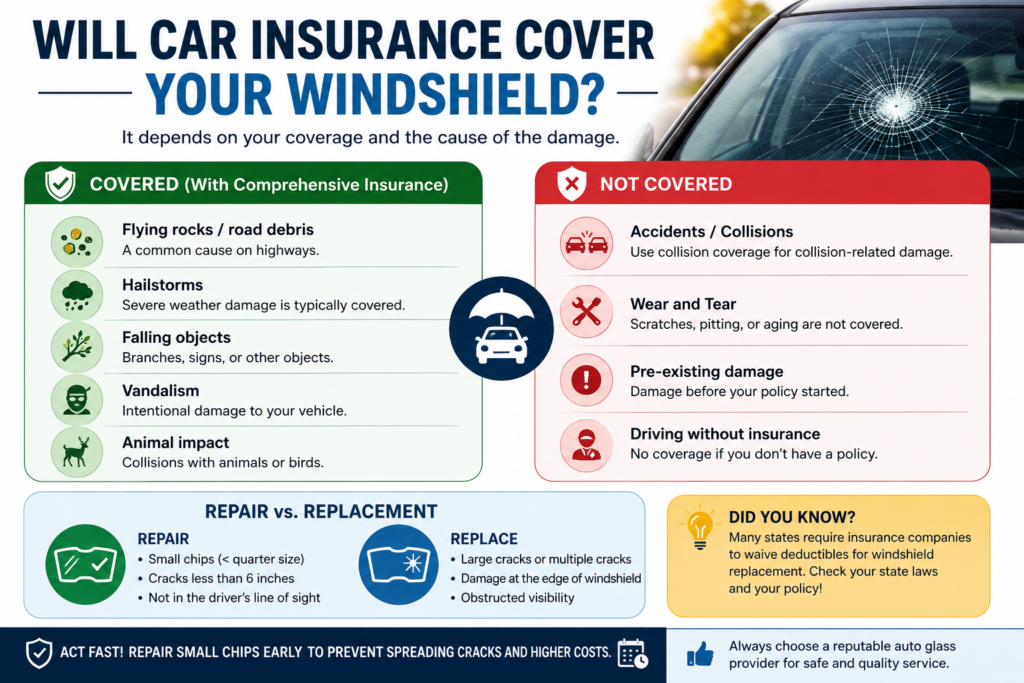
Insurance usually covers windshield replacement when the damage results from a covered non-collision event.
Examples include:
Flying Road Debris
Loose gravel and rocks are among the leading causes of windshield damage in the U.S.
These incidents happen every day, especially on highways and construction routes.
Hailstorms
Large hailstones can easily crack or completely shatter auto glass.
If you carry comprehensive coverage, your insurer will generally pay for the damage after any applicable deductible.
Falling Objects
Tree limbs, construction materials, signs, or other falling objects may damage your windshield during storms or windy conditions.
These are commonly covered under comprehensive insurance.
Vandalism
If someone intentionally damages your windshield, comprehensive insurance typically covers the repair or replacement after you report the incident.
Wildlife
Birds, deer, or other animals can strike your windshield unexpectedly.
Depending on the circumstances, comprehensive coverage may apply.
When Won’t Insurance Cover Windshield Replacement?
Understanding what’s not covered is just as important.
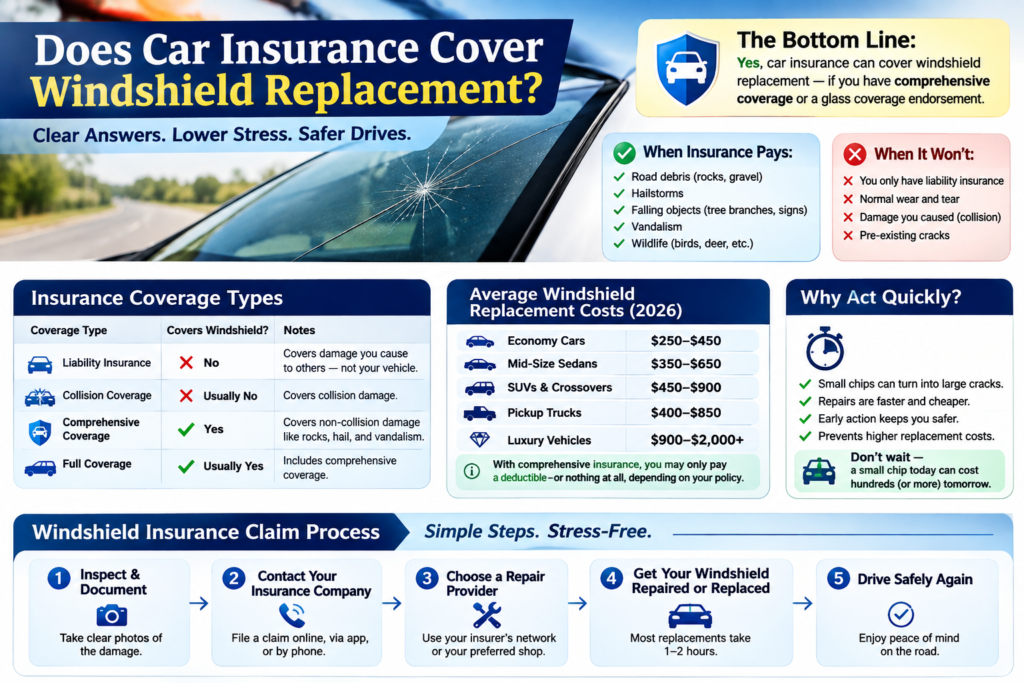
Insurance may deny your claim if:
You Only Carry Liability Insurance
Liability coverage protects other people—not your own vehicle.
If you don’t have comprehensive coverage, you’ll generally pay the repair bill yourself.
Normal Wear and Tear
Small scratches, aging, or gradual deterioration aren’t considered sudden accidental damage.
Insurance isn’t designed to cover routine maintenance.
Existing Damage
If your windshield was already cracked before purchasing the policy, insurers won’t pay to replace it later.
Fraudulent Claims
Submitting false information or intentionally damaging your windshield can result in denied claims and possible legal consequences.
The Hidden Cost of Waiting
Many drivers delay fixing a tiny chip because it seems harmless.
Unfortunately, windshields are under constant pressure from:
- Heat
- Cold
- Road vibrations
- Speed
- Moisture
A chip smaller than a coin can become a crack stretching across the windshield within days.
Replacing a windshield often costs several times more than repairing a small chip.
If your insurer offers free chip repair, acting quickly could save both time and money while helping preserve your vehicle’s structural safety.
How Much Does Windshield Replacement Cost in the U.S.?
One of the first questions most drivers ask after discovering a cracked windshield is:
“How much is this going to cost me?”
The answer depends on several factors, including your vehicle’s make and model, whether it has Advanced Driver Assistance Systems (ADAS), and the type of glass required.
Modern vehicles often have cameras and sensors mounted behind the windshield. After replacement, these systems usually need ADAS recalibration, which increases the total cost.
Average Windshield Replacement Costs (2026)
| Vehicle Type | Average Cost |
|---|---|
| Economy Cars | $250–$450 |
| Mid-Size Sedans | $350–$650 |
| SUVs & Crossovers | $450–$900 |
| Pickup Trucks | $400–$850 |
| Luxury Vehicles | $900–$2,000+ |
| Vehicles with ADAS Cameras | Additional $200–$600 for calibration |
A luxury SUV with lane-keeping assist, adaptive cruise control, and rain sensors can easily cost over $1,500 for a complete windshield replacement.
That’s why comprehensive insurance can be one of the most valuable coverages on your policy.
Windshield Repair vs. Replacement: How Insurance Companies Decide
Not every cracked windshield needs to be replaced.
Insurance companies usually follow industry safety standards when deciding whether your windshield should be repaired or replaced.
A Repair Is Usually Possible If:
- The chip is smaller than a quarter.
- The crack is shorter than about 6 inches.
- The damage is not directly in the driver’s line of sight.
- The inner layer of glass remains intact.
- The damage is recent and hasn’t spread.
Repairs are quicker, less expensive, and help preserve the windshield’s original factory seal.
A Replacement Is Usually Necessary If:
- The crack extends across the windshield.
- Multiple cracks are present.
- The damage reaches the edge of the glass.
- Visibility is affected.
- ADAS cameras or sensors are impacted.
- The structural integrity of the windshield is compromised.
Remember, the windshield contributes significantly to your vehicle’s roof strength and supports proper airbag deployment during a collision. A severely damaged windshield isn’t just a cosmetic issue—it can become a serious safety concern.
Real-Life Story: Emily’s Family Road Trip
Emily and her husband had planned a long-awaited summer road trip from Ohio to Florida with their two young children.
Just outside Atlanta, a loose stone from a construction vehicle struck their windshield.
At first, the damage looked like a tiny star-shaped chip.
Emily considered waiting until they returned home.
The next morning, after the car sat overnight in the heat, the chip had turned into a crack stretching nearly halfway across the windshield.
Their vacation suddenly became stressful.
Instead of enjoying the beaches, they spent hours locating an auto glass shop and contacting their insurance company.
Fortunately, Emily had comprehensive coverage with glass protection. The insurer approved the replacement quickly, allowing the family to continue their trip safely.
Looking back, Emily said,
“I thought it was just a small chip. I never imagined it could spread overnight.”
Her experience is a reminder that acting quickly often saves both time and money.
Does Filing a Windshield Claim Increase Insurance Rates?
This is one of the most misunderstood questions in auto insurance.
The honest answer is:
It depends.
Many insurance companies treat glass claims differently from at-fault accident claims.
If your windshield was damaged by a rock, hail, or another event outside your control, a single glass claim often has little or no effect on your premium.
However, insurers consider several factors, including:
- Your claim history.
- The number of recent claims.
- Your insurer’s underwriting guidelines.
- Your state.
- Whether you have accident forgiveness or glass coverage endorsements.
For example:
- One windshield claim in several years may have no noticeable impact.
- Filing multiple glass claims in a short period could influence future pricing or policy renewal decisions with some insurers.
If you’re unsure, ask your insurance representative how glass claims are handled before filing.
Will You Have to Pay a Deductible?
Many drivers are surprised to learn that the answer varies.
You May Pay a Deductible If:
- Your comprehensive policy includes one.
- Your state doesn’t require deductible waivers.
- Your insurer doesn’t offer full glass coverage.
For example:
Suppose your deductible is $500, and replacing your windshield costs $850.
You would typically pay the first $500, and your insurance would cover the remaining $350.
You May Not Pay a Deductible If:
- Your policy includes full glass coverage.
- Your insurer waives deductibles for windshield repairs.
- Your state requires zero-deductible windshield replacement under certain conditions.
Always review your declarations page or ask your insurer before assuming you’ll have to pay out of pocket.
States That Offer Special Windshield Replacement Benefits
Several states have laws or insurance practices that provide additional protection for drivers when it comes to windshield replacement.
Depending on your insurer and state regulations, eligible drivers may receive windshield replacement with no deductible under certain comprehensive policies.
Examples include states that have long been known for favorable glass coverage laws, such as:
- Florida
- Kentucky
- South Carolina
Because insurance regulations can change over time and vary by policy, always verify the current rules with your insurer or state insurance department.
Case Study #1: The Construction Zone Surprise
Driver: Daniel
Location: Texas
The Problem
Daniel commuted through an active highway construction zone every morning.
One day, loose gravel from a truck struck his windshield, creating a small chip.
Thinking it wasn’t urgent, he ignored it.
Three weeks later, temperature changes caused the chip to expand into a crack spanning nearly the entire windshield.
The repair option was no longer available.
The Solution
Daniel contacted his insurance company.
Because he carried comprehensive coverage, the insurer approved a full replacement after his deductible.
Lesson Learned
Small chips rarely stay small.
Prompt repairs often prevent more expensive replacements.
Case Study #2: The Hailstorm That Changed Everything
Driver: Linda
Location: Oklahoma
The Problem
A powerful spring hailstorm damaged Linda’s SUV overnight.
She woke up to find:
- Broken windshield.
- Cracked rear window.
- Dented hood.
- Damaged roof.
The repair estimate exceeded $4,000.
Linda feared she’d have to postpone her family’s planned move because of the unexpected expense.
The Solution
Her comprehensive insurance covered nearly all of the repairs after the applicable deductible.
Within days, her vehicle was back on the road.
Lesson Learned
Weather damage is unpredictable, and comprehensive insurance can significantly reduce the financial burden.
Common Mistakes Drivers Make
Many windshield claims become more expensive simply because of avoidable mistakes.
1. Ignoring Small Chips
A tiny chip can spread into a full crack within days.
2. Waiting Too Long
Extreme heat, cold, and road vibrations accelerate crack growth.
3. Assuming Liability Insurance Covers Everything
Liability insurance protects others—not your own vehicle.
4. Choosing the Cheapest Repair Shop
Poor-quality installation can lead to water leaks, wind noise, or ADAS calibration issues.
5. Not Asking About Mobile Repair
Many insurers partner with providers that can repair or replace your windshield at your home or workplace, saving you time.
Expert Tips to Save Money
Insurance professionals often recommend these practical steps:
Inspect Your Windshield Regularly
Check for chips after highway driving or severe weather.
Repair Chips Immediately
A quick repair is usually faster, less expensive, and helps preserve the original windshield.
Review Your Deductible
If you frequently drive on highways or gravel roads, consider whether a lower comprehensive deductible or optional glass coverage makes sense for your budget.
Ask About Glass Coverage
Some insurers offer optional endorsements that reduce or eliminate out-of-pocket costs for windshield replacement.
Use Approved Repair Facilities
Many insurers have preferred repair networks that streamline the claims process and may include warranties on workmanship.
Is Windshield Replacement Worth Filing a Claim?
Ask yourself these questions:
- How much does the replacement cost?
- What is my comprehensive deductible?
- Does my policy include glass coverage?
- Will paying out of pocket cost less than the deductible?
- Is the damage affecting my visibility or safety?
If the replacement cost is only slightly higher than your deductible, paying out of pocket may be worth considering. However, if the repair bill is substantial or your policy offers favorable glass benefits, filing a claim could provide meaningful savings.
How to File a Windshield Insurance Claim
Finding a crack in your windshield can be frustrating, but the claims process is usually straightforward if you know what to do.
Step 1: Inspect the Damage
Take a close look at the windshield and determine:
- Is it a small chip or a long crack?
- Is the damage blocking your view?
- Has the crack reached the edge of the windshield?
If the damage affects your visibility, avoid driving until it has been repaired.
Step 2: Take Photos
Before making any repairs, take clear pictures from different angles.
These photos can help support your insurance claim and speed up the approval process.
Step 3: Review Your Insurance Policy
Check whether your policy includes:
- Comprehensive coverage
- Full glass coverage (if available)
- Your deductible amount
Knowing your coverage beforehand helps avoid surprises.
Step 4: Contact Your Insurance Company
Most insurers allow you to:
- File a claim online
- Use their mobile app
- Call customer support
- Work directly with an approved auto glass repair partner
Have the following information ready:
- Policy number
- Vehicle details
- Date and location of the incident
- Photos of the damage
Step 5: Schedule the Repair
Many insurance companies partner with certified auto glass providers.
In many cases, you can choose:
- Mobile windshield replacement at your home or workplace
- In-shop replacement
- Same-day appointments (depending on availability)
If your vehicle has ADAS features, ask whether calibration is included after the replacement.
What If Another Driver Caused the Damage?
Sometimes, another vehicle is responsible for your damaged windshield.
For example:
A truck carrying loose gravel fails to secure its load, and rocks strike your windshield.
In situations where another driver’s negligence can be established, their liability insurance may cover the damage. However, proving responsibility isn’t always easy, especially if the rock bounced off the road before hitting your vehicle.
If responsibility cannot be determined, many drivers choose to file a claim under their own comprehensive coverage, if available.
Frequently Asked Questions (FAQs)
Q1. Does car insurance always cover windshield replacement?
No. Windshield replacement is generally covered only if you have comprehensive coverage or another applicable glass coverage endorsement. Liability insurance alone does not cover damage to your own windshield.
Q2. Is windshield repair free with insurance?
Many insurers repair small chips at little or no cost under comprehensive coverage, but this varies by insurer and policy.
Q3. Will my deductible apply?
Possibly. Whether you pay a deductible depends on your policy, insurer, and the laws in your state.
Q4. How long does windshield replacement take?
Most replacements take about one to two hours, although vehicles with ADAS systems may require additional calibration time.
Q5. Can I drive immediately after replacement?
Most installers recommend waiting for the adhesive to cure before driving. Follow the specific instructions provided by your repair shop.
Q6. Can a cracked windshield fail a vehicle inspection?
Yes. In many states, significant windshield damage that obstructs the driver’s vision can cause a vehicle to fail a safety inspection.
Q7. Is a small chip dangerous?
Initially, it may not seem serious, but small chips often spread into larger cracks due to vibration and temperature changes.
Q8. Should I repair or replace my windshield?
Small chips are often repairable, while larger cracks, edge damage, or compromised structural integrity typically require replacement.
Q9. Does comprehensive insurance cover hail damage?
Yes. Hail damage to your windshield is commonly covered under comprehensive insurance.
Q10. Can windshield replacement affect my insurance premium?
A single glass claim often has little or no effect on premiums, but multiple claims or insurer-specific underwriting practices may influence future rates.
Q11. Does full coverage include windshield replacement?
In many cases, yes, because full coverage usually includes comprehensive insurance. However, always review your policy details to confirm.
Q12. What happens if I ignore a windshield crack?
The crack can spread over time, making repairs impossible and increasing replacement costs. It may also reduce visibility and compromise vehicle safety.
Q13. Does insurance cover windshield damage from road debris?
If you have comprehensive coverage, damage from road debris is commonly covered, subject to your policy terms.
Q14. Can I choose my own auto glass repair shop?
Many insurers allow you to select a repair shop, although using a preferred provider may simplify the claims process and include additional warranties.
Q15. What is ADAS calibration, and why is it important?
Many modern vehicles have cameras and sensors mounted on the windshield. After replacement, these systems often require calibration to ensure safety features such as lane departure warning and automatic emergency braking function correctly.
Expert Tips Before Filing a Claim
Before contacting your insurer, ask yourself:
- Is the replacement cost higher than my deductible?
- Does my policy include full glass coverage?
- Is the damage getting worse?
- Is my visibility affected?
- Have I compared repair costs from reputable providers?
Making an informed decision can save both money and time.
Final Thoughts
A cracked windshield is more than an inconvenience—it’s a safety issue that deserves prompt attention.
For many drivers, comprehensive car insurance provides valuable protection against unexpected events like road debris, hail, vandalism, and falling objects. Understanding your policy, acting quickly when damage occurs, and knowing whether a repair or replacement is needed can help you avoid larger expenses and stay safe on the road.
If you’re unsure about your coverage, review your policy documents or contact your insurance provider before an emergency happens. A few minutes spent understanding your insurance today could save you hundreds of dollars tomorrow.
Call to Action
Have you ever had to replace your windshield or file a glass insurance claim?
Share your experience in the comments below. Your story could help another driver make the right decision.
If you found this guide helpful, explore our other auto insurance resources to learn how to lower your premiums, understand your coverage options, and make smarter financial decisions as a vehicle owner.
Also Read: Car Insurance Before Buying a Car: Do You Need It? (2026 Best Guide)
People Also Searched For: How Much Car Insurance Do I Need? Don’t Pay for the Wrong Coverage