
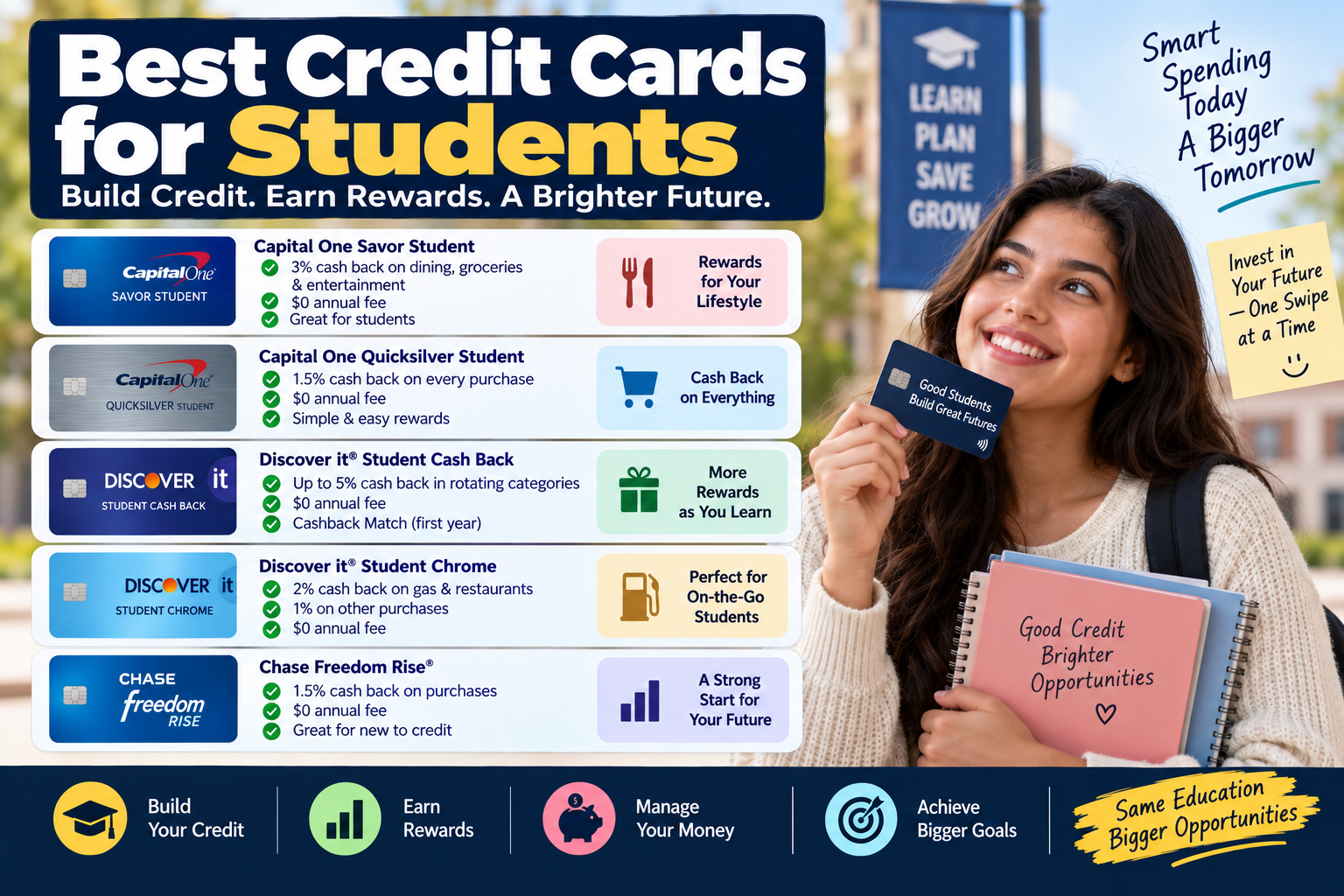
Finding the best credit cards for students can be confusing, especially if you’re applying for your first card and have little or no credit history. Student credit cards are generally designed with college students in mind and may offer easier qualification, lower credit limits, no annual fees, cash-back rewards, and tools that can help you establish credit responsibly.
The right card isn’t necessarily the one offering the biggest rewards. For most students, a better choice is a card with low fees, manageable rewards, realistic approval requirements, and strong credit-building potential.
Quick Answer: What Are the Best Credit Cards for Students?
Some of the strongest student credit cards to compare in 2026 include:
| Credit Card | Best For | Annual Fee | Main Benefit |
|---|---|---|---|
| Capital One Savor Student | Dining, groceries & entertainment | $0 | 3% cash back in eligible categories |
| Capital One Quicksilver Student | Simple cash back | $0 | 1.5% cash back on every purchase |
| Discover it® Student Cash Back | Rotating-category rewards | $0 | Up to 5% cash back in rotating categories when activated |
| Discover it® Student Chrome | Gas & dining | $0 | 2% cash back at gas stations and restaurants |
| Chase Freedom Rise® | Students new to credit | $0 | 1.5% cash back on purchases |
| Bank of America® Unlimited Cash Rewards for Students | Flat-rate cash back | $0 | 1.5% cash back on purchases |
| Bank of America® Customized Cash Rewards for Students | Category-based rewards | $0 | Choose a category for higher rewards |
| Bank of America® Travel Rewards for Students | Travel | $0 | Travel-focused rewards |
| Secured credit card | Limited credit history | Varies | Deposit-backed credit building |
| Credit-builder card | Students struggling to qualify | Varies | Designed to establish credit |
Credit-card rewards, bonuses, APRs, fees and eligibility requirements can change. Always check the issuer’s current terms before applying.
1. Capital One Savor Student — Best Overall for Rewards
The Capital One Savor Student is one of the strongest options for students who spend regularly on food, entertainment and streaming services.
Capital One currently lists the card with a $0 annual fee, 3% cash back at grocery stores and on dining, entertainment and popular streaming services, plus 1% on other purchases. Eligible new cardholders can also receive a current welcome bonus after meeting the required spending threshold.
Why consider it?
- $0 annual fee
- 3% cash back in eligible everyday categories
- 1% cash back on other purchases
- Student-focused eligibility
- Designed to help students build credit responsibly
Best for:
Students who spend a significant amount on food, entertainment, groceries and streaming.
2. Capital One Quicksilver Student — Best for Simple Cash Back
If you don’t want to track spending categories, the Capital One Quicksilver Student is easier to understand.
The card currently offers 1.5% cash back on every purchase, has a $0 annual fee and is designed for students who want to earn rewards while building credit.
Why consider it?
- $0 annual fee
- Unlimited 1.5% cash back
- Simple rewards structure
- No need to track rotating categories
- Student-focused card
Best for:
Students who want one simple cash-back rate on everyday spending.
3. Discover it® Student Cash Back — Best for Rotating Categories
The Discover it Student Cash Back can be attractive if you’re willing to activate quarterly bonus categories.
Discover currently advertises up to 5% cash back on everyday purchases at different places each quarter, up to the quarterly maximum when activated, plus 1% on other purchases. Discover also currently advertises an unlimited dollar-for-dollar Cashback Match at the end of the first year.
Why consider it?
- $0 annual fee
- Up to 5% cash back in selected quarterly categories
- 1% cash back on other purchases
- Cashback Match for the first year under the current offer
- No credit score required to apply for eligible students
Best for:
Students who are comfortable activating and using quarterly bonus categories.
4. Discover it® Student Chrome — Best for Gas & Dining
Students who drive to campus or regularly spend money at restaurants may prefer the Discover it Student Chrome.
Discover currently lists 2% cash back at gas stations and restaurants on up to $1,000 in combined purchases each quarter, plus 1% on other purchases. The card has a $0 annual fee.
Why consider it?
- $0 annual fee
- 2% cash back at gas stations and restaurants
- 1% cash back on other purchases
- Student-focused product
- Can be useful for students with limited credit history
Best for:
Commuter students and students who spend heavily on restaurants.
5. Chase Freedom Rise® — Best for Students New to Credit
The Chase Freedom Rise is designed for people who are new to credit, including students.
Chase currently lists a $0 annual fee, 1.5% cash back on other purchases and a current 3% dining offer. Chase also states that having at least $250 in a Chase checking or savings account increases your chances of approval.
Why consider it?
- $0 annual fee
- Designed for new-to-credit applicants
- 1.5% cash back on purchases
- Current dining promotion
- Potential pathway to future Chase products
Best for:
Students who are new to credit and already bank with Chase.
6. Bank of America® Unlimited Cash Rewards for Students — Best for Flat-Rate Rewards
The Bank of America Unlimited Cash Rewards credit card for Students offers a simple way to earn rewards without tracking rotating categories.
Bank of America currently lists unlimited 1.5% cash back on purchases and a $0 annual fee. Its current online offer also includes a cash-rewards bonus after meeting the required spending threshold.
Why consider it?
- $0 annual fee
- Unlimited 1.5% cash back
- Simple rewards structure
- Student-focused card
- No complicated reward categories
Best for:
Students who want straightforward cash back.
7. Bank of America® Customized Cash Rewards for Students — Best for Choosing a Spending Category
The Customized Cash Rewards for Students can make sense for students who want more control over where they earn higher rewards.
Instead of using one flat rewards rate for everything, the card is structured around selected spending categories.
Why consider it?
- Student-focused card
- $0 annual fee
- Category-based rewards
- Can work well when your spending is concentrated in particular areas
Best for:
Students who understand their spending habits and want to maximize rewards in specific categories.
Always check the current rewards structure and category limits before applying.
8. Bank of America® Travel Rewards for Students — Best for Student Travelers
Students who travel frequently may want to consider a student card focused on travel rewards.
Bank of America’s student travel card is designed for eligible students who want to earn rewards while making everyday purchases and using the card for travel.
Why consider it?
- Student-focused product
- $0 annual fee
- Travel-oriented rewards
- Useful for students who travel frequently
Best for:
Students who expect to spend regularly on travel and related purchases.
9. A Secured Credit Card — Best When Traditional Student Cards Aren’t Available
Not every student will qualify for an unsecured student credit card.
If you have limited credit history or difficulty getting approved, a secured credit card can be another route.
With a secured card, you generally provide a refundable security deposit that helps secure your credit line.
Why consider it?
- May be easier to qualify for
- Can help establish credit
- Deposit-backed account
- Some issuers offer an eventual upgrade to an unsecured card
Discover, for example, currently describes secured cards as an option for people who lack established credit and notes that some secured cards may eventually graduate to standard cards after responsible use.
Best for:
Students who can’t qualify for a traditional student card.
10. A Credit-Builder Card — Best for Students With Very Limited Credit
Some credit-building products are designed specifically for consumers who are just starting their credit journey.
These can be worth comparing if you don’t qualify for conventional student cards.
However, don’t assume that every credit-builder product is automatically a good deal.
Compare:
- Monthly fees
- Annual fees
- APR
- Credit reporting
- Deposit requirements
- Credit limit
- Upgrade opportunities
A low-fee product that reports responsibly to the major credit bureaus may be more valuable than a card with flashy rewards.
Best Student Credit Card by Situation
The “best” card depends on how you actually spend money.
| If You Are… | Consider |
|---|---|
| Spending heavily on dining and entertainment | Capital One Savor Student |
| Wanting simple cash back | Capital One Quicksilver Student |
| Comfortable with rotating categories | Discover it Student Cash Back |
| Spending heavily on gas and restaurants | Discover it Student Chrome |
| New to credit and use Chase | Chase Freedom Rise |
| Wanting flat-rate cash back | Bank of America Unlimited Cash Rewards for Students |
| Wanting category-based rewards | Bank of America Customized Cash Rewards for Students |
| Traveling regularly | Bank of America Travel Rewards for Students |
| Having difficulty getting approved | Secured credit card |
| Having very limited credit | Credit-builder card |
What Is a Student Credit Card?
A student credit card is a credit card designed specifically for college, graduate or other eligible students who may have limited or no credit history.
Student cards generally work like traditional credit cards, but they may have lower credit limits and eligibility criteria designed around people who are just beginning to establish credit.
They can provide two major benefits:
- Building credit
- Earning rewards on everyday spending
But neither benefit matters if you regularly miss payments or spend more than you can afford to repay.
Do You Need Good Credit to Get a Student Credit Card?
Not necessarily.
Some student cards are specifically designed for applicants with little or no established credit.
For example, Discover states that eligible students can apply for its Student Cash Back and Student Chrome cards without a credit score. Capital One also says its student cards may be available to students who don’t have a credit history yet.
However, being a student does not guarantee approval.
Issuers can consider income, existing debt, credit history and other information.
Can Students Get a Credit Card With No Credit History?
Yes.
Student credit cards are one of the main options for people who are beginning their credit journey.
Discover currently states that no credit score is required to apply for its eligible student cards, while Capital One describes student cards as products for students with minimal or no credit history.
If you don’t qualify for an unsecured student card, a secured credit card may be another option.
Do Students Need a Job to Get a Credit Card?
Not necessarily, but applicants generally need to demonstrate an ability to make payments.
For applicants under 21, federal rules impose additional requirements regarding income or ability to pay. Capital One notes that applicants under 21 must be able to show they can make the required minimum payments.
Never inflate or falsify income information on a credit-card application.
What Should Students Look for in a Credit Card?
Don’t choose a student card simply because it has the highest cash-back rate.
Consider these factors first.
1. Annual Fee
A $0 annual fee is often preferable for a first credit card.
There is little reason to pay an annual fee simply to establish credit if a suitable no-fee alternative is available.
2. APR
Student cards can have relatively high APRs.
If you carry a balance, interest charges can quickly outweigh your rewards.
3. Rewards
Look at where you actually spend money.
If you spend most of your money on groceries and dining, a category-based rewards card may make more sense than a flat-rate card.
4. Credit Reporting
A card that reports account activity to the major credit bureaus can help establish your credit history when you use the account responsibly.
5. Credit Limit
Don’t choose a card solely because it offers a large credit limit.
A smaller limit that you can manage responsibly can be perfectly adequate for building credit.
6. Prequalification
If the issuer provides an eligibility or prequalification tool, consider using it before submitting a full application.
This can help you understand your potential options without necessarily triggering the same type of hard inquiry as a full application.
How to Build Credit With a Student Credit Card
Getting approved is only the first step.
Your payment habits will matter much more over time.
Pay on time
Make every payment by the due date.
Pay the statement balance when possible
Paying your statement balance in full can help you avoid interest charges on purchases when your account terms provide a grace period.
Keep spending under control
Don’t spend $500 simply because your credit limit is $500.
Use the card for purchases you could realistically afford without borrowing.
Monitor your account
Check your account regularly for unexpected transactions and fees.
Don’t apply for multiple cards at once
One suitable card can be enough to start building credit.
Student Credit Card vs. Regular Credit Card
| Feature | Student Credit Card | Regular Credit Card |
|---|---|---|
| Target customer | Students | General consumers |
| Credit history | Often limited or none | Usually more established |
| Credit limit | Often lower | Can be higher |
| Rewards | Often student-friendly | Wide range |
| Annual fee | Many have $0 | Varies |
| Credit building | Yes | Yes |
| Approval | May be more accessible for students | Often depends more heavily on credit profile |
A student card isn’t necessarily better forever. Once your credit improves and your financial situation changes, you can compare broader credit-card options.
What Happens to a Student Credit Card After Graduation?
Graduating doesn’t necessarily mean your card immediately stops working.
The specific process depends on the issuer and card.
Some issuers may eventually transition or evaluate the account for other products, while others may simply allow you to continue using the same account under its existing terms.
Before applying, check what the issuer says about the card after graduation.
Common Mistakes Students Should Avoid
Carrying a balance just to build credit
You generally don’t need to pay interest to build credit.
Missing payments
Late payments can hurt the credit-building progress you’re trying to establish.
Spending the entire credit limit
Available credit isn’t free money.
Applying for too many cards
Multiple applications can create unnecessary hard inquiries.
Ignoring the APR
A high APR can become expensive if you carry balances.
Choosing rewards over affordability
The best rewards card is useless if the interest and fees outweigh the rewards.
Frequently Asked Questions
Q1. What are the best credit cards for students?
The best card depends on your spending and credit profile. Popular current options include Capital One Savor Student, Capital One Quicksilver Student, Discover it Student Cash Back, Discover it Student Chrome, Chase Freedom Rise and Bank of America student cards.
Q2. Can a student get a credit card with no credit history?
Yes. Some student cards are specifically designed for applicants with limited or no credit history. Discover currently states that eligible students can apply for its Student Cash Back and Student Chrome cards without a credit score.
Q3. What is the best student credit card for cash back?
It depends on your spending. Capital One Quicksilver Student is attractive for simple 1.5% cash back on every purchase, while Savor Student can be more rewarding for eligible dining, grocery, entertainment and streaming purchases.
Q4. Can I get a student credit card without a job?
Possibly, but you generally need to demonstrate an ability to make payments. The requirements can be different for applicants under 21, so check the issuer’s current application requirements.
Q5. Do student credit cards build credit?
Yes, when the issuer reports the account to credit bureaus and you use the card responsibly. Paying on time and keeping spending manageable can help you establish a positive credit history.
Q6. What credit score do I need for a student credit card?
There isn’t one universal minimum score. Some student cards accept applicants with little or no credit history, while others may target students with fair or better credit.
Q7. Is a student credit card better than a secured credit card?
If you qualify for a student card with reasonable terms and no annual fee, it may be preferable because you generally don’t need to provide a security deposit. A secured card can be useful if you can’t qualify for an unsecured student card.
Q8. Can international students get student credit cards in the USA?
Some international students may qualify for certain U.S. credit cards, but requirements vary significantly by issuer. You may need an eligible U.S. identification number, income and other documentation. Check the issuer’s current requirements before applying
Q9. Should college students have a credit card?
A credit card can be useful for building credit and managing planned purchases, but it isn’t necessary for every student. If you cannot reliably make payments on time or control spending, a debit card or other payment method may be more appropriate.
Q10. How many credit cards should a student have?
There is no required number. For someone just starting, one well-managed credit card may be enough to establish a positive credit history.
Final Takeaway
The best credit cards for students combine reasonable fees, useful rewards and realistic eligibility with an opportunity to establish responsible credit habits.
If you want category-based rewards, Capital One Savor Student can be attractive. If simplicity matters more, Capital One Quicksilver Student offers a straightforward 1.5% cash-back structure. Discover’s student cards can be particularly interesting for applicants with little or no credit history, while Chase Freedom Rise and Bank of America student cards provide additional alternatives.
Don’t choose a card just because it advertises a large reward. Choose the card you can manage responsibly. Paying on time, controlling spending and avoiding unnecessary interest charges can matter far more than a small difference in rewards.
Why Maintain Market Is Different
At Maintain Market, we don’t simply rank credit cards by rewards.
We look at the student’s actual situation—credit history, spending habits, annual fees, rewards, approval considerations and long-term credit-building potential.
Credit-card offers can change, so always verify the issuer’s current APR, rewards, fees, eligibility requirements and promotional offers before applying.
References
- Discover — Student Credit Cards
- Discover — Credit Cards for No Credit History
- Capital One — Student Credit Cards
- Capital One — College Student Credit Cards
- Chase — Freedom Rise
- Bank of America — Student Credit Cards
- NerdWallet — Best College Student Credit Cards
- Bankrate — Best Student Credit Cards
Editorial Review
Reviewed for: U.S. student credit-card options, current rewards and fees, no-credit-history considerations, student eligibility, credit-building guidance and responsible credit use.
This article is for educational purposes only and does not constitute financial advice. Credit-card approval, APRs, rewards, bonuses, fees and eligibility vary by issuer and applicant.