
Buying a home in the United States can be challenging, especially when saving enough money for a down payment and closing costs. Mortgage down payment assistance programs can help eligible homebuyers overcome this financial barrier by providing grants, forgivable loans, deferred-payment loans, or other forms of financial support.
These programs are commonly offered through state housing finance agencies, local governments, nonprofit organizations, and participating mortgage lenders. Depending on the program, assistance may cover part of your down payment, closing costs, or both.
Some programs are designed specifically for first-time homebuyers, while others are available to repeat buyers, veterans, teachers, public service employees, and households that meet certain income requirements.
However, down payment assistance is not always free money. Some programs require repayment when you sell or refinance your home, while others forgive the loan only after you meet specific occupancy requirements.
In this guide, you’ll learn how mortgage down payment assistance programs work, the different types of help available, who qualifies, how to find programs in your state, and how to apply.
What Are Mortgage Down Payment Assistance Programs?
Mortgage down payment assistance programs are financial assistance initiatives designed to help eligible homebuyers cover some of the upfront costs of purchasing a home.
They are often referred to as down payment assistance (DPA) programs.
These programs are generally administered by:
- State housing finance agencies
- City and county governments
- Local housing authorities
- Nonprofit housing organizations
- Community development organizations
- Participating mortgage lenders
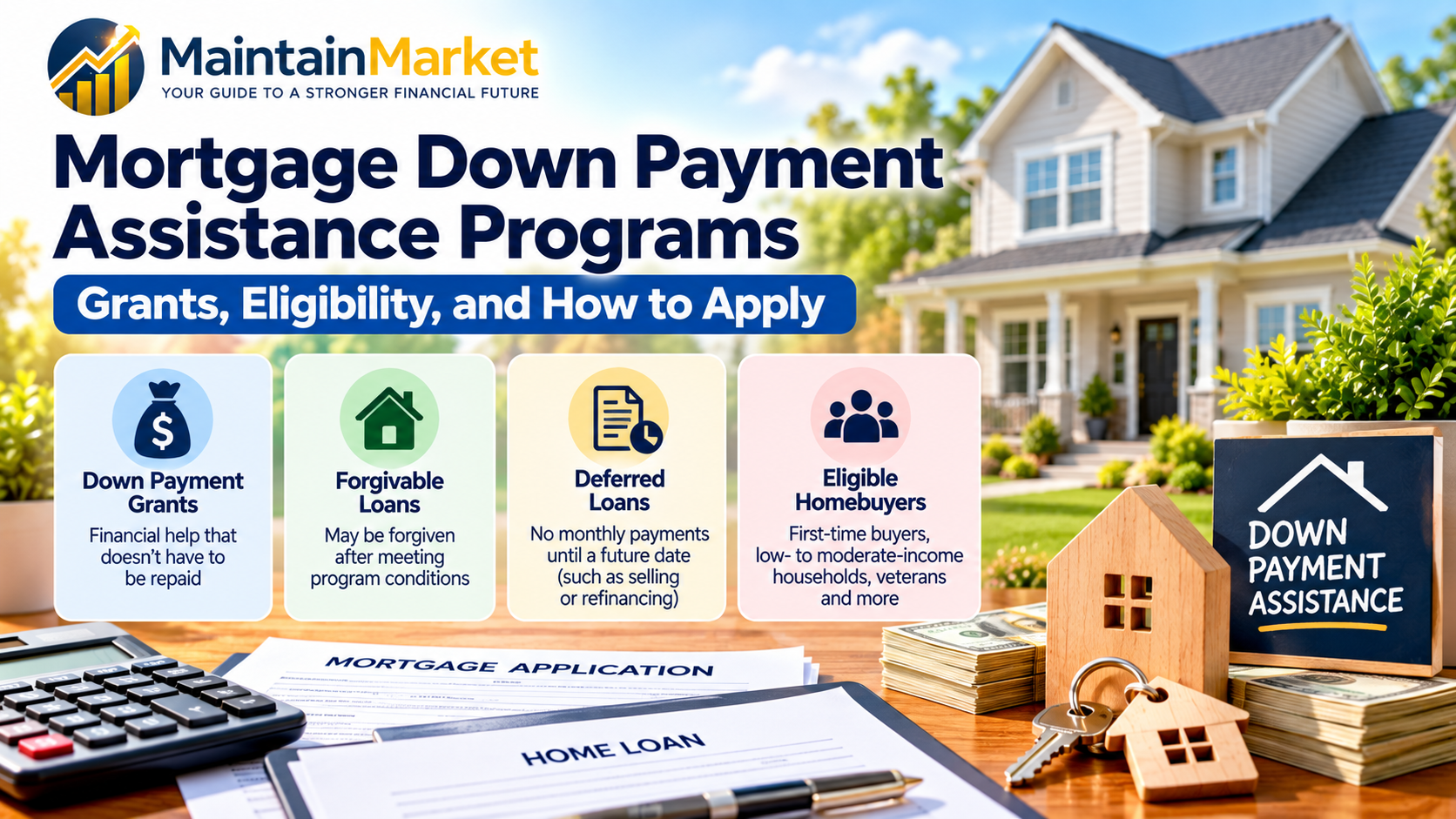
Depending on the program, eligible buyers may receive a grant, a forgivable loan, a deferred-payment loan, or a repayable second mortgage.
Some programs also help with eligible closing costs, mortgage insurance expenses, or other approved home purchase expenses.
For example, a program might provide $5,000 toward a buyer’s down payment, while another could offer assistance calculated as a percentage of the mortgage amount.
The actual assistance amount, eligibility rules, funding availability, and repayment conditions vary by location and program.
Important: Down payment assistance does not automatically mean you qualify for a mortgage. You must still meet the lender’s requirements for income, credit, debt, and other loan eligibility criteria.
How Do Down Payment Assistance Programs Work?
Most down payment assistance programs work alongside a primary mortgage.
Instead of receiving a separate mortgage to cover the entire purchase price, an eligible buyer receives additional financial support that can be applied toward approved upfront expenses.
Here is a simplified example:
Suppose you want to purchase a home for $300,000.
| Purchase detail | Amount |
|---|---|
| Home purchase price | $300,000 |
| Required down payment at 3% | $9,000 |
| Estimated closing costs | $9,000 |
| Total upfront expenses | $18,000 |
| Eligible down payment assistance | $7,500 |
| Remaining upfront expenses | $10,500 |
In this example, the buyer receives $7,500 in assistance and has $10,500 remaining to cover.
This is an illustrative calculation. The amount of assistance available, the expenses it can cover, and the buyer’s required contribution depend on the actual program and mortgage terms.
How the process generally works
- Find an assistance program: Search for state, county, city, and nonprofit programs in the area where you want to buy.
- Check eligibility: Review income limits, credit requirements, purchase-price restrictions, and first-time buyer rules.
- Choose an approved lender: Many programs require you to work with a participating mortgage lender.
- Complete the application: Provide the requested financial and property information.
- Receive program approval: The assistance provider or participating lender reviews your eligibility.
- Complete the mortgage process: Your primary mortgage and assistance are coordinated for the transaction.
- Close on your home: Approved funds are applied according to the program’s rules.
Some programs require homebuyer education or counseling before assistance is approved.
Types of Mortgage Down Payment Assistance Programs
Not all assistance programs work the same way. Understanding the different types can help you avoid unexpected repayment obligations.
1. Down payment assistance grants
A down payment assistance grant provides eligible buyers with financial support that generally does not have to be repaid.
For example, a local housing agency might offer a $5,000 grant that can be used toward an eligible down payment or closing costs.
However, grant conditions matter. Some programs include occupancy requirements, eligibility conditions, or repayment provisions if the buyer sells, refinances, or stops using the property as a primary residence within a specified period.
Before accepting a grant, read its written terms and confirm whether any circumstances could require repayment.
2. Forgivable down payment assistance loans
Forgivable loans provide financial assistance through a loan that may be forgiven after the buyer meets specified conditions.
For example, a program might provide $10,000 as a second mortgage that is forgiven after five years if the homeowner continues to occupy the property as their primary residence and meets all other program requirements.
If the buyer sells the property or violates the program’s conditions before the forgiveness period ends, some or all of the assistance may become repayable.
The forgiveness period and conditions vary by program.
3. Deferred-payment down payment assistance loans
A deferred-payment loan allows a buyer to receive assistance without making regular monthly payments during the deferral period.
However, the loan is generally still owed.
Depending on the agreement, repayment may become due when the homeowner:
- Sells the property
- Refinances the primary mortgage
- Pays off the original mortgage
- Stops using the home as their primary residence
- Reaches another repayment trigger specified in the agreement
Some deferred loans carry zero interest, while others may have interest or additional conditions.
Always review the second mortgage documents before accepting the assistance.
4. Repayable down payment assistance loans
Some programs provide assistance through a second mortgage that requires regular monthly payments.
The second loan is separate from your primary mortgage, so you must understand how both payments affect your budget and debt-to-income ratio.
For example, if you receive $8,000 through a repayable assistance loan, the program may require you to repay that amount over a specified period.
Check the interest rate, repayment schedule, fees, and whether the second loan can be paid off early.
5. Shared appreciation assistance programs
Some assistance programs provide funds in exchange for a share of the home’s future appreciation.
This means you may not have to make regular monthly payments on the assistance amount, but you could owe the original assistance plus an agreed portion of the property’s increase in value when you sell or reach another repayment event.
For example, a program might provide $40,000 toward your purchase in exchange for repayment of the original amount plus a defined share of eligible appreciation.
The amount owed can therefore be greater than the original assistance.
Read the shared-appreciation formula, repayment triggers, property valuation rules, and any caps before agreeing to this type of arrangement.
Who Qualifies for Down Payment Assistance Programs?
Eligibility varies significantly between programs. Some focus on first-time homebuyers, while others support repeat buyers or particular groups of borrowers.
Here are common eligibility factors.
1. First-time homebuyer status
Many down payment assistance programs are designed for first-time homebuyers.
However, the definition of a first-time buyer is not always the same across programs.
Some programs define a first-time buyer as someone who has not owned a primary residence during the previous three years. Others may have exceptions for veterans, buyers in designated areas, or certain household circumstances.
Do not assume that owning a home in the past automatically makes you ineligible. Check the specific program’s definition.
2. Household income limits
Many programs set income limits to prioritize households with low or moderate incomes.
The limit may depend on:
- Household size
- County or city
- Area median income (AMI)
- Number of people included in the application
- The specific mortgage assistance program
For example, one program may allow household income up to 80% of the local area median income, while another may use a higher threshold.
These figures are program-specific. Always check the current income limits for the property’s location.
3. Credit score requirements
Some programs establish minimum credit-score requirements, while others rely partly on the eligibility standards of the primary mortgage.
Your credit history may influence whether you qualify for a conventional, FHA, VA, or USDA mortgage.
A higher credit score can improve your available mortgage options, but it does not guarantee approval for assistance.
Ask the participating lender which credit-scoring model and minimum requirements apply.
4. Debt-to-income ratio
Lenders generally evaluate your debt-to-income ratio (DTI) when reviewing a mortgage application.
DTI compares your monthly debt obligations with your gross monthly income.
For example, if your gross monthly income is $6,000 and your qualifying monthly debt payments total $2,400, your DTI is 40%.
Some assistance programs also have specific DTI requirements or rely on the primary mortgage program’s underwriting rules.
Remember that an additional repayable assistance loan may affect your overall financial obligations.
5. Property requirements
The property you purchase may need to meet certain conditions.
Common restrictions can include:
- The home must be located within the program’s eligible area.
- The property may need to be your primary residence.
- The purchase price may need to remain below a program limit.
- The property must meet applicable safety and condition standards.
- Certain investment properties or vacation homes may be excluded.
Some programs also have rules for condominiums, manufactured homes, multi-unit properties, or newly constructed homes.
6. Homebuyer education requirements
Some programs require applicants to complete an approved homebuyer education course or counseling session.
These courses can explain budgeting, mortgage terms, credit, home maintenance, closing costs, and the responsibilities of owning a home.
The course may need to be completed before closing or before assistance is approved.
Check whether the program accepts online courses, in-person counseling, or only specific approved providers.
Where Can You Find Mortgage Down Payment Assistance Programs?
One of the most important steps is identifying programs available where you plan to purchase a home.
There is no single nationwide grant that every homebuyer can access. Assistance is commonly organized through state and local agencies, and funding may change over time.
The following resources can help you find programs.
1. State housing finance agencies
State housing finance agencies (HFAs) are among the most important places to look for down payment assistance.
They may offer programs that combine a primary mortgage with grants, second mortgages, or other forms of financial support.
Start with the National Council of State Housing Agencies (NCSHA) to find housing assistance resources and state-level organizations.
When contacting your state agency, ask about:
- Current down payment assistance programs
- First-time homebuyer requirements
- Household income limits
- Purchase-price limits
- Approved mortgage lenders
- Assistance amounts
- Repayment and forgiveness conditions
- Whether closing costs are eligible
Program availability and funding can change, so verify the current rules directly with the agency.
2. HUD housing resources
The U.S. Department of Housing and Urban Development (HUD) provides housing information and resources for homebuyers.
HUD-approved housing counseling agencies can help buyers understand mortgage options, homeownership responsibilities, and available local assistance.
You can find a housing counselor through the official HUD housing counseling directory.
HUD also administers housing programs that provide funding to eligible state and local governments. Some local agencies use these resources to support homeownership and down payment assistance.
However, HUD does not provide one universal down payment grant that is automatically available to every homebuyer.
3. City and county down payment assistance programs
Many cities and counties offer homebuyer assistance based on local housing needs.
These programs may provide:
- Grants for eligible down payments
- Forgivable second mortgages
- Deferred-payment loans
- Closing-cost assistance
- Affordable mortgage financing
Some programs target specific neighborhoods, income groups, or first-time buyers.
Contact the housing or community development department in the city or county where you want to purchase your home.
4. Freddie Mac DPA One
Freddie Mac offers a platform called DPA One that helps mortgage professionals identify and compare down payment assistance programs.
It includes information on state, local, and municipal programs and can help participating lenders match borrowers with potential assistance.
Visit Freddie Mac DPA One and ask your mortgage lender whether they can use this resource to identify programs for which you may qualify.
The platform is particularly useful because assistance programs are spread across different government agencies and organizations.
5. Nonprofit organizations
Some nonprofit organizations support homebuyers through education, financial assistance, or affordable homeownership initiatives.
Examples include local community development organizations and Habitat for Humanity affiliates.
Depending on the location and organization, assistance may involve grants, affordable financing, housing counseling, or other homeownership support.
Start with the Habitat for Humanity website to find a local affiliate and learn about its homeownership programs.
Do not assume every nonprofit offers direct cash assistance. Ask about the specific services and eligibility requirements in your area.
6. Participating mortgage lenders
Some banks, credit unions, mortgage companies, and community lenders work with state or local down payment assistance providers.
A participating lender can help identify programs that match your mortgage application and explain how the assistance works alongside your primary loan.
Ask the lender whether it offers access to state housing finance agency programs, local assistance, or other eligible mortgage support.
Federal Mortgage Programs That Can Help Reduce Upfront Costs
It is important to distinguish between a low-down-payment mortgage and a down payment assistance program.
A low-down-payment mortgage reduces the amount of your own money required for the down payment. A separate assistance program provides additional financial support that may help cover that amount.
Some federal mortgage programs can make homeownership more accessible, even though they do not automatically provide a grant.
1. FHA loans
Federal Housing Administration (FHA) loans are designed to make mortgage financing accessible to eligible borrowers.
For eligible borrowers, FHA-insured mortgages can allow a down payment as low as 3.5%, subject to credit and other program requirements.
However, FHA loans are not themselves free down payment assistance grants. You still need to provide the required down payment and cover other applicable expenses unless an eligible source of assistance or permitted contribution helps cover them.
FHA mortgages also involve mortgage insurance requirements.
Learn more through the official HUD website.
2. VA home loans
VA-backed home loans are available to eligible veterans, service members, and certain surviving spouses.
Many eligible borrowers can purchase a home with no down payment, subject to the lender’s approval, entitlement, and applicable loan requirements.
This can significantly reduce the upfront cash needed for a home purchase.
However, VA loans do not automatically provide a separate down payment assistance grant. Certain closing costs and other expenses may still apply, and a VA funding fee may be required unless the borrower qualifies for an exemption.
Visit the official VA home-loan website for eligibility and program details.
3. USDA home loans
USDA-backed mortgage programs can offer eligible buyers the opportunity to purchase qualifying homes with no down payment.
Eligibility depends on factors such as household income, property location, occupancy, and applicable loan requirements.
A USDA loan is not a universal down payment grant, and buyers may still need funds for closing costs or other expenses unless those costs are covered through permitted assistance or financing arrangements.
Check the official USDA Rural Development website for current requirements.
4. Fannie Mae HomeReady
Fannie Mae’s HomeReady mortgage is designed to support eligible low- to moderate-income homebuyers.
It offers low-down-payment financing and may be combined with eligible down payment assistance programs, subject to lender and program requirements.
Fannie Mae also announced a specific $2,500 very low-income purchase credit for qualifying HomeReady borrowers. Under the program details published by Fannie Mae, eligibility includes qualifying income at or below 50% of the applicable area median income. Beginning January 28, 2026, at least one borrower must also be a first-time homebuyer.
The credit is subject to delivery requirements, eligible loan terms, and applicable deadlines. It is not a universal grant available to every HomeReady applicant.
Review the current requirements with a participating lender and consult Fannie Mae’s official HomeReady information.
Can You Get Down Payment Assistance If You Are Not a First-Time Homebuyer?
Yes, in some cases.
Although many programs are designed for first-time homebuyers, certain state and local programs allow repeat buyers to apply.
Eligibility depends on the specific program and its definition of a qualifying buyer.
Some programs may accept:
- Repeat homebuyers
- Veterans and eligible military families
- Buyers purchasing in designated areas
- Buyers who have not owned a primary residence within a specified period
- Households meeting certain income requirements
For example, some state programs offer assistance to both first-time and repeat buyers, while other programs restrict assistance to first-time applicants.
If you previously owned a home, ask the program administrator whether you qualify under an exception or alternative eligibility category.
How Much Down Payment Assistance Can You Receive?
There is no standard amount of down payment assistance across the United States.
The amount varies according to the provider, funding availability, property location, household income, purchase price, and mortgage program.
Some programs provide a fixed dollar amount, while others calculate assistance as a percentage of the purchase price or loan amount.
Here are examples of how assistance can be structured:
| Assistance structure | Illustrative example |
|---|---|
| Fixed-dollar grant | $5,000 |
| Percentage of purchase price | 3% of a $300,000 home = $9,000 |
| Percentage of mortgage amount | 4% of a $280,000 loan = $11,200 |
| Deferred-payment loan | $10,000 |
| Shared appreciation assistance | $20,000 plus an agreed share of appreciation |
These are examples of possible program structures, not current offers from specific providers.
Before relying on a particular amount, verify the program’s maximum assistance, eligible expenses, funding availability, and repayment terms.
How to Apply for Mortgage Down Payment Assistance Programs
Applying for assistance generally involves several steps. Starting early is important because some programs have limited funding or require approval before you close on your home.
Step 1: Decide where you want to buy
Your location is one of the most important factors in determining which assistance programs are available.
Search using the city, county, and state where you plan to purchase.
Some programs are statewide, while others are limited to specific municipalities, neighborhoods, or property areas.
Step 2: Check your financial eligibility
Review your household income, credit history, monthly debt payments, available savings, and estimated purchase price.
Compare these details with the program’s published eligibility requirements.
Do not rely on an online advertisement alone. Confirm the current income and property limits with the program administrator.
Step 3: Find a participating mortgage lender
Many assistance programs require applicants to work with approved lenders.
Contact the housing agency or program administrator to obtain its lender list.
Ask the lender whether it has experience with the assistance program and whether the assistance can be combined with your preferred mortgage type.
Step 4: Complete any required homebuyer education
Some programs require an approved homebuyer education course or counseling session.
Complete this requirement as early as possible and keep your completion certificate or other documentation.
Step 5: Submit the required documents
Depending on the program, you may need to provide:
- Government-issued identification
- Recent pay stubs
- W-2 forms or tax returns
- Bank statements
- Employment and income information
- Credit information
- Household-size details
- Mortgage preapproval documents
- Purchase agreement, when available
Additional documents may be required for self-employed borrowers, gift funds, or specific assistance programs.
Step 6: Review the assistance agreement
Before accepting funds, read the complete program agreement.
Pay particular attention to:
- Whether the assistance is a grant or loan
- Whether interest is charged
- Whether monthly payments are required
- When repayment becomes due
- Whether the loan is forgivable
- Whether selling or refinancing triggers repayment
- Whether the home must remain your primary residence
- Whether the assistance can be combined with other programs
Ask questions about anything you do not understand.
Step 7: Complete your mortgage closing
Once your mortgage and assistance have been approved, the lender and assistance provider coordinate the funds according to the program rules.
Review your closing documents to confirm that the assistance amount and any second-mortgage obligations are correctly reflected.
Common Mistakes to Avoid When Applying for Down Payment Assistance
Down payment assistance can help make homeownership more affordable, but choosing the wrong program or overlooking its conditions can create problems later.
Avoid these common mistakes.
1. Assuming every grant is free money
Some programs advertise assistance without clearly explaining the repayment conditions.
A grant may have occupancy or other restrictions, while a loan may become due when you sell, refinance, or move.
Always read the written agreement.
2. Applying after signing a purchase agreement without checking program rules
Some programs require buyers to obtain approval before a particular stage of the purchase process.
If you wait too long, you may miss the opportunity to use the assistance.
Contact the program administrator and lender before making commitments.
3. Ignoring income and purchase-price limits
A program may have strict limits based on household size, location, and purchase price.
Check the current limits before spending time on an application.
4. Choosing assistance without comparing mortgage rates
Some assistance programs require buyers to use a specific first mortgage or lender.
The assistance may come with a different interest rate or loan structure than other available mortgage options.
Compare the complete cost of the mortgage, assistance loan, fees, and repayment obligations.
5. Assuming assistance covers all upfront expenses
A program may cover only part of your down payment, or it may limit assistance to certain closing costs.
You may still need personal savings for inspections, moving expenses, reserves, and other costs.
6. Overlooking repayment conditions
A deferred or forgivable loan can become expensive if you do not understand its repayment triggers.
Check what happens if you refinance, sell, rent out the property, or stop using it as your primary residence.
7. Falling for down payment assistance scams
Be cautious of advertisements promising guaranteed grants or asking for upfront payments to secure government assistance.
Verify programs through official state agencies, local government websites, HUD-approved counselors, or participating lenders.
Never share sensitive financial information with an unverified company or individual.
Frequently Asked Questions About Mortgage Down Payment Assistance Programs
Are there government programs that help with a mortgage down payment?
Yes. State and local housing agencies may offer down payment assistance using government-supported funding, housing programs, or other resources. Some nonprofit and lender-supported programs also provide assistance. Availability and eligibility depend on the buyer’s location and circumstances.
Can I get down payment assistance if I have low income?
Possibly. Many assistance programs are designed for low- and moderate-income households. However, you must meet the program’s income, credit, property, and mortgage eligibility requirements. Income limits often vary by location and household size.
Do I have to pay back down payment assistance?
It depends on the program. Grants generally do not require repayment if all conditions are satisfied. Forgivable loans may be forgiven after a specified period, while deferred-payment and repayable loans generally must be repaid under their agreement terms.
Can first-time homebuyers get down payment assistance?
Yes. Many state and local programs are specifically designed for first-time homebuyers. Some also provide assistance to repeat buyers who meet certain eligibility conditions.
Can I get down payment assistance with an FHA loan?
Potentially. Eligible down payment assistance may be combined with an FHA mortgage if the assistance source and transaction comply with FHA requirements. The lender must confirm that the program and funds are acceptable for the specific loan.
Can I get down payment assistance with a VA loan?
Eligible VA borrowers may be able to combine certain assistance programs with a VA-backed mortgage, subject to VA requirements, lender approval, and the terms of the assistance program. VA loans can also offer eligible borrowers no-down-payment financing without a separate DPA grant.
Can I use down payment assistance to pay closing costs?
Some programs allow assistance to cover both the down payment and eligible closing costs. Others restrict how the funds can be used. Check the program’s approved expense list before applying.
How much money can I receive through a down payment assistance program?
There is no standard nationwide amount. Assistance may be a fixed grant, a percentage of the purchase price, a percentage of the mortgage amount, or a loan. The maximum depends on the provider, location, funding, and buyer eligibility.
Can I qualify for down payment assistance if I have owned a home before?
Yes, with certain programs. Some assistance initiatives allow repeat buyers, while others require applicants to meet a first-time homebuyer definition. Check the program’s specific rules and any available exceptions.
Do down payment assistance programs have credit score requirements?
Some programs have minimum credit-score requirements, while others follow the requirements of the primary mortgage program. Your lender will review your credit history and other financial information to determine eligibility.
Can I combine two down payment assistance programs?
Sometimes. Certain programs allow assistance to be combined with other eligible funding sources, but others restrict stacking. The lender and program administrators must confirm that the combination is permitted and that total assistance does not exceed applicable limits.
Are down payment assistance programs available in every state?
Many states have housing finance agencies or other homeownership assistance resources, but the specific programs, funding, and eligibility requirements vary. Some assistance is available only in certain counties or cities.
How long does it take to get down payment assistance?
Processing times vary by program, lender, application volume, and funding availability. Some programs can be coordinated with a mortgage application, while others require separate approval or homebuyer education. Apply early and confirm the expected timeline before setting a closing date.
Is down payment assistance available for repeat homebuyers?
Some programs allow repeat buyers, although many focus on first-time buyers. Check the specific state or local program for its definition of an eligible homebuyer.
Final Thoughts
Mortgage down payment assistance programs can make buying a home more achievable for eligible households that have difficulty saving enough money for upfront expenses.
However, the right program is not necessarily the one offering the largest amount of assistance. You should compare the mortgage interest rate, assistance amount, repayment requirements, forgiveness conditions, closing costs, and long-term financial impact.
Start by checking your state housing finance agency, local government housing department, and participating mortgage lenders. Use official resources to verify current funding and eligibility before applying.
Most importantly, understand whether the assistance is a grant, a forgivable loan, a deferred loan, or a repayable second mortgage. Knowing the difference can help you make a more informed homebuying decision.
External sources
These are the sources I recommend retaining in the published article:
- NCSHA — Housing Help — state housing finance agency resources. FHFA.gov
- HUD — Housing Counseling — HUD-approved housing counseling resources.
- Freddie Mac — DPA One — assistance-program discovery for mortgage professionals. sf.freddiemac.com+1
- Fannie Mae — HomeReady — low-down-payment mortgage information.
- VA — Home Loans — VA-backed mortgage eligibility and benefits.
- USDA Rural Development — USDA mortgage programs.
- Habitat for Humanity — local homeownership resources.
Disclaimer: This article is for educational purposes only and does not constitute mortgage, financial, or legal advice. Down payment assistance programs, funding availability, income limits, property restrictions, and repayment requirements vary by location and may change. Verify all program details with the official administrator and a qualified mortgage lender before applying.