
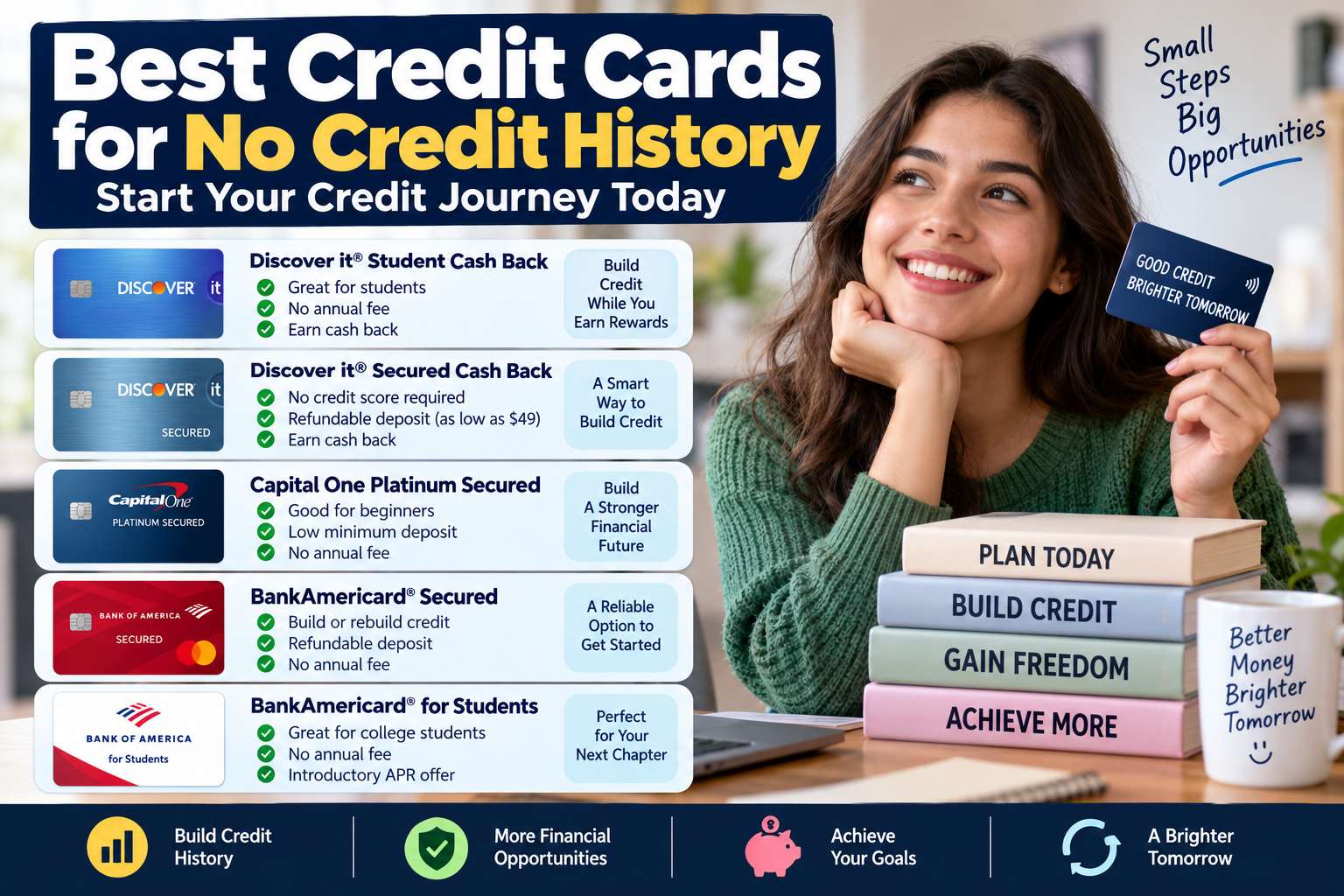
Finding the best credit cards for no credit history can be challenging because many traditional credit cards expect applicants to already have a credit record. The good news is that beginners have several options, including student credit cards, secured credit cards, and certain cards designed for applicants with limited or no established credit.
If you’re starting from scratch, the goal shouldn’t simply be getting any credit card. You want a card with manageable fees, realistic approval requirements, useful features, and a path toward building a strong credit history.
Quick Answer: What Are the Best Credit Cards for No Credit History?
For someone with no established credit history, the strongest options generally fall into two categories:
- Student credit cards — designed for eligible college students and generally don’t require a security deposit.
- Secured credit cards — require a refundable security deposit but can be easier for beginners to qualify for.
- Prequalification offers — when available, these can help you understand potential eligibility before submitting a full application.
Some current options worth researching include:
| Credit Card | Best For | Security Deposit | Annual Fee | Key Feature |
|---|---|---|---|---|
| Discover it® Student Cash Back | College students | None | $0 | Cash back and first-year Cashback Match |
| Discover it® Secured Cash Back | Beginners who can provide a deposit | As low as $49 | $0 | Cash back and potential upgrade path |
| Capital One Platinum Secured | Building credit with a secured card | $49, $99 or $200 minimum depending on terms/eligibility | $0 | Credit line starting at least $200 |
| BankAmericard® Secured | Building or rebuilding credit | $200–$5,000 | $0 | Potential deposit return after review |
| BankAmericard® for Students | Eligible college students | None | $0 | No annual fee and introductory APR offer |
Card terms, approval criteria, APRs, rewards and deposits can change. Always review the issuer’s current terms before applying.
1. Discover it® Student Cash Back — Best for Students With No Credit
If you’re a college student who has never established credit, the Discover it Student Cash Back card is one option worth considering.
Discover specifically states that eligible students can apply without a credit score, although the issuer may use a credit score if one is available. The card currently has no annual fee and offers cash-back rewards.
Why consider it?
- Designed for students
- No annual fee
- No credit score required to apply for eligible students
- Cash-back rewards
- Can help establish credit when used responsibly
This can be particularly useful if you’re a student who has income but hasn’t yet built a traditional credit history.
2. Discover it® Secured Cash Back — Best Secured Option to Consider
A secured credit card can be a practical starting point when you have no credit history and don’t qualify for an unsecured card.
Discover’s secured card currently requires a refundable deposit as low as $49 for a minimum $200 credit line, subject to the issuer’s requirements. It has no annual fee and offers cash-back rewards.
Discover also states that responsible card use can lead to getting the deposit back and upgrading to the Discover it Cash Back card.
Why consider it?
- No credit score required to apply
- Refundable deposit
- No annual fee
- Cash-back rewards
- Reports account activity to the three major credit bureaus
- Potential upgrade path
For someone who isn’t a student, this can be a particularly interesting starting point.
3. Capital One Platinum Secured — Best for a Traditional Secured Card
The Capital One Platinum Secured card is another option for people who are beginning their credit journey.
Capital One explains that secured cards can be easier to qualify for because the security deposit provides collateral. Its Platinum Secured card can have an initial deposit of $49, $99 or $200 depending on eligibility, with an initial credit line of at least $200.
Why consider it?
- Designed for building credit
- Relatively low minimum deposit depending on eligibility
- No annual fee
- Credit limit can potentially increase
- Useful alternative when an unsecured card isn’t available
The exact deposit and approval decision depend on the applicant and issuer.
4. BankAmericard® Secured Credit Card — Best for a Bank-Based Secured Option
The BankAmericard Secured Credit Card is designed to help establish, strengthen or rebuild credit.
Bank of America currently lists a refundable security deposit requirement between $200 and $5,000. The deposit, along with income and ability to pay, helps determine the credit line. The card has no annual fee.
Bank of America also says it periodically reviews accounts and some customers may qualify to have their security deposit returned.
Why consider it?
- No annual fee
- Refundable security deposit
- Designed for establishing credit
- Potential deposit return after account review
- Credit line can be based partly on the security deposit
5. BankAmericard® for Students — Best for Students Looking for No Annual Fee
The BankAmericard Credit Card for Students is another option for eligible college students who are beginning to establish credit.
Bank of America currently lists a $0 annual fee and an introductory APR offer for eligible applicants.
Why consider it?
- Designed for students
- No annual fee
- No security deposit
- Introductory APR offer
- Online account management and payment tools
Remember that approval isn’t guaranteed simply because you’re a student. The issuer still evaluates your application and ability to repay.
6. A Secured Credit Card From Your Bank or Credit Union
You don’t necessarily have to choose one of the nationally advertised cards.
Banks and credit unions may offer secured cards specifically designed for people who are establishing or rebuilding credit. The CFPB recommends considering secured cards when you don’t qualify for a regular credit card.
Look for:
- Low or no annual fee
- Refundable deposit
- Reporting to major credit bureaus
- Reasonable APR
- A possible upgrade to an unsecured card
A local credit union can sometimes be worth checking because it may have products specifically designed for members who are new to credit.
7. A Student Credit Card From Another Issuer
If you’re enrolled in college, don’t limit your search to one issuer.
Student cards are specifically designed for people who may have limited or no credit history. Discover notes that student cards are a common option for people beginning their credit journey.
Before applying, compare:
- Annual fee
- APR
- Rewards
- Foreign transaction fees
- Late fees
- Eligibility requirements
- Whether the issuer reports activity to the major credit bureaus
8. A Card With a Prequalification Option
Some credit card issuers allow consumers to check whether they may be prequalified before submitting a full application.
This can be useful when you have no credit history because you don’t want to submit multiple full applications without knowing whether the card is realistic for your profile.
However, prequalification isn’t the same as approval.
Remember:
Prequalified ≠ guaranteed approval.
The issuer may perform additional verification and evaluate your complete application before making the final decision.
9. A Secured Card With a Graduation or Upgrade Path
If you’re choosing between secured cards, consider what happens after you’ve established a positive payment history.
Some secured cards may periodically review your account and potentially return your deposit or transition you to an unsecured product.
For example, Discover says responsible use of its secured card can lead to getting the deposit back and upgrading to the Discover it Cash Back card. Bank of America also says it periodically reviews secured accounts and some customers may qualify to have their deposit returned.
This matters because you don’t necessarily want to keep your money tied up as a deposit indefinitely.
10. Becoming an Authorized User
If getting your own credit card is difficult, becoming an authorized user on someone else’s established credit card can be another way to potentially begin building credit.
However, this isn’t the same as having your own credit card account.
The primary cardholder is responsible for the account, so choose someone who manages the account responsibly. Before using this strategy, confirm how the issuer reports authorized-user activity to the credit bureaus.
Which Credit Card Type Is Best for You?
Your best choice depends largely on your situation.
| Your Situation | Option to Consider |
|---|---|
| College student with no credit | Student credit card |
| Non-student with no credit | Secured credit card |
| No money available for a deposit | Student or eligible unsecured starter card |
| You can afford a refundable deposit | Secured card |
| You want rewards while building credit | Cash-back student or secured card |
| You’re worried about unnecessary applications | Look for prequalification |
| Family member has excellent credit | Authorized-user option |
| You want to eventually move to an unsecured card | Look for an upgrade/graduation path |
What Does “No Credit History” Actually Mean?
Having no credit history is different from having bad credit.
No credit history generally means there isn’t enough information in your credit reports to generate a traditional credit score or evaluate your credit experience.
You may be in this situation if you:
- Recently turned 18
- Have never had a credit card
- Have never taken out a loan
- Recently moved to the U.S.
- Have only used cash or debit cards
- Have limited accounts reported to the credit bureaus
A person with bad credit, by contrast, has a credit history but may have negative information such as late payments, defaults or other problems.
That distinction is important because the best product for someone with no credit isn’t necessarily the same as the best product for someone with damaged credit.
How to Choose the Best Credit Card for No Credit History
Don’t choose a card simply because an advertisement says “easy approval.”
Look at these factors instead.
1. Annual Fee
A $0 annual-fee card can make sense when you’re just starting out.
There’s little reason to pay an annual fee simply to establish your first credit account if a suitable no-fee alternative is available.
2. Security Deposit
If you’re considering a secured card, check:
- Minimum deposit
- Maximum deposit
- Whether the deposit is refundable
- How the deposit determines your credit limit
- When the deposit could be returned
3. Credit Reporting
Building credit requires your account activity to be reported to credit bureaus.
The CFPB explains that payments reported to the nationwide credit reporting companies can help establish a credit history when you pay on time.
4. APR
The APR may not matter much if you plan to pay the statement balance in full every month.
But it becomes extremely important if you carry a balance.
5. Upgrade Potential
A secured card that can eventually graduate to an unsecured card may be more attractive than one that keeps your deposit locked up indefinitely.
6. Rewards
Rewards are useful, but they shouldn’t be the main reason to choose a starter card.
A card with slightly fewer rewards but better fees and easier long-term management may be the smarter choice.
How to Build Credit With Your First Credit Card
Getting the card is only the beginning.
Use these habits:
Pay every bill on time.
Payment history is one of the most important parts of responsible credit management.
Keep balances manageable.
Don’t use your entire credit limit simply because it’s available.
Pay the balance in full when possible.
The CFPB recommends paying your balance in full each month to avoid finance charges and maintain healthier credit habits.
Avoid applying for many cards at once.
Multiple applications can create unnecessary hard inquiries and make your credit profile more complicated.
Monitor your credit reports.
Make sure the information being reported about your account is accurate.
Can You Get a Credit Card With No Credit History?
Yes.
You may have fewer choices than someone with established credit, but you don’t necessarily need a high credit score to start.
Student cards can be available to eligible students without an established credit history, while secured cards can provide another path for people willing to make a refundable deposit.
The important thing is to choose a product designed for your current credit profile rather than repeatedly applying for cards intended for people with established credit.
Can You Get a Credit Card Without a Credit Score?
Yes, depending on the card and issuer.
For example, Discover currently states that eligible students can apply for certain student cards without a credit score, while its secured card also states that no credit score is required to apply.
That doesn’t mean everyone will be approved. Issuers can consider other information when evaluating an application.
What If You Have No Credit and No Income?
This situation can be more difficult.
Credit card issuers generally want to know that you have the ability to make payments. If you’re a student, the application may have specific requirements around income and eligibility.
If you don’t have sufficient income, don’t exaggerate or falsify information on an application.
Instead, consider whether a secured card, student card for which you’re eligible, or authorized-user arrangement makes more sense.
Common Mistakes to Avoid
Applying for too many cards
Don’t submit applications to every “easy approval” card you find.
Choosing based only on rewards
Rewards don’t compensate for poor terms or expensive fees.
Ignoring the security deposit
A secured card’s deposit isn’t a fee, but it does tie up your money while the account is secured.
Carrying a balance unnecessarily
You don’t need to carry debt from month to month to build credit.
Missing even one payment
Late payments can undermine the credit-building process you’re trying to establish.
Using the entire credit limit
A high balance relative to your limit can make your credit profile look riskier.
Frequently Asked Questions
Q1. What are the best credit cards for no credit history?
The best options are generally student credit cards for eligible college students and secured credit cards for people who can provide a refundable deposit. The right choice depends on your eligibility, income, fees, deposit requirements and desired features.
Q2. Can I get a credit card with no credit history?
Yes. Some issuers offer student and secured cards specifically for people who are new to credit. Approval still depends on the issuer’s eligibility requirements and application review.
Q3. Is a secured credit card good for building credit?
It can be. A secured card works much like a regular credit card but requires a refundable deposit. When the issuer reports your account activity to the credit bureaus, responsible use and on-time payments can help establish a credit history.
Q4. Do I need a security deposit if I have no credit?
Not necessarily. Eligible students may qualify for student credit cards that don’t require a security deposit. If you’re not eligible for a student card, a secured card may be another option.
Q5. How long does it take to build credit with a credit card?
There isn’t one guaranteed timeline. Your credit profile develops as account activity and payment history are reported over time. Consistently paying on time and managing balances responsibly is more important than trying to build credit as quickly as possible.
Q6. Should I pay my credit card in full every month?
Generally, yes, if you can afford to do so. Paying the statement balance in full can help you avoid interest charges and maintain responsible credit habits.
Q7. Can I get an unsecured credit card with no credit?
Sometimes. Certain student cards and beginner-friendly products may not require an established credit history, but approval depends on the issuer. If you don’t qualify, a secured card may be easier to obtain.
Q8. What credit score do I need for my first credit card?
Some starter, student, and secured credit cards are available to people without an established credit score. Each issuer has its own approval criteria, so having no score doesn’t automatically mean you’ll be rejected.
Q9. Does applying for a credit card with no credit hurt my credit score?
A full credit-card application can result in a hard inquiry, which may temporarily affect your credit score. If an issuer offers prequalification with a soft inquiry, checking that option first can help you compare your chances without the same type of hard inquiry.
Q10. How much should I spend on my first credit card?
Start with small purchases that you can comfortably afford to pay off. The most important habit is paying your bill on time and, ideally, paying the statement balance in full each month.
Final Takeaway
The best credit cards for no credit history aren’t necessarily the cards with the biggest rewards or highest limits.
For most beginners, the better starting point is a card that is realistically accessible, has reasonable fees, reports account activity to the credit bureaus, and helps you establish responsible credit habits.
If you’re a college student, start by comparing student cards. If you’re not a student or can’t qualify for one, secured credit cards can provide another path into the credit system.
The goal isn’t simply to get approved. The goal is to use your first card responsibly enough that it becomes the foundation for stronger credit in the future.
Why Maintain Market Is Different
At Maintain Market, we focus on explaining financial products in practical terms rather than simply listing attractive offers.
For beginner credit-card searches, we separate no credit history from bad credit, explain what each type of card is designed for, highlight costs and eligibility considerations, and show what to look for before applying.
Card terms can change, so readers should always verify current rates, fees, rewards and eligibility directly with the issuer before applying.
References
- CFPB — Ways to Start or Rebuild Good Credit
- CFPB — How to Rebuild Your Credit
- Discover — Credit Cards for No Credit History
- Discover — Discover it Secured Cash Back
- Discover — Student Credit Card
- Capital One — Credit Card With No Credit History
- Bank of America — BankAmericard Secured
- Bank of America — BankAmericard for Students
Editorial Review
Reviewed for: U.S. credit-card information, no-credit-history guidance, secured-card mechanics, student-card eligibility considerations and responsible credit-building practices.
This article is educational and does not constitute financial advice. Credit-card approval, APRs, rewards, fees and eligibility vary by issuer and applicant.