
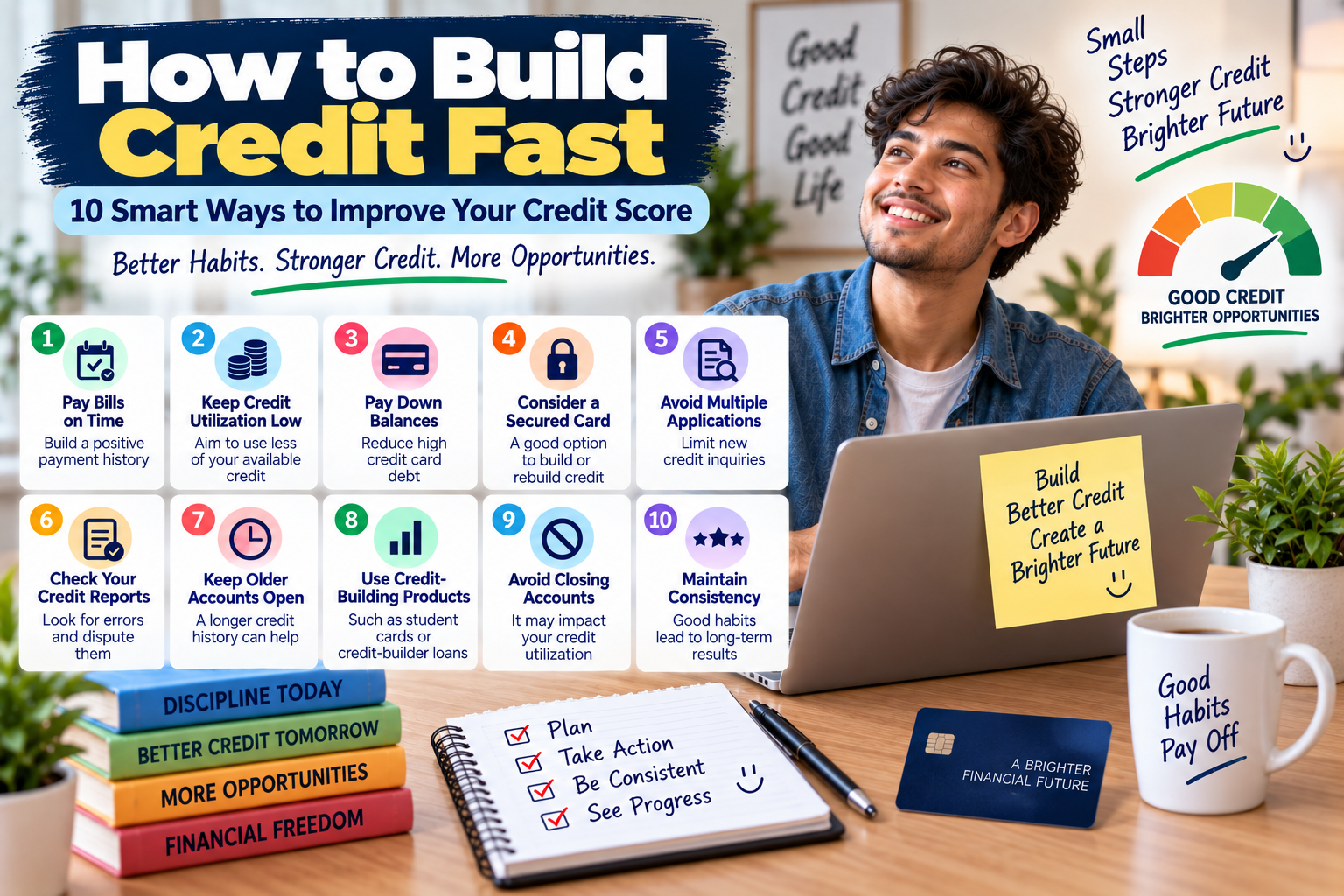
If you want to learn how to build credit fast, the best approach is to focus on responsible credit habits that can improve your credit profile over time. Paying bills on time, keeping credit card balances low, and choosing the right credit-building products can help you establish a stronger credit history.
However, building credit is not an overnight process. Some actions, such as reducing credit utilization or correcting an error, may produce changes relatively quickly after lenders report updates. Other improvements require several months of consistent financial behavior.
This guide explains practical ways to build credit quickly and safely in the United States, whether you have no credit history, a low credit score, or existing credit card debt.
Quick Answer: How to Build Credit Fast
To build credit as efficiently as possible:
- Pay every bill on time.
- Keep credit card utilization low.
- Pay down high credit card balances.
- Use a secured credit card if appropriate.
- Avoid applying for multiple accounts at once.
- Check your credit reports for errors.
- Keep older accounts open when financially appropriate.
- Use credit-building products that report payments.
- Avoid closing accounts without understanding the impact.
- Maintain responsible credit habits consistently.
There is no guaranteed way to increase your credit score by a specific number of points within a fixed timeframe.
How Quickly Can You Build Credit?
The speed of credit improvement depends on your starting point and the information contained in your credit reports.
| Situation | What May Help |
|---|---|
| No credit history | Open a suitable credit-building account |
| High credit utilization | Reduce revolving balances |
| Missed payments | Pay on time and bring accounts current |
| Credit report errors | Dispute inaccurate information |
| Too many recent applications | Avoid unnecessary new credit |
| Short credit history | Maintain responsible accounts over time |
Lenders and credit card companies report information at different times. Therefore, improvements may not appear immediately after you make a payment.
10 Ways to Build Credit Fast
1. Pay Every Bill on Time
Payment history is a major factor in many credit scoring models. Missing payments can negatively affect your credit profile, particularly when payments become significantly overdue.
To build a reliable payment history:
- Set up automatic payments.
- Use calendar reminders.
- Pay at least the minimum amount before the due date.
- Keep enough money available for scheduled payments.
- Contact creditors if you are struggling financially.
Paying on time consistently is more important than making occasional large payments.
Tip: Automatic payments can help reduce the risk of forgetting a due date, but you should still monitor your account balance.
2. Keep Your Credit Utilization Low
Credit utilization measures how much of your available revolving credit you are using.
For example:
| Credit Limit | Balance | Utilization |
|---|---|---|
| $2,000 | $200 | 10% |
| $2,000 | $600 | 30% |
| $2,000 | $1,600 | 80% |
High utilization can negatively affect your credit score.
Some experts recommend keeping utilization below 30%, while lower utilization may be more beneficial for some credit profiles. The 30% figure is not a universal approval or scoring threshold.
Ways to reduce utilization:
- Pay down existing balances.
- Avoid maxing out your credit cards.
- Make an early payment before the statement closing date when appropriate.
- Avoid unnecessary spending on revolving credit.
- Keep your total balances manageable.
You do not need to carry a balance or pay interest to build credit.
3. Pay Down High Credit Card Balances
Reducing your credit card balance may help lower your credit utilization after the updated balance is reported.
Consider this example:
- Credit limit: $5,000
- Current balance: $4,000
- Current utilization: 80%
If you reduce the balance to $1,500, your utilization becomes 30%.
The effect on your score depends on your overall credit profile and the scoring model used.
A practical approach:
- List your credit card balances.
- Identify cards with high utilization.
- Create a repayment budget.
- Avoid adding new unnecessary debt.
- Continue making every payment on time.
Do not use emergency savings needed for essential expenses simply to pursue a credit score increase.
4. Consider a Secured Credit Card
A secured credit card may be useful if you have limited credit history or difficulty qualifying for an unsecured card.
With many secured cards, you provide a refundable security deposit that may determine your credit limit.
Before applying, review:
- Deposit requirements
- Annual fees
- Interest rate
- Credit bureau reporting
- Upgrade opportunities
- Refund conditions
Not every secured card has identical terms or reporting practices.
A secured credit card can support credit-building efforts when used responsibly, but approval and credit improvement are not guaranteed.
5. Avoid Multiple Credit Applications
Applying for several credit cards or loans in a short period may result in multiple hard inquiries.
Frequent applications can affect your credit profile and may influence how lenders evaluate your recent credit activity.
Before applying:
- Review the issuer’s eligibility criteria.
- Use prequalification options when available.
- Apply only for credit you genuinely need.
- Compare fees and interest rates.
- Avoid submitting applications to multiple lenders without a clear reason.
Prequalification does not guarantee approval, and the inquiry process varies by provider.
6. Check Your Credit Reports for Errors
Credit report errors may affect your ability to build credit and qualify for financial products.
Review your reports for:
- Incorrect account balances
- Accounts that do not belong to you
- Incorrect payment history
- Duplicate accounts
- Incorrect personal details
- Accounts that should have been closed
You can access your credit reports through AnnualCreditReport.com.
If you find inaccurate information, you can generally dispute it with the credit reporting company and the business that supplied the information.
Checking your own credit report does not lower your credit score.
7. Keep Older Credit Accounts Open When Appropriate
The length of your credit history can influence some credit scoring models.
Closing an older credit card may reduce your available credit and increase your overall utilization if you have balances on other cards.
However, keeping every account open is not always appropriate. Consider:
- Annual fees
- Account security
- Spending habits
- Available credit
- Whether the account is useful
Do not keep an expensive or unsuitable account open solely for credit-building purposes.
8. Use Credit-Building Products That Report Payments
Some financial products are designed to help consumers establish or rebuild credit history.
Examples include:
- Secured credit cards
- Credit-builder loans
- Certain student credit cards
- Some retail credit cards
Before opening an account, confirm whether the provider reports payment activity to the major credit reporting companies.
Important: Debit cards, prepaid cards, and cash payments generally do not establish traditional credit history because they do not involve borrowing and repaying credit.
9. Avoid Closing Accounts Without a Plan
Closing a credit card can affect your available credit and utilization.
For example:
- Total credit limit before closure: $10,000
- Existing balances: $3,000
- Utilization before closure: 30%
If you close a card with a $5,000 limit while retaining the same balances:
- New total credit limit: $5,000
- Existing balances: $3,000
- Utilization after closure: 60%
This example illustrates how closing an account may affect utilization. The actual impact depends on the scoring model and credit reporting information.
Consider fees, account security, and your financial circumstances before closing an account.
10. Maintain Consistent Credit Habits
Building credit requires ongoing responsible behavior.
Focus on:
- Paying bills on time.
- Keeping balances manageable.
- Avoiding unnecessary borrowing.
- Reviewing credit reports.
- Applying for credit only when needed.
- Maintaining a realistic repayment budget.
A single payment or new account will not necessarily create a strong credit profile immediately.
Consistency is one of the most important parts of long-term credit building.
How to Build Credit Fast With No Credit History
If you have never used credit, you may need to establish a credit record before your score can be calculated using certain scoring models.
Potential options include:
| Option | What to Consider |
|---|---|
| Secured credit card | Deposit, fees, and credit reporting |
| Student credit card | Eligibility and income requirements |
| Credit-builder loan | Fees, repayment terms, and reporting |
| Retail credit card | Interest rates and limited use |
| Authorized user | Whether account activity is reported and managed responsibly |
An authorized user arrangement can have different effects depending on the account history and scoring model. Only consider arrangements with people you trust and understand the risks.
Do not open unnecessary accounts simply to create a credit mix.
How to Build Credit Fast With a 500 Credit Score
If your credit score is around 500, begin by identifying the factors affecting your credit profile.
Recommended Steps
- Obtain and review your credit reports.
- Identify missed payments, collections, and errors.
- Pay current bills on time.
- Reduce high credit card balances.
- Avoid unnecessary new applications.
- Consider suitable credit-building products.
- Monitor your progress over time.
If you have overdue accounts, prioritize bringing them current where possible. Serious negative information may continue affecting your credit profile even after you begin making payments on time.
How to Build Credit Fast Without a Credit Card
You do not necessarily need a credit card to establish credit.
Depending on your circumstances, you may consider:
- Credit-builder loans
- Certain installment loans
- Authorized-user arrangements
- Other products that report payments to credit bureaus
Before applying, confirm that the provider reports payment activity and understand all fees and repayment obligations.
Do not take out a loan solely to build credit if you cannot comfortably afford the payments.
How to Build Credit Fast as a Student
Students may have limited credit history, even if they have income or financial support.
Potential strategies include:
- Exploring student credit cards.
- Considering a secured credit card.
- Paying every bill on time.
- Keeping credit utilization low.
- Avoiding unnecessary applications.
- Learning how interest and fees work.
Students should avoid spending beyond their ability to repay. Building credit should not require accumulating expensive debt.
How to Build Credit Fast After a Late Payment
A late payment can negatively affect your credit profile, depending on how late it was and whether it was reported.
Possible steps include:
- Make the overdue payment as soon as possible.
- Bring the account current.
- Set up payment reminders.
- Contact the creditor to discuss available options.
- Review your credit reports for accuracy.
- Maintain on-time payments going forward.
Accurate negative information generally cannot be removed simply because it is unfavorable. The effect of negative information may decrease over time, but the timeframe varies.
How Many Points Can Your Credit Score Increase in 30 Days?
There is no reliable universal number of points that everyone can gain in 30 days.
A score may change after:
- A lower credit card balance is reported.
- An error is corrected.
- New payment information is added.
- A recent inquiry or account changes the credit profile.
The outcome depends on your existing credit history, the scoring model, and the information reported by lenders.
Be cautious of credit repair companies that guarantee a specific increase within a short period.
Common Mistakes to Avoid When Building Credit
Mistake 1: Carrying a Balance for Credit Building
You do not need to pay interest to build credit. Paying your balance in full can help manage interest costs and utilization.
Mistake 2: Applying for Too Many Cards
Multiple applications may result in additional hard inquiries and new account activity.
Mistake 3: Maxing Out Your Credit Cards
High utilization can negatively affect your credit score.
Mistake 4: Ignoring Credit Report Errors
Incorrect information may continue affecting your credit profile if it is not investigated.
Mistake 5: Taking Unaffordable Loans
A loan should not be used only to increase your credit score if the repayment obligation is unaffordable.
Mistake 6: Trusting Guaranteed Credit Repair Promises
Be cautious of companies promising guaranteed score increases or the removal of accurate negative information.
Frequently Asked Questions
1. How to build credit fast from no credit?
You can consider a secured credit card, student credit card, or credit-builder product that reports payment activity to credit bureaus. Make payments on time and keep balances manageable.
Building a credit history takes time, and approval depends on the provider’s eligibility requirements.
2. What is the fastest way to build credit?
There is no guaranteed fastest method for everyone. Paying on time, reducing high credit utilization, and correcting inaccurate information may help improve your credit profile.
The speed of change depends on your credit history and when updated information is reported.
3. Can I build credit in 30 days?
You may establish or update credit information within 30 days, depending on the account and reporting cycle. However, building a strong credit history generally requires consistent behavior over a longer period.
No specific score increase is guaranteed within 30 days.
4. Does carrying a credit card balance build credit faster?
No. You do not need to carry a balance or pay interest to build credit. Using a card responsibly and paying on time can help establish positive payment history.
Paying your balance in full may also help you avoid unnecessary interest charges.
5. Can a secured credit card help me build credit?
A secured credit card may help establish or rebuild credit when the issuer reports account activity and you use the card responsibly.
Review the issuer’s fees, deposit requirements, reporting practices, and other terms before applying.
6. How can I build credit with a 500 credit score?
Start by reviewing your credit reports, addressing overdue accounts, reducing credit utilization, and making all payments on time.
You may also consider credit-building products if their terms are affordable and suitable for your situation.
7. Does checking my credit score hurt my credit?
Checking your own credit score generally does not lower your credit score. Checking your own credit report is also generally a soft inquiry.
A lender’s credit application may involve a hard inquiry, so check the issuer’s disclosures.
8. Can I build credit without borrowing money?
Traditional credit scores generally rely on information from credit accounts. Cash, debit card transactions, and prepaid card activity typically do not establish traditional credit history.
You should not borrow money solely to build credit if repayment would be difficult.
9. How long does it take to build a good credit score?
The timeframe depends on your starting credit history, payment behavior, utilization, and other information in your credit reports.
Some changes may appear after a reporting cycle, while establishing a strong history generally requires months or longer.
10. Are credit repair companies necessary to build credit?
You can perform many credit-building activities yourself, including checking reports, disputing inaccurate information, paying bills on time, and reducing balances.
Be cautious of companies demanding upfront fees or promising guaranteed results. Accurate negative information generally cannot simply be removed because it is unfavorable.
Final Takeaway
Learning how to build credit fast starts with focusing on the factors you can control.
The most practical strategies include:
- Paying bills on time.
- Reducing credit card utilization.
- Checking credit reports for errors.
- Avoiding unnecessary applications.
- Choosing appropriate credit-building products.
- Maintaining consistent financial habits.
Some improvements may appear relatively quickly, but building strong credit is a long-term process. Avoid shortcuts that involve expensive debt or unrealistic promises.
Why Maintain Market Is Different
Maintain Market explains financial topics in practical, easy-to-understand language.
Our content focuses on helping readers:
- Understand credit-building strategies.
- Compare financial products.
- Identify potential fees and risks.
- Learn from official financial guidance.
- Make informed financial decisions.
Always verify current terms and eligibility requirements directly with financial institutions and official sources before applying for any financial product.
References
- CFPB – How to Rebuild Your Credit
- CFPB – How to Get and Keep a Good Credit Score
- CFPB – Ways to Start or Rebuild Credit History
- myFICO – How FICO Scores Are Calculated
- AnnualCreditReport.com
Editorial Review
Reviewed by: Maintain Market Editorial Team
Focus: Credit scores, credit cards, credit reports, and personal finance education
Disclaimer: This article is for educational purposes only. It does not guarantee credit approval, credit score increases, or specific financial outcomes.