
When comparing mortgage offers, you will usually see two percentages: the mortgage interest rate and the annual percentage rate (APR). Although they look similar, they measure different things. Understanding mortgage interest rate vs APR can help you compare lenders, understand borrowing costs, and avoid choosing a loan based on an attractive advertised rate alone.
Your mortgage interest rate determines the interest charged on the money you borrow. APR gives you a broader measure of the loan’s annual cost by including the interest rate and certain loan-related charges. Both figures matter when deciding which mortgage offer is right for you.
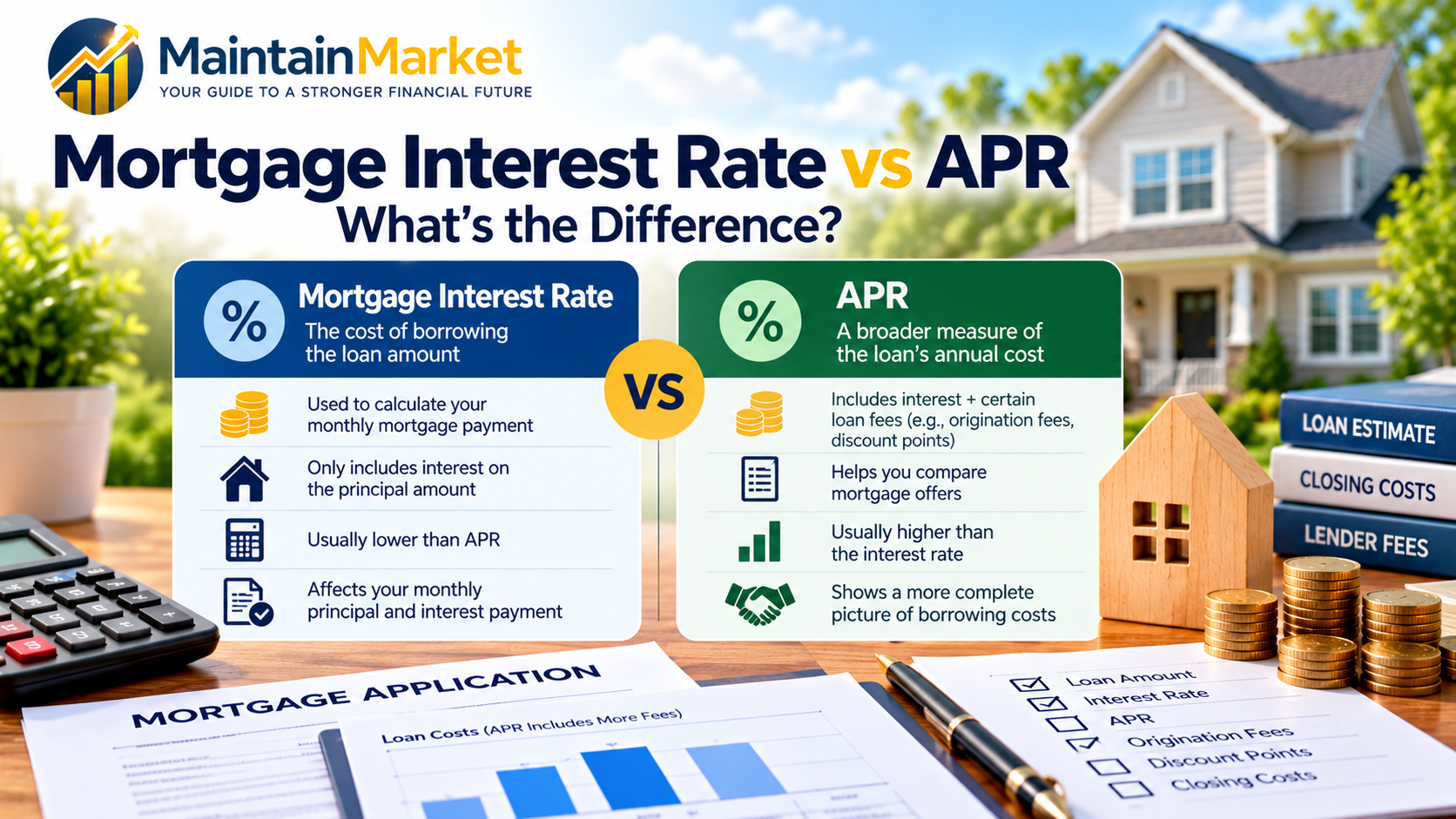
Mortgage Interest Rate vs APR: What’s the Difference?
The main difference is what each percentage measures:
- Mortgage interest rate: The percentage a lender charges you for borrowing the principal amount. It is used to calculate your regular principal-and-interest mortgage payment.
- Mortgage APR: A broader measure of borrowing cost that combines the interest rate with certain finance charges, such as applicable points and lender fees.
The APR is generally higher than the interest rate when the loan includes additional finance charges. However, the exact relationship depends on the loan’s structure and costs.
For example, a lender might advertise a mortgage interest rate of 6.50% while showing an APR of 6.75%. The difference reflects costs included in the APR calculation.
These figures are illustrative only, not current market mortgage rates or a lender quote.
What Is a Mortgage Interest Rate?
A mortgage interest rate is the percentage a lender charges you for borrowing money to purchase or refinance a home.
Your interest rate affects how much interest you pay over the life of the mortgage and how much your regular principal-and-interest payment will be.
For example, suppose you borrow $300,000 with a 30-year fixed-rate mortgage at 6.50%.
Your monthly principal-and-interest payment would be approximately $1,896.
This payment does not include property taxes, homeowners insurance, mortgage insurance, or other housing expenses.
What affects your mortgage interest rate?
Several factors can influence the interest rate a lender offers:
- Credit score: Borrowers with stronger credit profiles may qualify for more favorable rates.
- Down payment: Your down payment and loan-to-value ratio can affect pricing.
- Loan term: A 15-year mortgage may have a different rate from a 30-year mortgage.
- Loan type: Conventional, FHA, VA, and USDA mortgages have different pricing structures.
- Market conditions: Inflation expectations, Treasury yields, and broader financial-market conditions influence mortgage rates.
- Debt-to-income ratio: Your existing monthly debt obligations can affect your eligibility and loan pricing.
- Rate points: Paying discount points may reduce your interest rate in exchange for a higher upfront cost.
What Is Mortgage APR?
APR stands for Annual Percentage Rate. It is designed to show a broader picture of the cost of borrowing than the interest rate alone.
For a mortgage, APR generally includes the interest rate and certain finance charges associated with obtaining the loan. Depending on the loan, these may include:
- Discount points
- Certain mortgage broker fees
- Certain lender origination charges
- Other finance charges included under applicable disclosure rules
APR helps borrowers compare mortgage offers because it accounts for more than the advertised interest rate.
However, APR does not include every expense associated with owning a home. Property taxes, homeowners insurance, maintenance, utilities, and some other costs are not simply added to the APR.
Why is APR usually higher than the interest rate?
APR is usually higher because it accounts for certain upfront loan charges in addition to interest.
For example:
- Mortgage interest rate: 6.50%
- Mortgage APR: 6.75%
The 0.25 percentage-point difference reflects the effect of applicable loan costs in the APR calculation.
The APR is not an additional interest rate charged on top of your mortgage interest rate. You should not add the two percentages together.
Mortgage Interest Rate vs APR: Comparison Table
| Feature | Interest Rate | APR |
|---|---|---|
| What it measures | Cost of borrowing principal | Broader annual borrowing cost |
| Includes interest | Yes | Yes |
| Includes certain loan fees | No | Yes |
| Includes discount points | No | Generally, when applicable |
| Determines monthly principal-and-interest payment | Yes | No |
| Useful for comparing lenders | Yes | Yes |
| Usually higher | No | Often higher |
Both figures are important. The interest rate helps you understand your payment, while APR gives you another way to evaluate the overall cost of a mortgage.
Example: How Interest Rate and APR Work Together
Imagine you receive two hypothetical mortgage offers for the same $300,000 loan amount and 30-year fixed-rate term.
| Details | Lender A | Lender B |
|---|---|---|
| Interest rate | 6.50% | 6.625% |
| APR | 6.75% | 6.70% |
| Loan term | 30 years | 30 years |
| Loan amount | $300,000 | $300,000 |
These figures are hypothetical and are intended to demonstrate how the two percentages can differ.
Lender A has the lower interest rate, but Lender B has the lower APR. This could happen when the lenders have different fee and credit structures.
Does that automatically mean Lender B is the better option? No.
You should also compare:
- Monthly principal-and-interest payments
- Total lender fees
- Discount points
- Lender credits
- Cash required at closing
- Whether the interest rate is locked
- How long you expect to keep the mortgage
A lower APR can be useful, but it should not be the only factor in your decision.
Which Is More Important: Mortgage Interest Rate or APR?
Neither figure should be considered in isolation. They answer different questions.
Focus on the interest rate when:
- You want to estimate your monthly principal-and-interest payment.
- You are comparing the payment impact of different rates.
- You are evaluating fixed-rate mortgage options.
- You want to understand how much interest you may pay over time.
Focus on APR when:
- You are comparing the broader cost of similar mortgage offers.
- You want to understand how lender fees and points affect the cost.
- You are evaluating offers with different upfront charges.
- You want to look beyond the advertised interest rate.
The best approach is to compare both figures alongside the full Loan Estimate.
How to Compare Mortgage Offers Using APR
If you are shopping for a mortgage, request Loan Estimates from multiple lenders. Comparing standardized estimates makes it easier to identify differences in loan terms, fees, and costs.
Here are the steps to follow.
1. Request Loan Estimates from multiple lenders
Ask at least three lenders for estimates based on the same loan amount, mortgage type, loan term, and down payment.
This helps you make a more meaningful comparison.
2. Compare the interest rates
Look at the interest rate shown under the Loan Terms section on page one of your Loan Estimate.
Check whether each rate is fixed or adjustable and whether it has been locked.
3. Compare APRs
The APR appears on page three of the Loan Estimate under the Comparisons section.
Compare APRs for similar loan products, but remember that adjustable-rate mortgages and fixed-rate mortgages may not be directly comparable.
4. Review discount points and lender credits
A lender may offer a lower interest rate in exchange for discount points paid upfront.
Another lender may offer credits toward closing costs in exchange for a higher interest rate.
Ask each lender to provide comparable options with the same points or credits so you can evaluate the trade-off fairly.
5. Compare total loan costs
Look beyond the interest rate and APR. Review origination charges, services, lender credits, cash to close, and other relevant costs.
6. Consider how long you will keep the mortgage
If you expect to sell your home or refinance in a few years, paying substantial upfront points for a lower interest rate may not be worthwhile.
Ask lenders to calculate the cost of each option over the period you realistically expect to keep the loan.
Where Can You Find the Interest Rate and APR on a Loan Estimate?
The Loan Estimate is a standardized document that lenders provide after receiving a mortgage application.
You can find the two percentages in different sections:
- Interest rate: Page 1, under Loan Terms.
- APR: Page 3, under Comparisons.
The Loan Estimate also provides information about monthly payments, closing costs, lender credits, points, and estimated cash to close.
Reviewing these details can help you understand the complete mortgage offer rather than relying on a single advertised percentage.
You can use the CFPB Loan Estimate Explainer to understand the different sections of the document.
Does a Lower APR Always Mean a Better Mortgage?
No. A lower APR does not automatically mean a mortgage is the best choice for every borrower.
APR is useful, but it has limitations.
For example, the calculation generally assumes the loan will be held according to its disclosed terms. If you sell your home, refinance, or pay off the mortgage earlier than expected, the actual cost you experience may differ from what the APR suggests.
APR comparisons can also be less straightforward when comparing adjustable-rate mortgages with fixed-rate mortgages. An adjustable-rate APR does not show the maximum interest rate the loan could eventually reach.
Before choosing a loan, consider the interest rate, upfront fees, monthly payment, loan features, and how long you expect to keep the mortgage.
Mortgage APR vs Interest Rate: Common Mistakes to Avoid
Avoid these mistakes when comparing mortgage offers:
- Choosing the lowest advertised rate: A low rate may require expensive discount points.
- Assuming APR determines your monthly payment: Your principal-and-interest payment is based on the mortgage interest rate, not APR.
- Ignoring lender credits: A higher rate may come with credits that reduce your upfront costs.
- Comparing different loan products: Compare similar loan types, terms, and structures.
- Ignoring adjustable-rate risks: An initial rate does not necessarily represent the rate you will pay throughout the loan.
- Looking only at APR: Review the full Loan Estimate, including cash to close and other loan terms.
Frequently Asked Questions
1. What is the difference between mortgage interest rate and APR?
The mortgage interest rate is the cost of borrowing the principal amount. APR includes the interest rate and certain additional loan charges, providing a broader measure of borrowing costs.
2. Is APR always higher than the mortgage interest rate?
APR is generally higher because it includes certain loan-related finance charges. However, the exact relationship depends on the loan structure and applicable credits or charges.
3. Which is better, a lower interest rate or a lower APR?
Neither is automatically better. A lower interest rate can reduce your monthly principal-and-interest payment, while a lower APR may indicate lower overall borrowing costs under the APR calculation. Compare both with fees, points, credits, and your expected loan duration.
4. Does APR affect my monthly mortgage payment?
No. Your regular principal-and-interest payment is calculated using your mortgage interest rate, loan amount, and repayment term. APR is a broader cost comparison measure.
5. Why is my mortgage APR higher than my interest rate?
Your APR may be higher because it accounts for certain finance charges, including applicable discount points and lender fees, in addition to interest.
6. Where can I find APR on a mortgage Loan Estimate?
You can find the APR on page three of your Loan Estimate under the Comparisons section. The interest rate is shown on page one under Loan Terms.
7. Should I choose a mortgage with a lower APR?
A lower APR can be a useful sign when comparing similar mortgage offers, but it should not determine your decision by itself. Review the interest rate, fees, points, lender credits, monthly payment, and loan terms.
8. Can two lenders offer the same interest rate but different APRs?
Yes. Two lenders may offer the same interest rate but charge different fees or points. Those differences can result in different APRs.
9. Does a 30-year mortgage usually have a higher APR than a 15-year mortgage?
Not necessarily. APR depends on the interest rate and applicable finance charges, while loan term also affects how costs are spread over the repayment period. Compare offers for the same loan term before drawing conclusions.
10. Is APR important when refinancing a mortgage?
Yes. APR can help you compare refinancing offers that have different fees and interest rates. However, also calculate your break-even period and consider how long you expect to keep the refinanced loan.
Final Thoughts
Understanding mortgage interest rate vs APR can help you make a more informed home financing decision. The interest rate tells you how much you pay to borrow money, while APR gives you a broader view of the loan’s annual borrowing cost.
When comparing lenders, request multiple Loan Estimates and review both percentages alongside points, fees, lender credits, monthly payments, and total loan costs. Taking time to compare the complete offers can help you avoid choosing a mortgage based on an attractive advertised rate alone.
External authoritative links
These sources in the article:
- CFPB: Difference Between Mortgage Interest Rate and APR
- CFPB: Loan Estimate Explainer
- CFPB: Discount Points and Lender Credits
- CFPB: Shopping for a Mortgage
Disclaimer: This article is for educational purposes only and does not constitute financial, mortgage, or legal advice. Mortgage rates, fees, APR calculations, and loan eligibility vary by lender, loan type, borrower qualifications, and market conditions.