
Mortgage refinance rates determine the interest rate you may pay when replacing your existing home loan with a new mortgage. Finding a lower rate could reduce your monthly payment, help you pay off your home sooner, or lower the total interest you pay over time. However, refinancing is not automatically a good financial decision. Closing costs, your remaining loan term, credit profile, and the amount of equity in your home all matter.
Quick answer: Mortgage refinance rates vary by lender, loan type, credit score, loan-to-value ratio, and market conditions. To find a competitive rate, compare offers from multiple lenders and evaluate the annual percentage rate (APR), closing costs, monthly payment, and total borrowing cost—not just the advertised interest rate.
In this guide, you’ll learn how to compare mortgage refinance rates, understand the factors that affect your offer, calculate your potential savings, and decide whether refinancing makes sense for your financial situation.
Mortgage Refinance Rates Today
Mortgage refinance rates change with financial market conditions and lender pricing. Your actual rate may also differ from national averages because of your credit history, home equity, loan amount, property location, and mortgage type.
As a dated reference point, LendingTree reported the following national mortgage refinance rate averages on October 22, 2026.
| Refinance loan type | Interest rate | APR |
|---|---|---|
| 30-year fixed-rate refinance | 7.51% | 7.74% |
| 15-year fixed-rate refinance | 6.65% | 7.18% |
| 10-year fixed-rate refinance | 7.11% | 7.84% |
| FHA 30-year fixed-rate refinance | 6.58% | 7.74% |
| VA 30-year fixed-rate refinance | 6.69% | 7.02% |
| 30-year adjustable-rate refinance (5/1 ARM) | 6.55% | 6.66% |
Source: LendingTree’s mortgage refinance rate report, updated October 22, 2026. Rates are historical snapshots, not guaranteed offers or a live quote. Check the source for its latest published figures before relying on these numbers.
The interest rate and APR are different. The interest rate determines the interest charged on the outstanding loan balance, while APR reflects the interest rate and certain loan costs expressed as an annualized percentage. APR can help you compare offers, although you should still review the individual fees and loan terms.
Freddie Mac also publishes weekly mortgage rate averages. Its figures are useful for understanding broader market trends, but its standard survey focuses on conventional home-purchase mortgages rather than refinance-specific offers. You can check its official mortgage rate data.
What Are Mortgage Refinance Rates?
A mortgage refinance rate is the interest rate attached to a new mortgage that pays off your existing home loan.
For example, suppose your current mortgage has a 7.5% interest rate and you qualify for a new loan at 6.5%. Refinancing might reduce your interest costs, depending on the remaining balance, repayment term, and closing costs.
You can refinance for several reasons:
- Lower your interest rate: Replace a higher-rate mortgage with a lower-rate loan.
- Reduce your monthly payment: Choose a different rate or repayment term to make payments more manageable.
- Pay off your mortgage faster: Move from a longer repayment period to a shorter term.
- Switch loan types: Replace an adjustable-rate mortgage with a fixed-rate loan, for example.
- Access home equity: Use a cash-out refinance to borrow more than you owe and receive the difference, subject to lender requirements.
Each option has different costs and risks. A lower monthly payment does not necessarily mean the new loan is cheaper overall.
Average Mortgage Refinance Rates by Loan Type
The best mortgage refinance rate depends partly on which type of loan fits your situation.
1. 30-year fixed-rate refinance
A 30-year fixed-rate mortgage spreads repayment over a longer period, and its interest rate generally remains unchanged throughout the loan term.
This option may suit homeowners who want predictable principal-and-interest payments and lower required monthly payments than they would have with a shorter loan term.
However, extending your repayment period can increase the total interest paid. If you refinance a mortgage that already has many years of payments behind it into a new 30-year loan, you may be paying interest for considerably longer.
2. 15-year fixed-rate refinance
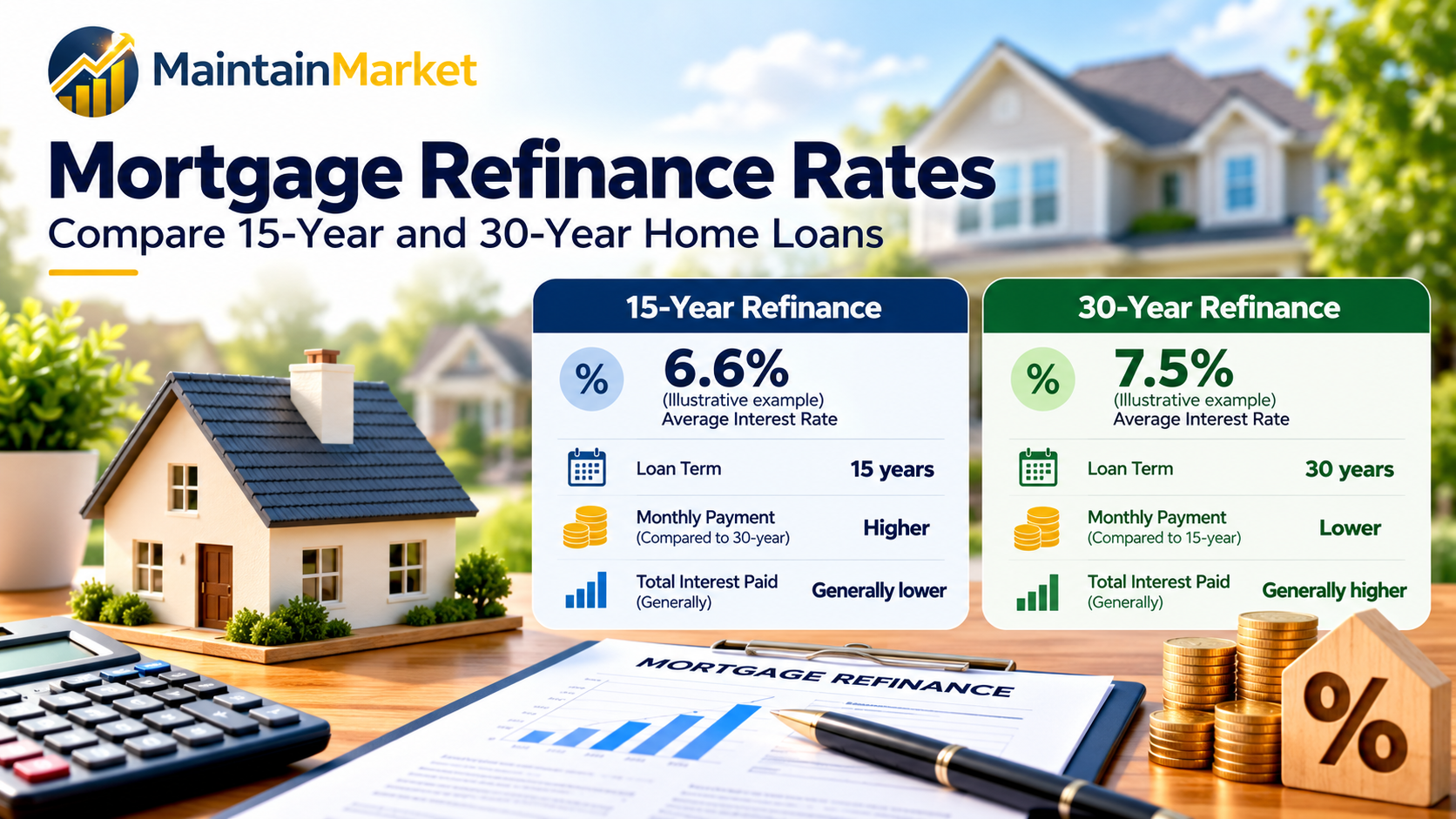
A 15-year fixed-rate mortgage typically comes with a higher monthly payment than a comparable 30-year loan because the balance must be repaid faster.
The advantage is that you may pay substantially less interest over the life of the loan. This can be a reasonable choice if you have stable income, sufficient savings, and room in your budget for the larger payment.
Before choosing a shorter term, make sure the payment remains affordable even if your household expenses increase.
3. FHA refinance loans
FHA refinancing is available to eligible borrowers through programs insured by the Federal Housing Administration.
Depending on the borrower’s circumstances, options may include FHA Streamline Refinance, which has specific eligibility and documentation requirements, or other FHA refinance programs.
FHA loans may involve mortgage insurance costs. Compare the complete cost of the new loan rather than choosing it solely because the advertised interest rate appears lower.
Learn more through the official HUD website.
4. VA refinance loans
Eligible veterans, service members, and certain surviving spouses may qualify for refinancing through the Department of Veterans Affairs.
Depending on eligibility and circumstances, options include an Interest Rate Reduction Refinance Loan (IRRRL) and a VA cash-out refinance.
The IRRRL is designed to refinance an existing VA-backed loan, subject to program rules. Compare the new interest rate, closing costs, funding fee where applicable, and expected time in the home before deciding.
Visit the official VA home-loan website for program details.
5. Adjustable-rate mortgage refinance
An adjustable-rate mortgage (ARM) may offer an initial rate that is lower than some fixed-rate alternatives. After the introductory period, however, the rate can adjust according to the loan’s terms and applicable index.
That means your monthly principal-and-interest payment could increase later.
An ARM may be worth comparing if you understand the adjustment schedule and can manage the possibility of higher payments. Read the rate caps, adjustment frequency, and other loan terms before choosing this option.
What Affects Mortgage Refinance Rates?
Lenders assess several factors when determining the interest rate and terms they can offer.
Credit score
Your credit score can influence the rates and loan terms available to you. A stronger credit profile may help you qualify for more competitive offers, although the effect depends on the loan program and lender.
Before applying, review your credit reports for errors, pay bills on time, and avoid taking on unnecessary new debt. Check your eligibility with multiple lenders rather than assuming one credit-score threshold guarantees the best rate.
Home equity and loan-to-value ratio
Home equity is the difference between your home’s current value and the outstanding mortgage balance.
The loan-to-value ratio (LTV) compares the loan amount with the property’s value. For example, if a home is worth $400,000 and the new mortgage is $300,000, the LTV is 75%.
A lower LTV may improve your refinancing options, depending on the loan program. A higher LTV can limit available products or increase the cost of borrowing.
Debt-to-income ratio
Your debt-to-income ratio (DTI) compares your monthly debt obligations with your gross monthly income.
Lenders may consider mortgage payments, car loans, student loans, credit card obligations, and other qualifying debts when evaluating your application.
Reducing outstanding debt and avoiding new monthly obligations before applying may help strengthen your overall application.
Loan term and loan amount
The repayment term affects both your monthly payment and total interest costs. A 15-year loan generally requires higher monthly principal-and-interest payments than a comparable 30-year loan, but it usually reduces the time over which interest accumulates.
The size of your loan and the property type can also affect the products and pricing available to you.
Market conditions
Mortgage rates are influenced by factors including Treasury yields, inflation expectations, economic growth, lender funding costs, and investor demand for mortgage-backed securities.
The Federal Reserve’s policy decisions can influence financial conditions, but mortgage rates do not move in lockstep with the federal funds rate.
As a result, waiting for a specific rate reduction is uncertain. Compare current offers against your existing mortgage and financial goals instead of relying on predictions alone.
Discount points and lender fees
Some lenders offer a lower interest rate in exchange for paying discount points upfront. One discount point generally equals 1% of the loan amount, although the rate reduction associated with a point varies.
Paying points can make sense if the monthly savings recover the upfront cost before you sell, move, or refinance again.
Compare offers with and without points so you can see whether the lower advertised rate is worth the additional expense.
How to Get the Best Mortgage Refinance Rates
You cannot control every factor that affects mortgage pricing, but you can take practical steps to find a competitive offer.
1. Check your credit reports
Review your credit reports before applying. Correct inaccurate information through the relevant credit reporting agency and continue making payments on time.
Avoid making unnecessary credit applications or opening new accounts just before refinancing.
2. Compare multiple lenders
Request comparable refinance quotes from several lenders, such as banks, credit unions, and mortgage companies.
When possible, obtain Loan Estimates for the same loan amount, term, loan type, and points structure. This makes it easier to compare offers fairly.
You can use the Consumer Financial Protection Bureau’s guide to comparing Loan Estimates.
3. Compare APR and closing costs
Do not focus only on the interest rate. Review the APR, lender origination charges, third-party services, lender credits, prepaid expenses, and total cash required at closing.
A lender advertising the lowest rate may charge more upfront. Another lender may offer a slightly higher rate but lower fees.
The better offer depends on how long you expect to keep the loan and how much you will pay over that period.
4. Consider paying discount points
Ask the lender to show you the cost of buying down the rate and the monthly savings you could expect.
Calculate the break-even period before paying for points. If the upfront cost takes too long to recover, paying points may not suit your plans.
5. Choose a suitable loan term
Compare 15-year, 20-year, and 30-year terms where available.
A shorter term may save interest but increase the required payment. A longer term may offer more monthly flexibility while extending the time you remain in debt.
Choose a payment that fits your budget without leaving you short of emergency savings.
6. Lock your rate when appropriate
A rate lock can protect an agreed interest rate for a specified period, subject to the lender’s conditions.
Ask how long the lock lasts, whether an extension costs extra, and what happens if closing is delayed. A lock does not necessarily guarantee that every fee will remain unchanged.
When Should You Refinance Your Mortgage?
Refinancing may be worth considering when it improves your overall financial position—not simply when a new rate looks lower.
Consider refinancing if:
- Your new loan meaningfully reduces borrowing costs after fees.
- You want to change from an adjustable rate to a fixed rate.
- You want to shorten your repayment term and can afford the higher payment.
- You want to remove or change mortgage insurance, where the relevant loan rules allow it.
- You need to change the structure of your mortgage for a specific financial reason.
Think carefully before refinancing if you expect to move soon, your current mortgage already has a low rate, the closing costs are high, or the new loan would substantially extend your repayment period.
A cash-out refinance also deserves special care. It converts some of your home equity into borrowed money and increases or restructures the debt secured by your home. Consider alternatives and make sure the purpose of the borrowing justifies the cost and risk.
How to Calculate Your Mortgage Refinance Break-Even Point
The break-even point estimates how long it takes for your monthly savings to recover the upfront cost of refinancing.
Use this formula:
Break-even period = Total refinancing costs ÷ Monthly savings
For example, suppose:
- Total refinancing costs: $3,000
- Monthly payment savings: $150
The calculation is:
$3,000 ÷ $150 = 20 months
In this simplified example, you would need approximately 20 months to recover the refinancing costs through your monthly payment savings.
If you sell the home or refinance again before reaching that point, you may not recover those costs through the monthly savings.
Important limitation
This calculation is only a starting point. A complete comparison should also account for the remaining loan balance, the old and new repayment schedules, total interest, any mortgage insurance changes, and whether closing costs are added to the new loan.
A lower monthly payment can result from restarting a longer repayment term rather than obtaining a genuinely cheaper loan.
For a more reliable comparison, review the Loan Estimate’s projected payments, closing costs, and five-year cost of borrowing. The CFPB’s Loan Estimate guidance explains what to examine.
Mortgage Refinance Rates vs. Purchase Mortgage Rates
Purchase mortgage rates and refinance mortgage rates are related, but they are not necessarily identical.
A purchase mortgage helps finance the purchase of a property. A refinance mortgage replaces an existing home loan. Lenders may price these transactions differently depending on loan type, borrower profile, property equity, and market conditions.
When comparing rates, use refinance-specific quotes whenever possible. A national purchase mortgage average is useful for understanding broad market movements, but it should not be presented as the exact rate available to someone refinancing.
Also check whether a quoted rate includes discount points, whether it is an interest rate or APR, and which loan term and borrower profile it assumes.
Are No-Closing-Cost Mortgage Refinances Really Free?
No. A no-closing-cost refinance generally means that you do not pay some or all eligible closing costs directly upfront.
Depending on the offer, the lender may provide credits in exchange for a higher interest rate, or certain costs may be added to the loan balance. The costs still matter economically, even if you do not pay them at closing.
Ask the lender to compare a no-closing-cost offer with an option where you pay the costs upfront. Review the monthly payment, APR, loan balance, and total cost over the time you expect to keep the mortgage.
Do not assume that a no-closing-cost loan is automatically cheaper or more expensive. The answer depends on the actual offer and your plans.
Frequently Asked Questions About Mortgage Refinance Rates
What are mortgage refinance rates today?
Mortgage refinance rates change regularly and vary by lender, loan type, credit profile, equity, and loan term. Check a recently updated refinance-specific rate source and request personalized quotes from multiple lenders. Always confirm the publication date before relying on an advertised average.
Are refinance rates higher than purchase mortgage rates?
They can be, but the difference depends on the lender, loan program, and borrower profile. Compare refinance-specific offers rather than assuming a purchase mortgage rate will apply to your refinance.
What credit score do I need to get the best mortgage refinance rate?
There is no single credit score that guarantees the best refinance rate across all lenders and loan programs. Requirements vary by product and borrower circumstances. A stronger credit profile may improve your options, but lenders also consider income, debt, home equity, and other eligibility factors.
When should I refinance my mortgage?
Consider refinancing when the new loan improves your financial position after accounting for closing costs, the remaining repayment period, and total interest. Your break-even period and how long you expect to keep the mortgage are important parts of the decision.
How much does it cost to refinance a mortgage?
Refinancing costs vary by lender, location, loan amount, and transaction type. They may include origination charges, appraisal or other third-party fees, title services, recording fees, and prepaid expenses. Request a Loan Estimate to review the actual costs for your situation.
How do I calculate my mortgage refinance break-even point?
Divide the total refinancing costs by the monthly savings. For example, $3,000 in costs divided by $150 in monthly savings gives a 20-month break-even period. This simplified calculation does not capture every difference between the old and new loans.
Can I refinance my mortgage with bad credit?
Possibly, depending on the loan program, lender, equity, income, and other eligibility requirements. A lower credit score may limit your choices or result in less favorable pricing. Check program requirements and compare offers before deciding whether refinancing is worthwhile.
Does refinancing hurt your credit score?
Applying for a refinance can result in a hard credit inquiry, which may affect your credit score temporarily. Opening a new loan also changes your credit profile. The impact varies by individual, so ask lenders about their credit-check process and compare offers within a focused shopping period.
Should I choose a 15-year or 30-year refinance?
A 15-year loan generally has a higher required monthly payment but can reduce total interest by repaying the balance faster. A 30-year loan usually offers a lower required payment but can extend repayment and increase total interest. Compare both options against your budget and long-term plans.
Are no-closing-cost refinance loans really free?
No. Eligible costs may be covered by lender credits in exchange for a higher rate, or some costs may be added to the loan. Compare the full loan terms, APR, payment, and total cost before accepting the offer.
Final Thoughts
Comparing mortgage refinance rates can help you find a loan that better fits your budget and financial goals. However, the lowest advertised rate is not always the best deal.
Compare offers from multiple lenders, review the APR and closing costs, and calculate your break-even point. Consider how long you expect to keep the mortgage and whether the new repayment term changes your total interest costs.
Most importantly, use current, dated refinance-rate data and personalized lender quotes. That will give you a more realistic picture of your options than relying on a headline rate alone.
Recommended Reads
- 10 Essential Mortgage Preapproval Requirements: Documents, Credit & Income You Need
- Mortgage Pre-Approval Secrets
- How Much Car Insurance Do I Need?
Disclaimer: This article is for educational purposes only and does not constitute financial, tax, or mortgage advice. Mortgage rates, eligibility requirements, fees, and loan terms vary. Verify the details with lenders and qualified professionals before making a financial decision.