
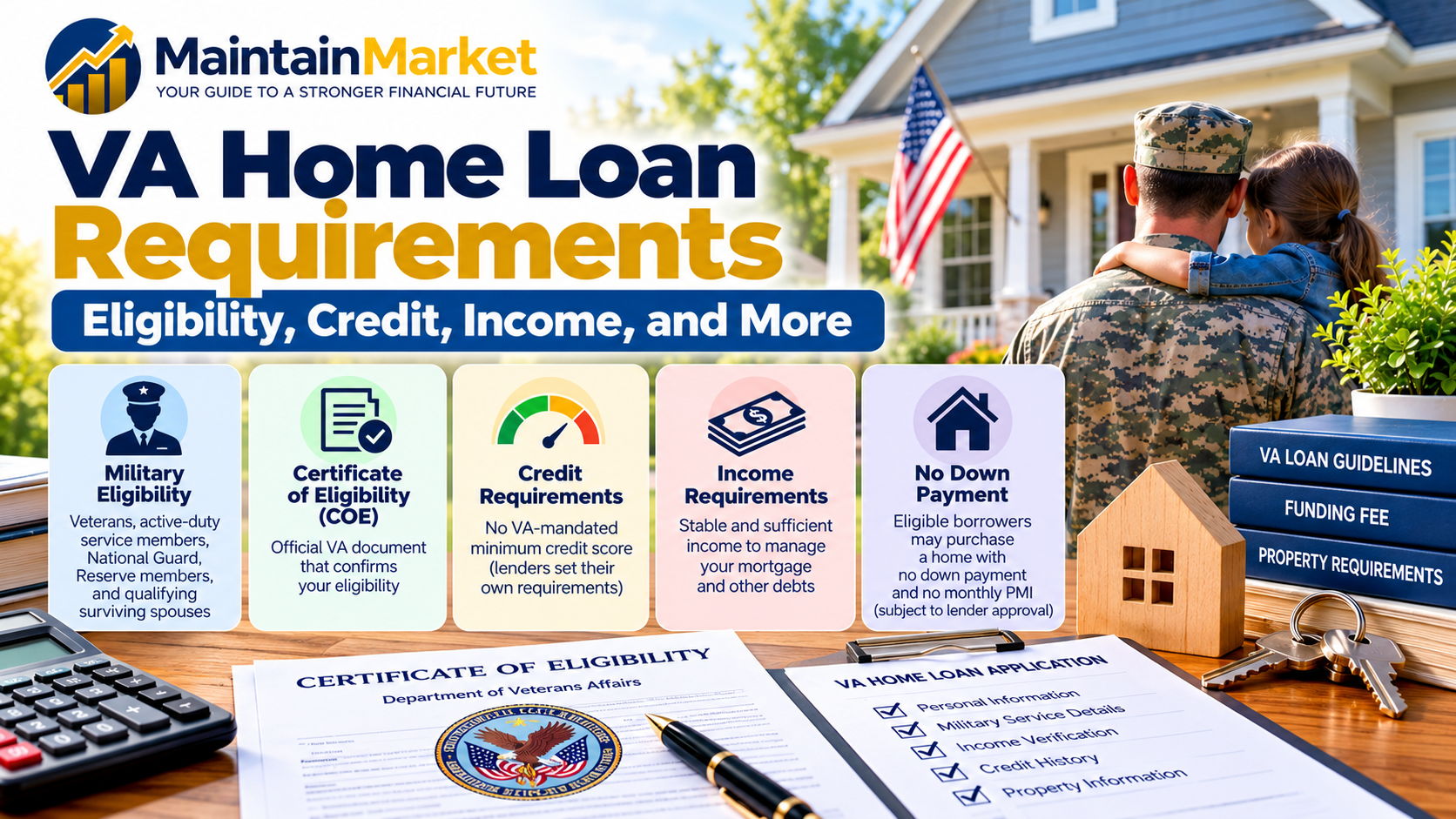
VA home loans can make buying a home more affordable for eligible veterans, active-duty service members, and certain surviving spouses. However, before applying, you need to understand the VA home loan requirements, including military service eligibility, credit history, income, occupancy rules, and the Certificate of Eligibility (COE).
One major advantage of a VA-backed mortgage is that eligible borrowers can often purchase a home with no down payment and without monthly private mortgage insurance (PMI). However, qualifying for the VA home loan benefit does not automatically guarantee mortgage approval. You must also meet your lender’s financial and underwriting requirements.
This guide explains who qualifies for a VA home loan, what documents you need, how the application process works, and what costs to expect.
What Are the VA Home Loan Requirements?
To qualify for a VA-backed purchase loan, you generally need to meet these requirements:
- Meet the VA’s military service or surviving-spouse eligibility rules.
- Obtain a valid Certificate of Eligibility (COE).
- Meet the lender’s credit and income requirements.
- Have sufficient income to manage your mortgage payments and other financial obligations.
- Intend to occupy the property as your home, subject to applicable VA occupancy rules.
- Purchase a property that meets applicable VA appraisal and property requirements.
The VA guarantees a portion of eligible loans made by private lenders. Banks, mortgage companies, and credit unions typically provide the financing and determine whether you qualify financially.
Who Is Eligible for a VA Home Loan?
VA home loan benefits are available to eligible veterans, active-duty service members, certain National Guard and Reserve members, and qualifying surviving spouses.
Your eligibility depends on your military service history, duty status, and character of discharge or separation.
1. Veterans
You may qualify if you completed the required active-duty service for the period in which you served and meet the applicable discharge requirements.
The minimum service period can vary depending on when you served. Certain exceptions may apply if you were discharged earlier for qualifying reasons.
2. Active-duty service members
Current service members may qualify after meeting the applicable minimum service requirements.
For example, the VA generally recognizes 90 continuous days of active duty as sufficient for certain current service members. Your exact eligibility depends on your service category and circumstances.
3. National Guard members
Eligible National Guard members may qualify through qualifying active service or other applicable service requirements.
Some National Guard members may qualify through at least 90 days of active service, including at least 30 consecutive days under specified Title 32 provisions.
4. Reserve members
Certain members of the Selected Reserve may qualify after completing the required service period and meeting the applicable eligibility conditions.
The VA evaluates the nature and length of service when determining eligibility.
5. Eligible surviving spouses
Some surviving spouses may qualify for VA home loan benefits.
This can include certain spouses of service members who died in service or veterans who died from service-connected disabilities. Other specific circumstances may also qualify.
The VA determines eligibility based on the applicable rules and documentation.
Important: Do not assume you are ineligible simply because your service history does not match a common example. Check the official VA eligibility requirements to determine whether an exception applies.
What Is a Certificate of Eligibility (COE)?
A Certificate of Eligibility, commonly called a COE, is an official VA document that confirms you meet the military service or other eligibility requirements for the VA home loan benefit.
Your lender will generally need this document before proceeding with your VA-backed mortgage.
A COE does not mean your mortgage is automatically approved. Your lender must still review your credit, income, debts, and other financial information.
How to get a VA Certificate of Eligibility
You can request your COE in three main ways:
- Online: Apply through the VA’s official website.
- Through your lender: A participating VA lender may be able to request the COE on your behalf.
- By mail: Submit VA Form 26-1880 with the required supporting documentation.
Documents you may need for your COE
| Applicant category | Common supporting document |
|---|---|
| Veteran | DD Form 214 |
| Active-duty service member | Current statement of service |
| National Guard member | Relevant discharge or service documentation |
| Reserve member | Applicable service records |
| Eligible surviving spouse | Documentation requested by the VA for the specific eligibility category |
The exact documents depend on your service history and eligibility category.
You can start through the official VA Certificate of Eligibility application.
VA Home Loan Credit Score Requirements
One important benefit of VA-backed loans is that the VA does not establish a universal minimum credit score for borrowers.
However, this does not mean you can qualify with any credit history.
Private lenders may establish their own minimum credit score requirements and underwriting standards. Your credit profile can also influence the interest rate and loan terms you receive.
What credit score do you need for a VA loan?
There is no single VA-mandated minimum credit score.
Individual lenders may have their own requirements. Some lenders may consider borrowers with lower scores, while others may apply stricter standards.
When evaluating your application, lenders may review:
- Payment history
- Outstanding credit card balances
- Credit utilization
- Previous bankruptcies or foreclosures
- Collections and outstanding judgments
- Recent credit inquiries
- Overall credit history
Can you get a VA home loan with bad credit?
Possibly, depending on the lender and your overall financial situation.
A lower credit score does not automatically mean you are ineligible for the VA benefit. However, a lender may decline an application if the borrower’s credit history does not meet its underwriting standards.
If your credit score needs improvement, consider paying down high credit card balances, making payments on time, reviewing your credit reports for errors, and avoiding unnecessary new debt before applying.
VA Home Loan Income Requirements
You must demonstrate that you have sufficient and stable income to repay the mortgage.
The VA does not set one universal minimum annual income that applies to every borrower. Your lender evaluates your income alongside the proposed mortgage payment, existing debts, and household financial obligations.
Depending on your circumstances, qualifying income may include:
- Employment income
- Military base pay
- Basic Allowance for Housing (BAH), when eligible
- Retirement income
- Eligible disability compensation
- Self-employment income
- Certain other documented income sources
Lenders determine which income sources can be counted and what documentation is necessary.
What is residual income for a VA loan?
Residual income is an important part of VA mortgage underwriting.
It refers to the amount of money you have left each month after paying major obligations, including estimated housing expenses, taxes, debts, and other applicable costs.
The VA uses regional residual-income guidelines that vary based on factors such as family size, geographic region, and loan amount.
Residual income helps lenders evaluate whether you can comfortably manage your mortgage and everyday living expenses.
What is the debt-to-income ratio for a VA loan?
Your debt-to-income ratio, or DTI, compares your monthly debt payments with your gross monthly income.
For example:
- Gross monthly income: $7,000
- Total monthly debt payments: $2,450
- DTI ratio: 35%
Calculation:
DTI = ($2,450 ÷ $7,000) × 100 = 35%
The VA uses 41% as an important DTI guideline in its underwriting framework, but it is not an automatic universal approval or rejection threshold. Residual income and other compensating factors also matter.
A lender evaluates your complete financial profile rather than relying on DTI alone.
Do VA Home Loans Require a Down Payment?
One of the biggest advantages of VA-backed purchase loans is that eligible borrowers may be able to buy a home without making a down payment.
However, zero down payment is not guaranteed in every situation.
Your available VA entitlement, loan amount, lender requirements, purchase price, and property appraisal can affect how much money you need to contribute.
For borrowers with full VA entitlement who meet the lender’s requirements, there is generally no VA-imposed loan limit. Borrowers with remaining or reduced entitlement may face different guaranty and down-payment considerations.
Example of a VA home purchase
Suppose you want to purchase a home worth $350,000.
- Purchase price: $350,000
- Eligible down payment: $0
- Base mortgage amount: $350,000
This is a simplified illustration. The actual amount financed can be affected by the funding fee, closing costs, credits, and other transaction details.
Even when no down payment is required, you may still need money for closing costs, prepaid expenses, inspections, moving costs, and other expenses.
Does a VA Home Loan Require Private Mortgage Insurance?
No. VA-backed loans do not require monthly private mortgage insurance (PMI).
This is an important difference compared with many conventional mortgage arrangements where borrowers may need PMI when making a smaller down payment.
However, VA borrowers may have to pay a one-time VA funding fee unless they qualify for an exemption.
The absence of monthly PMI does not mean a VA mortgage has no additional costs.
VA Funding Fee Requirements
The VA funding fee is generally a one-time charge associated with using the VA home loan benefit.
It helps support the VA loan program and reduces the cost to taxpayers.
The funding fee amount depends on factors such as:
- Type of VA loan
- Whether it is your first or subsequent use of the benefit
- Down payment amount, where applicable
- Other applicable eligibility conditions
Depending on the transaction, you may be able to finance the funding fee into your mortgage or pay it at closing.
Who is exempt from the VA funding fee?
You may be exempt if you meet certain conditions, including:
- Receiving VA compensation for a service-connected disability.
- Being eligible to receive VA compensation for a service-connected disability but receiving retirement or active-duty pay instead.
- Being an eligible surviving spouse under applicable VA rules.
Always verify your exemption status with the VA and your lender.
VA Home Loan Occupancy Requirements
VA-backed purchase loans are generally intended for a home that the borrower will personally occupy.
You cannot normally use a standard VA purchase loan to buy a property solely as an investment or vacation home.
What counts as primary residence occupancy?
The home should generally be your primary residence rather than a property purchased only for rental income.
Some exceptions and special circumstances may apply, including certain situations involving active-duty service members and eligible spouses or dependents.
The VA and lender will evaluate the applicable occupancy requirements for your transaction.
VA Home Loan Property Requirements
The property you purchase must meet applicable VA requirements.
A VA appraisal is required to help determine the property’s value and assess whether it meets the VA’s Minimum Property Requirements (MPRs).
These standards are designed to ensure the property is safe, structurally sound, and sanitary.
What does a VA appraisal check?
Depending on the property, an appraisal may consider:
- Structural safety
- Roof condition
- Heating and basic utilities
- Access to the property
- Water and sanitation
- Potential health and safety concerns
- Overall property condition
A VA appraisal is not a substitute for a professional home inspection.
Even if a property receives a satisfactory VA appraisal, buyers should consider arranging an independent home inspection to identify potential maintenance or repair issues.
What Documents Are Needed for a VA Home Loan?
When applying for a VA mortgage, your lender may request documents to verify your service eligibility, income, debts, assets, and property details.
Common documents include:
- Certificate of Eligibility (COE)
- Government-issued identification
- DD Form 214 or applicable service documentation
- Recent pay stubs
- W-2 forms or tax returns, as applicable
- Bank statements
- Employment history
- Documentation of additional income
- Information about existing loans and monthly debts
- Purchase agreement and property-related documents
Self-employed applicants may need additional financial records, such as business tax returns and profit-and-loss statements.
The exact documentation varies by lender and borrower circumstances.
How to Apply for a VA Home Loan
Once you understand the VA home loan requirements, you can follow these steps to begin the application process.
Step 1: Check your VA eligibility
Review the service requirements and determine whether you may qualify for the VA home loan benefit.
Step 2: Obtain your COE
Request your Certificate of Eligibility online or ask a participating lender to obtain it for you.
Step 3: Review your finances
Check your credit history, income, monthly debts, savings, and expected housing expenses.
Step 4: Compare VA-approved lenders
Contact multiple lenders that offer VA-backed mortgages. Compare their interest rates, fees, credit requirements, and loan terms.
Step 5: Get preapproved
A lender can review your financial information and provide an estimate of the mortgage amount you may qualify for.
Preapproval is not a final mortgage approval.
Step 6: Find an eligible property
Work with a real estate professional to find a home that meets your budget and the applicable VA requirements.
Step 7: Complete the VA appraisal
Your lender will arrange the required VA appraisal to assess the property’s value and compliance with applicable standards.
Step 8: Complete underwriting and close
The lender reviews your application, verifies documentation, and confirms that all requirements are satisfied before closing.
Common Reasons a VA Home Loan Application May Be Denied
Even eligible veterans and service members can have a VA mortgage application declined.
Some common reasons include:
- Credit history does not meet lender requirements.
- Insufficient or unstable qualifying income.
- High monthly debt obligations.
- Insufficient residual income.
- Property does not meet applicable VA requirements.
- Problems with occupancy eligibility.
- Missing or incomplete documentation.
- Loan amount or terms do not meet lender underwriting standards.
If your application is declined, ask the lender for the specific reasons and whether you can address the issues before applying again.
You may also compare other participating lenders because underwriting requirements can differ.
Frequently Asked Questions About VA Home Loan Requirements
1. What are the basic VA home loan requirements?
You generally need to meet VA military service or surviving-spouse eligibility rules, obtain a Certificate of Eligibility, satisfy lender credit and income standards, and meet applicable occupancy and property requirements.
2. What credit score is required for a VA home loan?
The VA does not set a universal minimum credit score. However, individual lenders may establish their own minimum score requirements and other credit standards.
3. Can I get a VA home loan with no down payment?
Yes. Eligible borrowers with sufficient entitlement may be able to purchase a home with no down payment, subject to lender approval and the applicable loan and property requirements.
4. Do VA home loans require PMI?
No. VA-backed home loans do not require monthly private mortgage insurance. However, most borrowers must pay a one-time funding fee unless they qualify for an exemption.
5. What is a VA Certificate of Eligibility?
A Certificate of Eligibility is an official VA document that confirms you meet the service or other eligibility requirements for the VA home loan benefit. Your lender generally needs it to process your VA-backed mortgage.
6. What is the income limit for a VA home loan?
There is no single universal VA minimum or maximum income limit for every borrower. Lenders assess sufficient qualifying income, monthly obligations, residual income, and the borrower’s ability to repay.
7. Can I use a VA loan more than once?
Yes. Eligible borrowers may be able to use the VA home loan benefit multiple times. Your available entitlement and the circumstances of any existing VA loan will affect how you can use the benefit again.
8. Can I use a VA loan to buy an investment property?
Generally, no. A VA-backed purchase loan is intended for a home the borrower will occupy as a primary residence, subject to applicable exceptions.
9. Do surviving spouses qualify for VA home loans?
Certain surviving spouses may qualify, including eligible spouses of veterans who died from service-connected disabilities or service members who died in service. The VA determines eligibility based on the applicable rules.
10. How long does it take to get a VA home loan approved?
The timeline varies by lender, documentation, appraisal, underwriting, and property conditions. Getting your COE and financial documents ready early can help reduce delays.
Final Thoughts
Understanding VA home loan requirements is an important first step toward using your military service benefits to purchase a home.
Eligible borrowers may benefit from no-down-payment financing, no monthly PMI, and competitive mortgage terms. However, you still need to satisfy lender requirements involving credit, income, debt obligations, and property eligibility.
Start by checking your eligibility and obtaining your Certificate of Eligibility. Then compare several VA-approved lenders and review the complete mortgage costs before choosing a loan.
Official resource: Visit VA.gov Housing Assistance for the latest eligibility information, loan options, and application guidance.
Authoritative external sources
These primary sources within the article:
- VA.gov – VA Home Loan Eligibility
- VA.gov – Request a Certificate of Eligibility
- VA.gov – VA Purchase Loan
- VA.gov – VA Funding Fee and Closing Costs
- VA.gov – Home Buying Process
Disclaimer: This article is for educational purposes only and does not constitute financial, mortgage, legal, or tax advice. VA home loan eligibility and lender approval depend on individual circumstances, applicable VA rules, and lender requirements. Always verify current requirements with the U.S. Department of Veterans Affairs and a participating lender.