
Looking for health insurance but don’t need a long-term policy? Short term health insurance may provide temporary medical coverage when you are between jobs, waiting for employer-sponsored insurance to begin, or experiencing a gap in your regular health coverage.
These plans, also known as short-term limited-duration insurance (STLDI), are designed to provide temporary protection against certain unexpected medical expenses. They may offer lower monthly premiums than comprehensive health insurance, but they generally come with fewer benefits and weaker consumer protections.
For example, a short-term health insurance plan may help pay for certain hospital stays, doctor visits, or emergency medical services. However, it may exclude pre-existing conditions, prescription drugs, maternity care, or mental health services.
Before purchasing a policy, it is important to understand what it covers, how long it lasts, how much it costs, and what expenses you may have to pay yourself.
In this guide, we’ll explain how short-term health insurance works, its benefits and disadvantages, eligibility requirements, costs, and alternatives available in the United States.
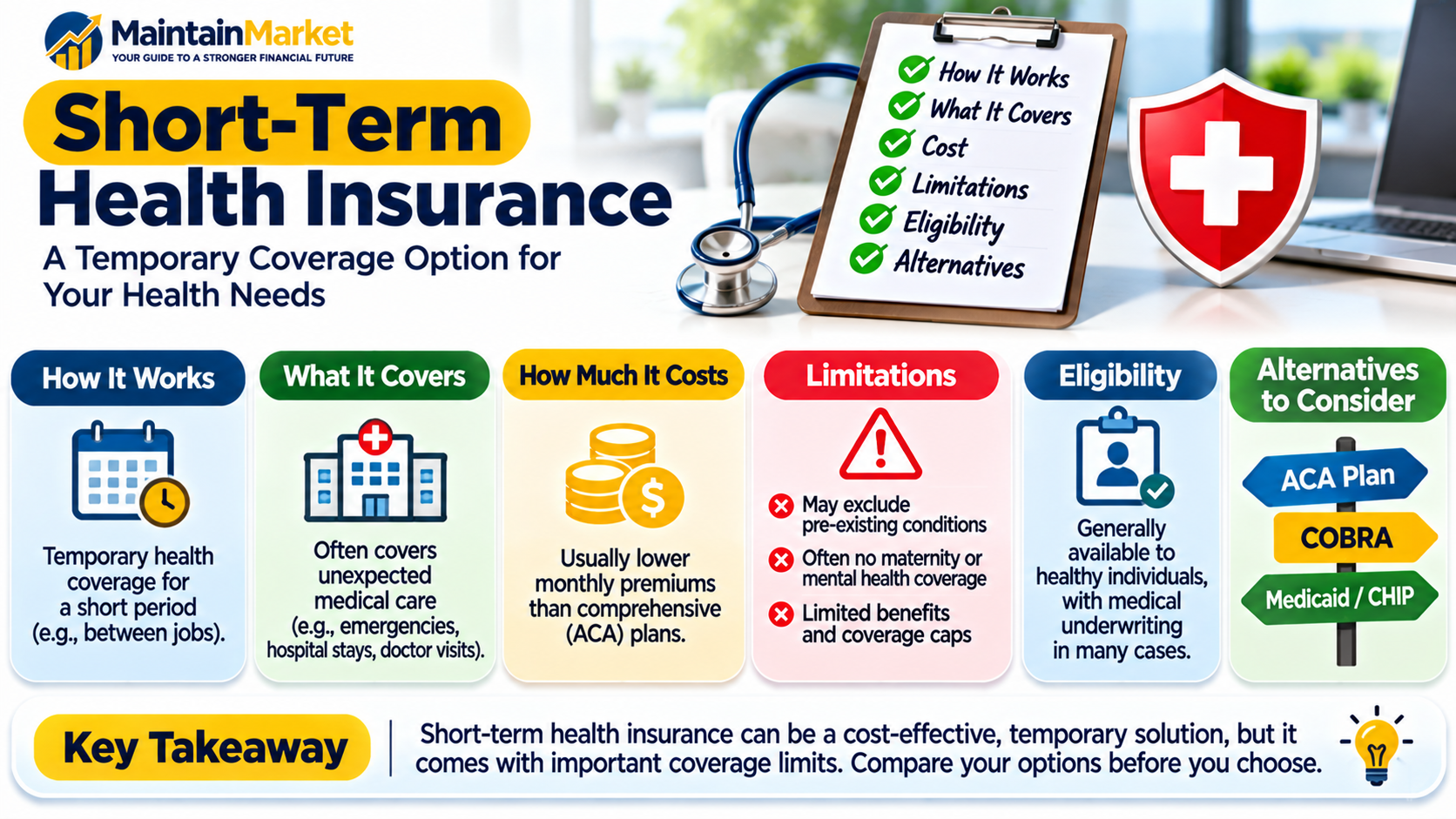
What Is Short-Term Health Insurance?
Short-term health insurance is temporary medical coverage designed to help individuals manage a gap between comprehensive health insurance policies.
It is generally intended for people who need temporary protection rather than a long-term replacement for employer-sponsored or Affordable Care Act (ACA)-compliant health insurance.
You may consider short-term health insurance if you are:
- Between jobs and waiting for new employer coverage.
- A recent college graduate transitioning to a full-time job.
- Waiting for employer-sponsored insurance to begin.
- Experiencing a temporary gap in health coverage.
- A seasonal worker without year-round employer benefits.
- Ineligible for certain other coverage options.
Unlike ACA Marketplace plans, short-term health insurance policies are generally not required to provide the same comprehensive benefits and consumer protections.
Insurance companies may evaluate your medical history before approving your application. They may also exclude pre-existing conditions or impose limits on certain medical benefits.
Important: Short-term health insurance is not equivalent to comprehensive health insurance. A lower premium does not necessarily mean lower overall healthcare costs.
How Does Short-Term Health Insurance Work?
Short-term health insurance generally works by providing temporary coverage for eligible medical expenses during a specified policy period.
The exact benefits, exclusions, deductibles, and payment limits depend on the insurance company and policy.
Here is how the process typically works:
- Choose a plan: Compare available short-term health insurance policies in your state.
- Complete an application: You may need to answer questions about your medical history.
- Underwriting review: The insurer evaluates your application and determines whether to offer coverage.
- Pay the premium: If approved, you pay the required premium.
- Receive coverage: Your policy begins on the effective date stated in the contract.
- Use covered medical services: You pay applicable deductibles, copayments, coinsurance, or other expenses.
- Submit claims: The insurer processes eligible medical claims according to the policy.
Some plans use provider networks, while others may have different arrangements for determining eligible payments. Out-of-network care can expose you to significant additional costs.
Always review the policy’s benefit schedule, provider network, exclusions, and claim procedures before enrolling.
What Does Short-Term Health Insurance Cover?
Short-term health insurance plans can cover different medical services depending on the policy.
Some plans offer protection for selected unexpected medical expenses, but they are not required to cover all the essential health benefits required of ACA-compliant Marketplace plans.
Here are examples of benefits that some short-term plans may offer.
1. Emergency Medical Care
Some policies provide benefits for eligible emergency medical treatment.
This may include:
- Emergency room visits.
- Treatment for sudden illnesses.
- Emergency medical evaluations.
- Certain emergency procedures.
However, emergency care does not automatically mean every related service or expense is covered. Review the policy’s emergency treatment provisions and exclusions.
2. Hospitalization
Some short-term health insurance plans provide benefits for eligible hospital stays.
Depending on the policy, this may include:
- Hospital room charges.
- Certain inpatient services.
- Covered surgical procedures.
- Hospital-related medical treatment.
Check whether the plan has a per-day benefit limit, a maximum hospital benefit, or other restrictions.
3. Doctor Visits
Some plans provide limited benefits for physician visits and consultations.
These may include:
- General doctor consultations.
- Certain specialist visits.
- Evaluation of unexpected illnesses.
- Selected outpatient services.
The number of covered visits and the amount paid by the insurer may be limited.
4. Diagnostic Tests
Depending on the policy, some diagnostic services may be covered.
Examples may include:
- Blood tests.
- Certain laboratory services.
- X-rays.
- Selected diagnostic imaging.
Not every test is necessarily covered, and some services may require approval or meet specific medical-necessity requirements.
5. Surgical Procedures
Some short-term policies cover eligible surgical procedures, including certain inpatient or outpatient surgeries.
However, coverage may depend on the medical condition, waiting periods, exclusions, benefit limits, and whether the procedure is considered eligible under the contract.
6. Prescription Drugs
Prescription drug coverage varies significantly.
Some short-term plans provide limited prescription benefits, while others offer little or no coverage for routine medications.
If you regularly take prescription medication, check:
- Whether your medications are covered.
- Whether generic drugs are preferred.
- Which pharmacies are included.
- Whether there are prescription benefit limits.
- Whether pre-existing conditions affect coverage.
Do not assume that a short-term policy includes a comprehensive prescription drug benefit.
What Does Short-Term Health Insurance Usually Not Cover?
One of the biggest disadvantages of short-term health insurance is that it does not have to provide the same benefits and protections as ACA-compliant health insurance.
Common limitations may include:
| Medical service or condition | Short-term plan coverage |
|---|---|
| Pre-existing conditions | May be excluded |
| Maternity and childbirth | Often excluded |
| Mental health services | May be excluded or limited |
| Prescription drugs | May be limited or excluded |
| Preventive care | May be limited or excluded |
| Substance use disorder treatment | May be excluded or limited |
| Rehabilitation services | May be limited or excluded |
| Certain specialist treatments | Depends on the policy |
These are common limitations, not a universal list. Individual policies may provide some of these benefits, but you must verify the actual contract.
Pre-Existing Medical Conditions
A pre-existing condition is a health condition that existed before your insurance coverage started.
Unlike ACA Marketplace plans, short-term health insurance policies are generally not required to cover pre-existing medical conditions.
An insurer may review your medical history, ask health-related questions, or exclude certain conditions.
For example, someone with a history of diabetes may find that a short-term plan excludes treatment related to that condition.
By comparison, ACA Marketplace plans must cover pre-existing conditions and cannot reject applicants or charge them more based on their health status.
Maternity and Pregnancy Coverage
Short-term health insurance generally does not provide the same maternity and childbirth protections as ACA-compliant plans.
If you are planning a pregnancy or already pregnant, carefully review the policy before purchasing it.
Do not assume that hospital coverage automatically includes prenatal care, childbirth, or maternity-related expenses.
Mental Health Services
Mental health and substance use disorder treatment may be limited or excluded under short-term plans.
If you need counseling, psychiatric treatment, medication, or other behavioral health services, confirm the benefits and exclusions before enrolling.
Short-Term Health Insurance vs. ACA Health Insurance
Short-term health insurance and ACA-compliant health insurance serve different purposes.
Short-term plans are designed for temporary coverage and generally have fewer consumer protections.
ACA Marketplace plans provide comprehensive coverage and must comply with federal consumer protection requirements.
Here is a comparison:
| Feature | Short-Term Health Insurance | ACA Marketplace Health Insurance |
|---|---|---|
| Main purpose | Temporary coverage | Comprehensive health coverage |
| Pre-existing conditions | May be excluded | Must be covered |
| Essential health benefits | Not required to cover all | Required |
| Maternity care | May be excluded | Covered |
| Mental health services | May be limited or excluded | Essential health benefit |
| Prescription drugs | May be limited | Essential health benefit |
| Annual or lifetime benefit limits | May apply | No annual or lifetime dollar limits on essential health benefits |
| Medical underwriting | May apply | Not permitted based on health status |
| Premium tax credits | Not eligible | May be available to eligible applicants |
| Coverage duration | Depends on state law and applicable federal rules | Generally renewable according to applicable rules |
Which Option Is Better?
For people who need comprehensive protection, an ACA Marketplace plan is generally the stronger option.
Short-term health insurance may be considered when someone needs temporary coverage and understands the exclusions, benefit limits, and potential financial risks.
However, compare the actual cost of both options before choosing.
You may qualify for Marketplace financial assistance that makes comprehensive coverage more affordable than expected.
You can explore options at HealthCare.gov.
How Much Does Short-Term Health Insurance Cost?
The cost of short-term health insurance varies by insurer, state, applicant, coverage period, and policy design.
Factors that may affect your premium include:
- Your age.
- Your location.
- Your medical history.
- The selected deductible.
- Coverage limits.
- Optional benefits.
- The length of the policy.
- The insurer’s underwriting requirements.
Some short-term policies may have lower monthly premiums than ACA Marketplace plans because they provide fewer benefits and are subject to fewer consumer protections.
However, a lower premium does not guarantee that the plan will save you money after a medical emergency.
Example: Understanding the Total Cost
Imagine you are comparing two hypothetical health insurance options.
| Expense | Short-Term Plan | Comprehensive Plan |
|---|---|---|
| Monthly premium | $150 | $400 |
| Annual premium equivalent | $1,800 | $4,800 |
| Deductible | $5,000 | $2,000 |
| Coverage | Limited benefits | Comprehensive benefits |
These figures are illustrative only, not actual market quotes.
At first glance, the short-term plan appears less expensive.
However, imagine you need medical treatment costing $12,000. If the condition is excluded or the treatment exceeds the policy’s benefit limits, you could face substantial out-of-pocket expenses.
The comprehensive plan may provide stronger financial protection, depending on its deductible, network, coinsurance, and out-of-pocket maximum.
The lesson: Compare total potential healthcare expenses, not just monthly premiums.
How Long Does Short-Term Health Insurance Last?
The duration of short-term health insurance depends on federal regulatory developments, state insurance laws, and the specific policy.
This is an area where consumers should be particularly careful because federal rules have changed in recent years.
Understanding the Federal Rules
In April 2024, federal agencies finalized a rule defining short-term limited-duration insurance for new policies issued on or after September 1, 2024.
Under that rule:
- The initial policy term is limited to no more than three months.
- The total coverage period, including renewals or extensions, is limited to no more than four months.
However, on August 7, 2025, the Departments of Labor, Health and Human Services, and the Treasury announced that they did not intend to prioritize enforcement actions related to violations of the 2024 definition while they considered future rulemaking.
The NAIC reported in July 2026 that federal enforcement of the 2024 duration rule had been suspended. A revised federal rule was also being considered.
What does this mean for consumers?
The 2024 rule has not simply disappeared from the regulatory text. The federal enforcement position has changed, and state insurance laws remain important.
Some states restrict short-term policies to shorter periods, while others prohibit their sale or allow different durations under state requirements.
Therefore, do not assume that every short-term plan can last three months, four months, or 36 months.
Before enrolling, confirm the current rules in your state and the exact policy duration with the insurer or your state insurance department.
Who Should Consider Short-Term Health Insurance?
Short-term health insurance may be worth comparing for certain people who need temporary coverage.
1. People Between Jobs
If you leave one employer and your new employer’s health insurance does not start immediately, you may experience a coverage gap.
A short-term plan may be one option to consider during that transition.
However, compare it with COBRA and ACA Marketplace coverage before making a decision.
2. Recent College Graduates
Recent graduates may lose eligibility for a parent’s health insurance plan and need temporary coverage while looking for employment.
Depending on the circumstances, they may also qualify for an ACA Marketplace Special Enrollment Period or Medicaid.
3. People Waiting for Employer Coverage
Some employers impose a waiting period before new employees become eligible for health insurance.
A short-term plan may provide temporary coverage during this period, depending on availability and state rules.
4. Seasonal Workers
People working in seasonal industries may experience periods without employer-sponsored health benefits.
Short-term insurance may be one option to evaluate, although other coverage alternatives may provide broader protection.
5. People Experiencing a Temporary Coverage Gap
If your current insurance ends and you are waiting for another policy to begin, temporary insurance may help cover certain unexpected medical expenses.
However, check whether you qualify for a Marketplace Special Enrollment Period before purchasing a short-term plan.
Who Should Avoid Short-Term Health Insurance?
Short-term health insurance may not be suitable for everyone.
You should be especially cautious if:
- You have ongoing medical conditions.
- You regularly need prescription medication.
- You are pregnant or planning pregnancy.
- You need regular mental health treatment.
- You expect expensive medical procedures.
- You need comprehensive preventive care.
- You cannot afford a large unexpected medical bill.
If you need regular healthcare or comprehensive financial protection, an ACA-compliant Marketplace plan, employer-sponsored insurance, or another qualifying comprehensive plan may be more appropriate.
What Are the Alternatives to Short-Term Health Insurance?
Before buying short-term health insurance, compare other available coverage options.
1. ACA Marketplace Health Insurance
You can purchase comprehensive health insurance through the federal Marketplace at HealthCare.gov or through your state’s Marketplace.
Marketplace plans cover essential health benefits and protect people with pre-existing conditions.
Depending on household income and other eligibility requirements, you may qualify for premium tax credits that reduce your monthly premium.
You can compare plans and prices at HealthCare.gov.
2. COBRA Health Insurance
COBRA allows eligible employees and their dependents to continue certain employer-sponsored health insurance after qualifying events such as job loss or reduced working hours.
It can provide continuity of coverage, including access to the same employer plan.
However, you may have to pay the full premium, including the portion previously paid by your employer, plus an administrative fee.
If you are eligible, compare the COBRA cost with Marketplace coverage.
3. Medicaid
Medicaid provides free or low-cost health coverage to eligible individuals and families.
Eligibility depends on factors such as household income, state rules, family size, and other circumstances.
You can apply for Medicaid throughout the year rather than waiting for Marketplace Open Enrollment.
Learn more at Medicaid.gov.
4. Children’s Health Insurance Program (CHIP)
CHIP provides health coverage to eligible children in families that earn too much to qualify for Medicaid but may not be able to afford private insurance.
Depending on the state, CHIP may also cover pregnant women.
Applications are accepted throughout the year.
Learn more at InsureKidsNow.gov.
5. Employer-Sponsored Health Insurance
If you are starting a new job, check when your employer-sponsored health insurance becomes effective.
You may be able to use COBRA or another qualifying coverage option during any waiting period.
Important: Does Losing Short-Term Health Insurance Qualify You for a Special Enrollment Period?
This is one of the most important details to understand before purchasing a temporary policy.
Losing qualifying comprehensive health coverage may give you a Special Enrollment Period to purchase an ACA Marketplace plan outside the annual Open Enrollment Period.
However, short-term health insurance generally is not considered minimum essential coverage under the ACA.
That means simply reaching the end of a short-term policy generally does not create a Marketplace Special Enrollment Period.
For example, imagine you purchase a short-term plan for several months and it expires in the middle of the year.
You may not be able to enroll in an ACA Marketplace plan immediately just because your short-term policy ended. You may have to wait until Open Enrollment unless you qualify through another event.
This is why you should investigate your Marketplace enrollment options before buying short-term coverage.
Check your eligibility directly at HealthCare.gov’s Special Enrollment Period page.
How to Choose the Right Short-Term Health Insurance Plan
If you decide to compare short-term health insurance policies, do not select a plan based only on its advertised monthly premium.
Review the following details before purchasing.
1. Check the Policy Duration
Confirm the start date, expiration date, and any renewal or extension provisions.
Also check whether state law limits the coverage period.
2. Review Pre-Existing Condition Exclusions
Read the medical underwriting questions and exclusions carefully.
Ask how the insurer defines a pre-existing condition and whether it uses a look-back period.
3. Compare Deductibles
The deductible is the amount you generally pay for eligible covered services before the insurer begins paying according to the policy.
A lower premium may come with a higher deductible.
4. Understand Benefit Maximums
Some short-term plans have limits on how much they will pay for a specific service, a medical condition, or the entire policy period.
Find out whether annual, per-condition, or lifetime benefit limits apply.
5. Check the Provider Network
Confirm whether your preferred doctors, hospitals, and medical facilities participate in the plan’s network.
Also ask what happens if you receive treatment outside the network.
6. Review Prescription Drug Coverage
If you take regular medication, verify whether it is covered and what your out-of-pocket costs may be.
7. Read the Exclusions
Review the complete exclusions section rather than relying only on the marketing summary.
Pay particular attention to pregnancy, mental health, preventive care, ongoing medical conditions, and emergency services.
8. Check the Insurer’s Credentials
Verify that the insurance company is authorized to sell the policy in your state.
You can contact your state’s department of insurance or use the NAIC’s consumer resources.
Short-Term Health Insurance Checklist Before You Buy
Use this checklist when comparing temporary health insurance plans:
- Confirm the insurer is authorized in your state.
- Check the policy’s start and end dates.
- Review state-specific duration restrictions.
- Understand pre-existing condition exclusions.
- Compare deductibles and coinsurance.
- Check annual and lifetime benefit limits.
- Review hospital and emergency coverage.
- Confirm prescription drug benefits.
- Check provider networks and out-of-network costs.
- Read the complete policy and exclusions.
- Compare ACA Marketplace and COBRA alternatives.
- Understand what happens when the policy expires.
Taking these steps can help you avoid purchasing a policy that does not meet your actual healthcare needs.
Frequently Asked Questions About Short-Term Health Insurance
1. What is short-term health insurance?
Short-term health insurance is temporary medical coverage designed to help people manage gaps between comprehensive health insurance policies. It may cover selected medical expenses but generally does not provide the same benefits and consumer protections as ACA-compliant coverage.
2. Is short-term health insurance worth it?
It may be worth comparing if you need temporary coverage and understand its exclusions and limits. However, it may not be suitable for people with pre-existing conditions, ongoing medical needs, or a need for comprehensive protection.
3. Is short-term health insurance cheaper than regular health insurance?
Short-term plans often have lower monthly premiums because they provide fewer benefits and are subject to fewer consumer protections. However, higher deductibles, exclusions, and benefit limits can result in substantial out-of-pocket expenses.
4. Does short-term health insurance cover pre-existing conditions?
Generally, short-term health insurance policies are not required to cover pre-existing conditions. Insurers may use medical underwriting and exclude certain conditions or related treatments.
5. Does short-term health insurance cover pregnancy?
Many short-term plans exclude maternity and childbirth coverage. Check the policy carefully if you are pregnant or planning to become pregnant.
6. Can I buy short-term health insurance at any time?
Many short-term policies are marketed outside the annual ACA Marketplace Open Enrollment Period. However, availability, eligibility, and policy duration depend on state law and the insurer.
7. How long can I have short-term health insurance?
There is no single duration that applies to every state and policy. The 2024 federal rule specifies a maximum initial term of three months and a total duration of four months for new policies, but federal agencies announced a non-enforcement position in August 2025 while considering future rulemaking. State restrictions may be stricter. Always verify the current rules where you live.
8. Can I renew my short-term health insurance?
Renewal options depend on the policy, insurer, state regulations, and applicable federal rules. Some policies are nonrenewable, while others may provide limited renewal options. Never assume you can automatically extend coverage.
9. Does short-term health insurance count as ACA-compliant coverage?
No. Short-term limited-duration insurance generally is not ACA-compliant comprehensive individual health coverage and is not required to provide the same essential health benefits and consumer protections.
10. Does short-term health insurance qualify for a Marketplace Special Enrollment Period when it ends?
Generally, no. Short-term coverage is not considered minimum essential coverage, so its expiration generally does not create a Marketplace Special Enrollment Period by itself. Other qualifying life events may still make you eligible.
11. Can I get short-term health insurance if I have a medical condition?
You may be able to apply, but insurers can use medical underwriting and may decline coverage or exclude pre-existing conditions. Eligibility depends on the insurer and state requirements.
12. What is the difference between short-term health insurance and COBRA?
Short-term health insurance is temporary coverage with potentially limited benefits. COBRA allows eligible people to continue their existing employer-sponsored group health plan for a limited period, generally by paying the full premium and applicable administrative costs.
Final Thoughts: Is Short-Term Health Insurance the Right Choice?
Short-term health insurance can provide temporary protection when you experience a gap in comprehensive health coverage.
It may be useful for people between jobs, recent graduates, seasonal workers, or individuals waiting for employer-sponsored insurance to begin.
However, these policies can have significant limitations. Pre-existing conditions, maternity care, prescription drugs, mental health services, and other benefits may be excluded or restricted.
Before purchasing a plan, compare its premium, deductible, coverage limits, provider network, exclusions, and duration with alternatives such as ACA Marketplace coverage, COBRA, Medicaid, and CHIP.
The most important thing is to understand what the policy will actually pay for before you need medical treatment.
Disclaimer: This article is for general educational purposes only and does not constitute health insurance, financial, or legal advice. Short-term health insurance availability, policy duration, benefits, exclusions, and consumer protections vary by state, insurer, and policy. Federal regulations and enforcement policies may change. Review the actual policy documents and consult your state insurance department or a licensed insurance professional before enrolling.
Authoritative Sources
- National Association of Insurance Commissioners (NAIC): Short-Term Limited-Duration Health Plans — Current overview of federal enforcement developments, state restrictions, benefits, and limitations.
- Centers for Medicare & Medicaid Services (CMS): Short-Term, Limited-Duration Insurance Final Rule — Federal 2024 rule, coverage duration, and consumer protections.
- U.S. Department of Labor: August 7, 2025 Statement on Short-Term Insurance — Federal agencies’ enforcement position while future rulemaking is considered.
- HealthCare.gov: Coverage for Pre-Existing Conditions — ACA Marketplace protections for pre-existing conditions.
- HealthCare.gov: Special Enrollment Periods — Eligibility for Marketplace enrollment outside Open Enrollment.
- CMS: Minimum Essential Coverage — Categories of coverage recognized as minimum essential coverage.
- KFF: Short-Term Limited-Duration Health Plans — Consumer-focused explanation of coverage gaps, limitations, and state restrictions.
- HealthCare.gov: COBRA Coverage When You’re Unemployed — Comparing COBRA with other health coverage options.