
Finding the best health insurance for freelancers can be challenging when you work independently and do not receive employer-sponsored benefits. Unlike traditional employees, freelancers, independent contractors, consultants, and self-employed professionals usually have to research coverage, compare premiums, and manage their own healthcare expenses.
Fortunately, working independently does not mean you have to go without health insurance. In the United States, freelancers can explore Affordable Care Act (ACA) Marketplace plans, private insurance options, Medicaid if eligible, and coverage through a spouse’s employer-sponsored plan.
Several insurers worth comparing include Blue Cross Blue Shield, Oscar Health, Kaiser Permanente, and Ambetter. However, the best choice depends on your ZIP code, household income, preferred doctors, prescription needs, and budget.
This guide explains the best health insurance options for freelancers, how to compare providers, what coverage to look for, and how to find a plan that fits your financial situation.
Quick Answer: What Is the Best Health Insurance for Freelancers?
For many U.S. freelancers, an ACA-compliant health insurance plan through the Health Insurance Marketplace is a practical starting point. It provides essential health benefits and may offer premium tax credits or other savings based on household income and eligibility.
Some insurers worth comparing include:
- Blue Cross Blue Shield: Worth considering if you want access to a broad network of doctors and hospitals.
- Oscar Health: Worth comparing if affordability and digital healthcare services are important to you.
- Kaiser Permanente: A potential option if you prefer coordinated care through an integrated healthcare system and live in its service area.
- Ambetter: Worth considering if you want to compare lower-cost, network-focused plans where available.
There is no single insurer that is best for every freelancer. Compare the actual plans available in your ZIP code before making a decision.
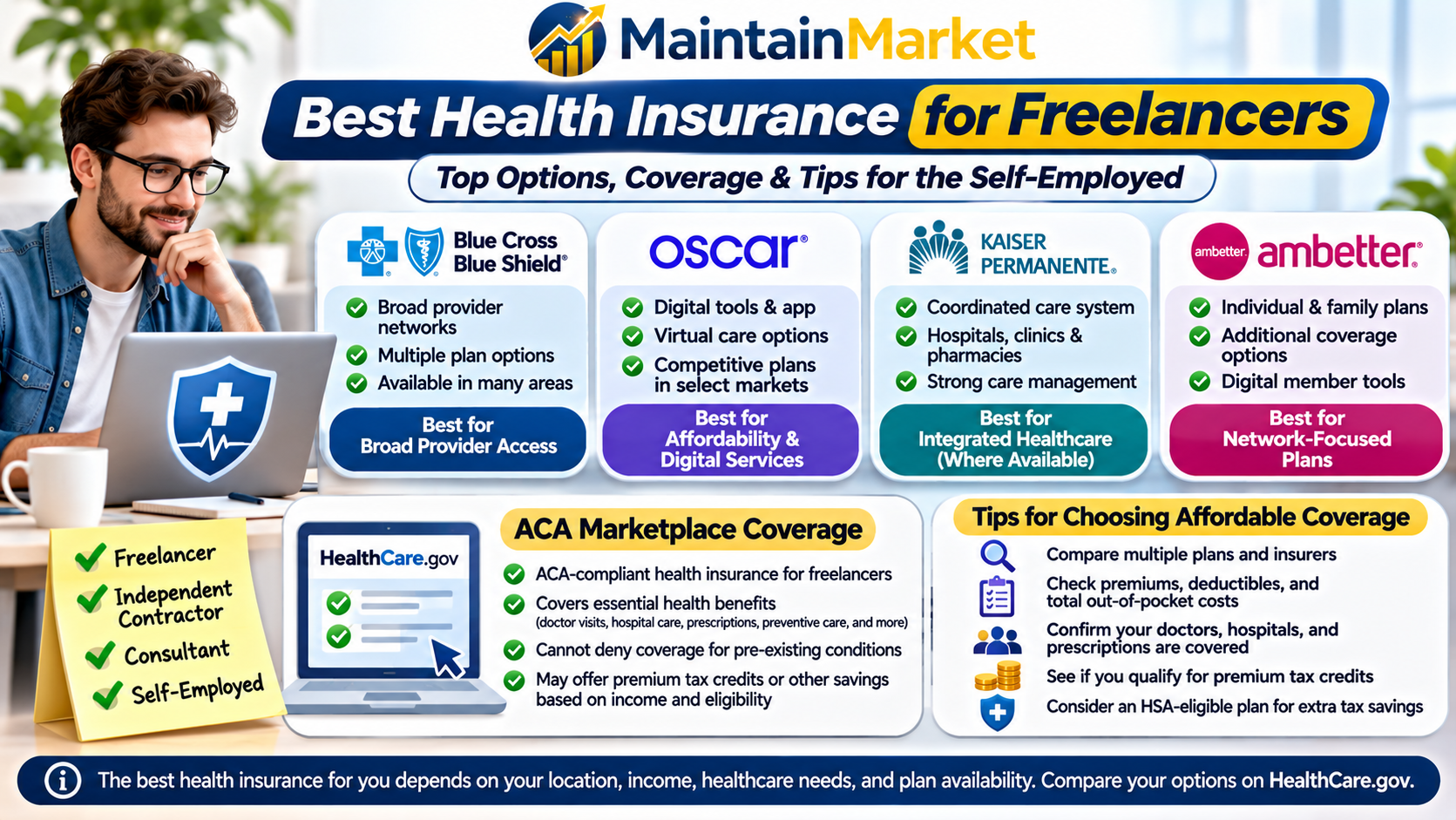
Best Health Insurance Companies for Freelancers
The following insurers appear in recent third-party comparisons of coverage for self-employed individuals. They are a shortlist to investigate, not a universal ranking. Availability, pricing, network quality, and plan benefits vary by state and county.
1. Blue Cross Blue Shield: Best for Broad Provider Access
Blue Cross Blue Shield (BCBS) is a major health insurance network made up of independent regional companies. Its plans may appeal to freelancers who want access to a wide selection of doctors, specialists, and hospitals.
Why consider Blue Cross Blue Shield?
- Broad provider networks in many markets
- Multiple plan types in some locations
- Options for individuals and families
- Potentially useful for people who travel frequently, depending on the specific plan
Potential disadvantages:
- Premiums can be higher than those of some competing plans.
- Benefits and customer service vary between regional BCBS companies.
- A broad brand network does not mean every doctor is covered by every plan.
Best for: Freelancers who prioritize provider choice and want to compare network access.
Before enrolling, check the exact regional insurer and confirm that your preferred doctors and hospitals participate in the specific plan.
2. Oscar Health: Worth Comparing for Affordability and Digital Services
Oscar Health offers individual and family health insurance plans in selected U.S. markets. Its digital tools and virtual care services may appeal to independent professionals who prefer managing healthcare through an app.
Why consider Oscar?
- Digital tools for managing healthcare
- Virtual care options on certain plans
- Individual and family coverage in selected markets
- Plans that may be competitively priced in some locations
Potential disadvantages:
- Availability is limited to selected states and counties.
- Provider networks may be narrower than those of some competitors.
- Customer experience and plan quality can vary.
Best for: Freelancers who value digital healthcare services and want to compare competitively priced Marketplace plans.
Check whether your preferred doctors, prescriptions, and nearby hospitals are included before choosing an Oscar plan.
3. Kaiser Permanente: Best for Integrated Healthcare Where Available
Kaiser Permanente combines health insurance coverage with its own network of healthcare professionals and facilities. This integrated approach can make it easier to coordinate appointments, prescriptions, and medical services.
Why consider Kaiser Permanente?
- Coordinated healthcare services
- Integrated hospitals, clinics, and pharmacies in its service areas
- Digital appointment and health management tools
- Competitive plan options in some markets
Potential disadvantages:
- Available only in selected states and regions.
- Members generally receive care through Kaiser facilities and affiliated networks.
- Out-of-network access may be limited, except for emergencies and services covered under the plan.
Best for: Freelancers who live in a Kaiser service area and prefer coordinated healthcare through one system.
Check the service area carefully before comparing its premiums with other insurers.
4. Ambetter: Worth Considering for Network-Focused Plans
Ambetter offers individual and family health insurance in selected U.S. markets. Depending on your location, its Marketplace plans may provide another option for freelancers comparing monthly premiums and out-of-pocket expenses.
Why consider Ambetter?
- Individual and family coverage in selected markets
- Different plan options depending on location
- Digital member tools and support
- Plans worth comparing when managing monthly insurance costs
Potential disadvantages:
- Availability varies by state and county.
- Some plans have restricted provider networks.
- Out-of-network care may not be covered except in specific circumstances.
Best for: Freelancers who are comfortable using an in-network provider system and want to compare available plan prices.
Review the provider directory, prescription formulary, and out-of-pocket costs before enrolling.
Health Insurance Companies Compared
| Insurance company | Potential strength | What to check |
|---|---|---|
| Blue Cross Blue Shield | Broad provider access in many markets | Regional company, network, and premium |
| Oscar Health | Digital tools and virtual care options | Local availability and provider network |
| Kaiser Permanente | Coordinated healthcare system | Service area and out-of-network restrictions |
| Ambetter | Additional Marketplace plan choices | Local availability and network limitations |
Recent comparisons from ValuePenguin and MoneyGeek also identify these companies among the insurers worth considering for self-employed consumers. However, their rankings and rate estimates differ because their methodologies and plan selections differ. Actual premiums depend on the applicant and location.
Where Can Freelancers Get Health Insurance?
You do not need an employer to obtain health insurance. Freelancers can investigate several coverage routes.
1. Affordable Care Act Marketplace
The Health Insurance Marketplace is one of the most important places for freelancers to start comparing coverage.
You can use HealthCare.gov to explore available plans and apply for coverage.
Marketplace plans are available to freelancers, independent contractors, consultants, and self-employed individuals who meet the applicable eligibility requirements.
ACA-compliant Marketplace plans cover essential health benefit categories, including:
- Doctor and outpatient services
- Emergency services
- Hospitalization
- Prescription medications
- Maternity and newborn care
- Mental health and substance use disorder services
- Preventive and wellness services
- Rehabilitative services
- Laboratory services
- Pediatric services
Marketplace plans also cannot exclude coverage for pre-existing conditions.
Depending on your household income and other eligibility requirements, you may qualify for premium tax credits or additional savings that reduce healthcare expenses.
2. Medicaid
Medicaid provides free or low-cost health coverage to eligible individuals and families.
Freelancers with lower or fluctuating income may qualify, depending on their state, household size, income, and other eligibility requirements.
Medicaid eligibility rules differ between states. You can check your eligibility through the Marketplace or your state’s Medicaid agency.
This may be an important option if you are starting a freelance business and your income is still relatively low.
3. Coverage Through a Spouse
If your spouse has employer-sponsored health insurance, you may be able to join their plan.
This can be a practical option if the employer offers dependent or spousal coverage at a reasonable cost.
Before deciding, compare:
- Additional monthly premiums
- Deductibles
- Copayments and coinsurance
- Provider networks
- Prescription coverage
- Family out-of-pocket maximums
Having access to a spouse’s employer-sponsored plan may also affect eligibility for Marketplace premium tax credits, depending on the circumstances and applicable affordability rules.
4. COBRA Continuation Coverage
If you previously worked for an employer and lost your job-based health insurance, you may be eligible for COBRA continuation coverage.
COBRA allows eligible individuals to continue certain employer-sponsored health coverage temporarily, usually by paying the full premium plus an administrative charge.
This can help freelancers avoid an immediate coverage gap when transitioning from employment to independent work.
However, COBRA can be expensive because the former employer may no longer contribute toward the premium.
Compare the total COBRA cost with available Marketplace plans before deciding.
5. Direct Insurance From an Insurance Company
You may also compare individual health insurance plans directly with insurance companies.
However, make sure you understand whether a plan is ACA-compliant.
Some products marketed as private or affordable health insurance may have different benefits, exclusions, and consumer protections from comprehensive ACA-compliant coverage.
Do not compare plans based on premiums alone. Review coverage for prescriptions, hospital care, mental health services, pre-existing conditions, and other healthcare needs.
How Much Does Health Insurance Cost for Freelancers?
The cost of health insurance for freelancers depends on several factors:
- Age
- ZIP code and state
- Household size
- Household income
- Type of insurance plan
- Metal tier
- Deductible
- Provider network
- Eligibility for financial assistance
There is no single monthly premium that applies to every freelancer.
For example, a 30-year-old freelancer living in Texas may receive different plan quotes from a 45-year-old freelancer living in New York, even if both choose similar coverage.
What Are the Average Costs of Health Insurance?
Third-party insurance comparisons publish average premiums using specific assumptions, such as a 40-year-old applicant selecting a Silver Marketplace plan.
These figures can help illustrate differences between insurers, but they should not be treated as personal quotes or guaranteed prices.
For an accurate estimate, enter your ZIP code, age, household details, and expected income into the official HealthCare.gov Marketplace.
The Marketplace can show available plans and determine whether you qualify for financial assistance.
Understanding Bronze, Silver, Gold, and Platinum Health Insurance Plans
Marketplace plans are grouped into metal categories. These categories describe how you and your insurer generally share covered healthcare expenses, not the quality of medical care.
| Plan category | Monthly premiums | Out-of-pocket costs when receiving care | General consideration |
|---|---|---|---|
| Bronze | Generally lower | Generally higher | May suit people who want lower premiums and can handle a higher deductible |
| Silver | Moderate | Moderate | Useful for comparing balanced costs and potential cost-sharing reductions |
| Gold | Generally higher | Generally lower | May suit people who expect to use healthcare services more often |
| Platinum | Generally highest | Generally lowest | May suit people who expect substantial covered medical expenses |
Bronze Plans
Bronze plans generally have lower monthly premiums but higher deductibles and other out-of-pocket costs.
They may suit freelancers who use healthcare services infrequently and can afford a higher unexpected medical expense.
However, a low monthly premium does not automatically make a plan affordable.
Silver Plans
Silver plans provide a middle ground between monthly premiums and healthcare expenses.
If you qualify for cost-sharing reductions, you must generally choose a Silver Marketplace plan to receive those additional savings.
For some freelancers, this makes Silver coverage particularly important to compare.
Gold Plans
Gold plans generally have higher monthly premiums but lower cost-sharing when you receive covered healthcare services.
They may be worth comparing if you regularly visit doctors, need prescription medications, or anticipate more medical care.
Platinum Plans
Platinum plans generally have the highest monthly premiums and lower cost-sharing for covered services.
They may appeal to people who expect frequent healthcare use, although the overall annual cost should still be compared with other plan categories.
HMO vs. PPO: Which Is Better for Freelancers?
The network structure of your health insurance plan can be just as important as its monthly premium.
Two common plan types are HMO and PPO.
| Feature | HMO | PPO |
|---|---|---|
| Provider network | Usually more restricted | Usually more flexible |
| Specialist referrals | Often required | Often not required |
| Out-of-network care | Generally limited, except emergencies and specified situations | Often available at higher costs |
| Premiums | Often lower | Often higher |
| Flexibility | More limited | Greater flexibility |
When Should a Freelancer Choose an HMO?
An HMO may be suitable if you are comfortable receiving care within a defined provider network.
It can be worth comparing if you want a lower premium and your preferred doctors are included.
When Should a Freelancer Choose a PPO?
A PPO may be suitable if you want more flexibility when choosing healthcare providers or need access to specialists outside a local network.
However, PPO premiums and out-of-network costs may be higher.
The actual rules depend on the specific plan. Read our detailed guide to HMO vs. PPO health insurance.
How Freelancers Can Save Money on Health Insurance
Health insurance can be a significant business and household expense when you work independently. These steps may help you manage the cost.
1. Check Whether You Qualify for Premium Tax Credits
Premium tax credits can reduce the monthly cost of eligible Marketplace health insurance plans.
Your eligibility generally depends on household income, household size, access to other qualifying coverage, and applicable tax rules.
Freelancers should estimate their net self-employment income for the coverage year rather than simply using last year’s income.
If your income changes during the year, update your Marketplace application. This helps keep your financial assistance aligned with your current estimate.
2. Compare More Than One Insurance Company
Do not select the first plan you see.
Compare at least several available plans and look at:
- Monthly premiums
- Deductibles
- Copayments
- Coinsurance
- Out-of-pocket maximums
- Doctor and hospital networks
- Prescription drug coverage
A plan with a lower monthly premium may cost more overall if you regularly need medical care.
3. Choose a Suitable Metal Tier
A Bronze plan may have a lower premium, but it can expose you to higher expenses when you need medical treatment.
A Silver or Gold plan may provide a better balance depending on your expected healthcare use and eligibility for cost-sharing reductions.
Consider your likely annual healthcare expenses rather than focusing only on the monthly premium.
4. Review the Provider Network
Before purchasing a plan, confirm that your preferred doctors, hospitals, pharmacies, and specialists are included.
If you travel frequently for freelance work, check whether the plan provides useful access to healthcare outside your home area.
5. Consider an HSA-Eligible Plan
A Health Savings Account (HSA) allows eligible individuals to set aside money for qualified medical expenses with tax advantages.
To contribute to an HSA, you generally need to be enrolled in an HSA-qualified high-deductible health plan and meet other eligibility requirements.
An HSA can help freelancers prepare for healthcare expenses, but it should not replace comprehensive insurance coverage.
Check the plan’s HSA eligibility before enrolling.
Can Freelancers Deduct Health Insurance Premiums on Their Taxes?
Some self-employed individuals may qualify for the self-employed health insurance deduction on their federal income tax return.
Depending on the applicable IRS rules, eligible taxpayers may be able to deduct qualifying health insurance premiums paid for themselves, their spouse, and dependents.
However, the deduction is subject to eligibility requirements and limitations.
For example, the deduction generally cannot exceed the earned income from the relevant trade or business, and eligibility for employer-sponsored coverage can affect the deduction.
Premium tax credits and the self-employed health insurance deduction can also interact, so you should not assume that the same premium can be fully counted twice.
Review the current IRS guidance on self-employed health insurance or speak with a qualified tax professional to determine your eligibility.
When Can Freelancers Enroll in Health Insurance?
Marketplace health insurance is generally available during the annual Open Enrollment Period.
For HealthCare.gov, the standard annual period runs from November 1 through January 15, although state-based Marketplaces may have different deadlines or procedures.
You may also qualify for a Special Enrollment Period after certain life events, such as:
- Losing employer-sponsored health coverage
- Getting married
- Having a baby or adopting a child
- Moving to a new area with different health plan options
- Certain changes in household circumstances
Losing job-based insurance can create an opportunity to enroll in Marketplace coverage outside the normal Open Enrollment Period.
Check the official HealthCare.gov enrollment information for the applicable dates and eligibility rules.
Common Health Insurance Mistakes Freelancers Should Avoid
1. Choosing a Plan Only Because It Has a Low Premium
A low premium may come with a high deductible, limited provider network, or substantial cost-sharing.
Compare the full potential annual cost before enrolling.
2. Ignoring Prescription Drug Coverage
If you regularly use medication, check the plan’s drug formulary, covered medication tiers, and pharmacy requirements.
A plan that excludes or places your medication on a costly tier may not be suitable.
3. Not Checking the Doctor Network
Do not assume that every doctor accepts every plan from a particular insurance company.
Confirm participation using the specific plan’s provider directory and, when necessary, directly with the provider.
4. Underestimating Self-Employment Income
Marketplace financial assistance is based on estimated household income for the coverage year.
If your freelance income changes significantly, update your application to reduce the risk of receiving incorrect advance premium tax credits.
5. Assuming Short-Term Insurance Is Equivalent to ACA Coverage
Short-term health insurance may have different coverage rules and exclusions from comprehensive ACA-compliant plans.
Before considering it, check whether it covers pre-existing conditions, prescriptions, mental health services, hospitalization, and other important healthcare needs.
Read our guide to short-term health insurance to understand its limitations and alternatives.
Frequently Asked Questions
1. What is the best health insurance for freelancers?
There is no single best health insurance company for every freelancer. Blue Cross Blue Shield, Oscar Health, Kaiser Permanente, and Ambetter are companies worth comparing, depending on local availability, premiums, provider networks, and coverage requirements. ACA Marketplace plans are an important starting point.
2. Can freelancers get health insurance without an employer?
Yes. Freelancers, independent contractors, consultants, and self-employed individuals can generally apply for individual health insurance through the Marketplace. They may also qualify for Medicaid or other coverage options depending on their circumstances.
3. Is health insurance more expensive for freelancers?
Freelancers generally pay their own health insurance premiums instead of receiving an employer contribution. However, eligible individuals may qualify for Marketplace premium tax credits and other savings based on household income and applicable requirements.
4. Can freelancers get free health insurance?
Some freelancers may qualify for Medicaid or other low-cost coverage programs, depending on their state, income, household size, and eligibility. Check through the Marketplace or your state Medicaid agency.
5. Can self-employed individuals get ACA subsidies?
Eligible self-employed individuals may qualify for premium tax credits and cost-sharing reductions through the Marketplace. Eligibility depends on household income, family size, access to other coverage, and applicable rules.
6. Is Blue Cross Blue Shield good for freelancers?
Blue Cross Blue Shield may be a suitable choice for freelancers who want to compare broader provider networks. However, coverage and costs differ between regional BCBS companies and individual plans. Always check the network and benefits available in your location.
7. Is an HMO or PPO better for freelancers?
An HMO may suit freelancers who prefer a defined provider network and potentially lower premiums. A PPO may offer greater provider flexibility, including some out-of-network coverage at higher costs. The better choice depends on your healthcare needs and budget.
8. Can freelancers deduct health insurance premiums?
Eligible self-employed taxpayers may qualify for a federal income tax deduction for certain health insurance premiums. The deduction has limitations and may interact with Marketplace premium tax credits. Review current IRS rules or consult a tax professional.
9. What happens to health insurance if a freelancer’s income changes?
If your estimated income changes, update your Marketplace application. Your eligibility for premium tax credits and other financial assistance may change as well. Keeping your application current can help avoid tax-credit reconciliation problems.
10. When should freelancers buy health insurance?
Freelancers can generally enroll during the annual Marketplace Open Enrollment Period or through a Special Enrollment Period if they experience a qualifying life event. Medicaid applications may be available throughout the year for eligible individuals.
Final Thoughts: Choosing the Right Health Insurance as a Freelancer
Finding the best health insurance for freelancers requires more than comparing monthly premiums. You need coverage that fits your income, healthcare requirements, preferred doctors, and ability to manage unexpected medical expenses.
Start by exploring ACA Marketplace plans and checking whether you qualify for premium tax credits or Medicaid. Then compare insurers such as Blue Cross Blue Shield, Oscar Health, Kaiser Permanente, and Ambetter where they operate.
Before enrolling, review the deductible, out-of-pocket maximum, prescription coverage, and provider network. A plan that looks inexpensive each month may not be the most affordable choice when you need medical care.
As a freelancer, you manage your own income, business expenses, and benefits. Choosing suitable health insurance can help protect both your health and your financial stability.
Disclaimer: This article is for general educational purposes for U.S. consumers and is not individualized insurance, medical, or tax advice. Insurance availability, benefits, premiums, provider networks, and eligibility for financial assistance vary by state, county, insurer, and individual circumstances. Always review the official plan documents before enrolling.
References
- HealthCare.gov – Health Coverage for Self-Employed People
- HealthCare.gov – Coverage Options for Self-Employed Workers
- IRS – Tax Guide for Small Business
- IRS – Premium Tax Credit
- ValuePenguin – Best Health Insurance for Self-Employed Freelancers
- MoneyGeek – Best Health Insurance for the Self-Employed
Editorial Review: Reviewed for U.S. consumer relevance, coverage terminology, and clarity. Insurer comparisons are based on published third-party research and are not guarantees of plan availability, price, or performance.