
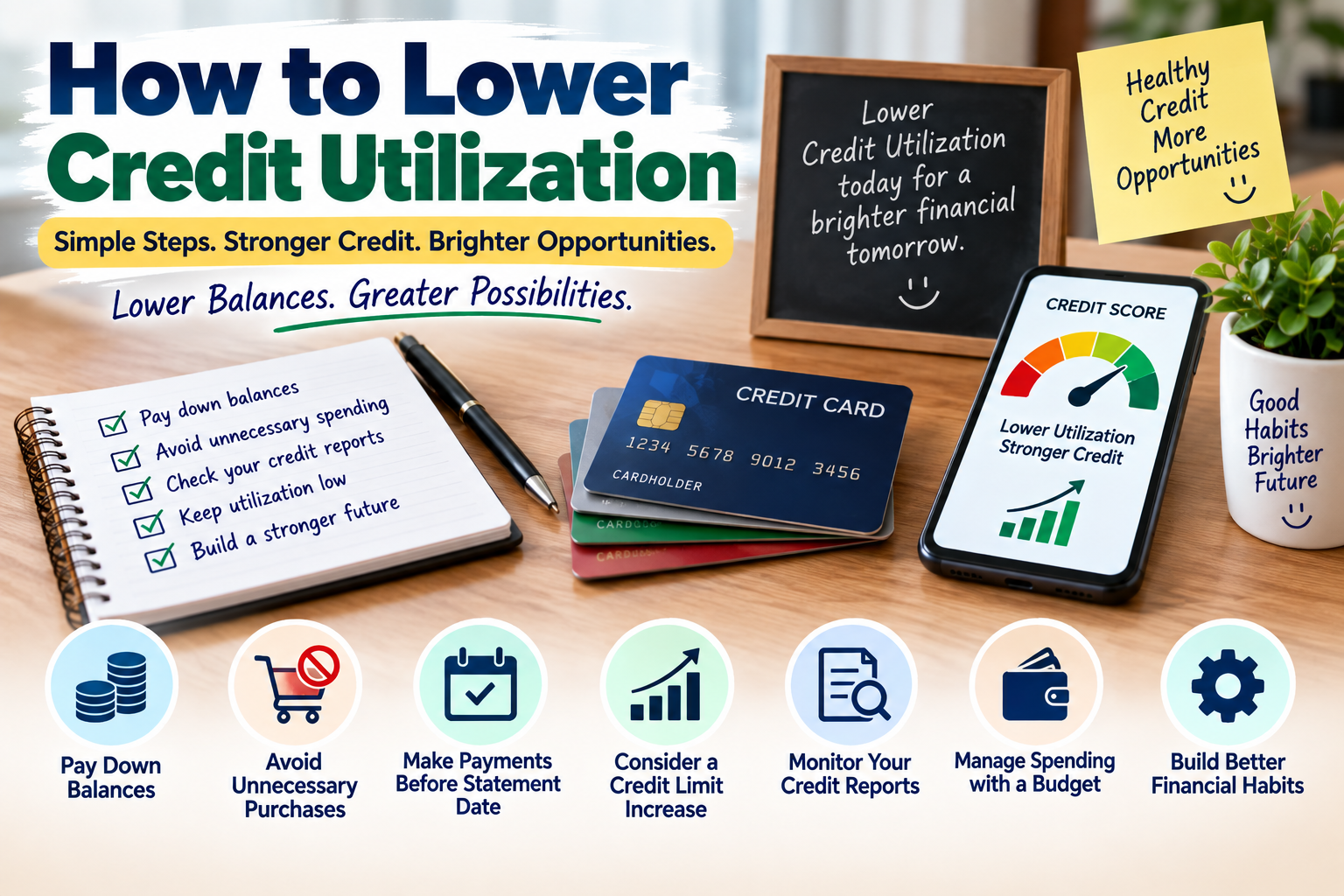
Learning how to lower credit utilization can help you manage credit card debt and potentially improve your credit score. When your credit card balances are high compared with your available credit limits, your credit profile may be negatively affected—even if you make payments on time.
The good news is that credit utilization can often be improved by reducing outstanding balances, requesting a higher credit limit when appropriate, and managing your spending more carefully.
This guide explains practical ways to lower credit utilization without taking unnecessary financial risks.
Quick Answer: To lower credit utilization, pay down your credit card balances, make payments before the statement closing date when possible, avoid maxing out cards, request a credit limit increase only when appropriate, and reduce unnecessary spending. Keeping utilization below 30% is a commonly used guideline, but lower utilization is not a guaranteed credit score formula.
What Is Credit Utilization?
Credit utilization is the percentage of your available revolving credit that you are currently using.
Credit utilization formula
Credit Utilization = Total Credit Card Balances ÷ Total Credit Limits × 100
For example, suppose you have:
- Total credit limit: $10,000
- Total credit card balance: $6,000
Your credit utilization is:
$6,000 ÷ $10,000 × 100 = 60%
A 60% utilization rate means you are using 60% of your available credit.
Credit utilization example
| Total Credit Limit | Credit Card Balance | Utilization |
|---|---|---|
| $10,000 | $1,000 | 10% |
| $10,000 | $2,000 | 20% |
| $10,000 | $3,000 | 30% |
| $10,000 | $5,000 | 50% |
| $10,000 | $8,000 | 80% |
Credit scoring models may consider both your overall utilization and the utilization of individual cards.
Why Does Credit Utilization Matter?
Credit utilization is one factor used in many credit scoring models. High utilization may suggest that you are relying heavily on available credit.
The Consumer Financial Protection Bureau recommends avoiding getting close to your credit limit and explains that your reported balance may affect your credit score even if you pay the balance in full later.
However:
- There is no single utilization percentage that guarantees a good credit score.
- Different scoring models may evaluate utilization differently.
- Your payment history and other credit factors also matter.
- A low utilization rate does not guarantee loan or credit card approval.
The goal should be to manage debt responsibly—not simply to reach a particular percentage.
10 Effective Ways to Lower Credit Utilization
1. Pay Down Your Credit Card Balances
The most direct way to lower credit utilization is to reduce the amount you owe.
Start by reviewing all your credit card balances and available limits. Then decide how much you can realistically pay toward your outstanding debt each month.
Practical approach
- List your credit card balances.
- Record each card’s credit limit.
- Calculate your utilization.
- Prioritize high-interest debt.
- Make additional payments when your budget allows.
Example
Suppose you have a credit card with:
- Credit limit: $5,000
- Current balance: $3,000
- Utilization: 60%
If you pay the balance down to $1,500, your utilization becomes 30%.
You do not need to pay the entire balance immediately if doing so would leave you unable to cover essential expenses. Create a repayment plan that you can maintain.
2. Make Payments Before the Statement Closing Date
Many credit card issuers report account information to credit bureaus periodically. The balance reported may not always be the same as the balance on your payment due date.
This means you could pay your bill in full by the due date but still have a high balance reported if your balance was high when the issuer reported it.
What you can do
- Check your statement closing date.
- Review your issuer’s reporting practices.
- Make an early payment when possible.
- Continue paying at least the required amount by the due date.
- Avoid spending the amount you just paid off again.
Important: Statement closing dates and reporting schedules vary by issuer. Do not assume every lender reports on the same day.
3. Stop Using Your Credit Card for Unnecessary Purchases
If your credit card balance keeps increasing, repayment alone may not solve the problem.
Review your recent transactions and identify expenses that can be reduced or temporarily paid using available cash.
Consider limiting:
- Unnecessary subscriptions
- Impulse purchases
- Expensive dining
- Nonessential online shopping
- Repeated buy-now-pay-later transactions
- Purchases made only to earn rewards
You do not need to stop using credit cards completely. The objective is to avoid adding new debt faster than you can repay it.
4. Request a Credit Limit Increase Carefully
A higher credit limit can reduce your utilization if your balance remains the same.
Example
Before the increase:
- Credit limit: $5,000
- Balance: $2,500
- Utilization: 50%
After the increase:
- Credit limit: $10,000
- Balance: $2,500
- Utilization: 25%
However, a credit limit increase is not guaranteed. The issuer may review your income, payment history, account activity, and credit profile.
Before requesting an increase, check:
- Whether the issuer performs a hard inquiry
- Whether your income information is up to date
- Whether you can manage the existing balance
- Whether the higher limit could encourage unnecessary spending
Do not request a higher limit if it may cause you to spend more than you can afford to repay.
5. Pay More Than the Minimum When Possible
The minimum payment helps you remain current, but it may not reduce your balance quickly, especially when interest charges are high.
Paying more than the minimum can help lower your balance faster and reduce the amount of credit you are using.
Example
If your credit card balance is $4,000, paying only the minimum may leave you with a large balance for an extended period.
An additional payment—even a manageable amount each month—can gradually reduce your outstanding balance.
Before increasing payments, ensure you can still cover:
- Rent or mortgage
- Utilities
- Food
- Transportation
- Emergency expenses
- Other required debt payments
Avoid using another high-interest loan to make credit card payments unless you have carefully evaluated the total cost and repayment terms.
6. Focus on Cards With the Highest Utilization
You should monitor both overall utilization and individual card utilization.
Example
| Card | Credit Limit | Balance | Utilization |
|---|---|---|---|
| Card A | $8,000 | $1,600 | 20% |
| Card B | $2,000 | $1,800 | 90% |
| Card C | $5,000 | $1,000 | 20% |
Your total utilization is:
$4,400 ÷ $15,000 × 100 = 29.3%
Although your overall utilization is below 30%, Card B has utilization of 90%.
Depending on the scoring model, the high utilization on an individual card may matter. If possible, prioritize reducing heavily utilized cards while maintaining required payments on all accounts.
7. Avoid Closing Credit Cards Without Reviewing the Impact
Closing a credit card can reduce your total available credit and potentially increase your utilization ratio.
Example
Before closing a card:
- Total credit limit: $10,000
- Total balance: $3,000
- Utilization: 30%
After closing a card with a $5,000 limit:
- Remaining credit limit: $5,000
- Total balance: $3,000
- Utilization: 60%
The account closure may therefore increase your utilization even though your balance has not changed.
Before closing an account, consider:
- Annual fees
- Whether you can control spending
- Your total available credit
- The effect on your credit profile
- Whether the account has other useful benefits
Do not keep an expensive or unsuitable account open solely for credit score purposes.
8. Use a Debt Repayment Strategy
A structured repayment method can make it easier to reduce credit card balances.
Debt avalanche method
Pay extra toward the debt with the highest interest rate while making minimum payments on other accounts.
Potential advantage: May reduce total interest costs.
Debt snowball method
Pay extra toward the smallest balance first while maintaining minimum payments on other debts.
Potential advantage: Paying off smaller balances may provide motivation and simplify your finances.
Choose a strategy that fits your budget and helps you remain consistent.
Your credit utilization may decline as balances decrease, but the repayment strategy itself does not guarantee a specific credit score increase.
9. Avoid Using New Credit to Hide Existing Debt
Opening another credit card can increase your total available credit, but it may also create additional financial risk.
Avoid opening new accounts solely to make your utilization percentage appear lower.
Consider the following risks:
- Additional hard inquiries
- New annual fees
- More accounts to manage
- Higher total debt
- Increased temptation to spend
- Possible rejection by lenders
A new credit card may be appropriate in some situations, but it should support a realistic financial plan—not replace debt repayment.
10. Track Your Utilization Every Month
Credit utilization can change frequently as you make purchases and payments.
Create a monthly tracking system that records:
- Credit limit for each card
- Current balance
- Statement closing date
- Payment due date
- Amount paid
- Utilization percentage
Simple monthly tracker
| Month | Total Credit Limit | Total Balance | Utilization |
|---|---|---|---|
| January | $10,000 | $6,000 | 60% |
| February | $10,000 | $4,500 | 45% |
| March | $10,000 | $3,000 | 30% |
| April | $10,000 | $2,000 | 20% |
This example shows how reducing balances can lower utilization over time.
Your actual credit score may not change immediately because scoring models consider multiple factors and creditors may report at different times.
What Is a Good Credit Utilization Ratio?
A commonly used guideline is to keep credit utilization below 30%. However, 30% is not a universal cutoff or a guaranteed scoring target.
Some consumers may see better credit outcomes with lower utilization, while others may have strong credit profiles despite higher reported utilization.
| Utilization Level | General Interpretation |
|---|---|
| 0% | No reported revolving balance; not necessarily required |
| 1%–9% | Low utilization |
| 10%–29% | Generally considered moderate to low |
| 30%–49% | Higher utilization |
| 50%–74% | High utilization |
| 75%–100% | Very high utilization |
These categories are general educational descriptions, not official scoring thresholds.
Focus on paying your bills on time and avoiding debt you cannot comfortably repay.
How to Lower Credit Utilization Without Paying Everything at Once
You may not need to eliminate your entire credit card balance immediately.
Try these steps:
- Stop adding unnecessary purchases.
- Pay more than the minimum when possible.
- Make smaller payments throughout the month.
- Prioritize cards with high utilization.
- Reduce interest-bearing debt.
- Avoid taking on additional expensive credit.
- Monitor your reported balances.
Example
If you owe $6,000 across several cards but can only afford an additional $300 per month, create a repayment plan that fits your income.
Consistency is more sustainable than making a large payment that leaves you unable to pay rent, utilities, or other essential expenses.
Does Paying Your Credit Card in Full Lower Utilization?
Yes. Paying your credit card balance in full reduces the amount you owe.
However, the balance reported to credit bureaus may depend on when the issuer reports account information.
For example:
- Your statement closes with a $2,000 balance.
- The issuer reports that balance.
- You pay the full $2,000 before the payment due date.
You may avoid interest on eligible purchases, but the $2,000 balance could still have been reported for that reporting period.
To manage reported utilization, check your statement closing date and consider making an earlier payment when practical.
How Long Does It Take to Lower Credit Utilization?
Credit utilization can sometimes change quickly after a lender reports a lower balance.
The timeline depends on:
- When you make your payment
- When your issuer reports information
- How quickly the payment posts
- Whether you continue making new purchases
- The credit bureau and scoring model being used
A lower reported balance may affect your score in the next scoring cycle, but there is no guarantee of a particular increase.
Reducing utilization is different from repairing late payments, collections, or bankruptcy-related credit damage. Those issues may require a longer-term strategy.
Common Mistakes When Lowering Credit Utilization
Mistake 1: Assuming 30% Guarantees a Good Credit Score
The 30% guideline is not a guaranteed cutoff. Credit scores depend on multiple factors.
Mistake 2: Paying Off a Card and Immediately Spending Again
If you repay a balance but immediately use the available credit again, your utilization may remain high.
Mistake 3: Ignoring Individual Card Utilization
Your overall utilization may look acceptable while one card is nearly maxed out.
Mistake 4: Closing Cards Without Calculating the Impact
Closing an account can reduce your available credit and increase utilization.
Mistake 5: Taking Out Expensive Debt to Pay a Credit Card
A new loan may create additional interest costs and repayment obligations.
Mistake 6: Missing Payments While Focusing on Utilization
Lower utilization does not compensate for repeated late payments. Payment history remains an important credit factor.
30-Day Plan to Lower Credit Utilization
Week 1: Review Your Credit Situation
- List every credit card.
- Record each credit limit and balance.
- Calculate overall and individual utilization.
- Check statement closing and payment due dates.
- Review your monthly budget.
Week 2: Reduce New Spending
- Pause unnecessary purchases.
- Cancel avoidable subscriptions.
- Set a realistic payment amount.
- Prioritize high-interest balances.
Week 3: Make Strategic Payments
- Make payments according to your budget.
- Consider an early payment before the statement closing date.
- Confirm that payments have posted.
- Avoid using the paid-down amount again.
Week 4: Review Your Progress
- Recalculate utilization.
- Check account balances.
- Review your credit reports when appropriate.
- Adjust your repayment plan for the next month.
This plan does not guarantee a credit score increase, but it can help you develop more consistent credit management habits.
Frequently Asked Questions
1. How can I lower my credit utilization quickly?
The fastest practical method is usually to reduce your outstanding credit card balances. Making a payment before the issuer reports your balance may help lower the amount reported, but reporting schedules vary.
2. Is 30% credit utilization good?
Keeping utilization below 30% is a commonly used guideline, but it is not a guaranteed credit score threshold. Lower utilization may be beneficial, but payment history and other credit factors also matter.
3. Can I lower utilization without paying off my entire balance?
Yes. Reducing your balance, limiting new spending, and making additional payments can lower utilization without requiring immediate full repayment.
4. Does paying before the due date lower credit utilization?
It can lower the balance reported if the payment is processed before the issuer reports your account information. The payment due date and statement closing date are not always the same.
5. Can requesting a credit limit increase lower utilization?
It may lower utilization if your credit limit increases and your balance stays the same. Approval is not guaranteed, and the issuer may conduct a credit review.
6. Should I keep my credit utilization at 0%?
A 0% reported balance is not required to build credit. Responsible use, on-time payments, and manageable balances are generally more important than forcing utilization to zero.
7. Does credit utilization affect loan approval?
Lenders may consider credit utilization when evaluating your credit profile, but approval decisions also depend on factors such as income, debt obligations, credit history, and lender-specific requirements.
8. How often should I check my credit utilization?
Review your balances at least monthly, and more frequently if you are actively paying down debt or preparing for a major credit application.
9. Can lowering credit utilization increase my credit score?
It may improve your score, depending on your credit profile and the scoring model used. However, no specific increase is guaranteed.
10. Should I open another credit card to lower utilization?
Opening another card may increase your available credit, but it can also create additional debt and hard inquiries. Consider it only after evaluating your spending habits, eligibility, and financial goals.
Why Maintain Market Is Different
At Maintain Market, we focus on practical financial education rather than promising instant credit score improvements.
This guide explains:
- How credit utilization is calculated
- Ways to reduce outstanding balances
- The difference between statement dates and payment due dates
- Risks of requesting credit limit increases
- Debt repayment strategies
- Common mistakes to avoid
Lowering credit utilization can be helpful, but sustainable credit management requires more than chasing a particular percentage.
Recommended Reads
References
- https://www.consumerfinance.gov/consumer-tools/credit-reports-and-scores/understand-your-credit-score/
- https://www.consumerfinance.gov/consumer-tools/credit-reports-and-scores/how-to-rebuild-your-credit/
- https://www.myfico.com/credit-education/credit-scores/amount-of-debt
- https://www.myfico.com/credit-education/blog/credit-utilization-be
- https://www.consumerfinance.gov/ask-cfpb/does-it-hurt-my-credit-to-close-a-credit-card-en-1231/
- https://www.annualcreditreport.com/gettingReports.action
Editorial Review
Content type: Personal finance and credit education
Review focus: Credit utilization calculations, responsible repayment guidance, consumer protection, and accuracy
Disclaimer: This article is for educational purposes only and does not constitute personalized financial advice. Credit scoring models and lender policies vary.