
Managing several debts at once can become expensive and stressful. Credit card balances, personal loans, medical bills, and other payments may leave you dealing with multiple interest rates, due dates, and monthly obligations.
A debt consolidation loan in the USA can help simplify repayment by combining eligible existing debts into one new loan. Instead of making several payments, you use the new loan to pay off multiple balances and then make one regular payment to the new lender.
However, debt consolidation does not automatically reduce your debt or guarantee lower interest. Whether it saves money depends on the new loan’s APR, fees, repayment term, and how you manage your spending afterward.
In this guide, you’ll learn how debt consolidation loans work, compare personal loans with balance transfer cards and other options, understand the costs, explore an illustrative savings example, and identify the risks before applying.
What Is a Debt Consolidation Loan?
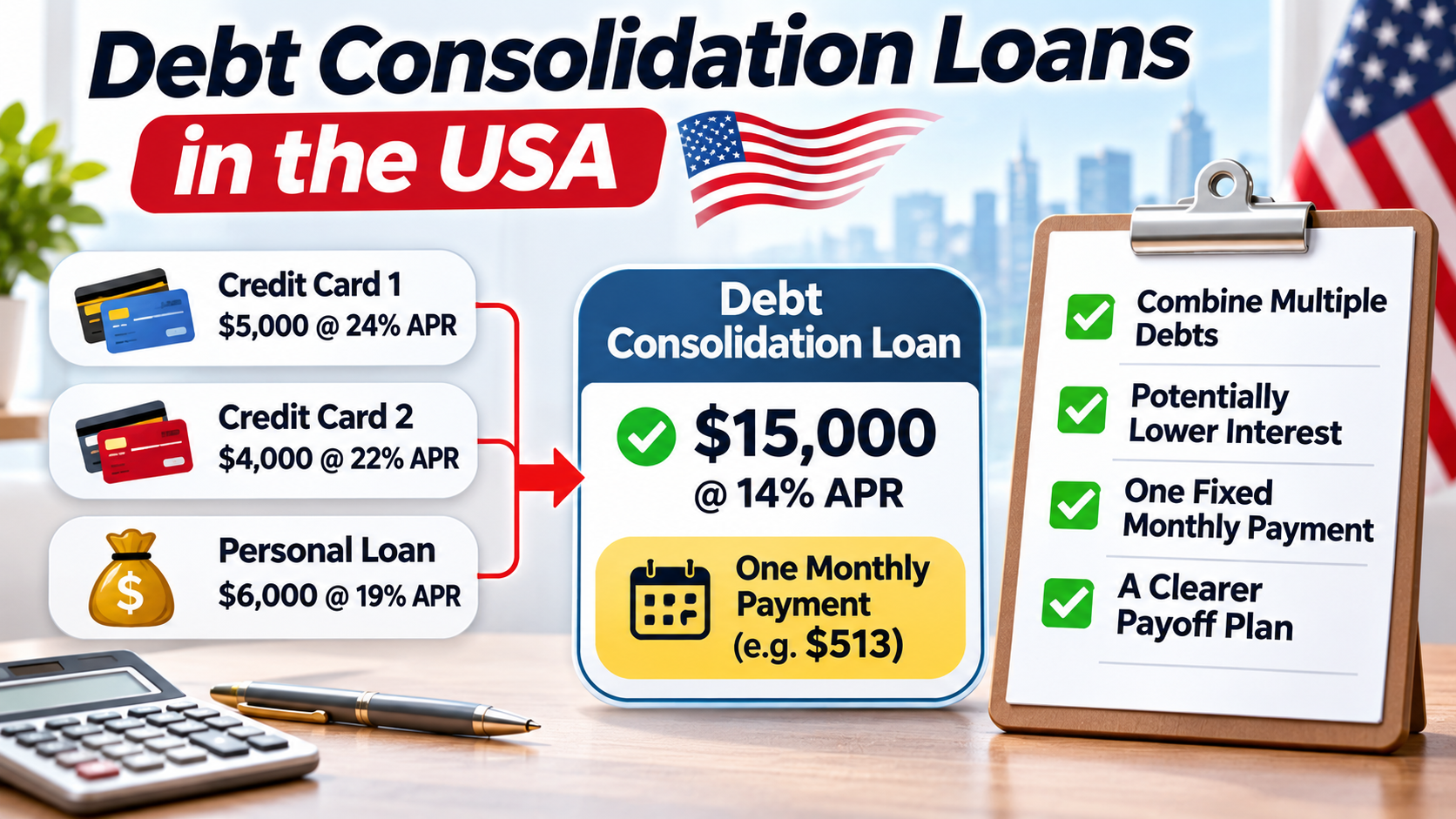
A debt consolidation loan is a new loan used to pay off multiple existing debts.
For example, suppose you have:
- $5,000 in credit card debt
- $4,000 on another credit card
- $6,000 remaining on a personal loan
Your total outstanding debt is $15,000.
Instead of managing three separate balances, you may qualify for a new $15,000 personal loan and use its proceeds to pay off those debts.
After the original balances are paid, you make payments toward the new loan according to its repayment schedule.
The main objectives are to:
- Simplify multiple debt payments.
- Potentially obtain a lower interest rate.
- Establish a predictable repayment schedule.
- Set a clear date for paying off the consolidated balance.
Important: Consolidation changes how you repay debt. It does not erase the amount you owe.
How Do Debt Consolidation Loans Work in the USA?
The process generally involves replacing several existing debt balances with one new loan.
Here is how it works:
Step 1: List your existing debts
Write down each balance, APR, minimum payment, and remaining repayment period.
Step 2: Calculate your total debt
Add the balances you want to consolidate. Include any fees or other costs you may need to cover separately.
Step 3: Compare available loan offers
Look at the APR, origination fee, repayment term, monthly payment, and total repayment amount.
Step 4: Apply for a suitable loan
The lender may review your credit history, income, existing debt, and other application information.
Step 5: Use the funds to pay off existing balances
Some lenders offer direct payment to creditors. Others deposit the loan proceeds into your bank account, leaving you responsible for paying the original creditors.
Step 6: Repay the new loan
Make the required payments on time until the loan is paid off.
Before accepting an offer, confirm that the original balances have actually been paid. Continue making their required payments until the creditors show the accounts as paid or otherwise updated.
Types of Debt Consolidation Options in the USA
Debt consolidation does not always require taking out a personal loan. Depending on your credit profile, financial situation, and the type of debt you have, several approaches may be available.
1. Personal Loans for Debt Consolidation
A personal loan is one of the common ways to consolidate credit card balances and other eligible unsecured debts.
You borrow a fixed amount and repay it through scheduled payments over an agreed term.
Potential advantages:
- One scheduled payment instead of several.
- Fixed interest rate may be available.
- A defined repayment period.
- Potentially lower interest than existing credit card APRs.
Potential disadvantages:
- Approval depends on the lender’s criteria.
- An origination fee may reduce the amount you receive.
- A longer repayment term can increase total interest.
- The new APR may be higher than your existing weighted interest rate.
Best suited for: Borrowers who qualify for a loan with a competitive APR and manageable repayment terms.
2. Balance Transfer Credit Cards
A balance transfer credit card allows you to move eligible existing credit card debt to another card.
Some cards offer an introductory 0% APR period for qualifying balance transfers.
For example, a card may offer a promotional interest rate for a limited period. If you pay off the transferred balance before the promotional period ends, you may reduce the interest you pay.
However, check the details carefully.
Potential advantages:
- Promotional 0% APR may be available.
- Can reduce interest costs during the promotional period.
- May help you pay down credit card debt faster.
Potential disadvantages:
- A balance transfer fee may apply.
- The promotional rate eventually expires.
- The regular APR may be high afterward.
- Your approved credit limit may not cover all your balances.
- New purchases may have different interest terms.
Best suited for: Borrowers who qualify for a suitable offer and can realistically repay the transferred balance during the promotional period.
3. Home Equity Loans
A home equity loan allows eligible homeowners to borrow against the equity they have built in their property.
The funds may be used for various purposes, including debt repayment.
Potential advantages:
- May offer a lower interest rate than some unsecured debt.
- Can provide access to a larger amount of money.
- Usually comes with a defined repayment schedule.
Potential disadvantages:
- Your home serves as collateral.
- You could lose your home if you fail to meet repayment obligations.
- Closing costs and other fees may apply.
- You are converting unsecured debt into debt secured by your property.
Best suited for: Homeowners who understand the risks, have sufficient equity, and can comfortably manage the repayment obligation.
Using home equity to pay off credit card debt is a serious decision. A lower interest rate does not automatically make the arrangement safer.
4. Home Equity Lines of Credit (HELOCs)
A HELOC is a revolving credit line secured by your home equity.
Unlike a traditional home equity loan, which generally provides a lump sum, a HELOC allows eligible borrowers to draw funds during a specified period.
Potential advantages:
- Flexible access to available credit.
- May offer competitive interest rates.
- Can be used to repay eligible existing debts.
Potential disadvantages:
- Your home is collateral.
- Interest rates may be variable.
- Payments can change over time.
- Fees and repayment rules vary by lender.
Best suited for: Homeowners who understand variable-rate borrowing and have a realistic repayment plan.
5. Debt Management Plans
A debt management plan (DMP) is not a loan.
It is generally arranged through a credit counseling organization. A counselor reviews your finances and may help you develop a repayment plan with participating creditors.
Depending on the arrangement, creditors may agree to reduced interest rates or modified payment terms.
You generally make one payment to the credit counseling organization, which distributes payments according to the plan.
Potential advantages:
- Help organizing multiple debts.
- Possible interest-rate concessions from participating creditors.
- Guidance from a credit counselor.
- A structured repayment plan.
Potential disadvantages:
- Program fees may apply.
- Not every creditor or debt will necessarily participate.
- Some plans may require you to stop using enrolled credit cards.
- Repayment can take several years.
Best suited for: People who need structured repayment support but may not qualify for a suitable consolidation loan.
The Consumer Financial Protection Bureau explains the differences between credit counseling, debt management plans, debt settlement, and consolidation.
Debt Consolidation Loan vs. Balance Transfer vs. Debt Management Plan
These options can all help manage debt, but they work differently.
| Feature | Personal consolidation loan | Balance transfer card | Debt management plan |
|---|---|---|---|
| New loan required | Yes | No traditional installment loan | No |
| Main purpose | Combine eligible debts | Transfer eligible card balances | Organize debt repayment |
| Interest structure | Fixed or variable, depending on offer | Promotional and/or regular card APR | Depends on creditor agreements |
| Fees | May include origination fees | Balance transfer fees may apply | Counseling or program fees may apply |
| Repayment structure | Scheduled loan payments | Card payments | Usually one payment through the plan |
| Collateral | Usually unsecured | No collateral | No collateral |
| Main consideration | APR and total loan cost | Promotional period and transfer fee | Creditor participation and plan terms |
The right option depends on the type of debt, your eligibility, and how much you can realistically afford to repay.
Debt Consolidation Loan Interest Rates in the USA
The interest rate on a debt consolidation loan depends on several factors.
Lenders may consider:
- Credit history and credit score.
- Income and employment information.
- Existing debt and monthly obligations.
- Loan amount.
- Repayment term.
- Whether the loan is secured or unsecured.
- State regulations and lender requirements.
There is no single APR available to every borrower with a particular credit score.
A borrower with strong credit may qualify for a more competitive offer, while someone with missed payments or high existing debt may receive a higher APR or may not qualify.
What Is APR?
APR stands for annual percentage rate.
It represents the yearly cost of borrowing expressed as a percentage and generally includes the interest rate plus certain lender fees.
When comparing loans, look at the APR rather than comparing advertised interest rates alone.
Also check:
- Origination fees.
- Late payment fees.
- Prepayment terms.
- Loan repayment period.
- Total amount repaid.
A loan with a lower advertised interest rate may still cost more if it has substantial fees or a much longer repayment term.
Real Example: How Debt Consolidation Could Save Money
Let’s look at a hypothetical example to understand how consolidation may affect repayment.
Imagine a borrower has three debts:
| Existing debt | Balance | APR |
|---|---|---|
| Credit Card 1 | $5,000 | 24% |
| Credit Card 2 | $4,000 | 22% |
| Personal Loan | $6,000 | 19% |
| Total | $15,000 | — |
The borrower considers replacing these balances with a $15,000 personal loan at a hypothetical 14% fixed APR over 36 months.
Assuming each existing debt is also repaid through equal monthly payments over 36 months, with no additional charges:
| Repayment option | Approx. combined monthly payment | Approx. total interest |
|---|---|---|
| Existing three debts | $568.86 | $5,479 |
| New $15,000 consolidation loan at 14% | $512.66 | $3,456 |
Illustrative difference:
- Approximate monthly payment reduction: $56.20.
- Approximate interest reduction: $2,023.
- Repayment period: 36 months in both scenarios.
These calculations are illustrative estimates, not actual lender offers. They assume fixed APRs, monthly amortization, no additional fees, no new purchases, and the same 36-month repayment period for all debts.
Actual credit card minimum payments generally work differently from fixed installment payments. A real comparison should use your current statements and the exact terms of any new loan.
The important lesson: Consolidation may save money when the new APR and fees are lower than the cost of repaying your existing debts over a comparable period.
How to Calculate Whether Debt Consolidation Is Worth It
Before applying, compare the total cost of your current debts with the total cost of the proposed consolidation loan.
Collect the following information:
- Current balance on each debt.
- APR for each account.
- Current monthly payment.
- Remaining repayment period, if applicable.
- New loan APR.
- Origination and other fees.
- New loan term.
- Total repayment amount.
Then compare:
Current debt cost: The estimated amount you would pay to clear your existing debts under your current repayment plan.
New loan cost: The total of all scheduled loan payments plus applicable fees.
If the new loan reduces the total repayment cost without creating an unaffordable payment or additional collateral risk, consolidation may be worth considering.
Do not judge the offer only by its monthly payment. A lower payment caused by extending the repayment period may mean you pay more interest overall.
Who Should Consider a Debt Consolidation Loan?
A consolidation loan may be worth exploring if:
- You have multiple high-interest debts.
- You have a stable source of income.
- You qualify for an APR lower than the cost of your existing debts.
- You can afford the new monthly payment.
- You want a defined repayment schedule.
- You have a plan to avoid accumulating new debt.
However, consolidation may not be appropriate if:
- The new APR is higher than your existing rates.
- Fees eliminate the potential savings.
- You cannot afford the new payment.
- You are using a loan to continue unnecessary spending.
- You would need to put your home or another important asset at risk.
- Your financial situation requires credit counseling or another form of debt relief.
A consolidation loan is a financial tool, not a solution to every debt problem.
Does Debt Consolidation Improve Your Credit Score?
Debt consolidation can affect your credit score in different ways.
The result depends on your existing credit profile, the type of loan, how the original accounts are handled, and your payment behavior.
Possible positive effects
1. Lower credit utilization
If you use a personal loan to pay off credit card balances, your revolving credit utilization may decrease after the creditors update their records.
Credit utilization is one factor considered in many credit scoring models.
2. Consistent payment history
Making every required payment on time can help establish a positive payment history.
3. Easier payment management
Having one scheduled payment may make it easier to avoid missed due dates.
Possible negative effects
1. Hard credit inquiry
Applying for a personal loan may result in a hard inquiry, which can have a temporary effect on your credit score.
2. New account
Opening a new credit account can affect factors such as account age and credit mix.
3. Continued credit card spending
If you pay off your cards with a consolidation loan and then build up new balances, you may end up with both the new loan and additional credit card debt.
There is no guaranteed number of points your credit score will increase after consolidation. Avoid lenders or services that promise a specific credit-score improvement.
Common Debt Consolidation Mistakes to Avoid
Consolidation can become more expensive if you overlook important details.
1. Choosing a Loan Only Because the Monthly Payment Is Lower
A lower payment may result from a longer repayment term.
Compare total interest and total repayment costs, not just the monthly amount.
2. Ignoring Origination Fees
Some lenders deduct an origination fee from the loan proceeds.
For example, if you borrow $15,000 and the lender deducts a fee, the amount available to pay your creditors may be less than $15,000.
Check whether the loan amount will fully cover the balances you intend to repay.
3. Continuing to Use Paid-Off Credit Cards
If you consolidate credit card debt but continue spending without a repayment plan, you could end up with more debt than before.
Consider limiting card usage while you repay the new loan.
4. Applying for Too Many Loans
Submitting multiple applications can result in multiple hard inquiries and make it harder to manage your options.
Where available, use prequalification tools that involve a soft credit inquiry. Confirm the lender’s terms because final approval may still require a hard inquiry.
5. Using Your Home as Collateral Without Understanding the Risk
A home equity loan or HELOC may offer a lower interest rate, but your home is at risk if you fail to repay.
Do not convert unsecured credit card debt into debt secured by your home without carefully considering the consequences.
6. Ignoring the Underlying Spending Problem
If spending continues to exceed income, consolidation may only postpone the problem.
Build a realistic budget and identify how you will avoid accumulating additional debt.
Documents Needed for a Debt Consolidation Loan in the USA
Requirements vary by lender, but applicants may be asked for:
| Document or information | Purpose |
|---|---|
| Government-issued identification | Identity verification |
| Social Security number or accepted alternative | Application and identity checks |
| Proof of income | Assess repayment ability |
| Employment information | Verify financial circumstances |
| Bank account details | Funding and repayment |
| Existing debt information | Understand the debts being consolidated |
| Credit history | Evaluate creditworthiness |
Some lenders may also request additional documents.
Only submit personal or financial information through the lender’s official website or another verified channel.
How to Choose the Best Debt Consolidation Loan Lender
Do not choose a lender based only on advertisements or claims of fast approval.
Compare several offers using the same loan amount and repayment period.
Consider these factors:
1. APR
Compare the annual percentage rate, including applicable fees.
2. Origination Fee
Check whether the lender deducts a fee from the loan proceeds or adds it to the amount you repay.
3. Repayment Term
A longer term may reduce the monthly payment but increase the total interest paid.
4. Monthly Payment
Make sure the payment fits your budget after essential expenses and other financial obligations.
5. Direct Creditor Payment
Some lenders may send funds directly to your creditors. Others require you to make the payments yourself.
6. Prepayment Terms
Check whether you can repay the loan early without a prepayment penalty.
7. Customer Support and Lender Legitimacy
Verify the lender’s identity, licensing where required, complaint history, and loan agreement before accepting an offer.
Debt Consolidation Lenders and Companies to Compare in the USA
The following companies are examples of providers borrowers may research when comparing personal loans or debt-related financial services.
Their products, availability, fees, rates, and eligibility requirements can change. Inclusion here does not mean a company is the cheapest or best for every borrower.
Upstart
Upstart offers personal loans and uses its own underwriting process to evaluate applicants.
Compare its available loan amount, APR, origination fee, repayment terms, and eligibility requirements.
Official website: Upstart
LendingClub
LendingClub offers personal loan products that may be used for eligible debt consolidation purposes.
Review the current loan terms, fees, funding arrangements, and eligibility requirements before applying.
Official website: LendingClub
Upgrade
Upgrade offers personal loans and other financial products.
Compare its current APR, origination fee, loan term, monthly payment, and total repayment amount.
Official website: Upgrade
Discover Personal Loans
Discover offers personal loan products, subject to its current eligibility and underwriting requirements.
Review its current rates, fees, repayment terms, and whether the loan is suitable for your intended debt consolidation purpose.
Official website: Discover Personal Loans
Before applying: Check the lender’s current availability in your state. Use prequalification where offered, and compare the final loan disclosures before accepting any offer.
Banks vs. Online Lenders vs. Credit Unions
You can compare debt consolidation financing through different types of financial institutions.
| Provider type | Potential advantages | What to consider |
|---|---|---|
| Traditional banks | Existing customer relationships and established lending services | Eligibility criteria and available loan terms |
| Online lenders | Convenient application and comparison tools | Fees, APR, privacy, and lender legitimacy |
| Credit unions | Member-focused financial services and potential competitive terms | Membership eligibility and available products |
A credit union may be worth contacting if you are already a member or qualify for membership.
There is no guarantee that online lenders approve more applicants or that banks always offer lower rates. Compare actual loan disclosures.
Debt Consolidation vs. Debt Settlement
Debt consolidation and debt settlement are different financial approaches.
| Feature | Debt consolidation | Debt settlement |
|---|---|---|
| Main purpose | Combine or restructure repayment | Negotiate to pay less than the full amount owed |
| Debt repayment | Generally repay the new loan in full | Creditor may agree to accept a reduced amount |
| New loan required | Usually, if using a consolidation loan | No |
| Credit impact | Depends on new borrowing and account management | Missed payments and settled accounts may negatively affect credit |
| Fees | Loan fees may apply | Settlement company fees may apply |
| Tax considerations | Borrowed loan proceeds are generally not income | Forgiven debt may have tax consequences, subject to exceptions |
Debt settlement can carry serious risks, including collection activity, potential lawsuits, credit damage, and possible tax consequences.
The IRS generally treats canceled or forgiven debt as taxable income unless an exception or exclusion applies. Review the IRS guidance and seek tax advice if a creditor forgives part of your debt.
Sources:
Debt Consolidation Scams in the USA: Warning Signs
People experiencing financial difficulties can be vulnerable to misleading debt-relief advertisements.
Be cautious of companies that:
- Guarantee that all your debt will disappear.
- Promise approval regardless of your credit or income.
- Demand fees before providing debt-relief services.
- Pressure you to sign immediately.
- Tell you to stop paying creditors without clearly explaining the consequences.
- Refuse to provide written terms and fee disclosures.
- Ask for sensitive information through unverified channels.
The Federal Trade Commission warns consumers about debt-relief companies that charge illegal upfront fees or make unrealistic promises.
Before working with a company, verify its identity, understand the service being offered, and review the contract.
Read: FTC – How to Avoid Debt Relief Scams
A Step-by-Step Debt Consolidation Action Plan
Follow this checklist before accepting a new loan.
Step 1: List All Your Debts
Write down each outstanding balance, APR, minimum payment, and due date.
Step 2: Calculate Your Total Debt
Add the balances you want to consolidate.
Do not automatically borrow more than the amount needed to repay those debts and any necessary fees.
Step 3: Review Your Credit Reports
Check your credit reports for incorrect information, unfamiliar accounts, and errors.
You can access your credit reports through the federally authorized website:
Step 4: Check Your Budget
Calculate how much you can comfortably afford to pay each month after essential expenses.
Do not choose a loan just because a lender offers a larger amount.
Step 5: Compare Multiple Offers
Compare APR, origination fees, repayment terms, monthly payments, and total repayment costs.
Step 6: Read the Loan Agreement
Review the full terms before accepting the offer.
Pay particular attention to fees, late-payment terms, prepayment conditions, and whether the loan is secured.
Step 7: Pay Off the Original Debts
If the lender does not pay creditors directly, use the loan proceeds for the intended balances.
Confirm that the original creditors have received the payments.
Step 8: Follow Your New Repayment Schedule
Set up payment reminders or automatic payments if appropriate.
Continue monitoring your spending so that you do not build up new balances while repaying the consolidation loan.
Frequently Asked Questions About Debt Consolidation Loans in the USA
1. Is a debt consolidation loan a good idea?
It may be a good option if the new loan has a lower APR and total repayment cost than your existing debts, and the monthly payment fits your budget. It may not help if fees or a longer term make the new loan more expensive.
2. Can I get a debt consolidation loan with bad credit?
Possibly. Some lenders consider applicants with less-than-perfect credit, but approval is not guaranteed. You may receive a higher APR, a smaller loan amount, or less favorable terms. Compare the total cost before accepting an offer.
3. What credit score do I need for a debt consolidation loan?
There is no universal minimum credit score. Each lender has its own eligibility and underwriting criteria. Income, existing debt, credit history, and other financial information may also matter.
4. Does a debt consolidation loan close my credit cards?
No. Taking out a personal consolidation loan does not automatically close your credit card accounts. However, you should consider whether keeping the accounts open is appropriate for your financial situation.
5. Does debt consolidation hurt your credit score?
It can cause a temporary change because applying may involve a hard inquiry and opening a new account. Paying off revolving balances and making on-time payments may have positive effects over time. Results vary by credit profile.
6. Is debt consolidation taxable in the USA?
The proceeds of a genuine loan that you are obligated to repay are generally not taxable income. However, if a creditor forgives or cancels part of your debt, the forgiven amount may be taxable unless an exception or exclusion applies. Consult the IRS or a tax professional about your circumstances.
7. How long does it take to get a debt consolidation loan?
The time varies by lender. Application review, identity and income verification, approval, and funding may take different amounts of time. Do not rely on a guaranteed 24-hour or 48-hour funding promise.
8. Can I consolidate payday loans?
Some borrowers may be able to use a personal loan or another eligible financial product to repay payday loan balances. However, approval and affordability depend on the lender. Compare the new APR and fees carefully before replacing one debt with another.
9. Is debt consolidation better than bankruptcy?
Not necessarily. Consolidation may be suitable for borrowers who can afford repayment under new terms. Bankruptcy is a separate legal process that may provide relief in some situations but has serious financial and legal consequences. Consider speaking with a qualified bankruptcy attorney or nonprofit credit counselor before making this decision.
10. Is a 3-year or 5-year debt consolidation loan better?
A shorter term generally means higher monthly payments but may reduce total interest. A longer term may lower monthly payments but increase the total borrowing cost. Compare both options using the actual APR and fees.
11. Can I pay off a debt consolidation loan early?
Many personal loans allow early repayment, but you should check the loan agreement for prepayment penalties or other conditions before signing.
12. What happens if I miss a debt consolidation loan payment?
You may face late fees, additional interest or other consequences under the loan agreement. Late payments may also be reported to credit bureaus and damage your credit history. Contact the lender promptly if you think you may miss a payment.
Final Thoughts: Is Debt Consolidation Right for You?
A debt consolidation loan in the USA can make debt repayment easier to manage, particularly when you are dealing with several high-interest credit card balances or personal loans.
However, a lower monthly payment does not automatically mean you are saving money.
Before applying, compare the new APR, fees, repayment period, and total amount you will repay. Consider alternatives such as a balance transfer credit card or a debt management plan if a personal loan is not suitable.
Most importantly, address the spending habits and financial pressures that contributed to the debt in the first place.
With a realistic budget, a suitable repayment strategy, and consistent payments, debt consolidation may help you work toward becoming debt-free.
Disclaimer: This article is for educational purposes only and does not constitute financial, tax, or legal advice. Loan availability, interest rates, fees, eligibility requirements, and state lending laws vary. Review the lender’s current disclosures and consider consulting a qualified financial or credit counselor before making a borrowing decision.
Recommended Reads:
3 thoughts on “Debt Consolidation Loans in the USA: How They Work, Costs & Options”