
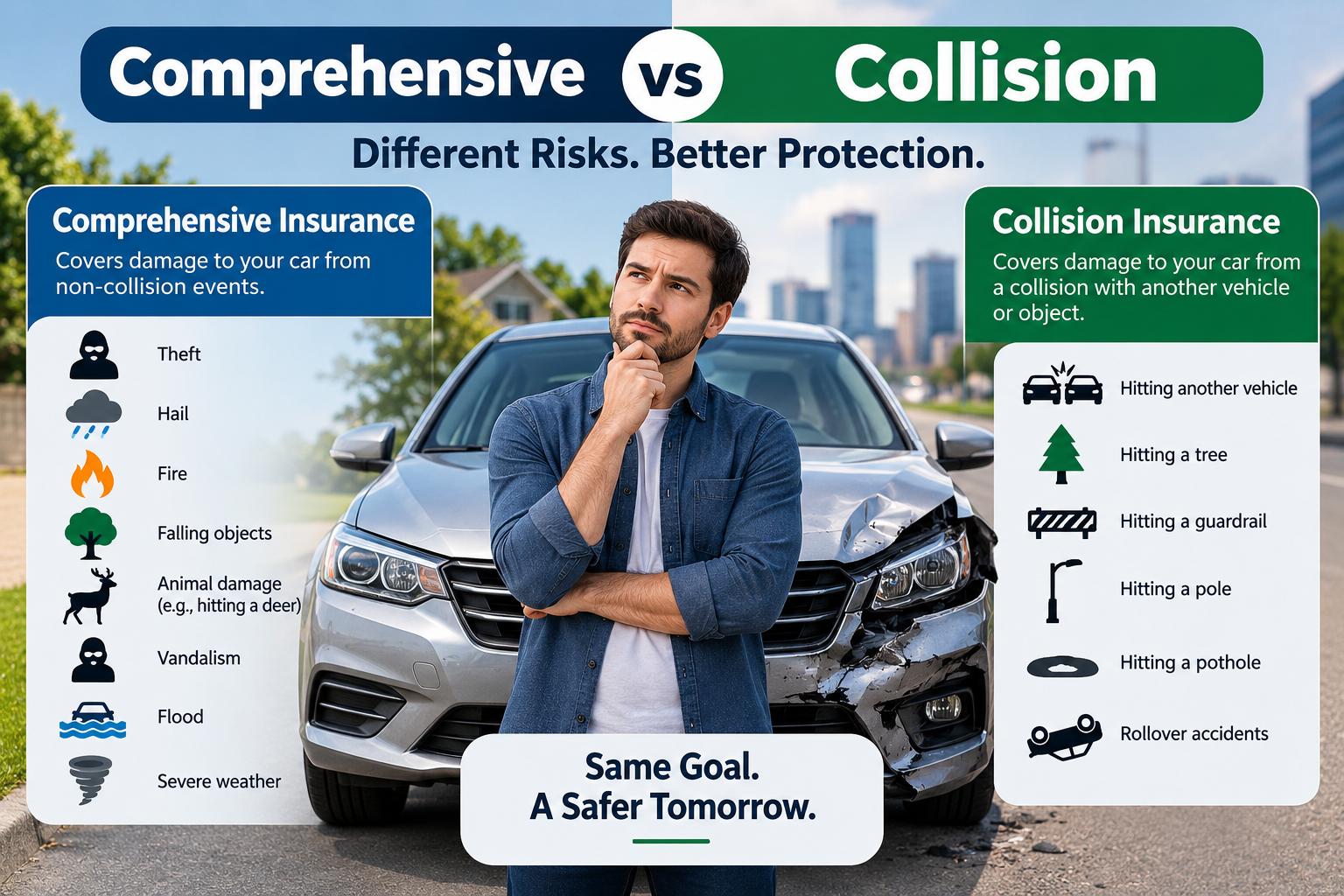
Comprehensive vs collision insurance is one of the most common questions drivers have when choosing car insurance. Both cover damage to your own vehicle, but they protect against very different types of losses. Collision insurance generally covers damage caused by hitting another vehicle or object, while comprehensive insurance covers many non-collision events such as theft, hail, fire, vandalism and falling objects.
Understanding the difference can help you decide whether you need one, both, or neither—and how much coverage makes sense for your vehicle.
Quick Answer: Comprehensive vs Collision Insurance
The easiest way to remember the difference is:
- Collision insurance = damage to your car caused by a collision.
- Comprehensive insurance = damage to your car caused by something other than a collision.
For example:
| Situation | Comprehensive | Collision |
|---|---|---|
| You hit another car | ❌ | ✅ |
| You hit a tree | ❌ | ✅ |
| Your car rolls over | ❌ | ✅ |
| You hit a pothole | ❌ | ✅ |
| Your car is stolen | ✅ | ❌ |
| Hail damages your car | ✅ | ❌ |
| A tree falls on your car | ✅ | ❌ |
| Your car is vandalized | ✅ | ❌ |
| Your car catches fire | ✅ | ❌ |
| You hit a deer | ✅ | ❌ |
| Flood damages your car | ✅ | ❌ |
The exact terms, deductibles and exclusions depend on your policy, but this is the basic distinction used in U.S. auto insurance.
The National Association of Insurance Commissioners (NAIC) describes collision coverage as protection for physical damage resulting from your vehicle colliding with another vehicle or object, while comprehensive generally covers losses such as theft, fire, severe weather, vandalism and floods.
What Is Collision Insurance?
Collision insurance pays for damage to your vehicle resulting from a collision with another vehicle or object.
That can include accidents where you are at fault.
For example, collision coverage may apply if you:
- Hit another car
- Hit a tree
- Hit a guardrail
- Hit a fence
- Hit a building
- Hit a pole
- Hit a pothole
- Roll or overturn your vehicle
The Insurance Information Institute (Triple-I) also notes that collision coverage can apply to pothole damage and rollover damage.
Example of collision coverage
Imagine you are driving your 2022 Honda Accord and accidentally hit a concrete barrier.
The repair bill is $4,000.
If you have collision coverage with a $1,000 deductible, you would generally pay the first $1,000 and the insurer could pay the remaining covered amount, subject to the policy terms and limits.
So:
$4,000 repair bill − $1,000 deductible = $3,000 insurance payment
What Is Comprehensive Insurance?
Comprehensive insurance covers damage to your vehicle from many causes that are not collisions.
Despite the name, comprehensive insurance does not mean “everything is covered.”
Common covered events can include:
- Theft
- Vandalism
- Hail
- Flood
- Fire
- Windstorm
- Falling trees
- Falling branches
- Certain animal-related damage
- Riots
- Broken glass, depending on the policy
- Other non-collision losses covered by the policy
Triple-I describes comprehensive coverage as protection against theft and damage from events other than collisions, including fire, hail, floods, vandalism, falling objects and animal contact.
Example of comprehensive coverage
Suppose you park your car outside during a severe hailstorm.
After the storm, your hood, roof and trunk have significant hail damage.
Because hail is a non-collision event, comprehensive coverage would generally be the coverage that applies, subject to your deductible and policy terms.
Comprehensive vs Collision Insurance: The Biggest Difference
The simplest way to understand the difference is to ask:
“Did my car get damaged because it collided with something?”
If yes, collision coverage may apply.
If no, and the damage resulted from something such as theft, hail, fire, vandalism or a falling object, comprehensive coverage may apply.
Think of it this way:
Collision = crash-related damage
Comprehensive = non-collision damage
This simple rule can help you understand most common situations.
Comprehensive vs Collision Insurance Examples
Here are some real-world situations to make the difference easier to understand.
1. You hit another vehicle
You accidentally rear-end another car.
Coverage: Collision
Your liability coverage may address damage you cause to the other vehicle, while your collision coverage can potentially cover damage to your own car, subject to your deductible and policy terms.
2. Someone hits your parked car
The answer can depend on the circumstances.
If another driver hits your parked car and is identified and legally responsible, their property-damage liability coverage may potentially pay for your damage.
If you make a claim under your own collision coverage instead, your deductible may apply.
3. A tree falls on your car
Coverage: Comprehensive
A falling tree is generally considered a non-collision event.
4. Hail damages your car
Coverage: Comprehensive
Hail damage is one of the classic examples of a comprehensive claim.
5. You hit a deer
Coverage: Generally comprehensive
Animal-related damage can fall under comprehensive coverage rather than collision coverage, depending on the circumstances and policy.
6. You hit a pothole
Coverage: Collision
Pothole damage is generally handled under collision coverage because your vehicle collided with an object or road hazard.
7. Your car is stolen
Coverage: Comprehensive
Comprehensive coverage can cover theft of the vehicle, subject to the policy terms.
8. Your car is vandalized
Coverage: Comprehensive
Examples include someone breaking a window or intentionally damaging your vehicle.
Do You Need Comprehensive and Collision Insurance?
You may want both if you want protection for your own vehicle against both collision and non-collision losses.
Having both can be particularly important if:
- You have a newer vehicle
- Your vehicle would be expensive to replace
- You have an auto loan
- You lease your vehicle
- You cannot comfortably afford a major repair
- You want broader protection for your vehicle
If you finance or lease a vehicle, the lender or leasing company may require comprehensive and collision coverage.
However, state law generally does not require comprehensive or collision coverage. These are optional physical-damage coverages, although a lender or lessor can require them as part of the financing or lease agreement.
Do You Need Both or Just One?
This is where things become more personal.
You don’t necessarily have to purchase both.
Choose both if:
You want broad protection for your vehicle and can afford the combined premium.
This is often the simplest choice for drivers with newer or financed vehicles.
Consider collision without comprehensive if:
Your biggest concern is accident damage, and you are comfortable paying out of pocket for theft, hail, vandalism and other non-collision losses.
Consider comprehensive without collision if:
Your vehicle is inexpensive and you are mainly concerned about theft, weather, fire or other non-collision risks.
This can make sense in some situations, but you should compare the cost against the value of the vehicle and your ability to pay for repairs.
Consider dropping both if:
Your vehicle has a low market value and the premium and deductibles don’t make financial sense compared with what the car is worth.
The NAIC recommends considering your vehicle’s value, the cost of replacing or repairing it and the savings from removing physical-damage coverage before making that decision.
Comprehensive vs Collision Insurance Cost
There is no single price for comprehensive or collision coverage.
Your premium can depend on factors such as:
- Your location
- Driving history
- Vehicle
- Vehicle value
- Coverage limits
- Deductible
- Claims history
- Insurer
- Other rating factors used by the insurance company
In general, collision coverage tends to cost more than comprehensive coverage because collision claims can involve expensive vehicle repairs.
Triple-I reports that comprehensive coverage typically costs less than collision coverage.
Your actual price can be very different from national averages, so comparing quotes is more useful than relying on a generic number.
Comprehensive vs Collision Deductible
Both coverages commonly have a deductible.
A deductible is the amount you agree to pay toward a covered claim before your insurer pays the remaining covered amount.
For example:
Collision
Repair cost: $5,000
Collision deductible: $1,000
Potential insurance payment:
$5,000 − $1,000 = $4,000
Comprehensive
Hail damage: $3,000
Comprehensive deductible: $500
Potential insurance payment:
$3,000 − $500 = $2,500
The actual settlement depends on the policy, claim circumstances and covered amount.
Should Your Comprehensive Deductible Be Lower Than Your Collision Deductible?
It can be.
Some drivers choose a lower comprehensive deductible because certain comprehensive claims—such as windshield damage, hail or theft—can be relatively common in some locations.
Others choose higher deductibles to reduce their premium.
The important thing is to choose a deductible you could realistically afford after an unexpected loss.
NAIC notes that higher deductibles generally reduce premiums, but consumers should consider what they can afford to pay when a claim occurs.
Comprehensive vs Collision for an Older Car
This is one of the most important decisions for drivers with older vehicles.
Suppose your car is worth only $5,000.
Your annual cost for comprehensive and collision is $1,200, and your collision deductible is $1,000.
You need to ask:
Does paying $1,200 every year make financial sense for a vehicle worth around $5,000?
There isn’t one universal answer.
You should consider:
- The current value of the car
- Annual insurance cost
- Deductibles
- Your savings
- Repair costs
- How difficult it would be to replace the vehicle
- Your risk of theft, weather damage or accidents
If you have enough savings to replace the vehicle, dropping some physical-damage coverage may be worth considering.
If losing the vehicle would create a major financial problem, keeping the coverage may make more sense.
What Does Comprehensive and Collision Insurance Not Cover?
Comprehensive and collision coverage are not the same as “everything insurance.”
They generally don’t cover things such as:
- Normal wear and tear
- Mechanical breakdowns
- Routine maintenance
- Oil changes
- Tire wear
- Damage excluded by the policy
- Injuries to other people under these coverages
- Damage you cause to another person’s vehicle under your own collision coverage
Your liability insurance is generally the coverage designed to address bodily injury and property damage you cause to others, subject to the policy and state requirements.
Your policy documents are the final authority on what is covered and excluded.
Does Comprehensive Insurance Cover Accidents?
Usually, no—not when the damage results from a collision.
For example, if you accidentally hit another vehicle, collision coverage is generally the relevant coverage for damage to your own car.
Comprehensive coverage is intended for covered losses other than collision.
This is why having both can provide broader protection.
Does Collision Insurance Cover Theft?
Generally, no.
Theft is normally handled under comprehensive coverage.
For example, if someone steals your vehicle, collision coverage generally isn’t the coverage that pays for the theft.
Comprehensive coverage is generally the relevant coverage, subject to the policy terms.
Does Comprehensive Insurance Cover Hail Damage?
Yes, hail damage is generally covered under comprehensive insurance if you have comprehensive coverage and the loss is covered by your policy.
For example:
Hailstorm → damaged roof → comprehensive claim
You would generally be responsible for your comprehensive deductible.
Does Collision Insurance Cover a Hit-and-Run?
It can.
If another driver hits your vehicle and leaves, collision coverage may cover the damage to your own vehicle, subject to your deductible and policy terms.
Depending on your state and circumstances, uninsured motorist property-damage coverage may also be relevant.
Because hit-and-run rules vary by state, check your policy and state insurance requirements.
Is Comprehensive or Collision Insurance Required?
Generally, no state law requires drivers to carry comprehensive or collision coverage on a personal vehicle.
However, your lender or leasing company may require both.
For example, if you finance a new car, the lender has a financial interest in that vehicle. It may therefore require physical-damage coverage until the loan is paid off.
NAIC confirms that comprehensive and collision are generally optional under state law but may be required by lenders or lessors.
Comprehensive vs Collision vs Liability Insurance
These three coverages serve different purposes.
| Coverage | Primarily protects | Typical purpose |
|---|---|---|
| Liability | Other people | Injuries/property damage you cause |
| Collision | Your vehicle | Damage from collisions |
| Comprehensive | Your vehicle | Theft and non-collision damage |
A liability-only policy generally won’t pay to repair your own car after an accident you caused.
That’s why drivers who want protection for their own vehicle often add comprehensive and collision coverage.
Comprehensive and Collision Insurance for Financed Cars
If you’re still making payments on your vehicle, check your loan agreement.
Many lenders require both comprehensive and collision coverage.
Dropping required coverage could violate the terms of your financing agreement and potentially create additional problems.
Before changing your coverage, contact your insurer and lender.
Comprehensive and Collision Insurance for Leased Cars
Leased vehicles commonly require comprehensive and collision coverage because the leasing company remains financially interested in the vehicle.
Your lease agreement should explain the required insurance.
If you are leasing a vehicle, don’t assume that liability-only insurance is sufficient.
You may also want to understand how gap coverage works because comprehensive and collision generally pay based on the vehicle’s covered value rather than automatically paying off whatever remains on your lease or loan.
Can You Have Comprehensive Without Collision?
Yes, depending on the insurer and your circumstances, you may be able to carry comprehensive coverage without collision coverage.
However, whether that makes sense financially depends on your vehicle and risk.
For example, you might be primarily worried about:
- Theft
- Hail
- Flooding
- Fire
- Vandalism
But remember that if you remove collision coverage, damage from a collision may no longer be covered under your own physical-damage coverage.
Can You Have Collision Without Comprehensive?
Yes, depending on the insurer and policy structure.
But removing comprehensive means you may have no coverage under your own policy for certain losses such as:
- Theft
- Hail
- Fire
- Vandalism
- Flood
- Falling objects
- Certain animal-related damage
Before removing either coverage, compare the premium savings against the risks you’re accepting.
How to Decide Between Comprehensive and Collision Insurance
Use this simple checklist.
Choose collision if your biggest concern is:
- Crashing into another vehicle
- Hitting an object
- Pothole damage
- Rollover accidents
Choose comprehensive if your biggest concern is:
- Theft
- Hail
- Fire
- Flood
- Vandalism
- Falling objects
- Animal damage
Choose both if:
You want broader protection for your vehicle.
Consider dropping one or both if:
The vehicle has a low value and the premium and deductible no longer justify the coverage for your financial situation.
A Simple $10,000 Car Example
Imagine your car is worth approximately $10,000.
You have:
- $500 comprehensive deductible
- $1,000 collision deductible
Now consider three scenarios.
Scenario 1: Hail damage
Damage: $3,000
Comprehensive applies.
Potential payment:
$3,000 − $500 = $2,500
Scenario 2: You hit a guardrail
Damage: $5,000
Collision applies.
Potential payment:
$5,000 − $1,000 = $4,000
Scenario 3: Car is stolen
If the theft is covered, comprehensive applies.
The insurer generally determines the vehicle’s covered value under the policy rather than simply paying the original purchase price.
This is why understanding your deductible and vehicle value is so important.
Does Full Coverage Mean Comprehensive + Collision?
In everyday insurance conversations, “full coverage” often refers to a policy that includes liability coverage plus comprehensive and collision coverage.
However, “full coverage” is not a standardized insurance policy that guarantees everything is covered.
Your policy can contain:
- Liability
- Collision
- Comprehensive
- Uninsured/underinsured motorist coverage
- Medical payments or PIP
- Rental reimbursement
- Roadside assistance
- Other optional coverage
The exact combination depends on your state, insurer and policy.
So when someone says they have “full coverage,” it’s better to ask exactly what coverages and limits they have.
Common Mistakes Drivers Make
1. Thinking comprehensive means everything is covered
It doesn’t.
Comprehensive has specific covered causes of loss and exclusions.
2. Thinking collision covers theft
It generally doesn’t.
Theft is generally a comprehensive claim.
3. Dropping coverage without checking the loan
Your lender may require comprehensive and collision.
4. Choosing a deductible you can’t afford
A lower premium isn’t helpful if you cannot afford the deductible after a claim.
5. Keeping expensive coverage on a very low-value car without doing the math
Review your vehicle’s value, premium and deductible periodically.
6. Assuming liability insurance covers your own vehicle
Liability coverage is primarily designed to protect against covered injuries or property damage you cause to others.
Frequently Asked Questions
Q1. Is comprehensive or collision insurance better?
Neither is automatically better. They cover different risks. Collision is designed primarily for collision-related damage to your vehicle, while comprehensive generally covers theft and other non-collision losses.
Q2. Do I need comprehensive and collision insurance?
You may want both if you want broad protection for your vehicle. They may also be required by a lender or leasing company.
Q3. Is comprehensive cheaper than collision?
Generally, yes. Triple-I reports that comprehensive coverage typically costs less than collision coverage, although your actual premium depends on your vehicle, location, insurer and other factors.
Q4. Does comprehensive insurance cover accidents?
Generally, comprehensive does not cover damage caused by a collision with another vehicle or object. That type of damage is typically handled through collision coverage.
Q5. Does collision insurance cover theft?
No, theft is generally covered by comprehensive insurance rather than collision coverage. If your vehicle is stolen, comprehensive coverage may help pay for the covered loss, subject to your deductible and policy terms.
Q6. Does comprehensive insurance cover hail damage?
Yes, hail damage is generally covered under comprehensive insurance if you have the coverage and the loss is covered by your policy. Your comprehensive deductible would typically apply to the claim.
Q7. Does collision insurance cover hitting a tree?
Yes, if your vehicle collides with a tree, collision coverage is generally the relevant coverage for damage to your car. Your collision deductible would typically apply.
Q8. Does comprehensive insurance cover hitting a deer?
Generally, damage from hitting an animal such as a deer is covered under comprehensive insurance. However, coverage can depend on the circumstances and the specific terms of your policy.
Q9. Does collision insurance cover pothole damage?
Yes, pothole damage is generally considered collision-related because your vehicle hits an object or road hazard. Collision coverage may pay for covered damage after your deductible.
Q10. Can I have comprehensive insurance without collision?
In some cases, you can carry comprehensive coverage without collision coverage, depending on your insurer and situation. However, you would generally have less protection for damage caused by a collision.
Q11. What is the main difference between comprehensive and collision insurance?
Collision insurance generally covers damage to your vehicle caused by hitting another vehicle or object. Comprehensive insurance generally covers non-collision losses such as theft, hail, fire, vandalism and falling objects.
Q12. Is comprehensive and collision insurance required by law?
Most states do not require comprehensive or collision coverage for a personal vehicle. However, a lender or leasing company may require both while you have a loan or lease.
Final Verdict: Comprehensive vs Collision Insurance
The difference between comprehensive vs collision insurance is actually quite simple once you know what each coverage is designed to protect against.
Collision insurance generally covers damage to your vehicle when it collides with another vehicle or object, including situations such as hitting another car, a tree, a guardrail or a pothole.
Comprehensive insurance generally covers damage from non-collision events such as theft, hail, fire, vandalism, flooding, falling objects and certain animal-related losses.
If you want broad protection for your own vehicle, carrying both comprehensive and collision is usually the more complete approach.
But if you’re trying to save money, don’t automatically drop coverage. Look at your vehicle’s current value, premiums, deductibles, financial situation and whether your lender requires the coverage.
The right answer isn’t necessarily the cheapest policy—it’s the coverage that gives you an appropriate level of protection without paying for coverage that no longer makes financial sense.
Why Maintain Market Is Different
At Maintain Market, we focus on explaining financial and insurance topics in plain English instead of overwhelming readers with complicated insurance terminology.
For car insurance questions, our goal is to help you understand:
- What a coverage actually protects
- When you may need it
- What it doesn’t cover
- How deductibles affect claims
- When dropping coverage might make sense
- What questions to ask before buying or changing a policy
Insurance decisions can affect your finances for years, so understanding the coverage before choosing a policy is just as important as comparing the price.
Also Read: Best Car Insurance Companies for Low Credit Score