
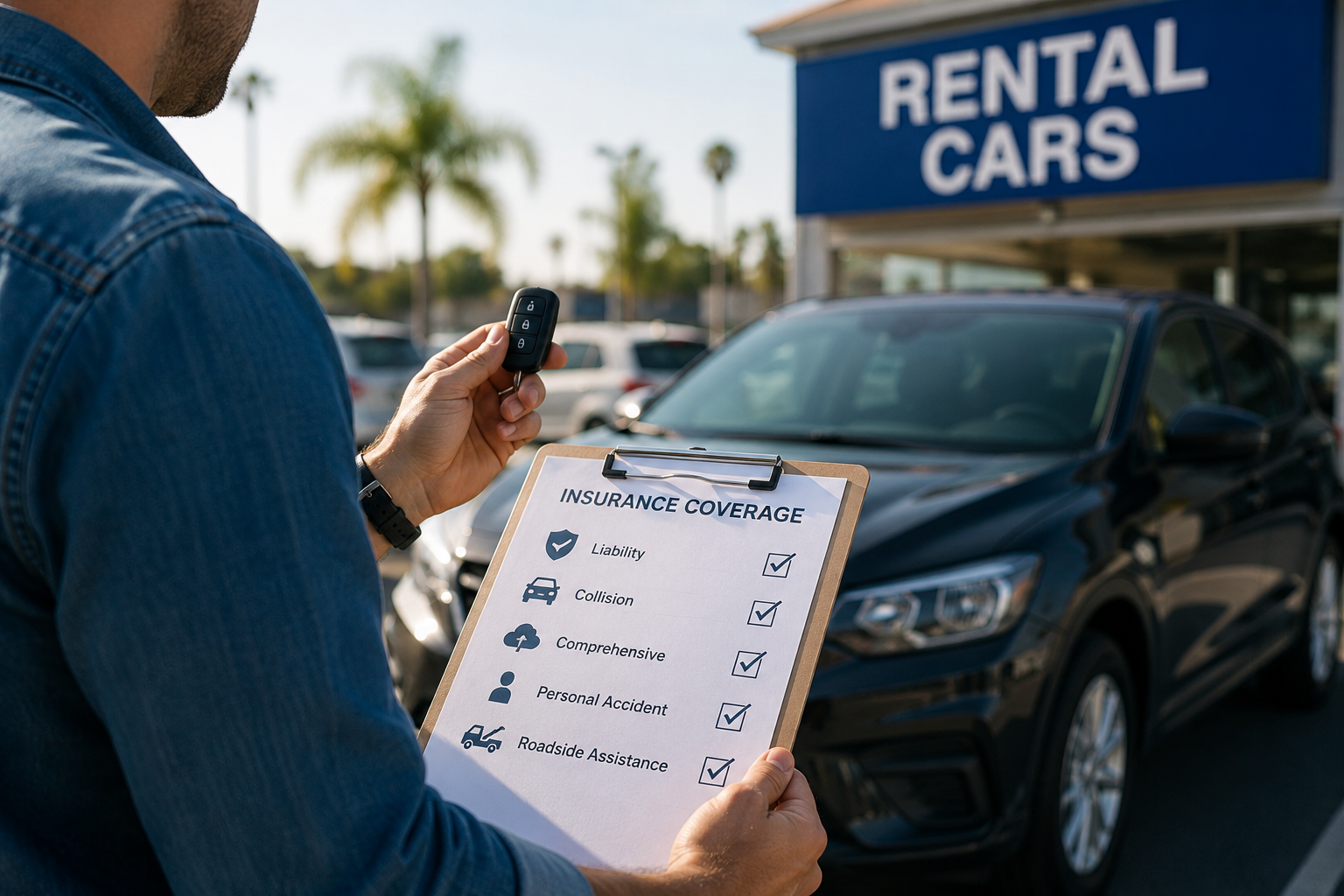
You’ve finally made it to the rental counter.
Maybe you just landed after a long flight. Maybe your own car is sitting in a repair shop after an accident. Or maybe you’re standing there with your family, luggage piled beside you, ready to start a vacation.
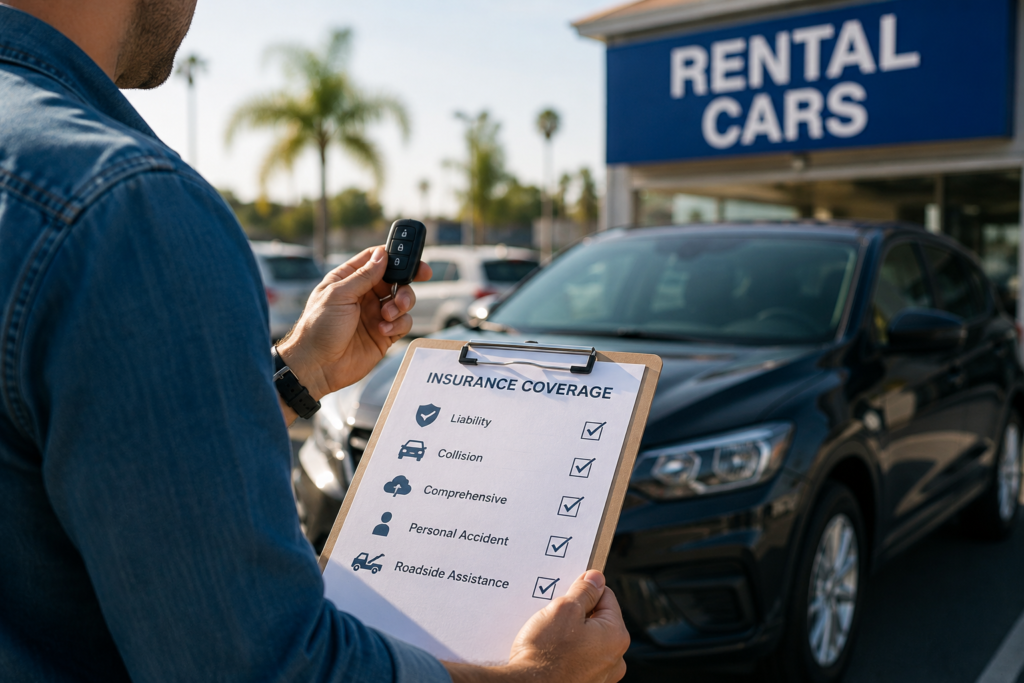
Then comes the question:
“Would you like to add insurance to the rental?”
Suddenly, something that sounded simple becomes confusing.
Doesn’t my regular car insurance already cover this?
What about the insurance on my credit card?
If I decline this coverage and crash a $35,000 rental car tomorrow, am I responsible for the entire bill?
Those are reasonable questions—and the rental counter is a terrible place to start researching them.
The good news is that your personal auto insurance may cover a rental car in the United States, especially when the rental is for personal use. But the answer depends on the coverages you already carry, your policy terms, where you rent, and why you are renting.
Here’s how to figure out what protection you already have—and where expensive gaps can still appear.
Quick Answer: Does Car Insurance Cover Rental Cars?
Yes, personal car insurance often extends to a rental car when you rent for personal use in the United States. If your policy includes liability, collision and comprehensive coverage, those protections may generally follow you to an ordinary rental vehicle, subject to your existing limits, deductibles, exclusions and policy terms.
But having car insurance does not automatically mean every rental-related expense is covered.
For example, liability coverage may protect you against injuries or property damage you cause to others but not damage to the rental car itself. Credit-card rental protection may cover damage to the rental vehicle but typically should not be assumed to provide liability insurance.
And renting a car while your own vehicle is being repaired is a separate issue: rental reimbursement coverage pays toward the cost of renting a replacement vehicle after a covered loss. It is not the same thing as insurance covering a car you voluntarily rent for vacation.
The safest move is to verify your policy before picking up the keys.
Does Your Personal Auto Insurance Follow You Into a Rental Car?
Think about your insurance as several separate protections rather than one giant umbrella labeled “car insurance.”
Your policy may include:
- Bodily injury liability
- Property damage liability
- Collision coverage
- Comprehensive coverage
- Personal injury protection (PIP)
- Medical payments coverage
- Uninsured/underinsured motorist coverage
- Rental reimbursement coverage
Each has a different job.
So the important question isn’t simply:
“Do I have car insurance?”
It’s:
“Which coverages on my personal policy extend to this rental?”
That distinction can save you from making an expensive assumption.
What Coverage May Follow You to a Rental Car?
| Coverage | What it normally protects | May extend to a rental? |
|---|---|---|
| Liability | Injuries/property damage you cause to others | Often |
| Collision | Collision damage to the vehicle | Often, if you carry it |
| Comprehensive | Theft and certain non-collision losses | Often, if you carry it |
| PIP/MedPay | Eligible medical expenses | Depends on policy/state |
| Uninsured/Underinsured Motorist | Loss involving inadequately insured drivers | Depends on policy |
| Rental Reimbursement | Cost of temporary transportation after a covered loss | Different coverage entirely |
| Credit Card Rental Protection | Typically eligible damage/theft to rental vehicle | Depends on card |
The exact answer depends on your insurer and policy.
1. Liability Insurance and Rental Cars
Imagine you’re driving a rental SUV through Florida.
Traffic slows suddenly. You react a second too late and rear-end the vehicle in front of you.
Now there are two separate financial problems:
Problem #1: Damage to the other driver’s vehicle and possibly injuries.
Problem #2: Damage to the SUV you rented.
Liability insurance is designed primarily for Problem #1.
If your personal auto liability coverage extends to the rental, it may help pay eligible costs when you are legally responsible for injuring someone or damaging their property, up to your policy limits.
But liability coverage generally does not pay to repair the rental vehicle you were driving.
That distinction matters enormously for drivers who carry liability-only policies.
Does liability-only insurance cover rental cars?
Your liability protection may extend to a rental depending on the policy, but liability-only insurance should not be assumed to cover physical damage to the rental vehicle itself.
So someone driving an older car at home with liability-only insurance may face a very different decision at the rental counter than someone carrying collision and comprehensive coverage.
Before declining a damage waiver, verify how damage to the rented vehicle would be covered.
2. Does Collision Insurance Cover a Rental Car?
Collision coverage protects your vehicle against covered collision damage.
For example:
You’re backing the rental car out of a tight hotel parking space.
You misjudge the concrete pillar beside you.
Scrape.
The passenger-side door and rear quarter panel are damaged.
No other driver is involved.
If your collision coverage extends to the rental, it may help pay for covered repairs, typically subject to your deductible and policy terms.
Suppose the covered repair bill were $4,000 and your applicable collision deductible were $1,000.
You could potentially be responsible for the first $1,000 before insurance covers the eligible remainder.
That’s why saying “my insurance covers rentals” does not necessarily mean:
“An accident in the rental costs me nothing.”
3. Does Comprehensive Insurance Cover Rental Cars?
Not every bad rental-car experience involves an accident.
Imagine waking up at your hotel and walking toward the parking lot.
You press the unlock button.
Nothing.
Then you realize the car isn’t where you left it.
It has been stolen.
Or perhaps a storm damages the vehicle. Someone breaks a window. A falling object hits it.
Those situations may fall under comprehensive coverage rather than collision coverage.
If your personal comprehensive insurance extends to the rental vehicle, it may cover eligible non-collision losses such as theft or certain weather, vandalism or falling-object damage, subject to the terms and deductible of your policy.
Again, check your policy rather than assuming.
4. Does “Full Coverage” Insurance Cover Rental Cars?
This is one of the most searched—and most misunderstood—questions.
“Full coverage” is not one standardized insurance product.
People usually use the phrase to describe a policy containing:
Liability + collision + comprehensive coverage.
If you have those coverages and they extend to a rental, you may already have substantial protection when renting an ordinary vehicle for personal use in the U.S.
But “full coverage” does not mean every possible rental expense is guaranteed to be covered.
Your:
- deductibles,
- liability limits,
- exclusions,
- territorial restrictions,
- vehicle restrictions,
- driver restrictions
can still matter.
Never make a rental decision based solely on seeing the words “full coverage” somewhere in your account.
Look at the actual coverages.
A Real-Life Style Example: The $12 Rental-Counter Decision
The following example is illustrative, not a documented insurance claim.
Sarah lives in Ohio and is flying to Denver for a four-day vacation.
Her rental costs $260.
At the counter, she’s offered an optional damage waiver for an additional daily charge.
She thinks:
“I already pay for car insurance every month. Why would I pay again?”
But instead of immediately declining, Sarah had checked her policy before traveling.
She confirmed that her personal policy included liability, collision and comprehensive coverage that applied to an eligible temporary rental used for personal travel.
She also discovered that her collision deductible would still apply if she made a covered claim.
The problem
Sarah initially assumed that “covered” meant she would owe nothing after damaging a rental.
That wasn’t necessarily true.
How she solved it
She compared three things before making the decision:
- Her existing auto insurance.
- Her credit card’s rental-car benefit.
- The rental company’s optional waiver.
Only then did she decide whether paying extra for the waiver was worth the additional protection and convenience.
The lesson
The smartest rental-car insurance decision usually happens before you reach the counter.
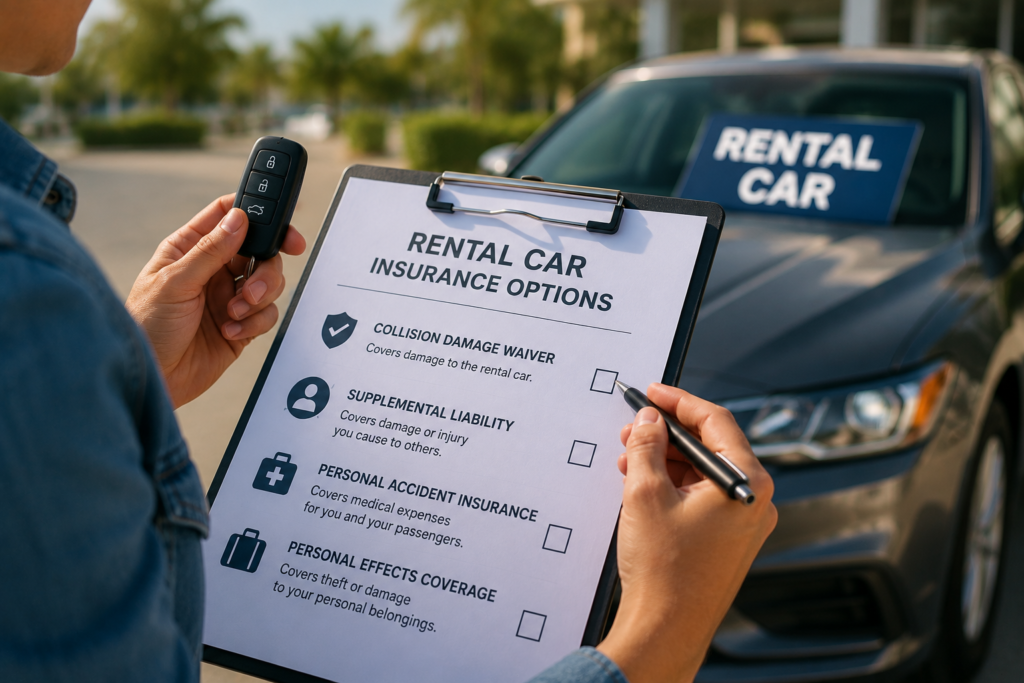
What Is a Collision Damage Waiver (CDW) or Loss Damage Waiver (LDW)?
Rental companies commonly offer a Collision Damage Waiver or Loss Damage Waiver.
Despite the way people casually describe it, this is generally a waiver rather than traditional auto insurance.
The rental company agrees, subject to the rental agreement and exclusions, to waive some or all financial responsibility for covered damage or theft of the rented vehicle.
The FTC notes that rental companies may offer CDW/LDW protection and that the waiver does not cover injuries to you or damage to your personal property.
It may nevertheless provide something valuable:
simplicity.
Imagine damaging the rental car on day two of a family vacation.
You don’t want to spend the rest of the trip wondering:
Will my insurer pay?
What will my deductible be?
Will the rental company charge additional fees?
A waiver may reduce certain risks and administrative headaches, depending on its terms.
But it costs extra.
That’s why there isn’t one universal answer to whether you should buy it.
Does Credit Card Insurance Cover Rental Cars?
This is where many travelers become overconfident.
You may have heard:
“Just use a credit card. The card covers the rental.”
Sometimes a credit card does provide rental-car protection.
But you need to understand exactly what the benefit covers.
The FTC notes that some credit cards provide rental protection when the card is used to pay for the rental. Depending on the benefit, you may also need to decline the rental company’s damage waiver for the credit-card protection to apply.
Terms can vary substantially by card.
Some rental-car benefits may cover eligible:
- collision damage,
- theft,
- towing,
- loss-related expenses.
But you should not assume your credit card provides liability insurance for injuries or property damage you cause to other people.
Primary vs. secondary rental coverage
This distinction matters.
Primary rental coverage can potentially respond before your personal auto insurance for an eligible rental claim.
Secondary coverage generally comes into play after applicable primary insurance and may cover certain remaining eligible expenses.
Check your card’s current benefits guide before relying on it.
Benefits can change.
Personal Auto Insurance vs. Credit Card vs. Rental Company Coverage
| Protection Source | Rental Vehicle Damage | Liability | Deductible Possible? | Important consideration |
|---|---|---|---|---|
| Personal auto insurance | Often, with collision/comprehensive | Often | Yes | Policy terms apply |
| Credit card benefit | Often limited to eligible damage/theft | Usually not the main liability source | Depends | Activation rules matter |
| Rental company LDW/CDW | Often | No | Often designed to reduce damage responsibility | Costs extra |
| Supplemental liability | No | Yes | Depends | Raises liability protection |
| Personal effects coverage | No | No | Depends | Protects eligible belongings |
Do not use this table as a substitute for reviewing the actual contracts.
Rental Car Insurance After an Accident: A Completely Different Question
Here’s a common situation.
David is driving home when another vehicle hits his car.
His car goes to the body shop.
Repairs will take two weeks.
David still needs to get to work every morning.
He calls his insurer and says:
“My policy covers rental cars, right?”
There are actually two questions hidden inside that sentence.
Question 1
Will David’s insurance protect him while he is driving a rental vehicle?
Question 2
Will his insurance pay the daily rental bill while his own vehicle is being repaired?
Those are not the same thing.
The second question concerns rental reimbursement coverage or another applicable source of reimbursement.
Rental reimbursement is an optional coverage on many auto policies that can help pay temporary transportation costs after a covered loss, subject to limits and terms.
So your personal policy might insure you while driving a rental yet not pay the rental company’s daily charge unless you have the appropriate reimbursement coverage or another party is responsible.
This distinction alone can prevent a frustrating surprise after an accident.
When Your Car Insurance May NOT Fully Cover a Rental
Rental coverage can become more complicated in several situations.
1. You only carry liability insurance
You may have liability protection but lack collision/comprehensive coverage for physical damage to the rental vehicle.
2. You rent outside the United States
Do not assume a U.S. personal auto policy follows you worldwide.
Coverage may extend into Canada under many policies, but Mexico and other countries can have very different insurance requirements.
International travelers should verify coverage for the specific country before leaving the U.S.
3. You rent an unusual or expensive vehicle
Your everyday sedan’s policy should not automatically be assumed to cover every exotic car, specialty vehicle, moving truck, large van or other vehicle you can rent.
4. You use the rental for business
A personal auto policy may have restrictions or exclusions involving certain business or commercial uses.
5. Someone not authorized drives the car
Both your insurance policy and rental agreement can impose restrictions on drivers.
Allowing an unauthorized person to drive can create serious coverage problems.
6. You violate the rental agreement
A damage waiver is not permission to do anything you want with the vehicle.
The FTC warns that waiver protection may be lost in situations such as reckless driving, driving under the influence, or allowing an unauthorized person to operate the vehicle.
Does Car Insurance Cover Rental Cars on Vacation?
Often, yes.
An ordinary short-term rental for personal vacation travel within the United States is one of the situations where existing personal auto coverage may extend to the rented vehicle.
But verify:
Where are you going?
Who will drive?
What vehicle are you renting?
How long is the rental?
Are you using it exclusively for personal purposes?
Those details can affect coverage.
Does Car Insurance Cover Rental Cars Out of State?
Traveling from one U.S. state to another does not automatically make your auto policy disappear.
Personal auto insurance generally travels with you across the United States, subject to your policy.
But state insurance laws differ, so your insurer is the best source for confirming how your coverage operates during interstate travel.
You shouldn’t buy duplicate coverage simply because you crossed a state border—but you shouldn’t assume every scenario works identically either.
Does Car Insurance Cover Rental Cars in Canada?
Many U.S. personal auto policies may provide coverage for eligible rentals in Canada.
But verify this before traveling.
Bring any required insurance documentation and confirm the rental company’s requirements.
Does U.S. Car Insurance Cover Rental Cars in Mexico?
This requires much more caution.
Do not assume your U.S. auto policy provides the insurance you need to drive legally or safely in Mexico.
Coverage and legal requirements differ, and specialized Mexican auto insurance may be necessary.
Confirm requirements before crossing the border.
The Emotional Side Nobody Talks About
Insurance feels boring until something goes wrong.
Nobody starts a vacation imagining themselves calling an insurance company from a hotel parking lot.
Nobody rents a car thinking:
“Tomorrow I might cause an accident.”
You’re thinking about your destination.
Your family.
The wedding you’re attending.
The road trip you’ve been planning for months.
Or maybe you’re not traveling for fun at all.
Maybe your car was wrecked yesterday and you’re renting because you still have to show up at work Monday morning.
That’s why rental insurance decisions feel frustrating.
You’re being asked to make a potentially expensive financial decision at the exact moment you’re most likely to want to say:
“Whatever. Just give me the keys.”
Five minutes of preparation beforehand can remove most of that pressure.
Before Renting a Car: The 5-Minute Insurance Check
Before your next rental, open your auto policy or contact your insurer and ask:
“Does my personal auto policy cover a rental car used for personal travel in [destination]?”
Then confirm:
- Does my liability coverage extend to it?
- Do collision and comprehensive coverage extend to it?
- What deductibles would apply?
- Are there restrictions on rental vehicle type, duration, location or drivers?
- Are loss-of-use, administrative fees or similar rental-company charges covered?
Next, check the credit card you plan to use.
Ask what rental protection it offers, whether it is primary or secondary, which countries and vehicle types are excluded, and what you must do to activate coverage.
Now you can evaluate the rental company’s options intelligently.
Should You Buy Rental Car Insurance?
You may be more comfortable declining some optional rental coverage when:
- Your personal policy clearly covers the rental.
- You have collision and comprehensive coverage.
- Your liability limits are adequate for your needs.
- Your credit card provides useful rental protection.
- You understand and can afford your deductible.
- You have confirmed there are no relevant exclusions.
Buying additional rental protection may make more sense when:
- You have no personal auto insurance.
- You carry liability-only coverage.
- Your policy does not cover the rental situation.
- You’re renting internationally.
- You’re uncomfortable paying your personal-policy deductible.
- You want protection against certain rental-company charges your existing coverage may not handle.
- You prefer not to rely solely on your personal auto policy for rental damage.
The cheapest choice at the counter is not automatically the smartest.
Neither is buying every product offered.
The goal is to avoid paying twice for protection you already have while leaving yourself exposed to the protection you actually need.
Example: A Family Road Trip Goes Wrong
This is an illustrative scenario designed to explain coverage, not a real customer case study.
Michael and his wife rent a midsize SUV for a road trip from Chicago to Nashville.
They decline the rental company’s damage waiver because Michael knows he has auto insurance.
On the second day, heavy rain hits.
Michael loses control and strikes a guardrail.
Everyone is safe.
The SUV isn’t.
The front bumper, headlight and side panel are damaged.
Michael calls his insurer.
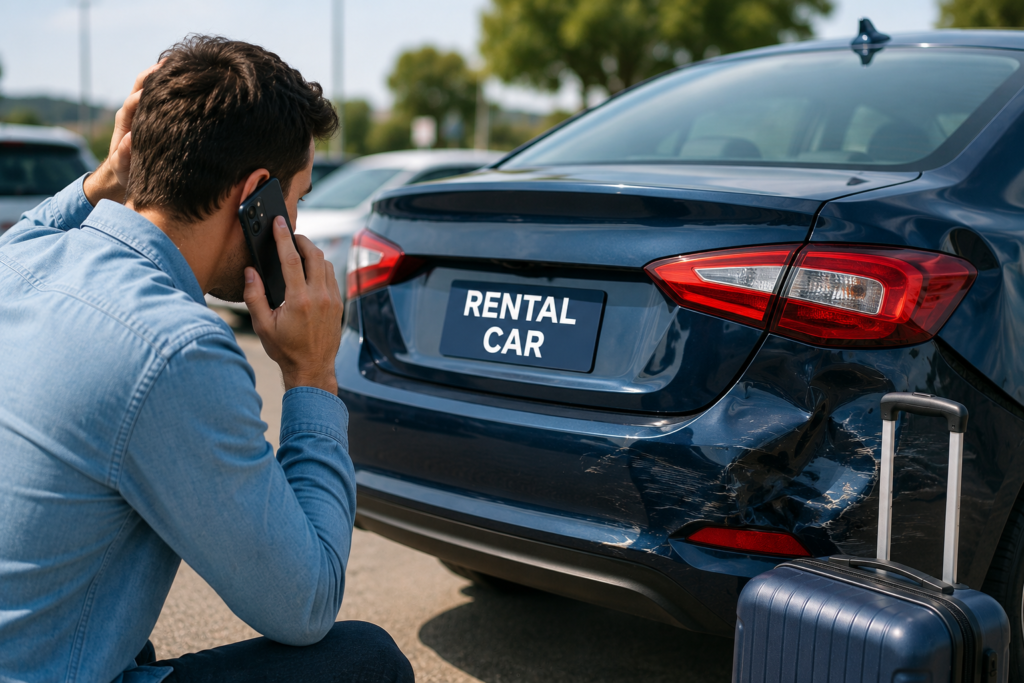
He learns that his collision coverage applies to the eligible rental claim, but his normal deductible still applies.
What went wrong?
Michael correctly understood that his insurance could cover the rental.
But he had misunderstood what “covered” meant.
He thought it meant zero out-of-pocket cost.
What solved the problem?
His collision coverage could address eligible physical damage under the terms of his policy.
But he still had to deal with the deductible and determine whether any charges from the rental company fell outside his policy.
Takeaway
Never ask only:
“Am I covered?”
Ask:
“Exactly what am I responsible for if the rental is damaged?”
That question produces a much more useful answer.
Frequently Asked Questions
Q1. Does my car insurance cover a rental car?
Personal auto insurance often extends to an eligible rental car used for personal purposes in the United States. The exact protection depends on the liability, collision, comprehensive and other coverages on your policy.
Q2. Does liability insurance cover rental cars?
Liability coverage may extend to eligible rentals and protect you against covered injuries or property damage you cause to others. Liability-only insurance generally should not be expected to pay for physical damage to the rental vehicle itself.
Q3. Does full coverage insurance cover rental cars?
Policies containing liability, collision and comprehensive coverage often provide substantial protection for eligible rental vehicles, but “full coverage” is not a standardized policy. Check your specific limits, deductibles and exclusions.
Q4. Does car insurance cover rental cars on vacation?
It often can for ordinary personal-use rentals within the United States, subject to policy terms.
Q5. Does car insurance cover a rental while my car is being repaired?
Your policy may protect you while driving the rental, but paying the rental bill is a separate question. Rental reimbursement coverage may help pay temporary transportation expenses after a covered loss.
Q6. Does car insurance cover rental cars out of state?
Personal auto insurance commonly applies while traveling across U.S. states, but policy terms and state rules should be verified with your insurer.
Q7. Do I need rental car insurance if I have car insurance?
Not necessarily. Your personal auto policy may already provide overlapping protection. However, additional rental coverage may be useful if you have coverage gaps, high deductibles, limited protection or simply want additional certainty.
Q8. Does my credit card cover rental cars?
Some credit cards offer eligible rental-car damage or theft protection when you pay with the card and meet the benefit requirements. Coverage varies, and credit-card rental benefits should not be assumed to replace liability insurance.
Q9. What happens if I damage a rental car?
Depending on the situation, damage may be handled through your personal collision/comprehensive insurance, a credit-card rental benefit, the rental company’s damage waiver, another driver’s insurance or another applicable source. Deductibles, exclusions and other charges may still apply.
Q10. Is rental reimbursement the same as rental car insurance?
No. Rental reimbursement helps pay for temporary transportation when your own vehicle is unavailable after an eligible covered loss. It is different from coverage protecting a rental vehicle you drive.
Conclusion
So, does car insurance cover rental cars?
For many U.S. drivers, the answer is yes—at least to some extent.
Personal liability insurance may extend to an eligible rental.
Collision and comprehensive coverage may protect the rented vehicle against eligible physical damage or theft.
Other policy protections may also apply.
But that doesn’t mean every rental-related cost is covered.
Your deductible can still matter. Your policy limits still matter. The country you’re driving in matters. The vehicle you rent matters. Your reason for renting can matter.
And credit-card protection and rental reimbursement are separate pieces of the puzzle.
So before the rental agent asks:
“Would you like the insurance?”
Know the answer before you walk through the door.
Pull up your policy.
Check your credit-card benefits.
Call your insurer when something isn’t clear.
Because the best time to discover a coverage gap is before you need the coverage—not while staring at a damaged rental car.
This article is for general educational purposes and does not provide insurance, financial or legal advice. Insurance policies, state requirements, rental agreements and credit-card benefits vary. Review your policy documents and confirm coverage with your insurer, card issuer and rental company before making a decision.
Also Read: How Much Car Insurance Do I Need? Don’t Pay for the Wrong Coverage
People Also Searched For: 15 Ways Americans Are Earning Extra Money in 2026