
You’re renewing your car insurance and see two quotes on your screen.
One is cheaper. Much cheaper.
The other offers higher liability limits, collision coverage, comprehensive coverage and a few protections you’re not completely sure you need.
Naturally, the cheaper one looks tempting.
After all, if you’re a careful driver, why spend hundreds of extra dollars every year on something you hope you’ll never use?
That’s where choosing car insurance gets tricky.
You’re not really buying insurance for the drive to work tomorrow morning. You’re buying it for the one day when tomorrow morning doesn’t go according to plan.
A distracted driver runs a red light. You brake a second too late. A storm drops a tree branch onto your parked car. Someone without insurance hits you. Your new car gets totalled while you still owe thousands on the loan.
Those situations can turn an ordinary financial decision into a very expensive one.
So, how much car insurance do you actually need?
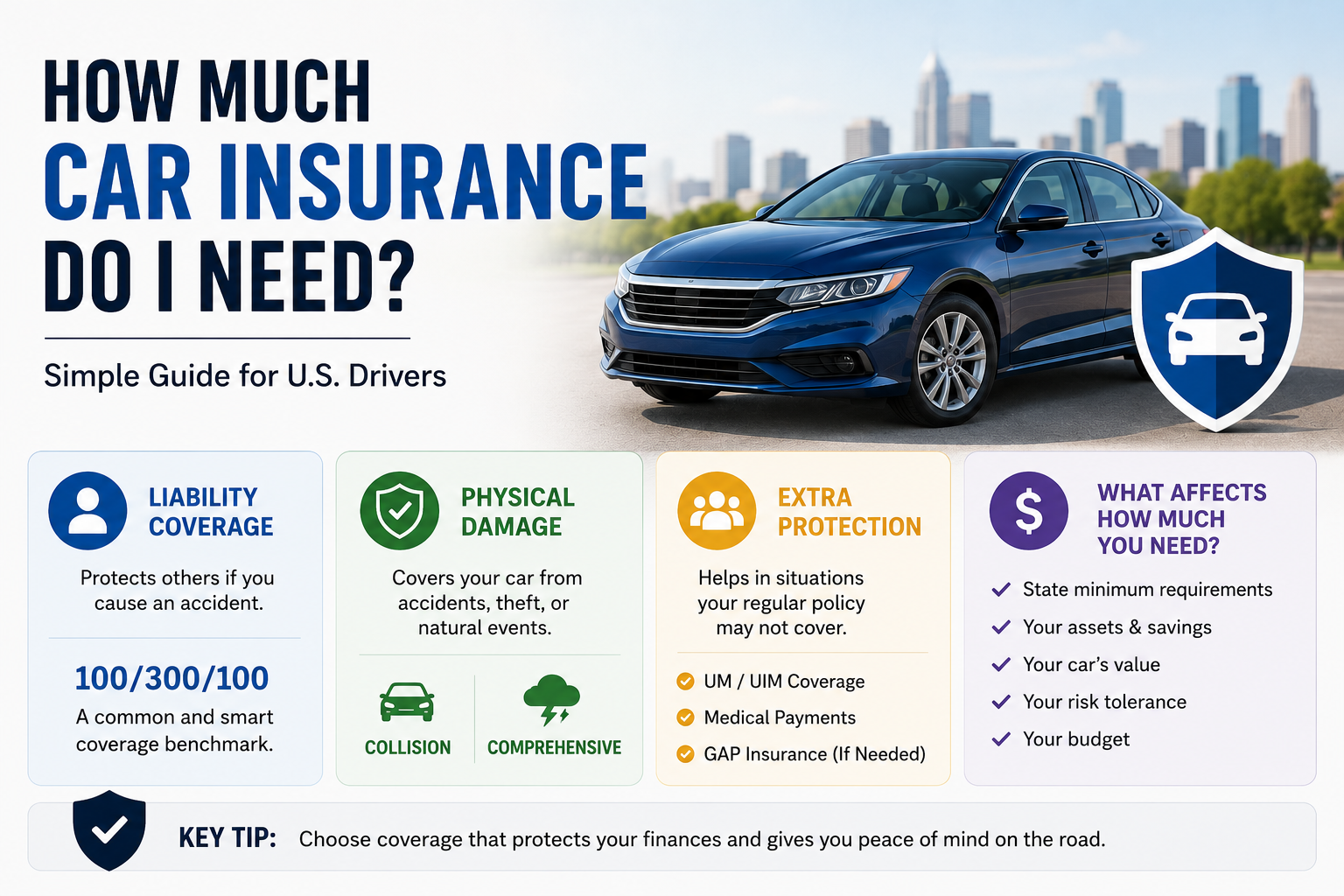
For many U.S. drivers, 100/300/100 liability coverage is a useful benchmark to compare when shopping for insurance, rather than automatically choosing the minimum required by the state.
But there isn’t one coverage amount that’s right for everyone.
The right policy depends on where you live, what you drive, whether your car is financed, your savings and assets, and—most importantly—how much financial risk you could handle yourself if something went seriously wrong.
Let’s work through it.
How Much Car Insurance Do I Need? The Quick Answer
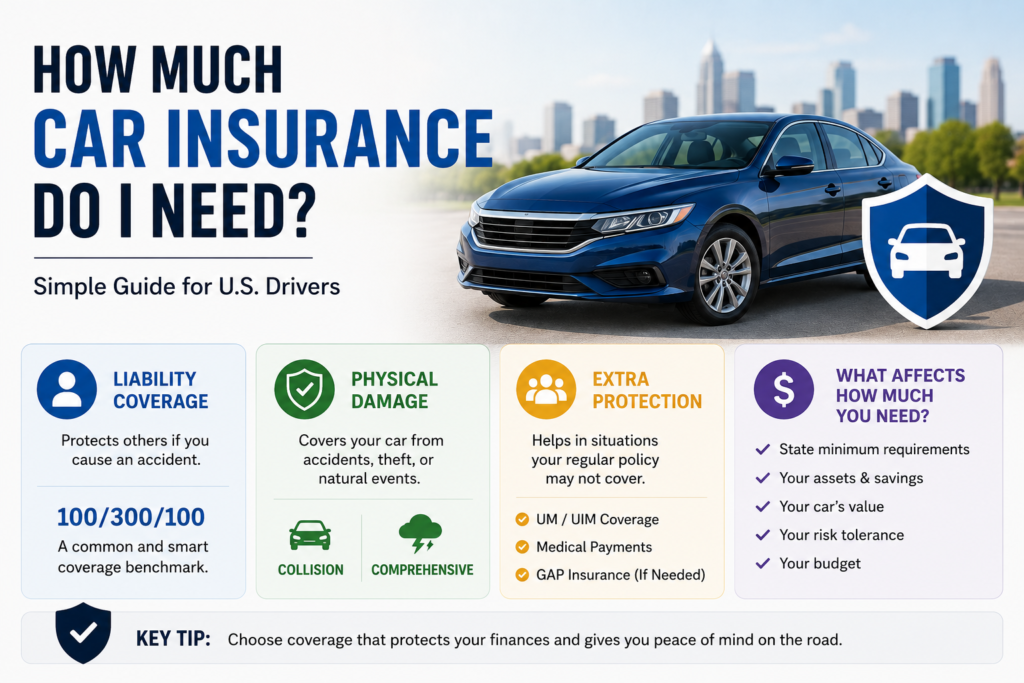
At minimum, you generally need whatever auto insurance your state requires.
But legal minimum and financially adequate are not the same thing.
Someone with an inexpensive paid-off vehicle and limited assets has different insurance needs from a homeowner driving a financed $50,000 SUV.
For many drivers, a good place to begin comparing quotes is:
$100,000 bodily injury liability per person
$300,000 bodily injury liability per accident
$100,000 property damage liability per accident
You’ll usually see this written as 100/300/100.
Depending on your circumstances, you should also consider uninsured/underinsured motorist coverage, collision, comprehensive, medical payments or PIP, and GAP protection.
Drivers with substantial assets may want to investigate higher liability limits and umbrella insurance.
The goal isn’t to buy every coverage available.
It’s to make sure one accident doesn’t undo years of financial progress.
The Question Most Drivers Ask Backwards
When people shop for car insurance, the conversation often begins with:
“How can I get my premium lower?”
That’s understandable.
Rent or mortgage payments are due. Groceries cost money. Gas costs money. Car payments cost money. Then another bill arrives for something you may never use.
Nobody enjoys paying insurance premiums.
But imagine you’ve spent years building a $25,000 emergency fund.
You finally feel financially comfortable.
Then you’re responsible for an accident that causes significant injuries and damages an expensive vehicle.
Your insurance coverage doesn’t become unlimited because the accident was unusually expensive. Policies have limits.
That’s why a better question is:
“What would happen to my finances if I caused a serious accident tomorrow?”
Your insurance should be built around that risk.
What Does 100/300/100 Car Insurance Actually Mean?
Insurance numbers look much more complicated than they are.
Suppose your policy shows:
100/300/100
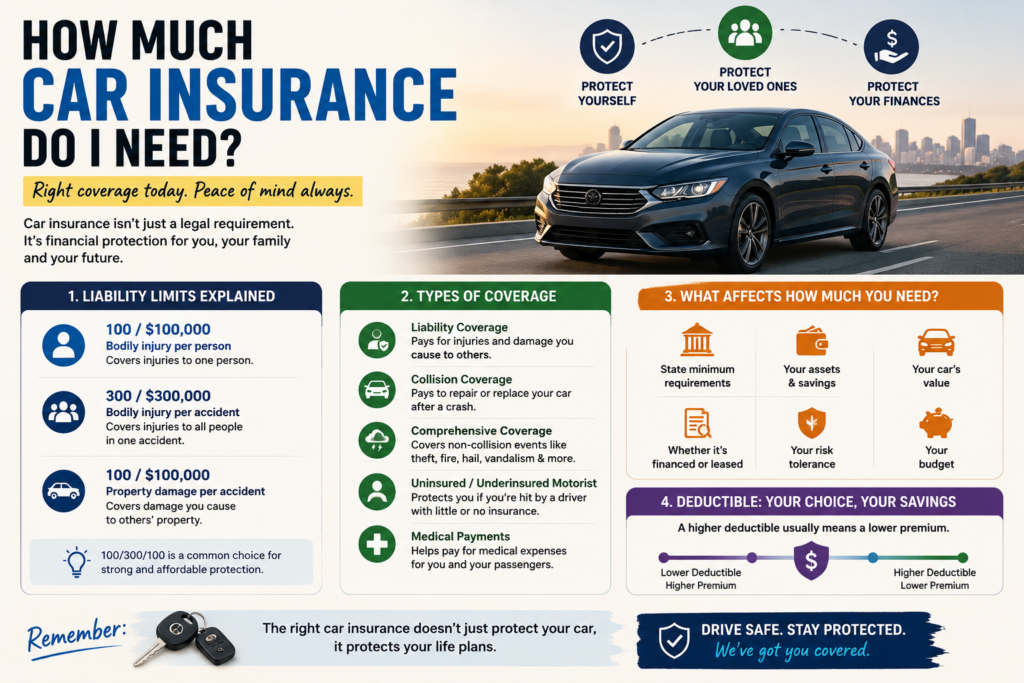
The first 100 generally means your insurer can pay up to $100,000 for covered bodily injury liability to one person, subject to the policy.
The 300 represents up to $300,000 for covered bodily injury liability per accident.
The final 100 represents up to $100,000 in covered property damage liability per accident.
So:
| Coverage | Policy Limit |
|---|---|
| Bodily injury — one person | $100,000 |
| Bodily injury — entire accident | $300,000 |
| Property damage — one accident | $100,000 |
Here’s why those numbers matter.
Imagine you’re responsible for a collision involving two people.
One person’s covered injury claim is $70,000.
The other’s is $45,000.
That’s $115,000 combined.
With 100/300 bodily injury limits, neither individual claim exceeds the $100,000 per-person limit and the combined amount remains below the $300,000 per-accident limit.
Of course, actual claims are more complicated than a simple example. Coverage depends on policy terms, fault, applicable law and other circumstances.
But it illustrates what those numbers are doing.
They’re defining how much financial protection stands between an accident and your own money.
Is Minimum Car Insurance Enough?
This is where drivers can make an expensive assumption.
Your state tells you the minimum amount of insurance required to legally drive.
That doesn’t mean the state has calculated the amount needed to protect your savings.
Think about today’s vehicles.
A collision doesn’t need to involve a Ferrari to become expensive.
Newer vehicles can contain cameras, sensors, radar systems and other technology. A serious crash can involve vehicle damage, medical bills and other costs.
Imagine your applicable property damage liability limit is $25,000.
You cause an accident resulting in $55,000 of covered property damage.
Your insurance doesn’t magically turn that $25,000 limit into $55,000.
There may be financial exposure above your policy limit.
Saving money on premiums feels good.
Finding out you were underinsured after the accident does not.
How Much Liability Insurance Should I Carry?
There’s no magic number, but there is a useful principle:
The more you have to lose, the more seriously you should take liability coverage.
Consider someone named Mark.
Mark is 24, rents an apartment, drives an older car and has $3,000 in savings.
Now consider Sarah.
Sarah is 42, owns a home, has $90,000 invested, earns a strong salary and has two cars.
Should their insurance decisions automatically be identical?
Probably not.
Sarah has considerably more assets and income to protect.
That’s why many drivers can start by pricing 100/300/100, while households with more assets may consider quotes for limits such as 250/500 and higher property damage protection.
The key word is compare.
Ask your insurer what higher limits actually cost before assuming they’re unaffordable.
A $20 Decision Can Feel Very Different After an Accident
Consider this fictional scenario.
Jake is trying to reduce his monthly bills.
His insurer offers him higher liability limits, but the premium costs more.
Jake thinks:
“I’ve never caused a serious accident. Why should I pay extra every month?”
So he chooses lower limits.
Six months later, he’s driving home in heavy rain.
Traffic suddenly stops.
Jake brakes, but the car slides and crashes into another vehicle.
Suppose the accident creates $80,000 in covered liability, but Jake’s applicable policy limit is only $50,000.
That difference suddenly matters much more than the premium savings did.
Now change the story.
Suppose Jake had compared the higher-limit option and decided the additional premium was affordable.
The accident is still horrible.
He’s still shaken.
His car may still be damaged.
But financially, he’s in a stronger position.
That’s what good insurance does.
It doesn’t prevent bad days.
It helps keep a bad day from becoming a bad decade.
Do I Need “Full Coverage” Car Insurance?
You’ll hear the phrase full coverage everywhere.
But it can be misleading.
There isn’t one universal insurance product officially covering every possible thing that can happen to your car.
People commonly use “full coverage” to describe a policy containing:
Liability + collision + comprehensive insurance.
Each does a different job.
Liability Coverage
Liability coverage can pay covered costs when you’re legally responsible for injuries or property damage to others.
It protects you from liability arising from covered accidents.
But it generally doesn’t repair your own vehicle simply because you caused the crash.
That’s where collision coverage becomes important.
Collision Coverage
Imagine backing out of a parking space and hitting a concrete pillar.
Nobody else is involved.
Your bumper and side panel are badly damaged.
Liability coverage isn’t designed to repair your own car in that situation.
Collision coverage can help pay for covered damage to your vehicle after a collision, subject to your deductible and policy terms.
It may also apply when you hit another vehicle or certain objects.
Comprehensive Coverage
Now imagine something completely different.
You wake up Monday morning and walk outside.
Your car isn’t there.
It’s been stolen.
Or a severe hailstorm damages it.
Or a tree falls on it during bad weather.
Comprehensive coverage generally addresses certain covered losses that aren’t collisions, including theft, vandalism and some weather-related damage.
Do I Need Collision and Comprehensive on an Older Car?
This is where the answer becomes personal.
Suppose your car is worth around $4,000.
Your collision deductible is $1,000.
You’re paying a meaningful amount each year for collision coverage.
At some point, you may ask whether continuing that coverage makes financial sense.
One useful calculation is:
Vehicle value − deductible = approximate value you’re protecting in a total-loss scenario
Then compare that with what you’re paying for the coverage and how easily you could replace the vehicle yourself.
Now imagine the opposite situation.
Your car is worth $22,000.
You have only $2,000 in emergency savings.
If the vehicle were totaled tomorrow, buying another car could be a serious financial problem.
Keeping collision and comprehensive coverage may feel very different in that situation.
Don’t drop coverage just because your car is “old.”
Look at its value and your financial ability to replace it.
What If Someone Without Insurance Hits Me?
This is one of the most frustrating scenarios for responsible drivers.
You’ve paid your premiums.
You stop at the light.
Someone crashes into you.
Then you discover the other driver doesn’t have adequate insurance.
You didn’t cause the accident.
But you’re still the person standing beside a damaged car wondering what happens next.
That’s why uninsured motorist (UM) and underinsured motorist (UIM) coverage deserve attention.
UM coverage can provide protection when an at-fault driver doesn’t have applicable insurance.
UIM can help when the other driver’s liability insurance isn’t enough for the covered loss.
Requirements and coverage rules vary by state.
Where appropriate and available, you can consider UM/UIM bodily injury limits comparable to your own bodily injury liability limits.
It’s easy to think:
“I’m insured, so I’m safe.”
Your protection can also depend on what happens when the other person isn’t adequately insured.
Do I Need GAP Insurance?
Here’s a painful financial situation many new-car buyers don’t think about.
You owe $34,000 on your car loan.
Then your vehicle is totalled.
Suppose your insurer determines the covered vehicle value is $29,000 before any relevant deductible.
Your car is gone.
Your loan balance isn’t automatically gone with it.
There’s potentially a:
$5,000 difference.
This is where GAP protection may help, depending on its terms.
GAP is particularly worth investigating when you owe more on your vehicle than it’s currently worth.
That situation can happen when you make a small down payment, take a long-term loan, finance a vehicle that depreciates quickly or roll debt from a previous vehicle into a new loan.
You won’t necessarily need GAP forever.
Once your loan balance falls comfortably below the vehicle’s value, revisit whether you still need it.
How Much Car Insurance Do I Need If My Car Is Financed?
Financing changes the equation.
When you finance a vehicle, you aren’t the only party with money tied to it.
Your lender has a financial interest in the car.
That’s why lenders commonly require borrowers to maintain collision and comprehensive coverage.
You may therefore want to consider:
Liability insurance: Appropriate limits for your financial situation
Collision: Usually required by the lender
Comprehensive: Usually required by the lender
UM/UIM: Depending on state requirements and your needs
GAP: Consider when the loan exceeds the vehicle’s value
Check your loan agreement for the actual requirements.
How Much Car Insurance Do I Need If I Own My Car?
Once the loan is paid off, you have more flexibility.
Nobody is requiring you to protect a lender’s collateral anymore.
But that doesn’t automatically mean:
“Drop collision and comprehensive.”
Ask yourself:
If this car disappeared tonight, could I comfortably buy another one?
Suppose you own a $16,000 vehicle outright but have only $4,000 in savings.
Dropping physical-damage coverage could save money today, but losing the car could create a much bigger financial problem.
On the other hand, someone with a $3,000 vehicle and $30,000 in accessible savings may reasonably view the risk differently.
Same coverage.
Different lives.
Different answer.
How Much Car Insurance Do I Need If I Have Savings?
People sometimes assume having more savings means they need less insurance because they can afford losses themselves.
For smaller losses, that can be true.
You might comfortably handle a $1,000 deductible.
But liability is different.
Suppose you’ve spent ten years building:
- $80,000 in investments
- $30,000 in cash savings
- Equity in your home
- A strong annual income
You’ve created something worth protecting.
Taking significantly more liability risk to save a relatively small amount on premiums may not be a tradeoff you want.
Insurance is partly about transferring risks that would be painful to absorb yourself.
A $500 repair?
Maybe you can handle it.
A six-figure liability claim?
That’s a different conversation.
Is 100/300/100 Enough Car Insurance?
For many U.S. drivers, 100/300/100 is a useful benchmark to compare with lower limits.
But “enough” depends on you.
Consider higher liability limits when you have significant savings, investments, home equity, high income or other assets you want to protect.
For example, you might ask for quotes comparing:
100/300/100
with
250/500/100 or 250/500/250
where those options are available.
Don’t assume the second policy will be dramatically more expensive.
Get the actual quote.
Then ask:
How much more am I paying, and how much additional risk am I transferring?
That’s a much better way to evaluate insurance.
Should I Buy Umbrella Insurance?
Imagine you’ve done well financially.
You own a home.
You’ve accumulated investments.
Your income has grown.
At some point, even high auto liability limits may not provide the level of protection you want.
A personal umbrella policy can provide an additional layer of liability coverage above certain underlying policies, subject to policy terms and required underlying limits.
It isn’t something every driver needs.
But households with substantial assets or liability exposure should at least understand what it does and discuss appropriate limits with a qualified insurance professional.
Building wealth and protecting wealth are two sides of the same financial plan.
Also Read: 5 Main Reasons Why Loan Denied After Pre-Approval? Solutions To Know (USA 2026)
What Car Insurance Deductible Should I Choose?
A deductible is the amount applied to certain covered claims before the insurer’s payment.
Common options may include:
$250
$500
$1,000
Higher deductibles generally reduce premiums because you’re agreeing to absorb more of the loss yourself.
That’s attractive until you actually need to file a claim.
Imagine choosing a $1,000 deductible because it saves money every month.
Three months later, your car is damaged.
Could you pay that $1,000 without borrowing money or missing rent?
That’s the real test.
Choose a deductible based on what your emergency fund can handle—not simply which option produces the lowest premium.
How Much Coverage Does Your Situation Suggest?
Use this as a starting framework, not a personalized insurance prescription.
| Your situation | Coverage worth evaluating |
|---|---|
| First car | Strong liability + UM/UIM + collision/comprehensive depending on vehicle |
| Financed vehicle | Liability + collision + comprehensive + consider GAP |
| New expensive vehicle | Strong liability + collision + comprehensive |
| Older paid-off car | Strong liability; evaluate collision/comprehensive against vehicle value |
| Homeowner | Higher liability limits may deserve consideration |
| Significant savings/assets | Higher liability + consider umbrella |
| Teen driver household | Strong liability protection deserves particular attention |
| Limited emergency savings | Be careful choosing a high deductible |
Your policy should change when your life changes.
The insurance you bought at 22 may not make sense at 35.
How Can I Lower My Premium Without Becoming Underinsured?
Nobody wants to overpay for insurance.
But reducing coverage isn’t the only way to reduce the bill.
First, compare quotes from several insurers using the same limits, deductibles and coverage types.
Otherwise, a quote that appears cheaper may simply provide less insurance.
Also investigate whether you qualify for discounts based on your circumstances, driving behavior, multiple policies, multiple vehicles, payment method or vehicle features.
You can also consider a higher deductible—but only if you can comfortably afford it.
And review your policy every year.
Your car gets older.
Your loan balance changes.
Your savings change.
Your income changes.
Your insurance should occasionally change too.
Before You Buy Car Insurance, Do This Five-Minute Check
Pull up the declarations page of your current auto policy.
Find:
Bodily Injury Liability: ___ / ___
Property Damage Liability: ___
UM/UIM: ___ / ___
Collision Deductible: $___
Comprehensive Deductible: $___
Now imagine tomorrow is the day you actually need the policy.
Could you afford your deductible?
Could you replace your car if it wasn’t covered?
Would your liability limits make you comfortable after a serious accident?
Are you still paying for coverage that no longer makes financial sense?
Do you owe more on your vehicle than it’s worth?
Those questions can reveal whether your current policy still fits your life.
Frequently Asked Questions
Q1. How much car insurance should I have?
At minimum, you generally need the insurance required by your state. For stronger financial protection, many drivers can begin by comparing 100/300/100 liability coverage with other available limits and adding coverage based on the vehicle and their financial situation.
Q2. Is 100/300 car insurance enough?
It may be appropriate for many households, but drivers with substantial assets or income may want higher liability limits. Your ideal limits depend on how much financial exposure you’re comfortable carrying.
Q3. Should I buy more than the state minimum?
It’s worth considering. State minimum insurance is designed around legal requirements, not necessarily your individual assets, income or potential liability from a serious crash.
Q4. What does 100/300/100 mean?
It generally means $100,000 of bodily injury liability coverage per person, $300,000 per accident and $100,000 of property damage liability coverage per accident, subject to policy terms.
Q5. Do I need full coverage if my car is paid off?
Not necessarily, but consider whether you could comfortably replace the vehicle yourself. Paying off a loan removes the lender requirement; it doesn’t eliminate your financial risk.
Q6. Do I need full coverage on a financed car?
Lenders generally require collision and comprehensive coverage on financed vehicles. Check your financing agreement for specific requirements.
Q7. Is a $500 or $1,000 deductible better?
Neither is universally better. A higher deductible can reduce premiums but increases what you must absorb after a covered loss. Choose an amount you could comfortably pay unexpectedly.
Q8. Is GAP insurance worth it?
It can be useful when your outstanding auto loan is higher than your vehicle’s value. Review the product’s price, limits, exclusions and terms before purchasing.
Q9. Does car insurance cover everything after an accident?
No. Policies contain coverage limits, deductibles, exclusions and conditions. The specific protection depends on the coverage you’ve purchased and the circumstances of the claim.
Final Thoughts: You’re Not Really Insuring the Car
It’s easy to think car insurance is about the vehicle sitting in your driveway.
In reality, you’re protecting much more.
Imagine you’ve worked for years to save $40,000.
Maybe that money represents a future home.
Your child’s education.
A business you want to start.
Or simply the security of knowing that if life goes wrong, you have something behind you.
Then one ordinary Tuesday, one mistake on the road creates a financial problem you never planned for.
That’s the risk insurance is supposed to help manage.
For many drivers, 100/300/100 liability coverage is a useful starting point to compare, while collision, comprehensive, UM/UIM and GAP depend on your vehicle, state and financial situation.
But don’t blindly copy someone else’s policy.
The cheapest coverage isn’t automatically the smartest.
The most expensive policy isn’t automatically the best either.
Buy enough insurance so that when something goes wrong, your first thought can be:
“Is everyone okay?”
rather than:
“How am I ever going to pay for this?”
Because ultimately, good car insurance isn’t about predicting an accident.
It’s about making sure one accident doesn’t get to decide your financial future.
Also Read: 15 Ways Americans Are Earning Extra Money in 2026
People Also Searched For: Lost 50–100 Credit Score Dropped Suddenly? Fix It Before It Costs You Loans