
If you’re wondering how to remove late payments from credit report, the right approach depends on whether the information is accurate. You can dispute late payments that were reported incorrectly, contact your lender to request a goodwill adjustment, or challenge payments connected to identity theft. However, an accurate late payment generally cannot be forced off your credit report simply because it is hurting your credit score.
In the United States, most negative payment-history information can remain on a credit report for up to seven years. The good news is that you have options if a lender made a reporting mistake, and you can take steps to rebuild your credit even when a legitimate late payment cannot be removed.
Quick Answer: Can You Remove Late Payments From a Credit Report?
Yes, in certain situations. You may be able to get a late payment removed if it was reported inaccurately, belongs to someone else, resulted from identity theft, or is removed voluntarily by a lender following a goodwill request.
Here are the main options:
- Incorrect late payment: Dispute it with the credit bureau and the lender that reported it.
- Payment made on time: Provide bank statements, payment confirmations, or other supporting records.
- One-time mistake: Ask your lender for a goodwill adjustment, although approval is not guaranteed.
- Identity theft: Report the fraudulent account and follow the official identity-theft recovery process.
- Accurate late payment: Focus on maintaining on-time payments and allowing the negative information to age off your report.
You can review your credit reports for free at AnnualCreditReport.com.
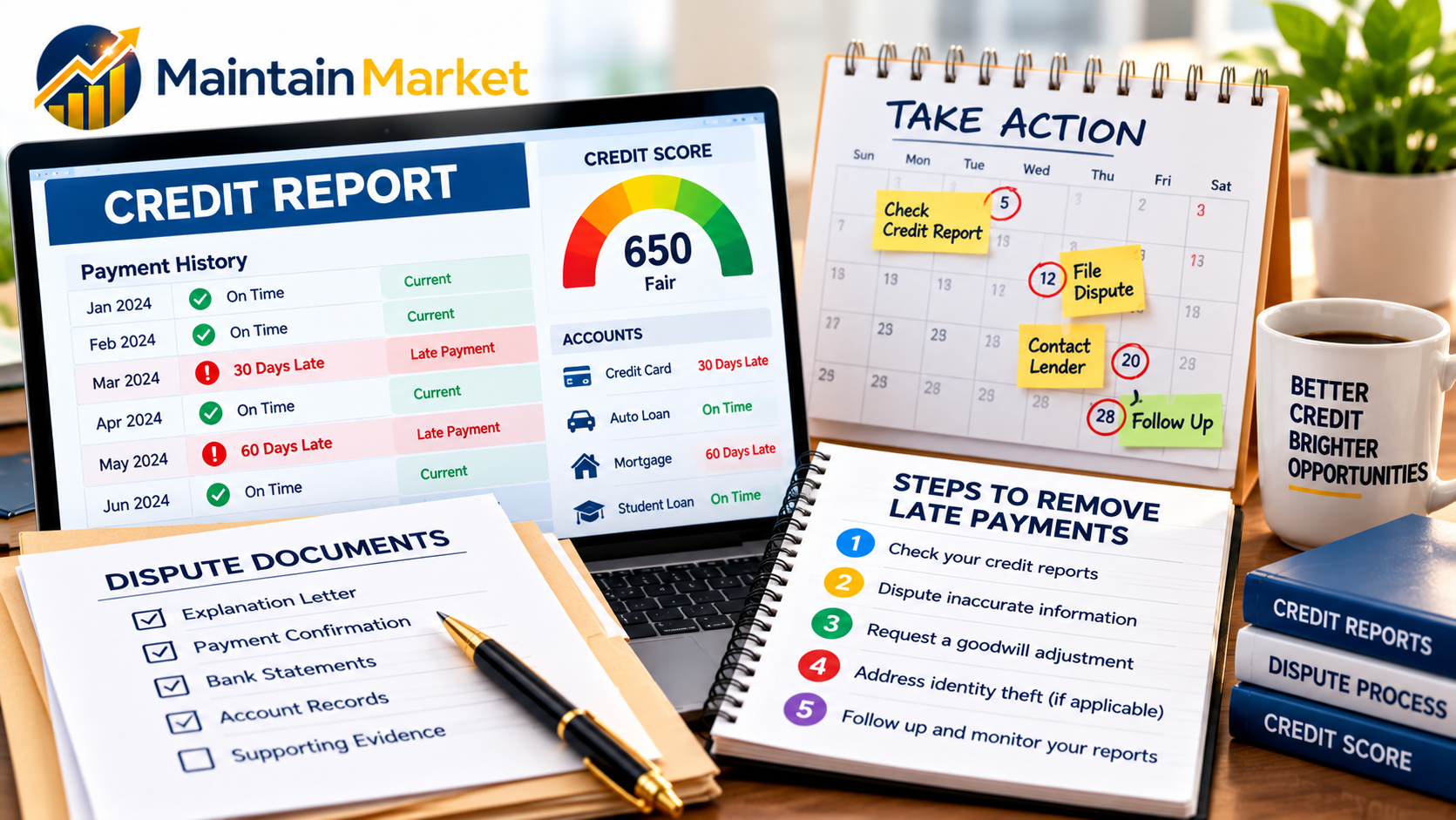
1. Check All Three Credit Reports for Late Payment Errors
Before contacting a lender, check your reports from Experian, Equifax, and TransUnion. A late payment might appear on one report but not another because not every lender reports to all three bureaus.
Look for errors such as:
- A payment marked late even though you paid on time.
- A payment reported as 60 or 90 days late when it was less delinquent.
- A late payment attached to an account that does not belong to you.
- An incorrect payment date or account status.
- The same negative information appearing more than once.
- An account affected by identity theft.
Gather proof before disputing
Collect any records that support your position, including:
- Bank statements showing the payment date.
- Payment confirmation emails or receipts.
- Creditor statements and account histories.
- Records of an approved payment extension or hardship arrangement.
- Correspondence with the lender about the disputed payment.
Example: Suppose your credit report shows that your credit card payment was 30 days late in March, but your bank statement shows that the payment was completed before the due date. That evidence can support a dispute with the credit bureau and the lender.
Do not dispute a payment simply because you dislike the negative mark. Identify the specific information that is wrong and explain why.
2. Dispute the Late Payment With the Credit Bureaus
If you find inaccurate information, you can dispute it directly with the credit bureau reporting it. You can also contact the lender that supplied the information.
The Consumer Financial Protection Bureau recommends explaining the error clearly and providing copies of supporting documents.
Use the official dispute resources below:
How to file a dispute
- Identify the account and the exact late-payment entry you believe is incorrect.
- Select the appropriate dispute reason.
- Explain what is inaccurate and what the correct information should be.
- Attach copies of your supporting evidence.
- Save your submission confirmation and any reference number.
- Review the investigation results and check your credit reports afterward.
You should generally dispute the error with both the relevant credit bureau and the company that furnished the information. This helps address the issue at both points in the reporting process.
Under federal law, credit reporting agencies generally have 30 days to investigate a dispute, although certain circumstances can extend the period to 45 days.
If the investigation confirms that the information is inaccurate or cannot be verified, it must be corrected or removed as required by law. If the late payment is verified as accurate, it may remain on your report.
For more details, read the CFPB’s guide: How to Dispute an Error on Your Credit Report.
3. Contact Your Lender and Request a Goodwill Adjustment
What if the late payment is accurate?
You may still have another option: ask the lender for a goodwill adjustment. This is a voluntary request asking the lender to remove or adjust an accurately reported late payment as a courtesy.
A goodwill request is not the same as a credit-report dispute. You are acknowledging that the payment was late and asking the lender to make an exception.
A lender does not have to approve your request, and its policies may prevent it from doing so.
When should you request a goodwill adjustment?
Your request may be more persuasive if:
- The late payment was an isolated mistake.
- You usually paid on time before and after the incident.
- You have already brought the account current.
- You experienced a genuine temporary hardship, such as a medical emergency or job loss.
- You can explain how you will prevent future missed payments.
These circumstances do not guarantee approval. The lender will make its own decision.
Goodwill letter template to remove a late payment
You can adapt the following letter for your credit card issuer, auto lender, or other creditor.
Subject: Request for Goodwill Adjustment of Late Payment
Dear Customer Service Team,
I am writing to request a goodwill adjustment for a late payment reported on my account ending in [last four digits of account number].
The payment in question relates to [month and year]. I understand the importance of making payments on time, and I take responsibility for the missed payment.
The delay occurred because of [briefly explain your genuine circumstances]. Since then, I have taken steps to keep my account current and prevent similar issues in the future.
I value my relationship with your company and would be grateful if you would consider removing the late-payment notation from the credit bureaus to which you report, as a one-time goodwill exception.
I understand that this request is discretionary, and I appreciate your time and consideration.
Sincerely,
[Your Full Name]
[Account Number or Last Four Digits]
[Contact Information]
Where should you send the letter?
Start by contacting the lender’s customer service department and asking for the appropriate address or process for goodwill requests. You can also ask whether the company has a credit-reporting or account-resolution team that handles these requests.
Keep a copy of your request and any response.
Important: Never claim that a payment was reported incorrectly if it was genuinely late. A goodwill request should be honest and separate from a factual dispute.
4. Address Late Payments Caused by Identity Theft
If the late payment appears on an account you never opened, the problem may involve identity theft rather than an ordinary payment mistake.
Take these steps:
- Review your reports for other unfamiliar accounts or activity.
- Report the suspected identity theft through IdentityTheft.gov.
- Contact the lender’s fraud department and explain that the account is not yours.
- Follow the official process for blocking or removing fraudulent information.
- Dispute the account with each credit bureau that reports it.
- Keep copies of your identity-theft report, correspondence, and dispute confirmations.
Do not admit responsibility for a fraudulent account or make payments on it before understanding your options. If you are unsure how to respond to a creditor or collector, seek guidance from an appropriate consumer-protection resource.
The removal of fraudulent information depends on the facts and applicable legal requirements, but you do not have to accept an account that was opened through identity theft as your own.
5. Understand When a Late Payment Will Fall Off Your Credit Report
If a late payment is accurate and your lender refuses a goodwill request, it generally cannot be removed just because you ask.
Under federal law, most negative payment-history information can be reported for up to seven years. The reporting period generally relates to the original delinquency, not the date you noticed the item or submitted a dispute.
For example, an accurate late payment from June 2022 may generally remain reportable until around June 2029, subject to the applicable reporting rules and circumstances.
Paying the overdue amount does not automatically erase the historical late payment. It can bring your account current, but the past delinquency may remain visible.
Read the CFPB’s explanation of how long information stays on your credit report.
What should you do while waiting?
- Bring any overdue account current as soon as you reasonably can.
- Pay all future bills by their due dates.
- Set up reminders or automatic payments where appropriate.
- Keep credit card balances manageable.
- Avoid unnecessary new credit applications.
- Check your reports periodically for errors.
A late payment’s effect on your credit score can lessen over time, particularly as you build a consistent history of on-time payments. However, the exact impact and recovery timeline depend on your entire credit profile and the scoring model used.
Can a Credit Repair Company Remove Late Payments?
A credit repair company cannot lawfully guarantee the removal of accurate, verifiable late payments simply by charging a fee.
You already have the right to dispute inaccurate information yourself, generally at no cost. Be cautious of companies that:
- Guarantee a specific credit-score increase.
- Promise to erase every negative item.
- Tell you to dispute information you know is accurate.
- Encourage you to make false identity-theft claims.
- Demand large upfront fees for services they have not performed.
You can start with the free resources provided by the CFPB and the Federal Trade Commission.
How to Improve Your Credit Score if the Late Payment Cannot Be Removed
If your late payment is accurate, concentrate on the parts of your credit profile you can improve.
Pay every bill on time going forward
Payment history is an important factor in many credit-scoring models. Set calendar alerts and consider automatic payments for at least the minimum amount due, provided you can keep enough money in the linked account.
Reduce credit card utilization
If possible, lower your credit card balances relative to your available limits. Lower utilization can help your credit profile, although the exact effect depends on your circumstances and scoring model.
Avoid unnecessary applications
Applying for several new accounts in a short period may lead to additional hard inquiries and can affect your credit profile.
Keep checking your credit reports
Review your reports for new errors, inaccurate balances, and accounts you do not recognize. Correcting errors can help ensure that your report reflects your actual credit history.
Give your positive history time to build
There is no guaranteed timeline for recovering from a late payment. The effect depends on factors such as how recent the payment was, how severe the delinquency was, and the rest of your credit history.
For additional strategies, read our guides on how to rebuild credit and why your credit score dropped.
Frequently Asked Questions
1. Can I remove a late payment from my credit report immediately?
Only in circumstances where removal or correction is justified and the relevant process allows it. For example, an investigation may correct an inaccurate entry. A goodwill request may also succeed, but lenders are not required to approve it. Accurate late payments generally cannot be removed immediately on demand.
2. How long do late payments stay on a credit report?
Most negative payment-history information can remain on a U.S. credit report for up to seven years. The applicable reporting period and start date depend on the type of information and circumstances.
3. Can a goodwill letter remove an accurate late payment?
Possibly. A goodwill letter asks the lender to remove a legitimate late-payment notation as a courtesy. Approval is discretionary, so there is no guarantee that the lender will agree.
4. Should I dispute a late payment if I actually paid late?
Do not falsely claim that an accurate payment history is wrong. You can ask the lender for a goodwill adjustment, explain any genuine hardship, and request help with your account.
5. What if I paid on time but the credit report shows a late payment?
Gather evidence such as bank statements, payment confirmations, and account statements. Dispute the specific error with the credit bureau and the lender that reported it.
6. Will paying off the overdue balance remove a late payment?
No, not automatically. Paying the overdue amount may bring the account current, but an accurately reported historical late payment can remain on your credit report for the applicable reporting period.
7. Can all three credit bureaus show different late-payment information?
Yes. Creditors do not necessarily report to all three bureaus, and reporting information can differ. Review each report separately and dispute inaccurate entries with every bureau reporting them.
8. Can a credit repair company guarantee late-payment removal?
Be skeptical of any guarantee. Accurate negative information generally cannot be removed just because a company requests it. You can dispute errors yourself for free.
9. Will removing a late payment increase my credit score?
It may help if the late payment is removed and the scoring model uses the affected information. However, the size of any change is unpredictable because credit scores depend on multiple factors.
10. Where can I get my credit reports for free?
Visit AnnualCreditReport.com, the federally authorized website for requesting credit reports from the nationwide credit reporting companies.
Why Maintain Market Is Different
At Maintain Market, we focus on practical personal-finance guidance that helps readers understand their options before spending money on financial services.
When dealing with late payments, the most important distinction is between an actual reporting error and an accurate negative mark. Knowing the difference helps you choose the right next step, avoid misleading credit-repair promises, and work toward a healthier credit profile.
References and Official Resources
- Consumer Financial Protection Bureau — How to Dispute an Error on Your Credit Report
- Consumer Financial Protection Bureau — Is It Possible to Remove Accurate Negative Information?
- Consumer Financial Protection Bureau — How Long Does Information Stay on Your Credit Report?
- Federal Trade Commission — Disputing Errors on Your Credit Reports
- AnnualCreditReport.com — Official Credit Report Requests
- IdentityTheft.gov — Report and Recover From Identity Theft
Editorial Review
Late-payment removal depends on whether the information is inaccurate, fraudulent, eligible for correction, or voluntarily adjusted by the lender. No credit-score increase or removal outcome is guaranteed.