
Going to college can change almost everything about how you use your car—and that can affect your car insurance. Read more about Car Insurance for College Students in this article.
You may be moving to another city or state, leaving your car at home, taking it to campus, or driving only during school breaks. Each situation can affect your insurance coverage, premium, discounts, and whether staying on your parents’ policy makes sense.
In many cases, college students can remain on a parent’s auto insurance policy while attending school, but the exact rules depend on the insurer, vehicle ownership, where the car is kept, and the student’s circumstances.
The good news is that college students and their families have several ways to reduce insurance costs, including good-student discounts, student-away-at-school discounts, usage-based programs, and comparing quotes from multiple insurers.
This guide explains how car insurance for college students works, what coverage you may need, how much it can cost, and how to find a cheaper policy without sacrificing important protection.
Quick Answer: What Is the Best Car Insurance Option for a College Student?
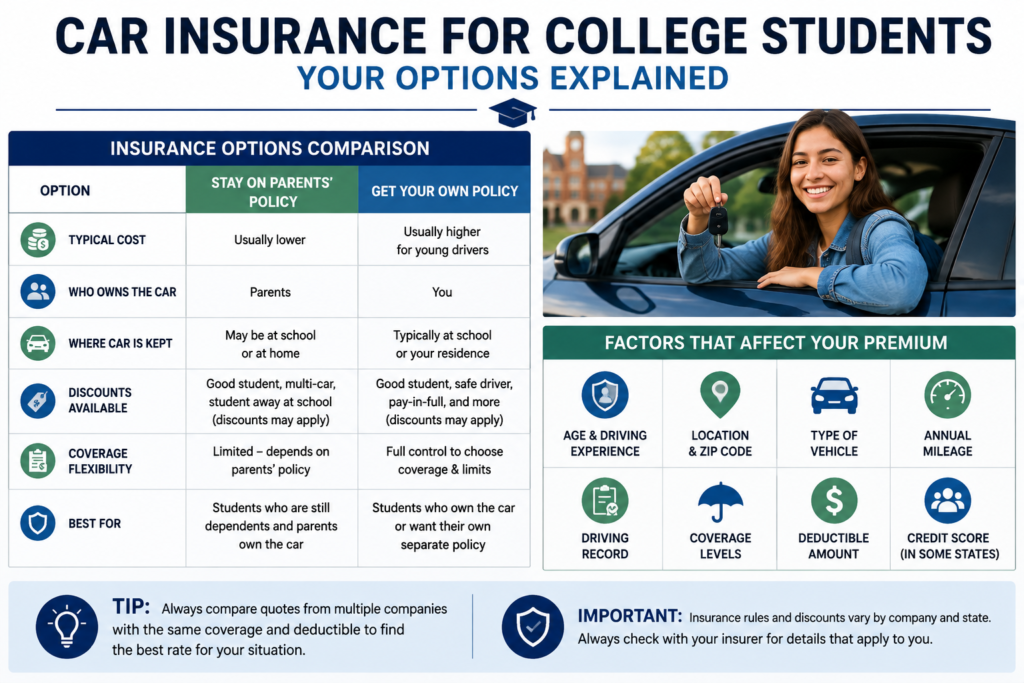
For many college students, staying on a parent’s car insurance policy can be simpler and less expensive than purchasing an individual policy, especially when the student is still a dependent and the parents own the vehicle.
However, this isn’t automatically the cheapest option for everyone.
Your best choice depends on:
- Who owns the vehicle
- Where the vehicle is kept during the school year
- Whether the student takes the vehicle to college
- How often the student drives
- Whether the college is in another state
- The student’s driving record
- Available student discounts
- The insurance company’s rules
- State insurance requirements
If you’re moving away for college, contact the insurer before the move and explain exactly where the student and vehicle will be located.
Can College Students Stay on Their Parents’ Car Insurance?
Yes, many college students can stay on their parents’ auto insurance while attending college, particularly when they remain dependents and the vehicle is owned by the parents.
However, there isn’t one universal rule that applies to every insurer or situation.
Insurance companies may consider the student’s permanent address, school location, vehicle ownership, where the vehicle is primarily kept, and how often it is driven.
For example, Progressive says college students may be able to remain on their parents’ policy when their primary circumstances continue to meet the insurer’s requirements. It also notes that where the vehicle is kept overnight can affect eligibility.
GEICO similarly says the decision can depend on who owns the vehicle, where it is kept, and how often the student drives it.

When staying on your parents’ policy may make sense
It may be worth considering when:
- Your parents own the vehicle
- You’re still financially dependent on your parents
- You return home during school breaks
- You occasionally drive a family vehicle
- Your insurer permits students away at college to remain on the policy
- The combined policy is cheaper than buying your own policy
When you may need your own policy
You may need or prefer an individual policy if:
- The vehicle is titled solely in your name
- You permanently move away from your parents
- You are no longer considered part of the household under the insurer’s rules
- Your insurer requires separate coverage
- You purchase your own vehicle
- Your circumstances make an individual policy more appropriate
Always ask the insurer before assuming you’re covered.
Does a College Student Need Their Own Car Insurance?
Not necessarily.
A college student doesn’t automatically need a separate auto insurance policy simply because they move away for school.
The answer depends largely on the ownership of the car, the student’s relationship to the household, where the vehicle is kept, and the insurer’s rules.
If the parents own the vehicle and the student is attending college away from home, the student may be able to remain on the parents’ policy.
But if the student owns the vehicle, a separate policy may be required.
GEICO specifically advises considering whose name appears on the vehicle title when determining who should carry the policy.
Important: Don’t simply assume that being listed on a parent’s policy means every situation is automatically covered. Tell the insurer where the student will attend school and where the vehicle will be stored.
How Much Does Car Insurance Cost for College Students?
There isn’t one nationwide price for college student car insurance.
Insurance premiums can vary significantly depending on factors such as:
- Age
- Driving experience
- Driving record
- Location
- Vehicle
- Coverage limits
- Deductible
- Mileage
- Claims history
- Insurance company
- Applicable discounts
- State regulations
Young drivers often pay more because insurers generally consider inexperienced drivers to represent greater risk.
That means a 19-year-old college student can pay substantially more than a 35-year-old driver with many years of clean driving experience.
Why is car insurance expensive for college students?
The biggest reasons can include:
Young age: Younger drivers generally have less driving experience.
Limited driving history: A new driver has fewer years of insurance and driving history for an insurer to evaluate.
Location: Moving from a rural area to a large city or another ZIP code can change the premium.
Vehicle: A sports car or expensive vehicle can cost more to insure than a lower-risk, less expensive vehicle.
Coverage: Full coverage generally costs more than carrying only the minimum required liability coverage.
Driving record: Accidents and tickets can increase premiums.
Is Car Insurance Cheaper for College Students on Their Parents’ Policy?
It can be, but there is no guarantee.
Keeping a student on a family policy may be more affordable than purchasing a separate policy because the family may already have multiple vehicles, established insurance history, and access to discounts.
But the cheapest option depends on the individual circumstances.
For example, if a student moves to a location with significantly different insurance rates, an individual policy could potentially become competitive.
The right approach is to compare the cost of:
- Keeping the student on the family policy
- Keeping the student on the family policy with available discounts
- Purchasing an individual policy
- Comparing multiple insurers using equivalent coverage limits
Don’t compare only the monthly premium. Compare the same coverage levels, deductibles and limits.
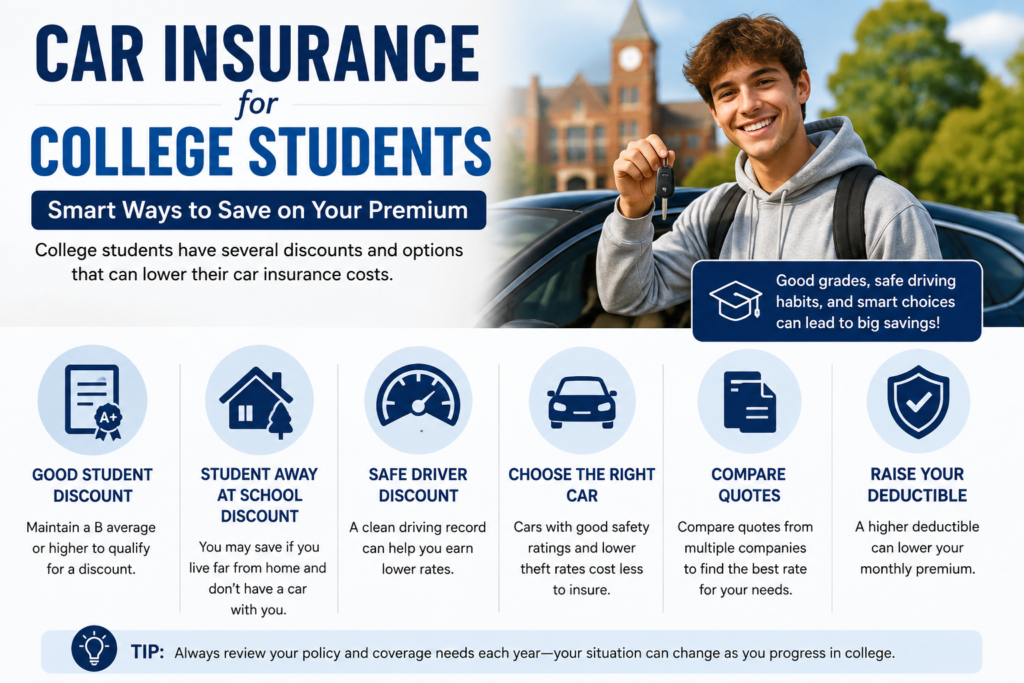
Can College Students Get a Good Student Car Insurance Discount?
Yes. Many insurers offer good-student discounts, although eligibility requirements and savings vary by company and state.
For example, Progressive says its good-student discount starts at 5% in most states and is available to eligible full-time students under 23 who maintain a B average or better.
GEICO says eligible full-time students with a good academic record may qualify for a good-student discount, with savings of up to 15% on certain coverages.
State Farm says eligible students may save up to 25%, subject to its requirements and state availability.
What GPA do you need for a good student discount?
There is no single GPA requirement across all insurance companies.
Some insurers use a B average or equivalent. Others may accept criteria such as:
- A minimum GPA
- Dean’s List or Honor Roll
- Class ranking
- Certain standardized test results
- Full-time student status
For example, State Farm states that its good-student discount can apply when a full-time student maintains a 3.0+ GPA, ranks in the top 20% of the class, or qualifies through its other listed academic criteria.
The best approach is to ask your insurer exactly what documentation it accepts.
What Is a Student Away-at-School Car Insurance Discount?
A student-away-at-school discount is a potential insurance discount for students who attend college away from home and don’t regularly have access to a vehicle.
The requirements vary by insurer.
For example, Progressive says its distant-student discount may apply to eligible students age 22 or younger who attend school more than 100 miles from home and don’t have a vehicle at school.
State Farm also offers a student-away-at-school discount for eligible students under 25 who move away to school and use the vehicle only while home during school vacations and holidays.
GEICO also lists a student-away-at-school discount, with eligibility depending on circumstances and state.
Can you get this discount if you take your car to college?
Usually, this particular type of discount is designed for students who don’t have regular access to the vehicle while away at school.
If you take your car with you and use it regularly on campus, you may not qualify.
That’s why you should tell your insurer exactly what your situation is instead of assuming you’re eligible.
What Happens to Car Insurance If You Go to College Out of State?
Going to college in another state does not automatically mean you need to buy a separate policy, but you should tell your insurer.
State Farm says many U.S. states allow students to remain on their parents’ auto insurance while away at college, while also recommending that the insurer be informed about the school location.
The location of the vehicle matters because insurance requirements and rates can vary by state and location.
If you’re taking a car to an out-of-state college, ask your insurance company:
- Does my existing policy remain valid?
- Do I need to update the vehicle’s garaging address?
- Does the policy meet the school’s state’s minimum requirements?
- Will my premium change?
- Do I qualify for any student discounts?
- Does my coverage change while I’m away?
What If You Leave Your Car at Home While You Go to College?
If you leave your car at your parents’ home while attending college, tell your insurer.
You may qualify for a student-away-at-school or low-mileage-related discount depending on the insurer and your circumstances.
The Insurance Information Institute has advised families to notify their insurer when a college student goes away to school and leaves the vehicle at home because the insurer may reevaluate the policy and potentially offer a discount.
You should also explain:
- Who will drive the car while you’re away
- Whether the car will remain unused
- How often you return home
- Whether you will drive it during vacations
- Where the car is stored
Don’t simply stop driving the car and assume the insurer automatically knows.
Should You Take Your Car to College?
There isn’t one right answer.
Taking your car can be useful if you:
- Live off campus
- Have a job away from campus
- Regularly travel long distances
- Need your vehicle for family responsibilities
- Attend a school without convenient public transportation
But leaving your car at home can make sense if:
- You live on campus
- Public transportation is convenient
- Parking is expensive
- You rarely drive
- Your school is walkable
- You want to reduce driving-related costs
Example
Imagine a student lives 300 miles from home and attends a university where everything is within walking distance.
If the student rarely needs a vehicle, leaving the car at home could potentially reduce driving and may allow the family to qualify for an applicable student-away-at-school discount.
On the other hand, a student who commutes to an off-campus job every day may need regular access to a car, making that discount unavailable.
What Coverage Should College Students Have?
The right amount of coverage depends on the student’s situation, state requirements, vehicle value, finances and risk tolerance.
Auto insurance commonly includes different types of protection, such as:
Liability Coverage
Liability coverage can help pay for injuries or property damage you cause to others in a covered accident, subject to the policy limits.
Most states require some level of auto liability insurance, although requirements vary by state.
Collision Coverage
Collision coverage can help pay for damage to your vehicle resulting from a covered collision, subject to the policy terms and deductible.
Comprehensive Coverage
Comprehensive coverage can help cover certain non-collision losses, such as theft or damage caused by certain weather events, subject to the policy terms.
Uninsured/Underinsured Motorist Coverage
This coverage can help protect you if you’re involved in an accident with a driver who doesn’t have enough insurance or has no insurance, depending on state rules and policy terms.
Medical Payments or Personal Injury Protection
Depending on the state, policies may offer medical payments coverage or personal injury protection.
Because coverage requirements vary by state, don’t assume that the minimum required coverage provides the protection you actually need.
The NAIC notes that each state has its own auto insurance rules and that many drivers choose coverage beyond the legal minimum.
Is Minimum Car Insurance Enough for a College Student?
Not necessarily.
Minimum coverage may satisfy your state’s legal requirement, but it may not fully protect your vehicle or finances after a serious accident.
For example, liability insurance generally protects against claims you cause to others, but it doesn’t automatically pay to repair your own vehicle.
If you have a newer or financed vehicle, additional coverage may be particularly important.
Before choosing minimum coverage simply because it is cheaper, consider:
- The value of your car
- Your savings
- Your ability to replace the vehicle
- Whether the car is financed or leased
- Your state’s requirements
- The potential financial impact of a serious accident
If a lender finances the vehicle, the lender may also require certain coverage.
The CFPB recommends shopping and comparing insurance options before buying or financing a vehicle and comparing both coverage and cost.
10 Ways to Get Cheaper Car Insurance as a College Student
1. Stay on a Parent’s Policy When Appropriate
If you’re eligible and your insurer allows it, remaining on a family policy may be more affordable than purchasing an individual policy.
Don’t assume, though—compare actual quotes.
2. Ask About a Good Student Discount
Good grades can potentially translate into insurance savings.
Ask your insurer what academic requirements and documentation are accepted.
3. Ask About a Student-Away-at-School Discount
If you’re going away to college without taking your vehicle, ask whether your insurer offers this discount.
4. Compare Multiple Insurance Companies
Rates can differ substantially between insurers.
Get multiple quotes using the same:
- Liability limits
- Deductibles
- Comprehensive/collision coverage
- Vehicle information
- Driver information
That makes the comparison more meaningful.
5. Consider a Less Expensive Vehicle
The vehicle itself can have a significant effect on insurance costs.
A reliable, modest vehicle may be less expensive to insure than a high-performance or luxury vehicle.
6. Maintain a Clean Driving Record
Tickets and accidents can make insurance more expensive.
Safe driving can help you qualify for certain discounts over time.
7. Ask About Usage-Based Insurance
Some insurers offer telematics programs that evaluate driving behavior.
Progressive, for example, offers Snapshot, while GEICO offers DriveEasy for eligible customers.
However, participation and savings vary, so understand how the program works before enrolling.
8. Consider Your Deductible Carefully
A higher deductible can reduce your premium in some situations, but it also means you’ll pay more out of pocket after a covered claim.
Don’t choose a deductible you couldn’t realistically afford.
9. Ask About Bundling
If your family has multiple insurance policies, ask whether combining policies could provide a discount.
Some insurers offer discounts for multiple vehicles or multiple policies.
10. Re-Shop Your Insurance Regularly
Your insurance needs can change after:
- Graduation
- Moving
- Buying a different car
- Getting married
- Improving your driving record
- Changing mileage
- Moving to a new ZIP code
A policy that was inexpensive last year isn’t necessarily the cheapest option today.
Also Read: Does Car Insurance Cover Hail Damage? The Complete 2026 Guide Every U.S. Driver Should Read
Is Full Coverage Car Insurance Worth It for a College Student?
It depends on the vehicle and financial situation.
“Full coverage” isn’t a single standardized insurance product. The term is commonly used to describe a policy that includes liability coverage along with comprehensive and collision coverage.
It can make more sense when:
- The vehicle is newer
- The vehicle is expensive
- The student has limited savings
- The vehicle is financed
- Replacing the car would create a major financial problem
For an older car with low market value, paying for comprehensive and collision coverage may not always make financial sense.
However, don’t cancel coverage simply because the car is old without considering the potential cost of replacing it.
Can College Students Get Car Insurance Without Their Parents?
Yes. College students can purchase their own auto insurance in appropriate circumstances.
Whether it makes financial sense depends on the student’s age, driving record, vehicle ownership, location and available discounts.
If the student owns the vehicle, an individual policy may be necessary.
If the student is still part of the parents’ household and the parents own the vehicle, staying on the family policy may be an option.
Before purchasing a separate policy, compare the cost with the parents’ existing policy.
What If the Student Owns the Car?
Vehicle ownership becomes especially important.
If the vehicle is titled in the student’s name, the student will generally need insurance appropriate for that ownership arrangement.
GEICO notes that the person listed on the vehicle title is usually the one responsible for carrying the auto insurance policy.
If you’re buying a car for college, it’s smart to get insurance quotes before completing the purchase.
A vehicle that looks affordable at the dealership may become considerably more expensive once insurance, fuel, maintenance, parking and registration are included.
Does a College Student Need Insurance If They Don’t Drive?
If the student doesn’t own or operate a vehicle, they generally don’t need their own auto insurance policy simply because they’re a college student.
But if a student is listed as a driver on a family policy or occasionally drives a parent’s vehicle, the family should discuss the situation with its insurer.
Never assume that an occasional driver is automatically covered under every policy.
Can College Students Stay on Their Parents’ Insurance After Graduation?
Possibly, but graduation can change the circumstances that allowed the student to remain on the policy.
Factors can include:
- Whether the student still lives with the parents
- Whether the student is financially dependent
- Vehicle ownership
- Where the vehicle is kept
- The insurer’s underwriting rules
- Whether the student has permanently moved out
There is no universal “age 26” rule for auto insurance comparable to the federal rule commonly associated with dependent health coverage.
So don’t assume that turning 26 is automatically when auto insurance must change.
Instead, ask the insurer when your circumstances change.
What Information Do You Need to Get a College Student Car Insurance Quote?
When requesting quotes, have the following information available:
- Student’s driver’s license
- Date of birth
- Vehicle year, make and model
- VIN
- Vehicle ownership information
- School address
- Home address
- Where the vehicle will be stored
- Estimated annual mileage
- Driving history
- Current insurance information
- Desired coverage limits
- Deductible preferences
The NAIC’s auto insurance shopping materials also note that insurers may ask about drivers, vehicles, mileage, vehicle location and how the vehicle is used.
Car Insurance for College Students: Example Scenarios
Scenario 1: Student Leaves Car at Home
A 19-year-old attends college 250 miles away and doesn’t take the family car.
The family should notify its insurer and ask whether the student-away-at-school discount applies.
The student may continue to use the vehicle during vacations and holidays, depending on the policy and insurer’s rules.
Scenario 2: Student Takes the Family Car to College
A 20-year-old takes a parent’s car to an out-of-state university and drives it several times each week.
The family should tell the insurer that the vehicle will now be primarily kept at the college location.
The insurer may need to update the vehicle’s garaging address and reassess the premium and coverage requirements.
Scenario 3: Student Buys Their Own Car
A 21-year-old buys a vehicle titled in their own name.
The student should contact insurers and obtain an individual policy quote based on the vehicle and location.
Scenario 4: Student Lives Off Campus
A student moves into an apartment near campus and uses the car for commuting to class and work.
The student may need to update the insurance company with the new address because the location where the vehicle is kept can affect insurance pricing and coverage.
What About Renters Insurance for College Students?
Car insurance doesn’t protect everything a college student owns.
If you’re living in a dorm or off-campus apartment, you may also need to consider renters or homeowners insurance coverage for personal belongings.
The NAIC recommends that college students living off campus consider renters insurance because personal property may not be covered in the same way under a parent’s policy.
Your laptop, phone, bicycle, furniture and other belongings may be worth thousands of dollars.
Ask your parents’ insurer whether their existing homeowners or renters policy provides coverage while you’re away at school.
What Is the Best Car Insurance for College Students?
There isn’t one insurer that is automatically the best for every college student.
The best option depends on your:
- State
- ZIP code
- Age
- Driving history
- Vehicle
- Coverage needs
- Discounts
- Annual mileage
- Whether you’re on a parent’s policy
- Whether you take the car to college
When comparing companies, look beyond the headline price.
Consider:
| Factor | Why It Matters |
|---|---|
| Premium | Determines your regular insurance cost |
| Liability limits | Affects protection if you cause an accident |
| Deductible | Determines your out-of-pocket cost for certain claims |
| Student discounts | Can reduce premiums for eligible students |
| Away-at-school discount | May help students who leave their car at home |
| Claims experience | Important when you actually need your insurer |
| Coverage options | Determines what risks are protected |
| Financial strength | Can be relevant when evaluating an insurer |
| Customer service | Useful when managing claims or policy changes |
Companies such as GEICO, Progressive and State Farm currently advertise student-related discounts and insurance resources, but eligibility and savings vary by state and individual circumstances.
The best way to identify the cheapest option is to compare quotes based on equivalent coverage.
Common Mistakes College Students Make With Car Insurance
Mistake 1: Not telling the insurer about the move
Moving for college can change where the vehicle is primarily kept.
Mistake 2: Assuming parents’ insurance covers everything
Coverage depends on the actual policy and circumstances.
Mistake 3: Taking the car to another state without notifying the insurer
The insurer needs accurate information about where the vehicle is located.
Mistake 4: Missing student discounts
Ask specifically about good-student, student-away-at-school, safe-driving and other applicable discounts.
Mistake 5: Choosing the lowest price without comparing coverage
A cheaper policy isn’t necessarily a better value if it provides significantly less protection.
Mistake 6: Forgetting about renters insurance
Auto insurance generally doesn’t replace renters insurance for protecting personal belongings in an apartment.
Mistake 7: Waiting until after buying the car to check insurance costs
Always get an insurance estimate before purchasing a vehicle.
College Student Car Insurance Checklist
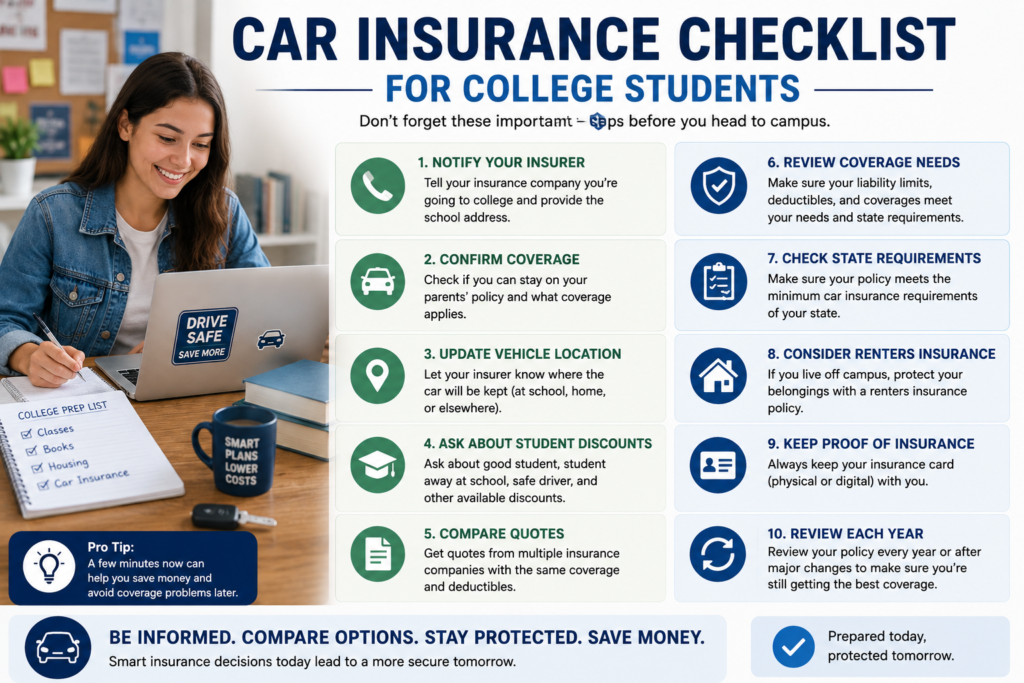
Before leaving for college, check these items:
- Tell your insurer where you’re attending college
- Confirm whether you can remain on your parents’ policy
- Tell the insurer where the vehicle will be stored
- Ask about a good-student discount
- Ask about a student-away-at-school discount
- Compare quotes from multiple insurers
- Check your state’s minimum coverage requirements
- Review liability limits
- Review your deductible
- Confirm comprehensive and collision coverage if needed
- Check whether your vehicle is financed
- Consider renters insurance if living off campus
- Keep proof of insurance accessible
- Review the policy again after graduation or moving
Frequently Asked Questions About Car Insurance for College Students
Q1. Can college students stay on their parents’ car insurance?
Yes, many college students can remain on a parent’s policy, but eligibility depends on factors such as vehicle ownership, where the student lives, where the car is kept and the insurer’s rules.
Q2. Is car insurance cheaper for college students on their parents’ policy?
It can be, but it isn’t guaranteed. Compare the cost of staying on the family policy with the cost of an individual policy using equivalent coverage.
Q3. Do college students get cheaper car insurance?
College students may qualify for discounts, but young drivers can still face relatively high premiums because of age and limited driving experience.
Q4. What is the best car insurance for college students?
The best insurer depends on the student’s location, age, vehicle, driving history, coverage needs and available discounts. Compare multiple insurers rather than relying on one national ranking.
Q5. Can I stay on my parents’ insurance if I go to college out of state?
Often, yes, but you should notify your insurer and confirm that the policy remains appropriate for the new school and vehicle location.
Q6. What if I leave my car at home while attending college?
Tell your insurer. You may qualify for a student-away-at-school or similar discount depending on the insurer’s rules.
Q7. What if I take my car to college?
Notify your insurer and provide the address where the vehicle will be kept. Your premium or coverage requirements may change.
Q8. What if I take my car to college?
Notify your insurer and provide the address where the vehicle will be kept. Your premium or coverage requirements may change.
Q9. Can a 19-year-old college student get their own car insurance?
Yes. A 19-year-old can purchase their own policy when appropriate, although staying on a parent’s policy may be more economical in some circumstances.
Q10. What GPA do you need for a good student discount?
It depends on the insurer. Some companies require approximately a B average, while others accept different academic criteria.
Q11. How can college students lower car insurance costs?
Compare quotes, maintain a clean driving record, ask about student discounts, consider usage-based programs, choose an appropriate vehicle, and review your coverage and deductible.
Q12. Does being a college student automatically lower insurance?
No. Being a student doesn’t automatically make insurance cheaper. Discounts may be available, but young age and limited driving experience can still result in higher premiums.
Q13. Do international students need car insurance in the U.S.?
Yes. If an international student drives a vehicle in the United States, they generally need auto insurance that meets the applicable state requirements. They should also confirm the driver’s license and insurance requirements in the state where they drive.
Final Thoughts: Finding Affordable Car Insurance for College Students
Car insurance for college students can be confusing because going to college often changes where you live, how often you drive, and where your vehicle is stored.
For many families, the first step is determining whether the student can remain on the parents’ policy.
From there, compare the available options.
If you’re leaving your car at home, ask about a student-away-at-school discount. If you’re taking the car to campus, tell your insurer where the vehicle will be kept. If you have good grades, ask about a good-student discount.
Most importantly, don’t choose an insurance policy based solely on the lowest advertised price.
Compare equivalent coverage from multiple insurers and make sure the policy reflects your actual situation.
A few minutes of comparison shopping before the semester starts could help you avoid paying for coverage you don’t need—or discovering too late that your policy doesn’t match your circumstances.
Why Maintain Market Is Different
At Maintain Market, we believe insurance information should do more than simply explain what a policy is.
Our goal is to make complicated financial and insurance decisions easier to understand and easier to compare.
Instead of focusing only on a single keyword, we look at the questions people are likely to have before and after making a decision—such as whether a student can stay on a parent’s policy, what happens when they move out of state, which discounts may apply, and what coverage they actually need.
We also aim to separate general guidance from insurer-specific rules, because insurance requirements and discounts can vary by state and company.
Our approach focuses on:
- Clear explanations instead of unnecessary jargon
- Practical examples that show how rules can work in real situations
- Questions people commonly ask before buying insurance
- Authoritative sources whenever factual verification is important
- Transparent explanations of limitations and exceptions
- Information designed to help readers compare their options rather than blindly choose one product
Our goal isn’t simply to help you find an answer. It’s to help you understand the decision behind the answer.
Maintain Market: Clear information. Smarter financial decisions.
Sources & Further Reading
This article uses information from authoritative and insurer sources, including the National Association of Insurance Commissioners (NAIC), Insurance Information Institute (III), and official insurance-company resources. Insurance rules, discounts and eligibility can vary by state and individual policy, so readers should verify details with their insurer or state insurance regulator before making a coverage decision.
Also Read: Car Insurance for First Time Drivers in 2026: 15 Smart Ways to Save Money Before You Buy