
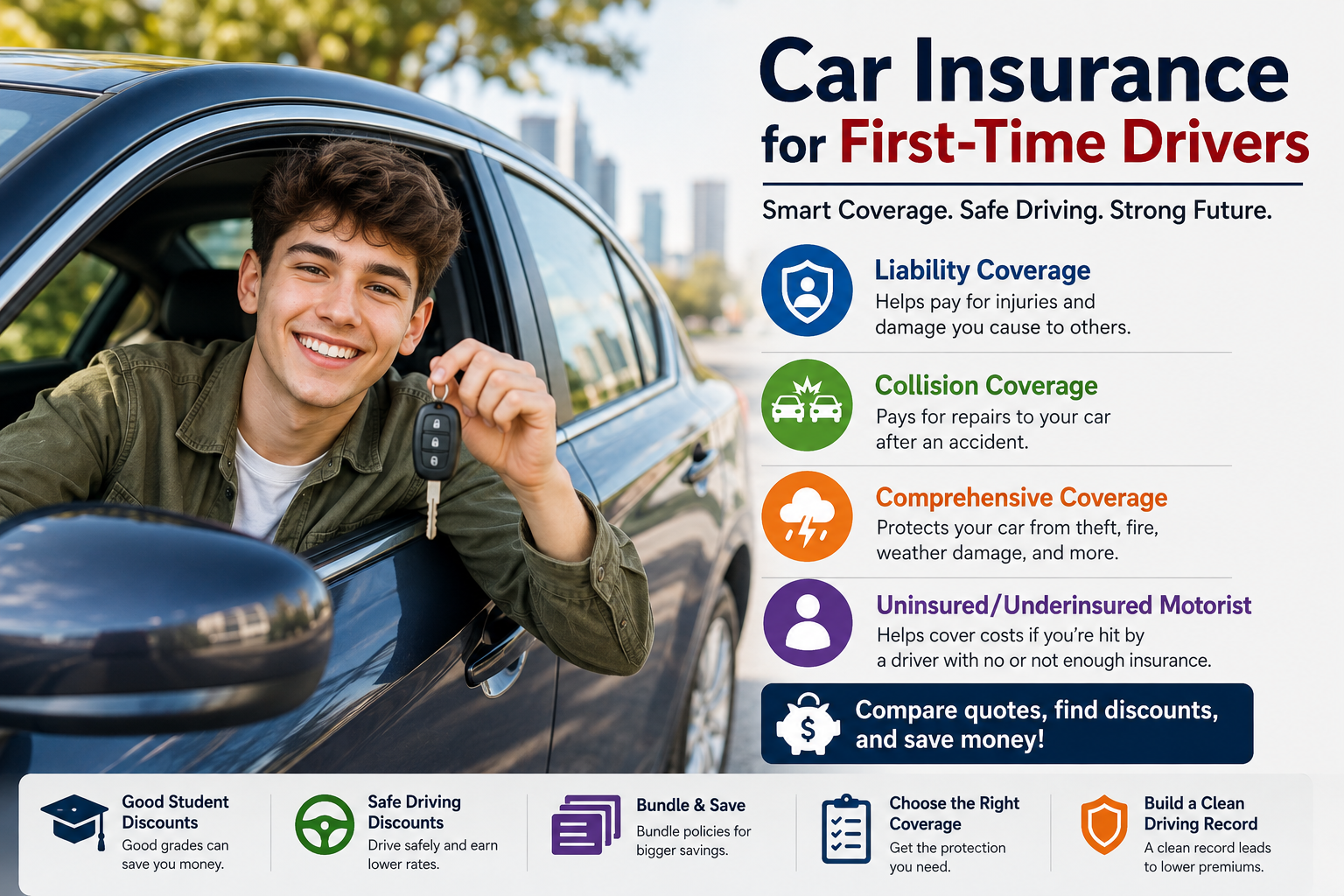
Buying your first car is an exciting milestone, but figuring out car insurance for first time drivers can quickly become confusing. How much coverage do you really need? Why is your first insurance quote so expensive? And is there a way to bring that cost down? This guide will help first-time drivers in the USA understand their insurance options, avoid common mistakes, and find coverage that protects them without unnecessarily stretching their budget.
Quick Answer
Car insurance for first-time drivers is usually more expensive because insurers consider new drivers to be higher-risk. Comparing quotes from multiple companies, choosing the right coverage, maintaining a clean driving record, and taking advantage of discounts can significantly reduce your insurance costs.
AI Overview Answer
If you’re buying car insurance for the first time, expect to pay higher premiums due to limited driving experience. The best way to save money is to compare quotes from several insurers, understand the difference between liability and full coverage, maintain a clean driving record, and ask about discounts such as good student, defensive driving, or telematics programs. Choosing coverage based on your budget and state requirements can help protect both your finances and your vehicle.
Key Takeaways
- First-time drivers usually pay the highest insurance premiums.
- Comparing multiple insurance quotes can save hundreds of dollars every year.
- Choosing the right deductible affects both monthly premiums and out-of-pocket costs.
- Liability insurance is the minimum requirement in most U.S. states, but full coverage provides broader protection.
- Discounts for students, safe driving, bundled policies, and telematics programs can lower costs.
- Building a clean driving history helps reduce premiums over time.
Car Insurance for First Time Drivers: Everything You Need to Know Before You Hit the Road
Buying your first car is one of life’s biggest milestones.
Maybe you’ve spent months saving money from your first job.
Maybe you’ve just graduated from college.
Or perhaps you’re finally in a financial position where owning a car gives you the freedom you’ve always wanted.
You picture weekend road trips.
Late-night drives with friends.
Visiting your family whenever you want.
No more waiting for buses.
No more expensive rideshares.
No more asking someone else for a ride.
But then reality hits.
You start looking at car insurance quotes.
One company says $2,400 per year.
Another quotes $3,100.
A third company offers something completely different.
Suddenly you’re asking yourself:
“Why is insurance so expensive when I’ve never even had an accident?”
If you’ve had this thought, you’re not alone.
Thousands of first-time drivers across the United States feel exactly the same way every day.
The good news?
Understanding how car insurance works before buying a policy can save you hundreds—or even thousands—of dollars over time.
This guide explains everything you need to know in simple language so you can make confident decisions without feeling overwhelmed.
Why Is Car Insurance So Expensive for First-Time Drivers?
Imagine lending your brand-new laptop to two people.
The first person has used computers professionally for 20 years.
The second person has never touched a laptop before.
Who would make you more nervous?
Most people would choose the second person—not because they’re irresponsible, but because they lack experience.
Insurance companies think similarly.
They don’t know whether you’re an excellent driver or a risky one.
Since you haven’t built a driving history yet, insurers have limited information to predict how likely you are to file a claim. As a result, they often charge higher premiums until you establish a safe driving record.
While this can feel frustrating, it doesn’t mean you’ll pay high rates forever.
Every year of safe driving can improve your insurance profile.
Understanding Car Insurance in Simple Words
Many people believe they’re paying for their own accidents.
That’s only part of the story.
Car insurance works by pooling risk.
Millions of drivers pay premiums into a shared pool.
When someone has a covered accident, the insurer uses money from that pool to pay eligible claims according to the policy terms.
This system helps drivers avoid bearing the full financial burden of a major accident on their own.
For example:
If your car is damaged in a covered collision, repairs could cost several thousand dollars.
Without insurance, those costs come directly from your savings.
With appropriate coverage, your insurer may pay most of the repair bill after you pay your deductible, subject to your policy’s limits and conditions.
That’s why choosing the right coverage matters.
What Makes First-Time Drivers a Higher Risk?
Insurance companies calculate premiums using many factors, including driving experience.
For first-time drivers, they don’t have a long history showing how you behave behind the wheel.
Other factors that may influence premiums include:
1. Limited Driving Experience
Experience often helps drivers recognize hazards, react calmly, and avoid risky situations.
A new driver is still learning these skills.
2. Higher Claim Rates
Industry data has consistently shown that newer and younger drivers tend to be involved in more accidents than experienced drivers. Individual results vary, but insurers price policies based on large groups of drivers rather than one person’s intentions.
3. Lack of Insurance History
If you’ve never had an auto insurance policy before, insurers have less information to assess your risk.
Building continuous insurance coverage over time can help demonstrate responsibility.
4. Vehicle Choice
The car you buy can significantly affect your premium.
Generally, insurers may charge more for vehicles that are expensive to repair, have powerful engines, or are stolen more frequently.
Choosing a practical, safety-focused vehicle can often help lower insurance costs.
Real-Life Example: David’s First Car Purchase
David, a 22-year-old graduate from Ohio, landed his first full-time job after college.
Excited about his new beginning, he purchased a sporty coupe he’d dreamed about for years.
He assumed insurance would cost around $100 per month.
Instead, his first quote was nearly three times that amount.
After speaking with an insurance agent, David learned that several factors increased his premium:
- He had no previous insurance history.
- His vehicle was expensive to repair.
- The car had a high-performance engine.
- He selected a low deductible, increasing the insurer’s potential payout.
Feeling discouraged, David explored alternatives.
He compared quotes from multiple insurers, switched to a more practical sedan with strong safety ratings, completed a defensive driving course, and enrolled in a telematics safe-driving program.
The result?
His annual premium dropped significantly while still providing the protection he needed.
David’s experience highlights an important lesson:
Your insurance cost isn’t determined by just one factor. The choices you make—from the vehicle you buy to the discounts you qualify for—can meaningfully affect what you pay.
The Emotional Cost of Being Underinsured
Imagine this scenario.
It’s your second week with your very first car.
You’re driving home after work.
Everything feels perfect.
Then another vehicle suddenly brakes.
You react, but it’s too late.
The front of your car is badly damaged.
Fortunately, no one is seriously injured.
After the shock wears off, another realization sets in:
You don’t have enough insurance coverage.
Repair bills, towing fees, rental car costs, and other expenses begin to pile up.
A moment that should have been a small setback becomes a financial burden.
This is why buying insurance isn’t just about meeting a legal requirement.
It’s about protecting the savings you’ve worked so hard to build—and giving yourself peace of mind every time you get behind the wheel.
Types of Car Insurance Coverage Explained
Choosing the right coverage is just as important as choosing the right car. Many first-time drivers buy the cheapest policy they can find, only to realize later that it doesn’t provide enough protection when they need it most.
Here’s a breakdown of the most common types of car insurance in the United States.
1. Liability Insurance
Liability insurance is required in almost every U.S. state. It helps pay for injuries or property damage you cause to other people if you’re responsible for an accident.
It typically includes:
- Bodily Injury Liability (BI)
- Property Damage Liability (PD)
Example
Suppose you accidentally rear-end another vehicle at a traffic light.
The other driver suffers minor injuries, and their car needs $8,000 in repairs.
If you have sufficient liability insurance, your insurer may cover those costs up to your policy limits. Without adequate coverage, you could be responsible for paying the remaining expenses yourself.
Best For: Drivers looking to meet minimum legal insurance requirements.
2. Collision Coverage
Collision coverage pays for damage to your own vehicle after a collision with another vehicle or object, regardless of who is at fault (subject to your deductible and policy terms).
Example
You accidentally hit a guardrail while driving in heavy rain.
Repair costs total $6,500.
If your deductible is $500, your insurer may cover the remaining eligible repair costs according to your policy.
Best For: New or financed vehicles.
3. Comprehensive Coverage
Comprehensive insurance covers damage caused by events other than collisions.
Examples include:
- Theft
- Fire
- Floods
- Hail
- Falling trees
- Vandalism
- Animal collisions
Example
A severe storm causes a tree branch to fall on your parked car.
Repair costs are $4,000.
Comprehensive coverage can help pay for the repairs after your deductible.
Best For: Drivers who want broader protection against unexpected events.
4. Uninsured & Underinsured Motorist Coverage
Not every driver carries enough insurance.
If someone without adequate insurance hits your vehicle, this coverage may help pay eligible expenses depending on your state’s rules and your policy.
Real-Life Situation
Imagine another driver runs a red light and crashes into your car.
You later discover they have no insurance.
Without uninsured motorist coverage, recovering your losses could be much more difficult.
5. Personal Injury Protection (PIP)
PIP helps pay for certain medical expenses and related costs for you and your passengers after a covered accident, regardless of who caused it, in states where it applies.
It may help cover:
- Medical bills
- Lost wages
- Certain rehabilitation expenses
6. Medical Payments Coverage (MedPay)
MedPay helps cover eligible medical expenses after an accident, regardless of fault. Availability varies by state.
This can include:
- Emergency room visits
- Ambulance charges
- Hospital bills
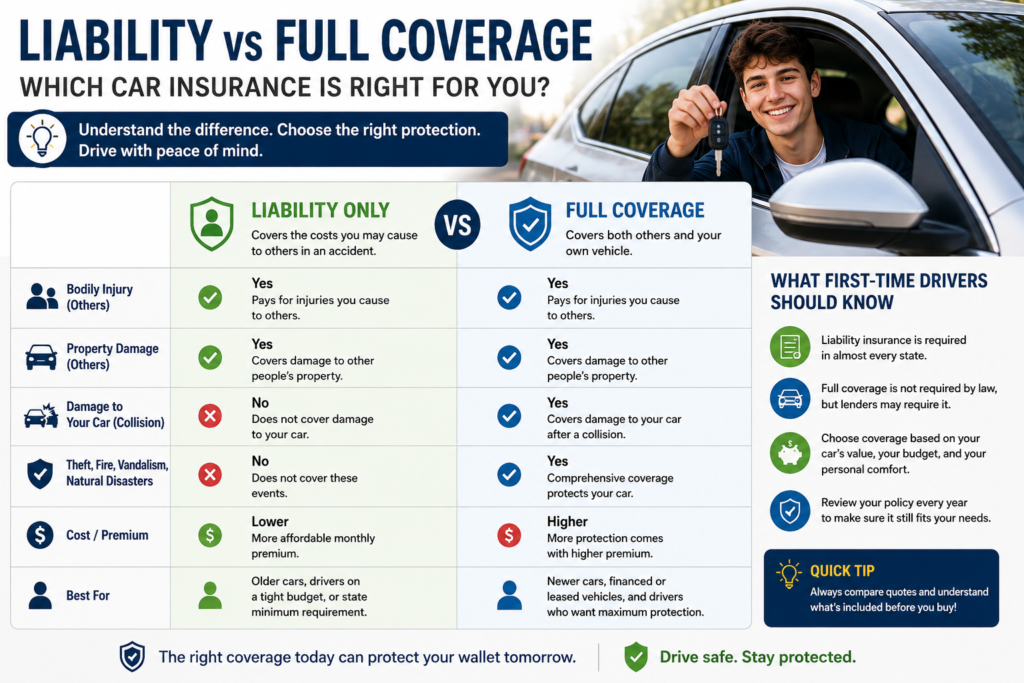
Liability vs Full Coverage: Which One Should You Choose?
One of the biggest questions first-time drivers ask is:
“Should I buy only liability insurance or full coverage?”
The answer depends on your car, your finances, and your comfort with risk.
| Feature | Liability Only | Full Coverage |
|---|---|---|
| Meets minimum legal requirements | ✅ | ✅ |
| Covers damage to your own vehicle | ❌ | ✅ |
| Covers theft or vandalism | ❌ | ✅ |
| Covers weather-related damage | ❌ | ✅ |
| Monthly premium | Lower | Higher |
| Best for | Older, lower-value cars | New, financed, or leased cars |
Expert Tip
If your car is financed or leased, your lender will often require collision and comprehensive coverage until the loan or lease is paid off.
How Much Does Car Insurance Cost for First-Time Drivers?
There’s no single price that fits everyone.
Insurance companies calculate premiums using many personal and vehicle-related factors.
Common factors include:
- Age
- Driving experience
- State of residence
- ZIP code
- Type of vehicle
- Annual mileage
- Coverage limits
- Deductible
- Driving record
- Credit-based insurance score (where permitted)
Because of these differences, two first-time drivers can receive very different quotes—even if they buy the same car.
Example
Emma
- Age: 19
- Clean driving record
- Compact sedan
- Completed a defensive driving course
Emma may receive lower quotes than another first-time driver with a more expensive vehicle and fewer discounts.
Jacob
- Age: 22
- Sports car
- No prior insurance history
- Urban area with higher claim rates
Jacob’s premiums could be significantly higher because of the combination of risk factors.
The takeaway?
Always compare quotes before choosing a policy.
What Factors Affect Your Insurance Premium?
Insurance pricing isn’t random.
Companies evaluate risk using several variables.
Your Age
Younger drivers often pay more because, as a group, they have less driving experience.
Driving History
A clean record can help lower costs over time.
Traffic violations and at-fault accidents generally increase premiums.
Vehicle Type
Luxury and sports cars usually cost more to insure than practical sedans or SUVs with strong safety ratings.
Location
Living in an area with more traffic, theft, or severe weather can influence premiums.
Credit-Based Insurance Score
In many states, insurers may use a credit-based insurance score as one factor in determining premiums. Some states restrict or prohibit this practice.
Annual Mileage
Drivers who spend more time on the road may present greater exposure to accidents.
Case Study: How Comparing Quotes Saved Michael Over $1,200
Michael had just accepted his first job in Texas.
He purchased a used Honda Civic and requested a quote from the first insurance company he found online.
The annual premium was nearly $2,900.
Instead of buying immediately, he compared quotes from several insurers.
He also:
- Increased his deductible to an amount he could comfortably afford.
- Completed an approved defensive driving course.
- Asked about available discounts.
- Chose paperless billing and automatic payments where discounts were offered.
After reviewing multiple options, Michael found a policy that met his needs at a much lower annual cost.
Lesson
Many first-time drivers assume the first quote is the best quote.
In reality, comparing multiple insurers can lead to substantial savings while maintaining similar levels of protection.
10 Common Mistakes First-Time Drivers Make
Avoiding these mistakes can save you money and frustration.
1. Buying the First Policy You See
Always compare multiple quotes before making a decision.
2. Choosing the Lowest Price Without Reviewing Coverage
A cheaper policy may provide less protection than you expect.
3. Ignoring Available Discounts
Ask about discounts for:
- Good students
- Safe drivers
- Defensive driving courses
- Multi-policy bundles
- Telematics programs
- Automatic payments
4. Buying a High-Performance Car as Your First Vehicle
Insurance costs for sports cars are often much higher.
5. Choosing a Deductible You Can’t Afford
Lower premiums aren’t helpful if you can’t comfortably pay your deductible after an accident.
6. Letting Coverage Lapse
A gap in insurance coverage can make future policies more expensive.
7. Underestimating Liability Limits
State minimum limits may not fully protect your finances after a serious accident.
8. Not Reading the Policy
Take time to understand what’s covered, what isn’t, and any exclusions or limitations.
9. Giving Incorrect Information
Providing inaccurate information can affect your premium and may create problems if you need to file a claim.
10. Forgetting to Review Your Policy
As your circumstances change, your insurance needs may change too. Review your policy periodically to ensure it still fits your situation.
Also read: Does Car Insurance Cover Windshield Replacement? The Complete 2026 Guide for U.S. Drivers
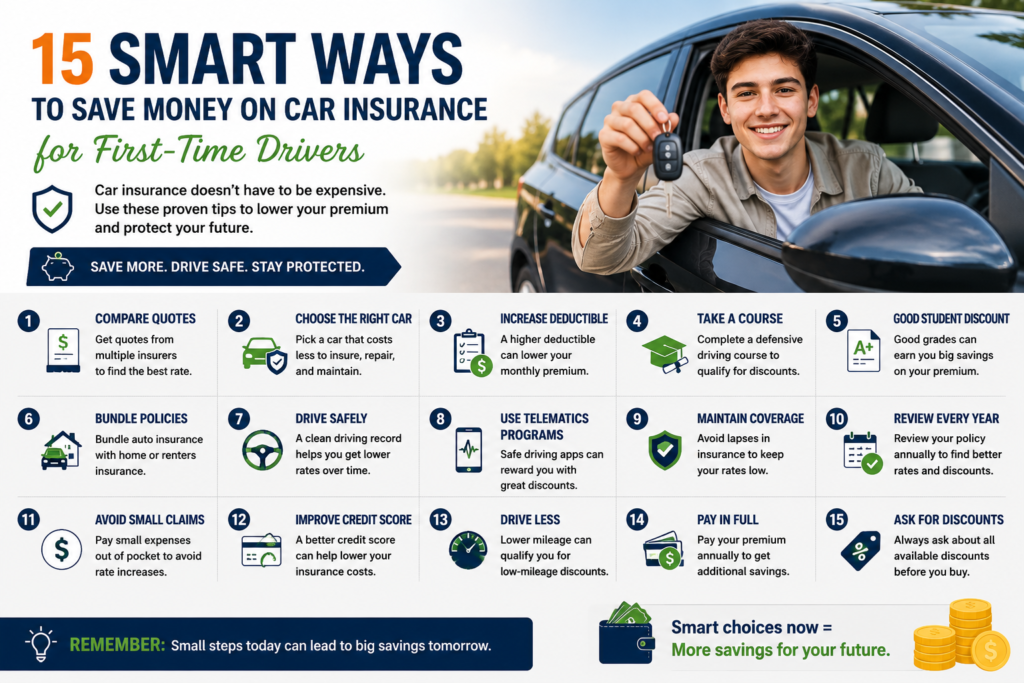
15 Proven Ways to Save Money on Car Insurance as a First-Time Driver
Buying car insurance for the first time doesn’t mean you have to accept the highest premium. With the right strategies, you can reduce your insurance costs while still getting the protection you need.
1. Compare Quotes from Multiple Insurance Companies
Never buy the first policy you see. Insurance companies calculate risk differently, so premiums for the same driver can vary significantly. Comparing at least three to five quotes helps you find the best value.
Pro Tip: Compare both price and coverage—not just the cheapest premium.
2. Choose a Car That’s Affordable to Insure
The vehicle you drive has a major impact on your insurance costs.
Cars with high safety ratings, lower repair costs, and fewer theft claims generally cost less to insure than sports cars or luxury vehicles.
3. Increase Your Deductible (If You Can Afford It)
A higher deductible usually lowers your monthly premium.
However, make sure you can comfortably pay that deductible if you need to file a claim.
4. Take a Defensive Driving Course
Many insurers offer discounts to drivers who complete an approved defensive driving course.
Besides lowering your premium, these courses can also help you become a safer driver.
5. Ask About Good Student Discounts
If you’re a student with strong academic performance, many insurance companies provide discounts.
Maintaining good grades can benefit both your education and your wallet.
6. Bundle Your Insurance Policies
If you also need renters, homeowners, or life insurance, bundling multiple policies with the same insurer may reduce your overall costs.
7. Drive Safely Every Day
Safe driving is one of the best long-term ways to lower insurance premiums.
Avoid:
- Speeding
- Distracted driving
- Aggressive driving
- Frequent traffic violations
A clean driving record often leads to lower premiums over time.
8. Enroll in a Telematics Program
Many insurers offer optional telematics programs that monitor driving habits through a mobile app or device.
Safe driving behaviors—such as smooth braking, steady speeds, and avoiding late-night driving—may qualify you for discounts.
9. Maintain Continuous Insurance Coverage
Keeping your policy active without gaps demonstrates responsibility and may help you qualify for better rates in the future.
10. Review Your Coverage Every Year
As your driving experience grows, your insurance needs may change.
Reviewing your policy annually can help you identify new discounts or adjust coverage to better fit your current situation.
11. Avoid Small Claims When Possible
Filing several small claims may affect future premiums.
If the repair cost is only slightly higher than your deductible, paying out of pocket may sometimes make financial sense. Consider your circumstances carefully.
12. Improve Your Credit (Where Allowed)
In many states, insurers may consider a credit-based insurance score when determining premiums.
Paying bills on time and managing credit responsibly may help improve your rates where this practice is permitted.
13. Drive Fewer Miles
If you don’t drive often, ask whether your insurer offers low-mileage discounts.
Less time on the road can mean lower risk.
14. Pay Your Premium in Full
Some insurers offer discounts if you pay your annual premium upfront instead of monthly installments.
15. Review Discounts Before Purchasing
Always ask your insurer about available discounts.
Many first-time drivers miss savings simply because they never ask.
Case Study: Emily Saved Over $900 in Her First Year
Emily, a 20-year-old college student from North Carolina, was excited to buy her first car.
Her first insurance quote was much higher than she expected.
Instead of accepting it, she researched her options.
She:
- Compared quotes from several insurers.
- Qualified for a good student discount.
- Completed a defensive driving course.
- Chose a reliable compact sedan with excellent safety ratings.
- Joined a telematics safe-driving program.
Within weeks, Emily found a policy that fit both her budget and her coverage needs.
Lesson: Taking time to compare options and ask about discounts can make a meaningful difference in your insurance costs.
Myth vs. Fact
| Myth | Fact |
|---|---|
| Red cars cost more to insure. | Vehicle color generally doesn’t determine insurance premiums. |
| Minimum coverage is always enough. | It meets legal requirements but may not fully protect your finances. |
| Insurance rates never change. | Premiums can change based on your driving history, vehicle, location, and other factors. |
| Young drivers always pay the same rates. | Rates vary depending on many personal and vehicle-related factors. |
| The cheapest policy is always the best. | Value depends on both price and the protection provided. |
Expert Tips Before Buying Your First Policy
- Compare multiple insurance quotes before making a decision.
- Understand exactly what your policy covers.
- Choose coverage based on your financial situation—not just the monthly premium.
- Review your policy regularly as your needs change.
- Ask about every available discount before purchasing.
Frequently Asked Questions (FAQs)
Q1. Is car insurance required for first-time drivers?
In almost every U.S. state, drivers must carry at least the minimum required auto insurance. Requirements vary by state.
Q2. Why is insurance more expensive for new drivers?
New drivers have limited driving history, making it harder for insurers to assess their risk.
Q3. Should I buy full coverage?
If your car is financed, leased, or relatively new, full coverage is often recommended and may be required by your lender.
Q4. Can I lower my premium?
Yes. Comparing quotes, driving safely, qualifying for discounts, and choosing an appropriate vehicle can all help reduce costs.
Q5. What is a deductible?
A deductible is the amount you pay out of pocket before your insurance begins covering an eligible claim.
Q6. Does my credit affect insurance?
In many states, insurers may use a credit-based insurance score. Some states prohibit or limit this practice.
Q7. Which cars are generally cheaper to insure?
Vehicles with strong safety ratings, lower repair costs, and lower theft rates are often less expensive to insure.
Q8. How often should I compare insurance quotes?
Review your policy and compare quotes at least once a year or whenever your circumstances change.
Q9. Can I switch insurance companies?
Yes. Many drivers switch insurers to find better rates or improved coverage.
Q10. Is the cheapest policy always the best?
Not necessarily. The right policy balances affordability with adequate protection.
Final Thoughts
Buying your first car insurance policy is more than checking a legal box—it’s about protecting yourself, your passengers, and your financial future.
While the process may seem overwhelming at first, taking time to understand your coverage options, compare quotes, and ask questions can help you make confident decisions.
Remember, your first insurance policy doesn’t have to be perfect forever. As you gain driving experience and your needs evolve, you can review and update your coverage to better match your lifestyle.
The most important step is to choose a policy that provides the protection you need while fitting comfortably within your budget.
Call to Action
Ready to buy your first car insurance policy?
Take time to compare quotes from multiple insurers, understand your coverage options, and choose a policy that protects both your vehicle and your financial future. A few extra minutes of research today could save you money—and provide valuable peace of mind—for years to come.
Also read: Does Car Insurance Cover Hail Damage? The Complete 2026 Guide Every U.S. Driver Should Read